Category: San Francisco

  • San Francisco Tape Music Festival

    As promised, here is my post on the San Francisco Tape Music Festival. I had an opportunity to attend last Saturday’s program.

    First, a word about “tape music.” Of course, it does not actually have to be on tape. Indeed it is now most often rendered as digital media: DVD or audio files. The San Francisco Tape Music Collective (which runs the festival) defines it as “audioArt diffused through a surround-sound speaker environment.” Essentially the “audio art” is music or other sound rendered onto media, and the performance is the live performance of that media in a hall through a speaker system. The way the media is mixed into the speakers and the live space creates a unique performance. And the fact that the material is recorded on media allows composers to create sounds that could never be performed live, even with modern computers – although the gap between what can be done live and what can only be rendered is narrowing over time. In the early days of electronic music, tape was in fact the only way to realize sounds, and thus the only way to perform the music. Modern tape music carries on that tradition.

    The idea of going to concert hall and listening to a recording may seem odd, but like any other performance, it is about matching the content and presentation. There are really good tape-music performances, and really bad ones, and I have been to both. The Saturday performance at the festival was definitely a good one. It included classics of electronic music, such as John R Pierce’s Stochatta, one of early experiments in computer music at Bell Laboratories; and Lubiano Berio’s Thema (Ommagio a Joyce). Both pieces were premiered over 50 years ago. John R Pierce may be familiar to longtime readers of CatSynth as one of the co-discovers of the Bohlen Pierce scale.

    Most of the other pieces on the program were far more recent, with the most recent being the premier of Cupido’s Suitcase by Cliff Caruthers. A series of three pieces in the first half, Winter Light (for Ingmar Bergman) by George Cremaschi, Pre-fader: Highly reverberant states by Goran Vejvoda and Chart Tempo & World Retrograde by Jon Liedecker/Wobbly explore three different aesthetics within recorded sound art: simple (but very powerful) sound synthesis with two oscillators, complex collages of sounds, and remixing of popular-music elements, respectively.

    One piece that also got attention when the program was first announced was a piece by The Fireman, which is actually a due of Paul McCartney and Martin Glover aka Youth. As a piece on the program, I don’t know that is as memorable as the others I have discribed.

    The program closed with a rather “hard” piece buzzz by Geraud Bec, which I leave to the reader’s imagination. Works by Maggi Payne, Zhiye Li and Kent Jolly rounded out the program.

    Overall, a very even performance, there was no point at which I didn’t want to be there listening. I also think that this series is fairly accessible for those who are not familiar with contemporary or experimental music, nothing is too harsh or too provocative – then again, I don’t know if I am the best judge of that.

  • CatSynth motivational poster: Tali and Serge

    From Carbon111, via matrixsynth:

    Actually we have seen Tali and the Serge modular before.

    As a bonus, another poster of Tali in the studio that Luna might appreciate:

  • Art and music notes from the past week

    During one of my long walks this weekend, I stopped in at Crown Point Press and found in the hallway several prints from Changes and Disappearances by the composer John Cage, a hero of ours here at CatSynth. My first impression was that these were graphical scores (i.e., scores where the performers interpret visual images), but they are in fact intended as independent works of visual art. However, many of the same compositional techniques can be found in both Cage’s music and visual art, as described in this essay by Ray Kass:

    It occurred to me that his etchings had an extraordinary correspondence to the methods he utilized in composing his music – and that they were visual counterparts of sorts, related in a manner that one might not have expected…But the connection between Cage’s use of “chance” methodology in his various kinds of work (composing, writing, installation & performance art, & now printmaking) made sense in a way that awakened me to the great scope of his work.

    I don’t think this was a special exhibition per se, as Cage had a longstanding relationship with Crown Point Press and they have displayed his work on several occasions. The main exhibition was a series of works by Tom Marioni.


    Both Marioni and Cage were featured in The Art of Participation at the San Francisco Museum of Modern Art (SFMOMA). Among the works in the exhibition were Marioni’s Free Beer (sadly, no free beer was being dispensed at the time, even though it was “Superbowl Sunday”), and John Cage’s most famous piece 4′ 33″. The full score was posted on a wall, and it was also displayed on a grand piano in its original form. I can’t say this was presented as a “participatory work”, however. Simply looking at the piano and listening to the museum commotion for the alloted time does not constitute a proper performance of the piece.

    There were, however, plenty of other interactive pieces in the exhibition to explore, such as Lygia Clark’s Diálogo: Óculos (Dialogue, Goggles):


    Last week, I attended an evening of electronic-music performances at the Climate Theatre, part of the regular Music Box Series. This series usually does not feature electronic music, but this time they darkened the room and presented “electronic soundspaces.”

    Christopher Fleeger opened the evening with lively performance featuring a touch screen, percussion controller and laptop. The music mixed synthesized and other familiar electronic sounds with some odd and amusing recordings, such as a rap extolling the virtues of Tallahassee, Florida as a center for faiths of all kinds, and a very memorable piece of “stand-up tragedy” about one man’s experience with “the store” – in the poem, every line ended with “the store” and often included other references.

    The second performance was by James Goode and featured a mixture of acoustic sources (percussion, toys, etc.) with sampling and looping, and reminded me a bit of my own performances at the Santa Cruz Looping Festival and other venues (it reminds me that I haven’t written about that). It can sometimes be a challenge to sustain full energy for an entire solo set of this nature, but Goode made this seem easy.

    Goode and Fleeger closed with an extended duet improvisation. At least one balloon went flying into the audience.


    I also attended the Saturday performance of the 2009 San Francisco Tape Music Festival, which I will discuss in a separate article.

  • Back home in 旧金山

    Most U.S. cities have transliterated names or at least phonetic approximations in Chinese, i.e., New York sounds somewhat like “New York”. Similar phonetic names exist for Chicago, Los Angeles, etc. But San Francisco has a unique name: 旧金山, which translates to “Old Gold Mountain”. This isn’t simply a nickname, but the official Chinese name, as it appears on my visa.

    It is good to be back home, though there always more I could have done on such an overseas trip, both personal and work-related. But now it’s time to pick up where things left off here. Lots of work to do, lots personal projects…and hopefully all the construction and drama at CatSynth HQ will wrap up in about a week.

  • Midnight Monday: Cat in the Window

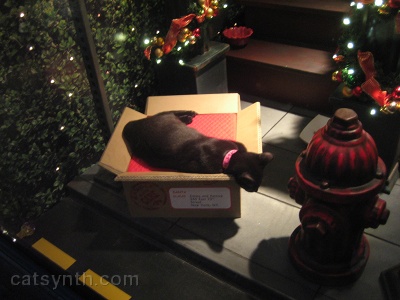
    No, this is not Luna. This black cat, featured in a holiday window display at Macy’s in San Francisco, did bear a strong resemblance.

    Macy’s and the San Francisco SPCA have a longstanding program that features adoptable animals (cats and dogs) in the store’s holiday window displays. You can find more info at the San Francisco SPCA site.