
Tag: Photography
-
The Forbidden City
The first stop on my weekend trip to Beijing was the Forbidden City.
The Forbidden City was the Chinese imperial seat of power from the Ming Dynasty to the Qing Dynasty. It is really is a “city” rather than a palace. It is huge and contains hundreds of buildings, and in three hours I was only able to cover part of it. This article presents only a small sampling of what I saw.
The Forbidden City is surrounded by a moat and walls, with towers at the corners:

Inside the walls are a patchwork of courts and buildings, of which Hall of Supreme Harmony is the largest and most iconic:

The people in the crowd (which is relatively modest for China) should provide some sense of scale for the size of the buildings and the courtyard. At this scale, the architecture seems relatively streamlined and spare, but a closer look reveals intricate details in the buildings, as well as the networks of stairways and paths.


The above architectural details are more intense, in terms of color and complexity, than those I had seen previously in the other cities. Other imperial and religious buildings in Beijing share a similar style.
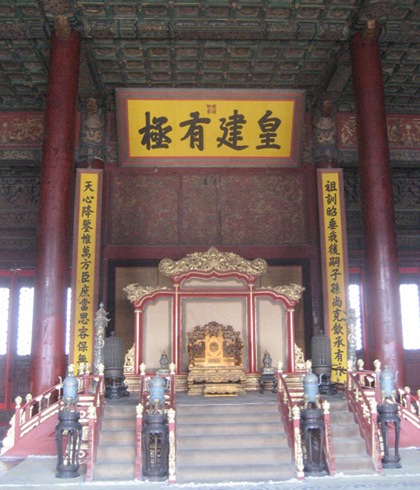
Views such as this may be recognizable to some readers who have seen documentaries, or films like The Last Emperor. Another image I did recall from seeing film many years ago was the imperial throne:

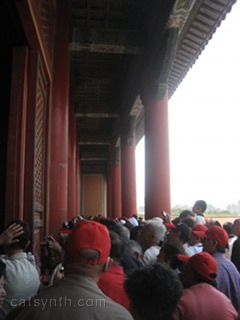
[click to enlarge]It was actually a challenge to get a good look at the throne or other significant building interiors, much less attempt to photograph them, because of the ubiquitous crowds:

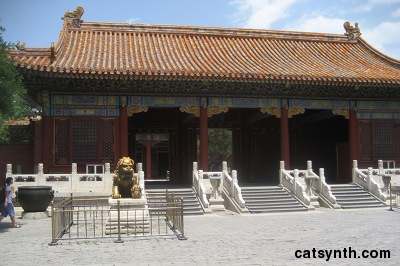
One could escape from the crowds for a bit by staying out in the middle of the courtyards, or venturing into the maze of side buildings. Wandering the side areas was quite interesting, around a narrow corridor one could easily find another whole court and buildings, “palaces within palaces”, such as Palace of Heavenly Purity with it’s golden lions in front:

[click to enlarge]Tucked inside the warren of side courts were numerous gardens, similar to those I saw in Suzhou and Wuxi. Some were similarly small an intimate, and seemed like pleasant oases. There was also the imperial garden, which contained this rather large rockery topped by a pavilion (closed to the public), which like it could be at home in a Lord of the Rings movie as much as a Chinese imperial palace.

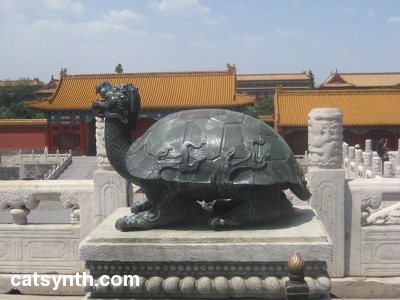
Scattered throughout the complex were numerous statues, such as the lions protecting palace, entrances and dragons, and other artifacts from the imperial courts:


[click to enlarge]
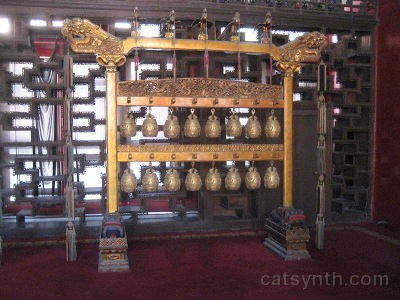
[click to enlarge]I would have liked to try out those bells.
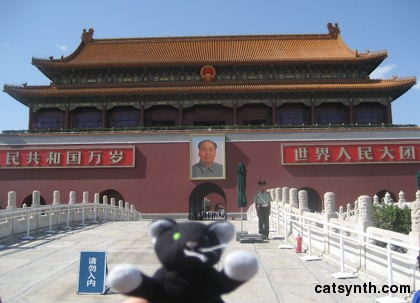
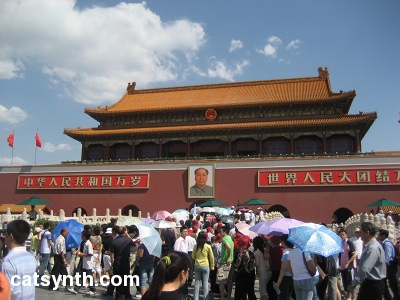
At the southern entrance is Tiananmen Gate, which now bears the portrait of Chairman Mao:
I of course could not resist having Zip pose for a “Mao and mao” photo (one of a few I have taken during my trips to China).

[click to enlarge] -
Liang Shan Buddha
In the hills not far from Wuxi stands 88-meter tall Liang Shan Buddha:

To get a sense of just how immense this statue is, consider the people on the staircase in the photo.
Looking down from the base of the Buddha, one can see the expanse of the valley and temple complex below:

In the temple courtyard, there is a scale replica, which one can view in alignment:

There is also a full-size copy of the Buddha’s hand. One is supposed to walk a full circuit while remaining in contact with the hand for good luck, and the wear from countless visitors is clearly visible.

I did the full circuit around the hand, and we’ll see how that works out…
The Liang Shan Buddha is not an ancient construction, but rather recent project sponsored by the Chinese government with some private donations. There is a certain over-the-top feel to the entire complex, almost like a Buddhist amusement park, with a huge parking lot, busses, etc. They have also built a large “palace” with rather gaudy devotional art. The huge circular meditation hall in the center was less ornate, with it’s arrangement of seats and geometric design, though they did have a constantly changing light show in the domed ceiling:


Not being a Buddhist, I don’t really have much interpretation of these aspects of the center. But certainly, the giant Buddha itself is impressive.
-
Suzhou Museum and Zhong Wang Fu
On Saturday morning, I visited the Suzhou Museum. I have been in the area around the museum, which includes the old canals and the Humble Administrator’s Garden, but never had the time until now to venture inside.
The museum is more a culture and heritage museum than an art museum. Its collection is primarily traditional Chinese items, though it does have a contemporary art wing as well. For me, however, the main attraction was the building itself. It was designed by the architect I. M. Pei, whose family has long resided in Suzhou.


The museum’s architecture incorporates the shapes and elements the adjacent traditional gardens and palaces, including its own gardens, pools and rockeries, but stripping away the ornaments and focusing on the lines and geometry. This extends to the interior as well:

Overall, the architecture and design of the museum was quite photogenic, and readers should look for more examples in future photo series, and of course “Wordless Wednesday.”
One exhibit recreated a traditional Chinese study, and suggest that traditional elements of Chinese design can fit very easily into a modern context:

I wish my office looked like that.
I did take some time to see a few of the traditional artifacts, including several examples of animal figures such as this black-and-white jade cat:

Before the new museum building opened in 2006, it was housed in the neighboring Zhong Wang Fu, a traditional Chinese mansion with gardens and courtyards. The grounds and buildings have been restored and remain open to the public:


One can observe which elements were incorporated into the new building, and which ones were not.