
Tag: San Francisco
-
Mission Arts and Performance Project, June 2010
 A couple of weeks ago, I attended the Mission Arts and Performance Project (MAPP), a bi-monthy neighborhood event in the Mission District of San Francisco that transforms homes, garages, cafes and other local businesses into makeshift galleries and performance spaces. I have attended several MAPP events in the past, and this was the largest I had seen in a long time – and while it is great to see the event thriving, it meant that in my limited time I was only able to see a few things.
This time there was a good balance of visual art in addition to performances. I did stop at Wonderland Gallery on 24th street. Several artists were featured, with several pieces that had an urban and/or graphic feel. Gianluca Franzese’s monochrome acrylics of a building in Chinatown the Mission police station caught my attention (in the photo below), as did some abstract geometric drawings by Paul Hayes (I did not get a decent photo, but do check out his flickr site).

[Gianluca Franzese. (Click image to enlarge)]
It was an rather warm evening (as I mentioned in my last article, we have had a few exceptionally warm weekends), perfect for walking around the neighborhood to take things in. At a garage along Folsom Street dubbed “Blue House”, I encountered the jazz trio Calliope. Visually and sonically, they appeared to step out of the 1940s into an blue illuminated garage in 2010:

Calliope
Calliope was followed by Susan Joy Rippberger performing her performance piece Slip Dance. Rippberger has done several visual works and installations focusing on slips as a very symbolic garment from another era. In this piece, she puts on slips from a large pile one at a time, and at the end reverse the process by removing them one by one.

[Susan Joy Rippberger. Slip Dance.]
While watching, I was thinking of the jazz performance right beforehand and thinking how it would be interesting to have vintage music in the background, perhaps from a small radio, as part of the piece.
I briefly stopped at nearby “La Case de los Sentidos” which featured a series of performances along with visual art pieces under the title “Immigration or Displacement? A World without Borders.” I also stopped a couple of times the Red Poppy Art House and was happy to see them participating more fully in this MAPP after their absence at previous events.
-
Angular and Architectural (901 Market Street, San Francisco)
A couple of weeks ago, I went to the opening for an exhibit entitled Angular and Architectural in downtown San Francisco. The title itself features elements that reappear in my own photography as well as my viewing and appreciation of art. Plus it was conveniently on the way home from work.
901 Market Street is one of those typical older office buildings one sees downtown (this building dates back to 1912). It is an imposing stone building, a bit heavy and a bit ornate. The inside, however, features an open modern atrium, very clean, full of light and space, and a perfect “canvas” for an art exhibition, particularly one whose theme is architecture and geometry.
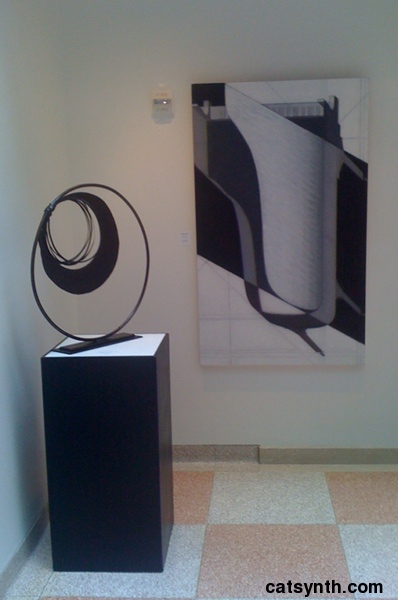
What made this particular exhibit stand out was the pairings and combinations of different artworks, among the best combination arrangements I have seen in a while. Many of these combinations involved paintings by John Haag paired with sculptures by Rebecca Fox and Yong Han. We have seen Fox’s and Han’s metal sculptures before at Open Studios and elsewhere, but Haag was a new discovery. Here is one of his paintings, Midnight Seranade, coupled with one of Fox’s sculptures:

[Click to enlarge image.]
The black-and-white of the painting matches the dark color of the sculpture against the white background, along with the thick bands of black and gentle curves.
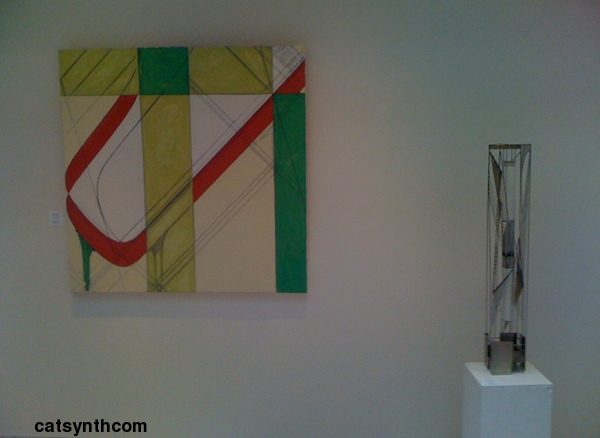
Here we see another painting, this time coupled with one of Han’s sculptures, last train of thought:

[Click to enlarge image.]
In this painting, the strong angles and thin lines in the painting match the sculpture, and both have a somewhat Art-Deco quality.
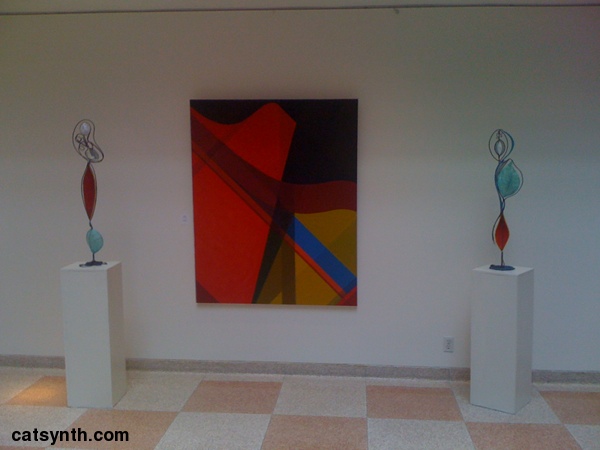
Here is one more set, with the sculptures framing the painting from either side:

[Click to enlarge image.]
The curved shapes and bright red in the last painting bring up the red elements in the two sculptures to either side.
This exhibit reminds us how the placement of disparate works in exhibition is itself a creative act, finding elements across artists and media that somehow work together.
-
Work in progress (Flora Davis) Part 2
Work continues on the art piece that I recently commissioned from local artist Flora Davis. Please refer to the first article in the series for more background about the commission and some images of the piece in its initial phases.
Since then, things have progressed. The metal surfaces are now cut to the appropriate sizes for each of the boxes and ready to be glued on:

Here they are after the surfaces were glued. The sides of the boxes have also been primed for painting.

It’s great seeing the boxes and the metal surfaces come together for the final piece. They do look like what I imagined. I have to admit, the stark white against the textured metal surfaces is a little jarring, but this is just an intermediate phase. The final paint on the sides will be metallic.
-
Our Struggle (Responding to Mein Kampf), Contemporary Jewish Museum
Today I visited the Contemporary Jewish Museum here in San Francisco to see the exhibition Our Struggle: Responding to Mein Kampf before it closes this coming week.
The exhibition, which is based on the book Notre Combat (Our Struggle) is the result of French artist Linda Ellia’s encounter with a copy of Adolf Hitler’s Mein Kampf, specifically a French-language copy that her daughter happened to bring home in 2005. Her response to the book, defacing the pages and using them to create new works of art in response, mirrors the larger question of how we should collectively deal with this book: we could attempt to ban it (which it would only lead to copies being secretly shared), we could destroy or burn every copy (which would be repeating what the Nazis and other totalitarian regimes have tried to do), or we can respond to it with our own statements and try to take ownership of it.
The exhibition includes 600 such responses created from the pages of the French copy that Ellia had found. Several are pages she altered herself, while others were contributed by artists, musicians, writers, teachers, survivors, and others whom Ellia invited to participate. Some pages were used as canvases for new drawings or paintings, others were cut apart and reassembled. There were grouped into sections, such as one section that featured images of hearts, both symbolic and anatomical, created on top of pages. There were plays on words, including blocking out words and leaving only a few to create new sentences. There were numerous caricatures of Hitler. There was a group of that seemed to just use the pages as surfaces for graffiti and surrealist images, which were among my favorite artistically. There was one with a young girl dressed in red sitting between two large black columns, with the words from the original page visible in the empty space behind her. Another featured a goth-looking figure with what appeared to be red cats being emitted from her mouth. One featured a very literal reference to the train cars that carried victims to the concentration camps. Another poignant work depicted figures walking in a long and meandering line, with the single word non.
Although the history and evil associated with the book was ever present in many (or most) of the responses, it was also at the same time being displaced by the new work being created, i.e., “here is a large conceptual work made with pages from a published book”.
Taken as a whole, the work functions as a new kind of memorial, one in which the participatory nature of its creation holds as much cathartic power as the finished product. The artist pages in Our Struggle don’t dwell on the original text, but instead diminish its power by turning it into the backdrop for profound acts of symbolic reclamation, a process Ellia feels is universally applicable. (from the press release.)
The exhibit does include an actual 1941 copy of Mein Kampf, a large and elaborate edition that was presented to one of the regional governors of the Third Reich. Its inclusion bring the reality and history back into focus just as one gets absorbed into the pieces as new works of art.
-
Quickening Moon Concert
Sometimes things linger undone for a quite a while. And that is the case with reviewing the Quickening Moon Concert, which I am finally getting around to doing as the next Full Moon concert is about to happen. Basically, the process goes like this. I wait a few weeks to look at the video of my own performance with a fresh perspective. I review the videos. Then post them online. Then a few more weeks pass as life intervenes. So here were are, finally getting to it many “moons” later. Memories of course fade over time, but even going by my own recollections, there is much to recall fondly. Bottom line is that it was a really good performance, in fact I would consider it one of my best solo electronic sets to date. This was in no small part to the advance preparation, but also to the audience, which filled to the Luggage Store Gallery to standing-room only capacity!
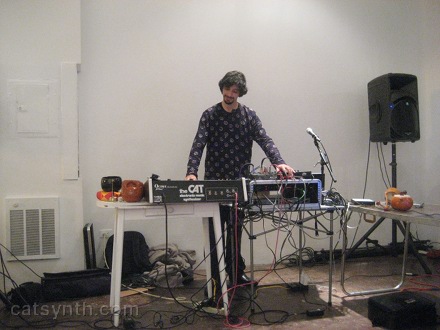
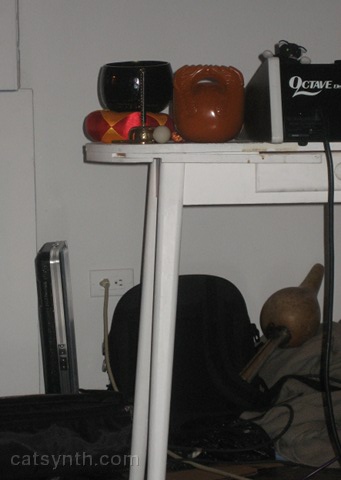
This was also one of the larger setups, featuring the Octave CAT vintage analog synthesizer, E-MU Proteus 2000, DSI Evolver, Korg Kaoss Pad, a Mac laptop running Open Sound World and Max/MSP, and the Monome controller, along with an array of my folk instruments from China and India. Even the iPhone made an appearance as an instrument.


[Click images to enlarge.]Of course, the highlight of the set was the premier of 月伸1, featuring improvised electronic music set against a video of Luna. Musically, I focused on the Octave CAT (seemed appropriate) with the other electronic instruments in a supporting role. You can see a full video of the performance of this piece below:
The music was improvised live, with some prepared guidelines. In this way, it was reminiscent of the live music performances from old silent films. I kept the music relatively sparse and maintained the focus on the visual elements, which moved back and forth between clips of Luna and abstract visual elements (you can read more about the video production here). The audience clearly responded to the video of Luna and the music, and their laughter at very points reminded just how funny a piece this was. It was easy to lose sight of that in the hours of very detailed and very technical preparation, and one of the delights of playing in front of a live audience. I also heard from people that could tell they were able to sense the affection for Luna that came through in the video, though the long shots and the breaks in the otherwise silent video where her voice came through.
The balance of the set leading up to 月伸1 featured various combinations of electronic and acoustic instruments. The monome was my main controller in several of the other pieces, including the opener that focused and live sample loops and patterns from the folk instruments.
I played the instruments live, and then replayed the samples in various patterns on the monome to create complex timbral and rhythmic patterns. I also used the monome in a later piece to control some very simple but musically interesting sound synthesis, as can be seen in this video.
The lights on the monome are visually compelling, but also provide a link for the audience between the actions (which are really just button pressing) and the music.
Several of the pieces including strong rhythmic elements, which helped propel the set forward – I even saw at least one person “grooving out” to one piece.
I replayed several of the pieces (but not the video) in another performance a few days later at the Meridian Gallery. I certainly hope I will have an opportunity to the video again as well.
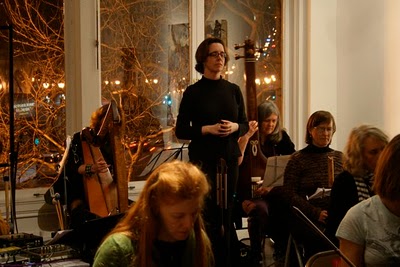
My performance was followed by the premier of Polly Moller’s Genesis. Genesis is “a musical experiment in which the M-theory of the 11-dimensional universe combines with the inward and outward spiral of the Western magical tradition.” The 11 member ensemble represent the 11 dimensions (which include Universal Time, the three spatial dimensions, and seven others) who combine to bring the “New Universe” into being, as portrayed by Matt Davignon on drum machines.

[Photo by Tom Djll.]Polly Moller conducted the piece, not from the traditional podium in front of the ensemble, but rather by walking in an inward and outward spiral among the performers. As she walks by, wind chimes in hand, different performers enter or exit. As the New Universe comes into being, Matt Davignon’s electronic performance emerges, culminating in an extended solo as the 11 performers representing the “parent dimensions” fade out.
Quite fortuitously, someone turned my video camera to face the ensemble, so I was able to capture some video of the performance. In the clips below, one can see the conducting by walking in a spiral, as well as parts of the New Universe solo.
-
Video by Anne Eastman, Maggie Foster, Guthrie Lonergan, Hayley Silverman Jancar Jones Gallery
We now turn our attention to another exhibition that is closing this week. For most of May, Jancar Jones Gallery has presented a group exhibit of videos by Anne Eastman, Maggie Foster, Guthrie Lonergan and Hayley Silverman. Each of videos explores subtle motion and illusory effects, either through the objects being filmed or through computer-based manipulation. The exhibit will remain open at the gallery through May 29.

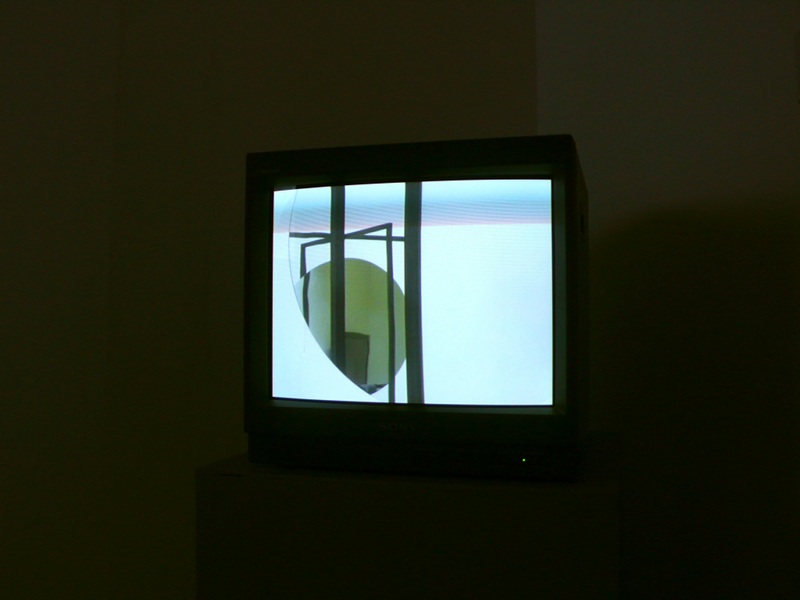
Anne Eastman, A Record of Abstract Ideas. Image courtesy of Jancar Jones Gallery. (Click to enlarge.) 
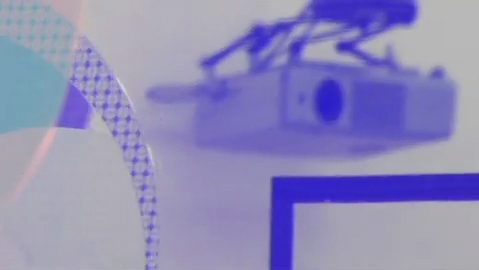
Anne Eastman. Image courtesy of Jancar Jones Gallery. (Click to enlarge.) The work that most caught my attention was A Record of Abstract Ideas, a mesmerizing video by New-York-based artist Anne Eastman. She creates sculptures and installations that are very abstract and formal, but also play with reflection, motion and changes through the inclusion of mirrors and mobile elements. She then creates videos of the installations, which become works in their own right. The video presented here appears to include images of Eastman’s 2009 installation “Mobiles” at the ATM Gallery in New York, as seen here. Throughout the video, one sees portions of geometric shapes, circles, rectangles and grids enter and exit the video at odd angles and reflect different textures and patterns within their boundaries. At times, one sees the elements close-up and disconnected, while at other moments there is enough context to recognize a piece of a sculpture. She also plays with colors and effects of the video itself in creating a work separate from the installation being filmed. At a few times, one can see a video projector in the background, presumably projecting an earlier video of and earlier installation.

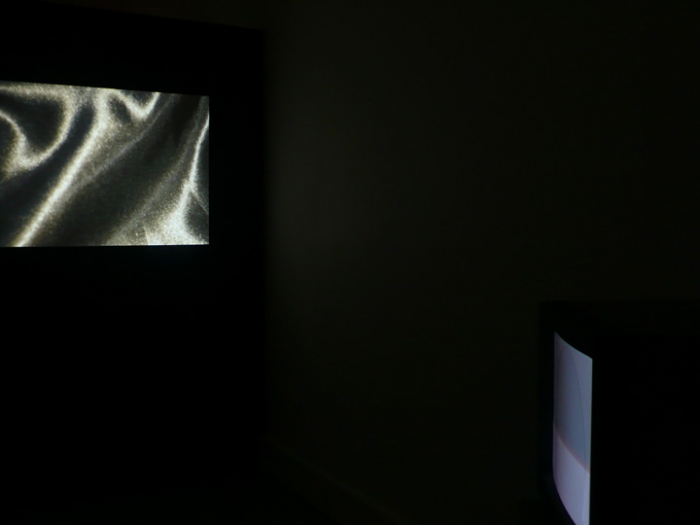
Installation view with Hayley Silverman's 1st Movement on left. Courtesy of Jancar Jones Gallery. (Click to enlarge.) Opposite Eastman’s video, the other works were projected onto the wall as part of a single continuous loop. Hayley Silverman’s 1st Movement features images of shiny fabrics that appear to be folding and collapsing naturally, as if a sheet or a piece of clothing were dropped on a surface. However, on close viewing one can see that the images are being digitally deformed, giving the illusion of the natural behavior of fabric. You can see a video example here. The other videos in the loop explore similar themes. In “Floor Warp 2“, Guthrie Lonergan creates the illusion of continuous motion of wooden flooring (very similar to the flooring at CatSynth HQ, actually). Similarly, Maggie Foster’s Untitled (2009) manipulates images of a green lawn creating illusions of distance.
-
(re-)Claim, SOMArts
I continue to work through my backlog of shows and exhibits to review, with a focus on exhibits that are still open. One of these is (re-)Claim, which will remain at SOMArts through Friday May 28.
(re-)Claim is part of the United States of Asian American Festival sponsored the Asian Pacific Islander Cultural Center (APICC), a month-long festival that celebrates “the artistic accomplishments and the cultural diversity of San Francisco’s Asian and Pacific Islander communities.” The exhibition features work made from discarded objects and materials explores “the redemptive process that renders an object ‘fundamentally new’”. I have seen several exhibitions this year on similar themes – perhaps a sign of the times – and in fact some of the same artists are featured in (re-)Claim, including Truong Tran and Christina Mazza. The other artists featured in this curated show include Mark Baugh-Sasaki, Kathy Fuji-Oka, Su-Chen Hung, and Judy Shintani.
We had last seen Christina Mazza’s work in the SF Recology Artists Program in January, where she also focused on found objects and materials from the San Francisco dump. For this exhibition, she created an impressive 9-foot-by-12-foot site-specific installation.

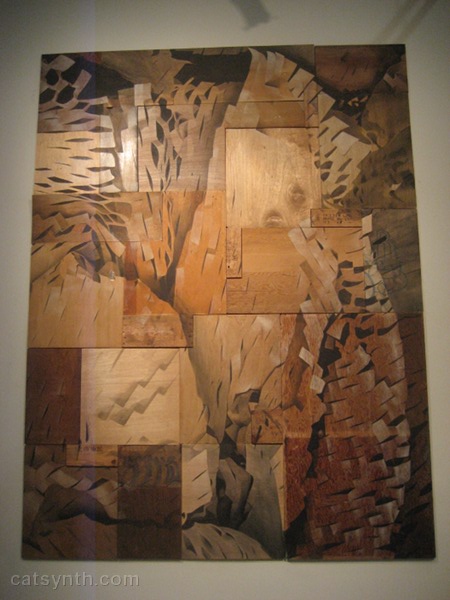
[Christina Mazza. Site-specific installation. (Click to enlarge.)]Up close, one focuses on the individual wooden panels that compose the work, and which reminded me a little of the panels from her “Contained Spaces” series from SF Recology (a few prints from that series were included here as well). From a distance, one could better see the landscape elements and the textures that combined both geometric and natural qualities.
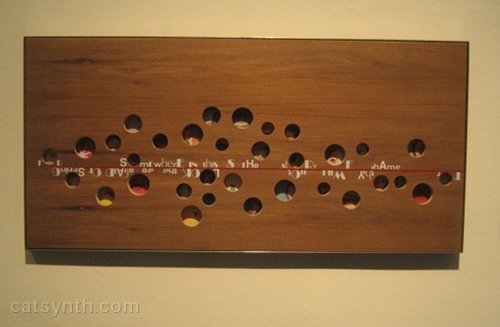
Truong Tran featured several works that I recognized from his solo exhibition the lost & found back in February. All of his works in that show were meticulously constructed from recycled objects and materials, many of which he found on his frequent walks around the city’s neighborhood (an activity that we at CatSynth wholeheartedly support). His pieces fit perfectly into the theme of the (re-)Claim show, where they would be seen alongside and compared to the works of the other artists. There was at least one piece that I didn’t recognize from the solo exhibition – it is shown here.

[Truong Tran. (Click to enlarge image.)]Sculptor Mark Baugh-Sasaki took a very different approach to reclamation. His large sculptures are composed in part from manufactured or processed materials, but have a very natural quality to them, as if they are part of some imaginary ecology. In his artist statement, he refers to them as “objects that are inhabitants of or illustrate the evolving systems and interactions in this new landscape.” I also quite liked his large wooden sculpture A Form Derived from a Constructed Landscape (shown below) and his metal sculpture Relic.

[“A Form Derived from a Constructed Landscape” by Mark Baugh-Sasaki. Image from the artist. (Click to the enlarge)]
We conclude with a mixed-media piece “My Friends” by Su-Chen Hung in which a pair of figures is constructed from a variety of household objects.

[“My Friends” by Su-Chen Hung.]
I would be remiss if I did not also mention the taco trucks that were on hand for the opening. Fusion taco trucks (i.e., assembly of spices and main ingredients from other cuisines in proper taco form served out of a truck) are a mainstay of street cuisine here in San Francisco, and there were two on hand for the opening. I have enjoyed the Asian asada from Kung Fu Tacos at several past events. But I was particularly fond of the paneer and extra-spicy sauce taco from Curry Up Now.