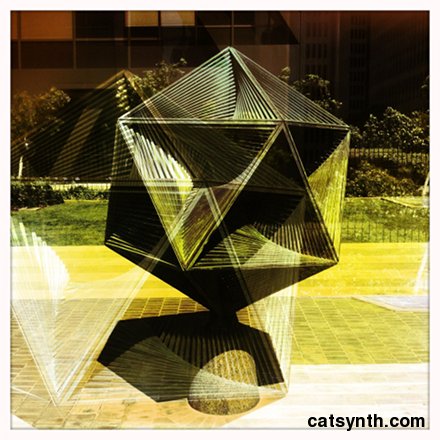

Tag: sculpture
-
MoMA: Pollock, Picasso, and Making Music Modern
No visit to New York is complete without a stop to the Museum of Modern Art (MoMA). Today we look back at three exhibitions that stood out during my most recent trip.

[Jackson Pollock (American, 1912-1956). One: Number 31, 1950. 1950. Oil and enamel paint on canvas, 8′ 10″ x 17′ 5 5/8″ (269.5 x 530.8 cm). The Museum of Modern Art, New York. Sidney and Harriet Janis Collection Fund (by exchange), 1968. © 2015 Pollock-Krasner Foundation / Artists Rights Society (ARS), New York]Jackson Pollock: A Collection Survey, 1934–1954 is a small but powerful exhibition tracing the artists’ career and development using pieces from MoMA’s extensive collection. There were of course the massive drip paintings such as the iconic One: Number 31, 1950, but also quite of few of his earlier works from the 1930s and 1940s that while abstract made extensive and overt use of mythological and folk elements. Indeed, one can even see figures in some of the earlier pieces.

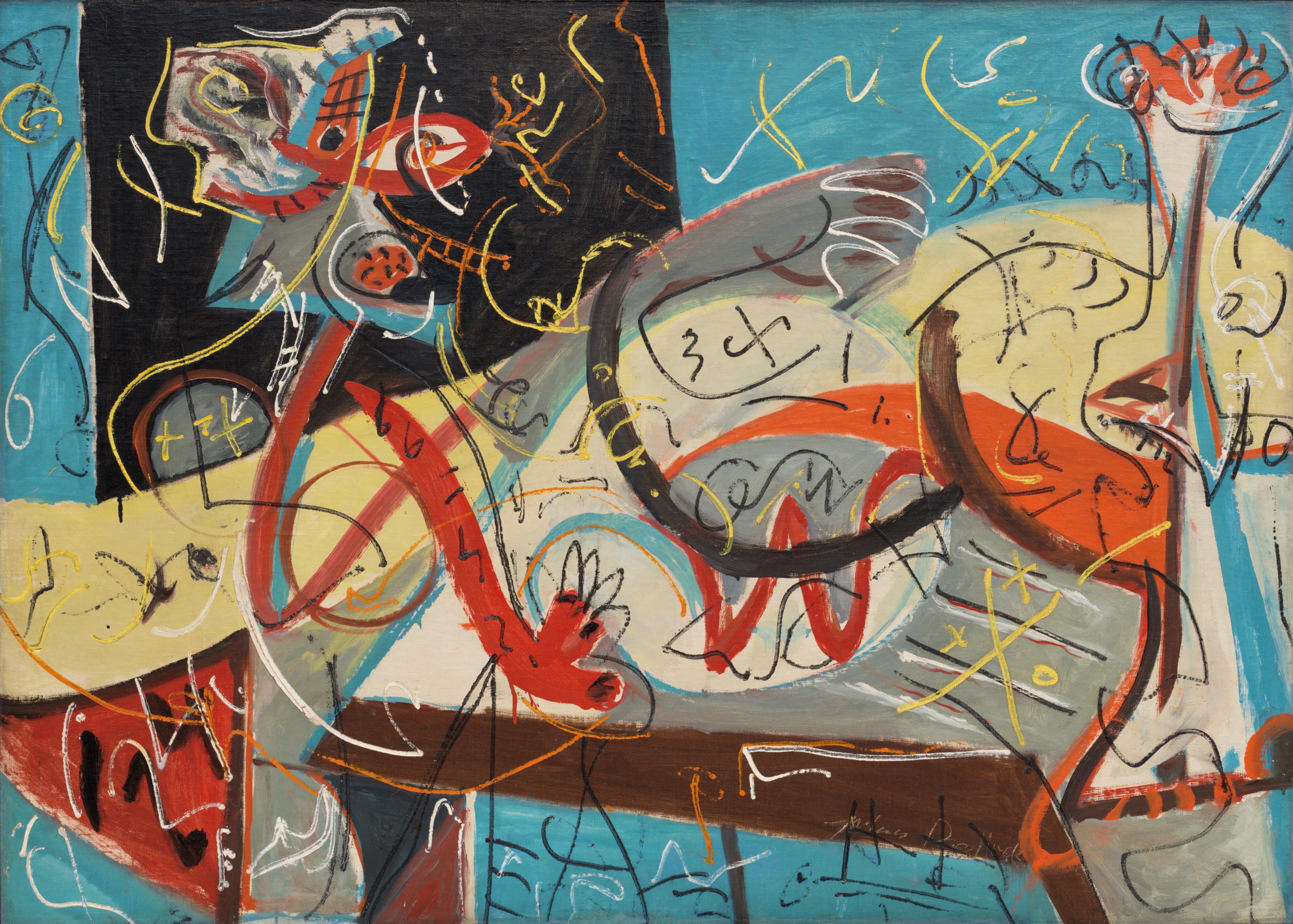
[Jackson Pollock (American, 1912-1956). Stenographic Figure. c. 1942. Oil on linen, 40 x 56” (101.6 x 142.2 cm). The Museum of Modern Art, New York. Mr. and Mrs. Walter Bareiss Fund, 1980 © 2015 Pollock-Krasner Foundation / Artists Rights Society (ARS), New York]One of the earliest paintings was quite reminiscent of Míro, another favorite of mine.
Seeing the works side by side in the compact two-room exhibit, it is easier to see the connections between the earlier and later works. Although the techniques and ideas are radically different, some of the shapes and other elements can be similar at times. Densely packed canvases with layered curving forms of color abound throughout his work.
One of the treats of this exhibition (which I don’t recall from the huge 1999 retrospective) were some of Pollock’s lesser-known drawings, sketches, and prints. Many of them date from the 1930s and 1940s, so have more in common with his paintings of those decades. But seeing Pollock writ small is in itself interesting given his association with paintings of monumental scale.

[Jackson Pollock (American, 1912-1956). Untitled (Animals and Figures). 1942. Gouache and ink on paper, 22 ½ x 29 7/8” (57.1 x 76 cm). The Museum of Modern Art, New York. Mr. and Mrs. Donald B. Straus Fund, 1958 © 2015 Pollock-Krasner Foundation / Artists Rights Society (ARS), New York]
[Jackson Pollock. Untitled.1950. Ink on paper. The Joan and Lester Avnet Collection]The exhibition was just opening at the time (indeed, we saw it as part of a members’ preview), and will remain on display through March 13, 2016.
Picasso Sculpture is a large and comprehensive survey of the artists’ sculptural works. While primarily known for his painting, Picasso was quite a prolific sculptor, and his sculptures can be seen as three-dimensional projections of his unique and instantly recognizable style of painting.

[Pablo Picasso (Spanish, 1881–1973)
Bull. Cannes, c. 1958.
Plywood, tree branch, nails, and screws. 46 1/8 x 56 3/4 x 4 1/8″ (117.2 x 144.1 x 10.5 cm).
The Museum of Modern Art, New York. Gift of Jacqueline Picasso in honor of the Museum’s continuous
commitment to Pablo Picasso’s art.
© 2015 Estate of Pablo Picasso / Artists Rights Society (ARS), New York.]In pieces like Bull, shown above, one can see the direct analogs to his cubist paintings. His figurative sculptures also often feature bulbous and exaggerated interpretations of the human body. Some of them border on caricature, with others are graceful and almost abstract.

[Installation view of Picasso Sculpture. The Museum of Modern Art, New York, September 14, 2015–February 7, 2016. © 2015 The Museum of Modern Art. Photo: Pablo Enriquez]The curving forms in both his human and animal were quite a contrast to the linear forms of the New York City skyline.

[Pablo Picasso, Spanish, 1881–1973
Maquette for Richard J. Daley Center Sculpture
1964
Simulated and oxidized welded steel
41 1/4 x 27 1/2 x 19″ (104.8 x 69.9 x 48.3 cm)
The Art Institute of Chicago. Gift of Pablo Picasso]There were several pieces that I recognized from my visit to the Musée Picasso in Paris, including this absolutely darling sculpture of a cat.

The exhibition, which covers all of the fifth floor of the museum, will be on display through February 7, 2016.
The exhibition on display in the design gallery was particularly appropriate for our interests at CatSynth. Making Music Modern: Design for Ear and Eye brought together a large collection of aesthetically beautiful objects used for both the creation and enjoyment of music.
Perhaps the simplest way to stage such an exhibit would be a linear progression of designs from earlier record players to iPods, but instead this exhibit branches off in multiple directions at once. We do see several of Dieter Rams’ iconic music players and a particularly beautiful and modernist radio by Michael Rabinowitz released in 1942 – and of course an iPod.

[Dieter Rams, Hans Gugelot. Radio-Phonograph (model SK 4/10). 1956. Painted metal, wood, and plastic, 9 1/2 x 23 x 11 1/2″ (24.1 x 58.4 x 29.2 cm). Mfr.: Braun AG, Frankfurt, Germany. The Museum of Modern Art, New York. Gift of the manufacturer]But we also see more esoteric musical instruments that blend art, design and technology, such as Joe Jones’ Mechanical Flux Orchestra, as well as the more mundane Fender Stratocaster.

[Joe Jones. Mechanical Flux Orchestra. c 1964. The Museum of Modern Art, New York. The Gilbert and Lila Silverman Fluxus Collection Gift 2266.2008]Through the exhibit are music posters, showing distinctive designs of different eras. Brightly colored posters of the 1960s are featured along with gritty black-and-white posters for New York City punk shows in the 1970s. There are also objects that are more purely art than functional design. Among those that straddle that divide are the Chamber Works: Architectural Meditations on Themes from Heraclitus from architect Daniel Libeskind.

[Daniel Libeskind. Sheet from the folio Chamber Works: Architectural Meditations on Themes from Heraclitus. 1983. Ink on paper, 22 3/8 x 30 1/4″ (56.8 x 76.8 cm). The Museum of Modern Art, New York. Andrew Cogan and Rob Beyer Purchase Funds © 2014 Daniel Libeskind]
I would love to “play” one of these pieces some day.
One of the more perplexing objects in the exhibit was the Scopitone, a 1950s behemoth that could select, play and rewind up to 36 short films produced for songs by European and American artists. It was in essence a jukebox for the forerunners of modern music videos.

[Scopitone 1963 16mm jukebox The Museum of Modern Art, New York. Film Study Center Special Collections F2007.4]
The Scopitone, never really caught on, but perhaps it was ahead of its time, with a medium more suited to small form factors and Internet distribution, i.e., YouTube.
There was so much in this exhibit that I would love to post all of it, but I think it’s best to see it in person. It will remain on display through January 18, 2016. And for those who can’t see it, I recommend a visit to the exhibition’s

28 Chinese, Asian Art Museum.
Last week I finally had a chance to see 28 Chinese at the Asian Art Museum in San Francisco. It was in many ways an inspiring exhibit and I had been hoping to write about it earlier than today – a series of unfortunate personal matters have gotten in the way of that. But it is nonetheless worth reading about, and seeing if you can this afternoon or tomorrow before it closes.
28 Chinese presents the work of 28 contemporary Chinese artists working in a variety of media. It ” is the culmination of more than a decade’s worth of exploration and research by art collectors Don and Mera Rubell,” who met with 100 artists in China between 2001 and 2012 to learn about them and assemble works from their collection. The exhibition features famous artists like Ai Weiwei, but also up-and-coming artists such as Lu Wei, whose large-scale oil-on-canvas work Liberation No. 1 was among my favorites in the show.

[Liberation No. 1, 2013, by Liu Wei (Chinese, b. 1972). Oil on canvas. Courtesy of Rubell Family Collection, Miami. © Liu Wei.]
It depicts a colorful and unfathomably dense urban landscape, even beyond what I experienced in Shanghai in 2009. It might be disquieting to some, but I find it welcoming. Lu Wei used computer software to generate the patterns which we then rendered as oil on canvas. Another work that made use of mathematical processes to direct traditional painting practice was Shang Yixin’s acrylic work 1061.

[1061, by Shang Yixini (Chinese, b. 1980). Acrylic on canvas. Courtesy of Rubell Family Collection, Miami. © Shang Yixin. Photo by CatSynth (Instagram)]
The artist uses the the square as the fundamental building block in all of his paintings. He uses precise rules to generate the patterns of colored squares, which result in different images each time. It seems he must be using stencils or edges to get such precise shapes and textures from acrylic.
An equally modernist but very different type of painting could be found in Zhu Jinshi’s Black and White Summer Palace – Black. The paint was applied using trowels to create a thick and presumably quite heavy topographical structure. It brought to mind the incredibly heavy painting The Rose by Jay DeFao.

[Black and White Summer Palace – Black by Zhu Jinshi (Chinese, b. 1954). Image from The Asian Art Museum’s Tumblr.]
There were quite a few interesting sculptural and conceptual works in the exhibition. One of the highlights was Zhu Jinshi’s monumental installation, Boat. It composed entirely of layered calligraphy paper and bamboo rods suspended from the ceiling. It was over 40 feet long, and visitors could walk inside of it.

[Boat, 2012, by Zhu Jinshi (Chinese, b. 1954). Xuan paper, bamboo, and cotton thread. Courtesy of Rubell Family Collection, Miami. © Zhu Jinshi. Photo by CatSynth (Instagram)]
Not as large in size, but also quite monumental in its weight was Ai Weiwei’s conceptual sculpture A Ton of Tea, which literally was a ton of tea compressed into a cube.

[A Ton of Tea, by Ai Weiwei (Chinese, b. 1957). Courtesy of Rubell Family Collection, Miami. © Ai Weiwei. Photo by CatSynth (Instagram)]
The setting for this piece and many others was inventive juxtaposition by the museum of works in the exhibition with the more traditional pieces from their permanent collection. The contemporary works stood quite a part from the traditional, but was interesting to see a few thousand years of Chinese artist practice all together.
One more surprising and intense conceptual work was He Xiangyu’s installation Cola Project, in which he boiled down 127 tons of Coca Cola to create a highly corrosive black residue. He used this as an ink to create traditional Chinese ink-on-paper drawings. In addition to the drawings, the installation featured a case of the rather disturbing substance, and the even more disturbing photos and videos from the worksite where large industrial cauldrons were creating it. The scene suggested a poorly regulated industrial site, and the room was filled with an odor of burnt caramel (probably emitted from the drawings). It was a rather intense work. And fortunately I am not fond of cola.
Like any good exhibition, this one inspired me in my own artist ideas – especially the two-dimension works. It also made me reminisce about my adventures at galleries and art districts in urban China, such as Shanghai’s Moganshan Road, which I’m sure has changed in the 6 years since I was last there.
28 Chinese is on display at the Asian Art Museum in San Francisco through tomorrow, Sunday, August 16. If you are in the area I recommend checking it out.

Chris Burden, Extreme Measures, New Museum
Among my first stops during this year’s New York trip was the New Museum, which is currently featuring a museum-wide exhibition of works by Chris Burden.
His work spans several decades and includes sculpture, performances and pieces that blur the boundary between the two. While the exhibition officially focuses on “weights and measures, boundaries and constraints”, the theme that seem to most unify all the pieces was “play”. Certainly, he has access to toys on larger scale than most of us could only dream of as kids who loved building sets. This was most apparent in his series of bridges, made from custom erector sets and other materials.

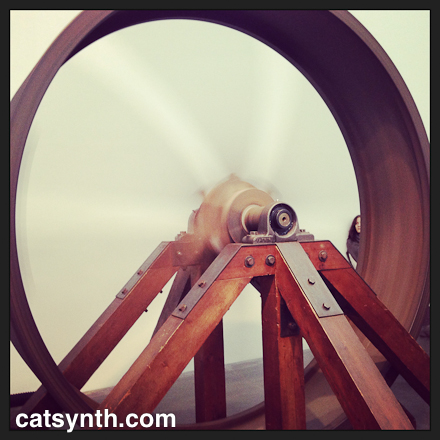
Similar principles are at work in his large-scale sculptures, which use metal and found material and also included a sense of motion. The Big Wheel is indeed a huge wheel constructed from weathered metal.

It is designed to spin freely, and visitors are treated to a twice-a-day “performance” of the piece where a motorcycle is used to start the wheel spinning. You can see a bit of this in the following video:
A nearby sculpture address the absence of motion with a perfectly balanced Porsche and meteorite. I am curious as to how Burden obtained such a large meteorite to use in this piece.

Motion is taken to another extreme in an outdoor piece (shown as video documentation in the exhibition) where large steel beams are dropped into a pool of wet cement. As the positions, angles, are unpredictable, the result is a rather chaotic jumble of vertical steel spires. The video itself is quite interesting with the motion of the cement in response to the the dropping beams.
Perhaps the element of play is most apparent (and most poignant) in A Tale of Two Cities. Burden constructs a tableaux of two city-states at war using sand, plants and a large array of toys.

Some of these toys (in particular, a few of the space-themed toys) were familiar from my own childhood. And certainly we sometimes created battles with them. But those fantasies never touched on the realities of war, and somehow Burden made that very apparent in this piece. Perhaps it was the presence of bullets among the toys that made it seem like something very, very bad could come of this.
The exhibition also includes other conceptual pieces, as well as some examples of Burden’s early video work, which was interesting precisely because it seems dated.
Chris Bürden: Extreme Measures will be on display at the New Museum through January 12, 2014.
Weekend Cat Blogging with Luna: Napping near the Artwork

Cats always find interesting places to nap. For Luna, that sometimes means next to the standing artwork. We have quite a few free-standing 3D pieces in the collection at CatSynth HQ.
Luna will probably be napping quite a bit this weekend, as I will be spending most of it in the studio with Reconnaissance Fly as complete the final mixes for our upcoming album. In the evenings, I will be back here to work on a completely different musical project, my electronic solo show in Portland next Saturday. But Luna gets to sit in and supervise that one.
Carnival of the Cats will be hosted this Sunday by Samantha, Clementine and Maverick.
And the Friday Ark is at the modulator.
By-product Becomes Product, Intersection for the Arts
Intersection of art and science is not uncommon in contemporary culture, or on the pages of this site. While this most often involves the integration of high technology (e.g., electronics and the Internet) into artistic pieces and practice, the current exhibition at Intersection for the Arts in San Francisco takes a new look at a more basic technology, the manufactured materials used by many artists. The show, titled By-product Becomes Product, is a collaboration of lead artist Christine Lee with research engineer John F. Hunt at the U.S. Department of Agriculture Forest Products Laboratory exploring the use of excess wood waste as a safer alternative to some of the toxic materials often used by artists.
Artists have made use of engineered wood products originally created for practical uses such as homebuilding and furniture manufacturing. Among these are plywood, particle board, oriented strand board (OSB) and medium density fiberboard (MDF). All of these have their positives and negatives, and among the negatives are the manufacturing processes, byproducts, and especially in the case of MDF toxic chemicals in the product itself. While a resident the University of Wisconsin at Madison, Lee worked with Hunt to develop a custom composite board made entirely from sawdust and paper fibers. A sample was available at the start of the exhibition:

Because the board was made entirely from waste material, it required no additional wood to be harvested. And because it does not include any adhesives or other additional chemicals, it is non-toxic for artists and viewers of the art. Finally, because it is made entirely from wood by-products, it is biodegradable, and the objects made from it will naturally decay and return to the environment. With this theme in mind, the boards were given to five additional artists to create new work for the exhibition. The results spanned a variety of conceptual and aesthetic styles, and crossed the boundaries between art and design. They were brought together into Intersection’s gallery space in an installation whose clean and spartan quality matched the texture of the material itself:

Russel Baldon’s Mutant Boxes perfectly balanced art and design, and was in many ways the most fun piece in the exhibition. Baldon used the composite material to fashion a series of exquisite corpse boxes featuring his own drawings. The drawings were fun, surreal, often comical or fantastic, and I found myself quite engrossed in playing with them.

[Russel Baldon, Mutant Boxes, 2013.]
This is Baldon’s first public exhibit featuring his drawings – most of his existing work is sculpture and furniture – but they look like the product of someone who is at ease with drawing. The images are clean and precise while maintaining a hand-drawn quality and a common sense a style among a diverse set of characters ranging from anthropomorphic cats to multi-tendriled space aliens. The idea to fashion the material into an object of play was a natural one for the artist, who started his work in his family’s wooden-toy business. It was also an opportunity to feel the material in the form of a finished piece, after touching the prototype board at the start of the exhibit.
Design was squarely the focus of Christine Lee’s own piece, Interwoven. This sculptural furniture piece is a prototype demonstrating the properties of the composite board in terms of strength and flexibility, and an effort that minimized wasted material and toxicity. But the geometric simplicity combined with the detail of the weave also makes it an aesthetically strong piece. It would certainly be at home at CatSynth HQ.

[Christine Lee, Interwoven, 2013.]
Imin Yeh adapted the new boards to an old artform, woodblock printing, in her conceptual installation Double Happiness. She used the composite board as a safe and more natural alternative to other materials used in contemporary woodblock printing. The result was a series of printed paper fruits that were assembled into a cart and crates, also made from the composite board. The scene evokes the wooden produce stands that can be seen around San Francisco:

[Imin Yeh, Double Happiness, 2012.]
The sculpture itself is intended to be a vending station, selling limited edition paper fruits as “organic, fresh, fine art.”
For feed/rest/nest, artist Barbara Holmes created a series of colorful bird houses arranged around the gallery’s spiral staircase.


[Barbara Holmes, feed/rest/nest, 2013.]
Aesthetically, the birdhouses themselves are reminiscent of California architecture of the mid-to-late 20th century. But they also serve a function of returning the materials, sawdust and paper fiber that were themselves by-products of trees removed from the natural environment back into the natural world. They provide habitat for birds, but also will naturally bio-degrade and be reabsorbed into the environment. Holmes intends to place the birdhouses into friends’ yards for habitation and will continue to track their use.
Like Imin Yeh, Julia Goodman used the composite board indirectly, is this case as a series of molds for cast paper. Her conceptual pieces FEMA 3 Step, Forgive and Forget, and Oversight embed words into the cast paper that recall the issues surrounding MDF and formaldehyde leakage in FEMA trailers after Hurricane Katrina. The issue of MDF had a personal dimension for Goodman, as she used MDF in her own art practice and was exposed to its toxic byproducts. She was drawn to the new materials promise as a non-toxic alternative for both art practice and for homes.
Among the artists in the exhibition Scott Oliver seemed to take the sustainability and minimization of waste to its furthest extreme. He used not only the composite boards, but the wooden crate that used to ship the raw material to him. The crate and boards were fashioned into a camper shell for the his Toyota pick-up, once again making an object that is both art and function at the same time. His title Tree, Crate, Camper Shell, Or, On the Way to Becoming Something Else suggests that the life cycle of the piece and its materials is not yet over. They started as trees, become crates and composite boards, but in the future the natural materials of the camper shell will decay and be returned to the environment.
The pieces in this exhibition demonstrate that Lee and Hunt’s new composite-board material has promise as a medium for art and design. They were all quite simple in both form and concept and attempted to relate directly to the themes of sustainability inherent in the material. It will be interesting too see if the material has a wider arrange of applications in more complex artworks in the future and ideas beyond these themes. That will clearly depend on its availability and the imagination of artists.
By-product Becomes Product will remain on display at Intersection for Arts through March 30.
San Francisco Electronic Music Festival (SFEMF): Art Installations
In addition to the main concerts, this year’s San Francisco Electronic Music Festival featured a concurrent gallery exhibition. It took place at Million Fishes in the Mission District of San Francisco, and featured a variety of works that combined sound and visuals. I had the opportunity to visit the gallery on the Saturday of the festival, just before that night’s concert.
I have experienced Matthew Goodheart’s work with transducer-excited cymbals a few times now, most notably in his solo performance at the Outsound Music Summit. Here, he arranged them around the front room over the gallery to create an immersive installation called …silence through things secret….


The installation dominated the main room both visually and aurally, with the late-afternoon sun reflecting off the cymbals, and a variety of sounds echoing around the room. Computer-generated sounds were created from analysis of the resonances of each cymbal and recordings of each instrument played in a variety of manners. The sounds were then used to excite the cymbals via small transducers.

Because the sound from the cymbals is acoustic, the only notion one has of electronics at work is the fact that they are standing on their own without anyone there to play them. But there is nonetheless something otherwordly about the visuals and sounds of the unattended cymbals. Goodheart’s piece was part of a larger project he has developed in conjunction withe Center foew New Music and Audio Technologies (CNMAT) at UC Berkeley.
Giant Leap, the result of collaboration by Floor van de Velde and Elaine Buckholtz, paid tribute to the late Neil Armstrong and the 1969 Apollo 11 moon landing. The audio-and-visual work combined an anaglyph image of the moon with a sound score realized using modified rotary telephones.
The moon landing and the sounds associated with that achievement are still quite fresh, but the use of rotary telephones reminds us just how long ago this achievement took place. I consider rotary phones a particularly endangered technology in that it bears so little resemblance to contemporary phones in both form and function.
Dan Good presented two small kinetic sound sculptures. Artificial Lung combined standard speaker drivers in a novel way. They were pressed against one another a driven with a 1Hz sine wave. While the signal is far below the range of human hearing, the pressure on the speakers was visible and created the illusion of a breathing organism.

In, Good’s sculpture Petri Dish, small glass spheres are pulled up and down in a glass bowl and tubes. The sound of the glass is subtle, but the visual is quite striking, especially when it is moving (the photograph does not really capture this aspect.)

Both of Good’s sculptures draw upon simple shapes, lines and processes to create something conceptually compact and understandable. As such, they play to the strengths of modernism – something refreshing to see in a contemporary setting,
SFEMF has featured installations before, usually as fixtures in the lobby during concerts. I thought separating it out into a gallery presentation worked well and allowed the pieces the chance to be seen outside the shadow of the live performances and milling crowds. I hope they do this again next year.