Among my first stops during this year’s New York trip was the New Museum, which is currently featuring a museum-wide exhibition of works by Chris Burden.
His work spans several decades and includes sculpture, performances and pieces that blur the boundary between the two. While the exhibition officially focuses on “weights and measures, boundaries and constraints”, the theme that seem to most unify all the pieces was “play”. Certainly, he has access to toys on larger scale than most of us could only dream of as kids who loved building sets. This was most apparent in his series of bridges, made from custom erector sets and other materials.

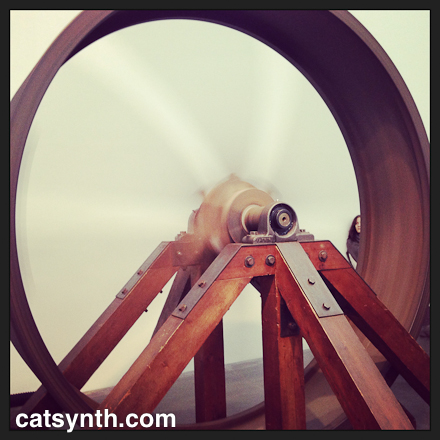
Similar principles are at work in his large-scale sculptures, which use metal and found material and also included a sense of motion. The Big Wheel is indeed a huge wheel constructed from weathered metal.

It is designed to spin freely, and visitors are treated to a twice-a-day “performance” of the piece where a motorcycle is used to start the wheel spinning. You can see a bit of this in the following video:
A nearby sculpture address the absence of motion with a perfectly balanced Porsche and meteorite. I am curious as to how Burden obtained such a large meteorite to use in this piece.

Motion is taken to another extreme in an outdoor piece (shown as video documentation in the exhibition) where large steel beams are dropped into a pool of wet cement. As the positions, angles, are unpredictable, the result is a rather chaotic jumble of vertical steel spires. The video itself is quite interesting with the motion of the cement in response to the the dropping beams.
Perhaps the element of play is most apparent (and most poignant) in A Tale of Two Cities. Burden constructs a tableaux of two city-states at war using sand, plants and a large array of toys.

Some of these toys (in particular, a few of the space-themed toys) were familiar from my own childhood. And certainly we sometimes created battles with them. But those fantasies never touched on the realities of war, and somehow Burden made that very apparent in this piece. Perhaps it was the presence of bullets among the toys that made it seem like something very, very bad could come of this.
The exhibition also includes other conceptual pieces, as well as some examples of Burden’s early video work, which was interesting precisely because it seems dated.
Chris Bürden: Extreme Measures will be on display at the New Museum through January 12, 2014.



.png) I-505 is a completely straight, flat, stretch of highway. This is pretty much true of the surrounding landscape as well, but the texture and details against this blank canvas can make for some interesting photos.
I-505 is a completely straight, flat, stretch of highway. This is pretty much true of the surrounding landscape as well, but the texture and details against this blank canvas can make for some interesting photos.
 I-505 merges into I-5, which continues northward through more of the relatively flat landscape, repeatedly crossing the Sacramento River in the process. Eventually we come to the city of Redding at the northern end of the Sacramento Valley. On my return trip from Portland, I finally had a chance to stop in Redding and visit the Sundial Bridge. This modernist architectural gem spans a wooded section of the Sacramento River completely, a world apart from the town of Redding itself or the strip malls and shopping centers that line the highways. Here, clean modern lines contrast with the natural forms of trees and running water.


 After passing Mount Shasta and Black Butte, I-5 descends into a wide valley, passing by the town of Weed, whose welcome sign is a popular backdrop for photographs. This is the start of US 97, which heads northeast towards Klamath Falls and central Oregon as I-5 continues due north through the Cascades towards Portland. The main street in Weed is also Historic US 99. The part of the historic route which returns to I-5 is now California Highway 265, one of the shortest in the system.


