After the intensity and non-stop stimulus of NAMM, I try to reserve the final Sunday for solitude and exploration of the greater Los Angeles Area. My most recent post-NAMM exploration included a trip north on I-710.

 Officially the “Long Beach Freeway”, the highway runs alongside the Los Angeles River for much of its length. The Los Angeles River is a naturally flowing river, but it has been encased in a concrete channel. It’s a rather dystopian vision, but very much characteristic of 20th century LA. It has served as a setting for numerous movies – think the scene in Terminator 2 where the cars crash in a giant concrete ditch and the shapeshifting guy walks away. Of course, I had to photograph this monument myself as well. I joined I-710 at its interchange with Highway 91. The river immediately comes into view to the right, concrete channel and all. However, along this section there has been a lot of work to provide green space on the banks, with bike and walking paths connecting a series of parks. I left the freeway at the Imperial Highway exit for a closer look.

[The mighty Los Angeles River.]
This location is actually the confluence of two rivers. The San Gabriel River, also enclosed in a concrete channel for much of its length, flows into the larger Los Angeles River – the merging of the two concrete channels is unique.

[The San Gabriel and Los Angeles Rivers.]
I suppose I choose to see the beauty in scenes like these where others refuse to or can’t. But on another level, it is not entirely a choice. I am inexorably drawn to such things. Even as are attitudes towards development change from 20th century models, I’d like to see artifacts like this concrete river preserved.

North of the Imperial Highway, I-710 crosses the Los Angeles River to the east bank.

[I-710 crossing the Los Angeles River.]
The freeway begins to diverge from the river, heading due north towards Pasadena and controversial “dead end”. You can read more about the efforts to complete (or not complete) the highway at the California Highways website. However, I chose to leave the highway and follow the river instead.
A stretch of Bandini Boulevard grazes the river, affording views of a section that is unequivocally industrial. No parks or bike paths here. But even here I can find visual beauty in the bleakness of the scene.

The river is of course in no way devoid of life. Tenacious vegetation can be found along the channel, and there are plenty of birds who take advantage of the shallow water.

I continued north near to the river into the city of Los Angeles. The industrial character remained for a while, and reminded me a bit of the southeastern section of San Francisco that I often frequent, but on a grander scale. I didn’t stop here, but perhaps I should have. Towards downtown, the river becomes incorporated into the greater city, with classic art-deco bridges spanning the channel. I crossed it one last time on the First Street Bridge:

[By Downtowngal (Own work) [CC-BY-SA-3.0], via Wikimedia Commons]
It was early enough to still visit a couple of L.A.’s art museums, but I am glad I was able to spend time first with this piece of the city’s history, and a work of art in its own right.

Once again, I will be in New York this month. It has become a yearly pilgrimage of sorts, as well as time to visit with family and friends. There will be lots of art, music and urban landscape writ large. And for this in the NYC area, I will be playing a show this Thursday.
November 15, 2012. Ambient-Chaos featuring Groupthink, Amar Chaudhary, LathanFlinAli, Charity Chan.
Spectrum, 121 Ludlow, Second Floor, New York.
LathanFlinAli, Groupthink, Amar Chaudhary, Charity Chan, and Lukas Ligeti live at the Spectrum Loft Space in Manhattan. Spectrum is a new loft space dedicated to experimental and music.
The event starts early. So please be there by 7:30 to settle in and enjoy the frequencies.
I will try and post sporadically, but in the meantime I do expect to continue with live updates of NY adventures via Twitter @catsynth.
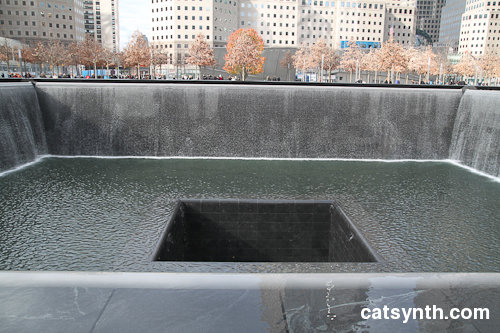
My trip to New York included a visit to the to 9/11 Memorial. As stated on the website, the memorial is “A national tribute of remembrance and honor to the men, women and children killed in the terror attacks of September 11, 2001 and February 26, 1993.” At its most essential level, it is a space rooted in tragedy and loss and remembrance. But it also is a positive space, in harmony with the modern urban landscape, the changes happening as the area is rebuilt, and a prototype for ways to think about public urban spaces for the future.
The memorial is located on the World Trade Center complex, and occupies a large portion of the original site. It is anchored by two large square waterfalls and reflecting pools, each approximately the size and location of the footprints of the original twin towers.

In this photo, one can see how the pools are situated with respect to the other architectural features of the landscape. Behind this pool on the footprint of the original south tower are (from left to right), the existing buildings from the World Financial Center in Battery Park City, the new One World Trade Center building still under construction, and the September 11 Museum (also still under construction).
At the center of each reflecting pool is a dark square hole whose bottom cannot be seen from the sides and into which water from the pool falls.

The trees visible in the above photo are swamp oaks, and form an important part of the memorial. Although orange and rather spare in late November, they form a green canopy that will shade much of the space during the spring and summer and add a sense of life to the space. They are also an integral part of the green design, with the shade helping to reduce stress and energy on the underground parts of the complex (including the major transit hub at the site). Conversely, the paved walkways are designed in such a way as to support the trees and not put undue stress on them or their roots (visit the website for more detail on how that works).
The sides of pools are lined with bronze onto which are inscribed the names of all the people who died in the attacks on September 11, 2001, as well as the six people who died in an earlier attack on the World Trade Center in 1993.

It is somewhat reminiscent of the names on the Vietnam Memorial in Washington, DC, and indeed I did see some people making rubbings of particular names.
The architecture of the pools, with the concentric squares and footprints, grounds the memorial in the architecture of the original site. The museum facade also takes on elements from the long lines of glass and steel structure of the original towers. Even the cascading water into the pools seems to have been designed to reflect the original architecture. The pattern of the water as it cascades over the edge strongly reminds me of the two-story lobbies of the original towers.

Visits to the memorial is still very controlled, and one has to book passes for a particular date and time well in advance. But we were able to get a good time during what is presumably a busy week. I am glad I had a chance to visit at this time, with the overall site still in progress. I would like to see it again in the future as the buildings and the museum move forward.