
Tag: soma
-
Readings at Electric Works, and the Snowball Pond Orchestra, December 7
The evening began at Electric Works for readings from the art issue of The Believer.
We spent a few minutes browsing the gallery at Electric Works, which featured work by Paul Madonna. His large-scale pieces included text that seemed only slightly related to the images, which often featured cartoon creatures, commercial art, and little “alien-monster” finger puppets similar to the ones I keep in my office at work.
Michelle Tea presented a reading from her piece about the fifth marriage ceremony of two “sexy performance artists” as an unauthorized event at the 2009 Venice Beinnale. Her descriptions of their costumes were quite detailed and her deadpan delivery of some their odd statements was amusing.The readings Jeff Chang and Michael Paul Mason seemed more like paper presentations at an academic conference, although I was quite intrigued by Mason’s piece on the disappearance of Ford Beckman, a highly successful minimalist artist who somehow went from the inner circles of the art world to working at a Krispy Kreme Donuts in Tulsa, Oklahoma. The examples of Beckman’s work shown in the presentation suggested the sparse geometry and simple patterns of minimalist work, but also a weathered quality that brings out the underlying materials.
The highlight of the evening was the presentation by Eames Demetrios. Demetrios. He is the grandson of the designers Charles and Ray Eames, a filmmaker, and also the Geographer-at-Large for Kcymaerxthaere, “a parallel universe that shares, to some degree, our physical planet.” After chiding the audience on their woeful state of knowledge of Kcymaerxthaere, he presented some examples of how the history and mythology intersect with our physical world, and his work to recognize significant intersections with commemorative plaques. My favorite observation was the many roads named in honor of Earl Frontage. The presentation concluded with a rousing group rendition of “Kymaerica, Sambamba Dier” sung to the tune of America the Beautiful.
After a brief stop for refreshments, it was off to The Makeout Room for the Snowball Pond Orchestra performing Piece to Celebrate the Proximity of Pearl Harbor Day and the Death of John Lennon, the first conducted composition by kingtone (aka Lucio Menegon). (Some readers my recognize Lucio as the host of the Ivy Room experimental-improv series.) “The piece is a a surround sound minimalist-meets-mayhem piece to celebrate the proximity of two events that managed to wake people out of their collective stupor for a moment or two.”
The first two sections appeared to focus more on Pearl Harbor and the last two more on John Lennon. The opening section featured the guitars, as described above. Later on, much darker guitar and string sounds were set against snare drums that sounded at once militaristic and like a clip from a rock solo, followed by long sustained guitar unisons and complex chords. The music gradually took on more of a rock feel as the narrative moved from Pearl Harbor to John Lennon, with quotations from “Helter Skelter” (from the White Album) towards the end.
You can read more about the performance, and see photos and a video clip at the kingtone website.
-
SF Open Studios Week 3, part 1: Abstract
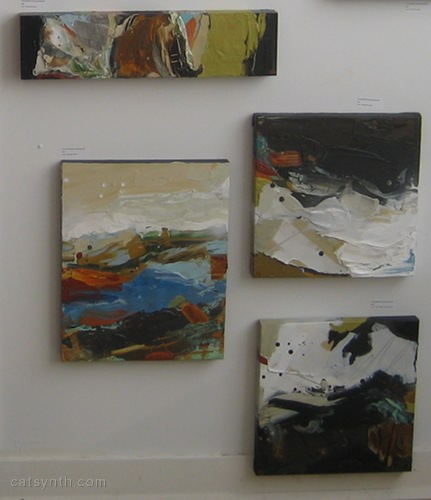
Week 3 of San Francisco Open Studios features South of Market (SOMA), my neighborhood, and Mission Bay, the corridor along 3rd street further south. This is a rather large piece of territory within the city, and a mixture of old industrial areas and downtown that seems to me very creative. I have decided to divide my experience into three distinct sections: abstract, architectural/urban, and figurative/characters. These are by no means authoritative groupings, they just represent the main areas of my interest among the work that I saw, and a way to separate the large number of artists I saw into something a bit more manageable. And of course many of the artists blue the boundaries between these distinctions. This article presents a few of the artists whose work was primarily abstract.

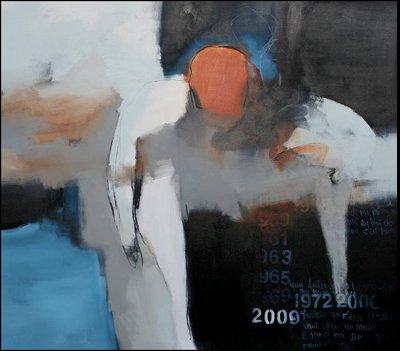
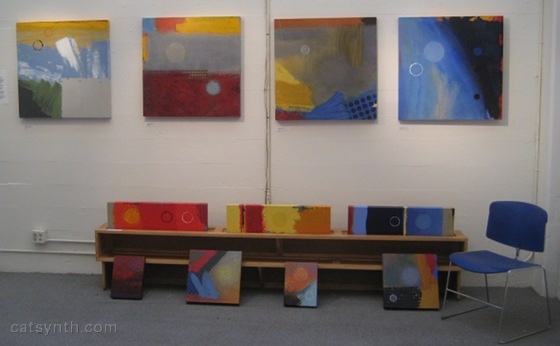
Paule Dubois Dupuis. Pour toi maman. (Click to enlarge) At South Beach Studios, I once again visited the studio of Paule Dubios Dupuis. I had seen her work last year when I was specifically looking for large abstract paintings, and indeed her rich and vibrant canvases were once again among the largest I saw this weekend. Her paintings feature shapes and areas of color of different sizes with soft of ambiguous borders – the content has a very expressive, even emotional, quality. Her smaller “Graffiti” series is very crisp and tight with shades of black and grey; her exceptionally large Pour toi maman is simultaneously study in color, shape, and use of text, and a moving tribute to her mother.

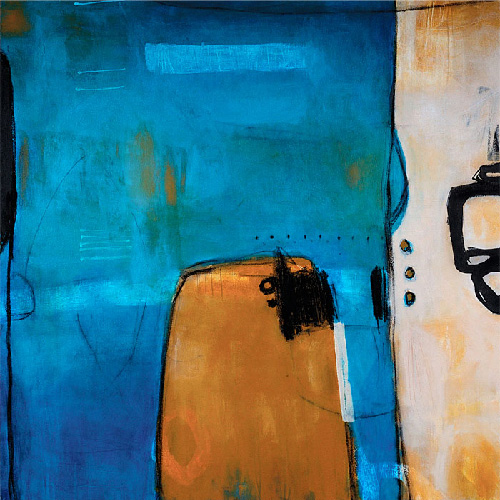
Clare Kuo. Boundaries #24. (Click to enlarge.) At 1035 Market Street, I encountered the work of Clare Kuo. Her large abstract paintings have very strongly defined shapes and boundaries, with large fields of color. Within each, one can see different shades in the brush strokes and fine detail, but it is the large outlined shapes that most stand out. Conceptually and texturally, her paintings remind me a bit of Silvia Poloto’s Observations series (from Open Studios week 1), but with a different vocabulary of shapes.

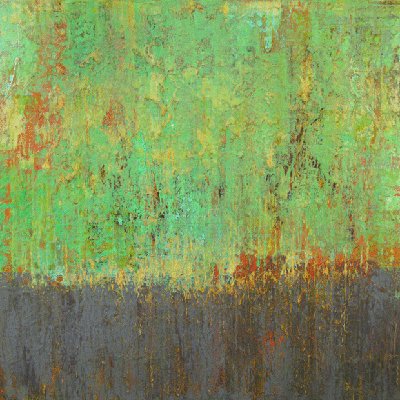
Andrzej Michael Karwacki. (Click to enlarge) Also at 1035 Market, Andrzej Michael Karwacki presented both abstract work as well as figurative work, and indeed I did not initially realize they were from the same artist.Karwacki keeps the two bodies of work fairly separate, and noted that the viewers and clients for his abstract and figurative work fell into two very distinct groups. So perhaps I was an exception in having an interest in both. His abstract work was very textural, with brighter natural colors often running down the canvas in a manner that suggests water running down the side of a wall. Some of his paintings also feature plant shapes and patterns. His figurative paintings, by contrast, had a very crisp feel with well defined lines, and reminded me of fashion and glamor photos. These images also incorporated text in the form of poems printed in the background.
One of my favorite “spaces” from the weekend was Pier 70, a collection of dilapidated port and industrial buildings in Mission Bay. I featured one of my own photos from this area in last week’s Wordless Wednesday, and will have more to say about it in a future article.

Phillip Hua. (click to enlarge) I did see several artists at the Noonan Building at Pier 70, including Phillip Hua. I have seen Hua’s abstract work from his De/Construction series before at Hang here in San Francisco. I was attracted to the large shapes lined with smaller dots and splatters; and stark coloring with broad areas of black set against white and bright colors. His more recent work, re:Action involves ink and tape placed on top of pages of the Wall Street Journal. The images of trees that emerge suggest the “reclaiming” of the Journal pages. The newspaper was created from trees, and now it is being used to recreate trees.
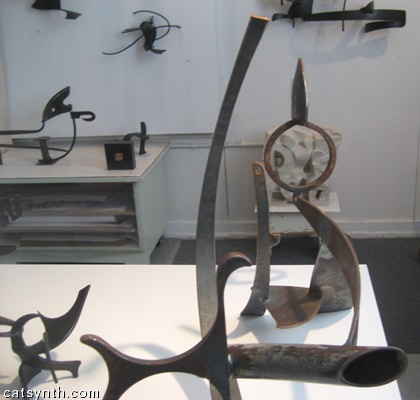
In a lower level of the same building, I found the work of John Haines. His metal sculptures feature soft curving lines, circles and smooth textures. The abstract metal shapes have a very organic feel and the thin lines in some of the pieces convey a sense of motion. It also was fun to try and use the circles as “windows” through which to peer at some of the other sculptures.

John Haines. (click to enlarge) 
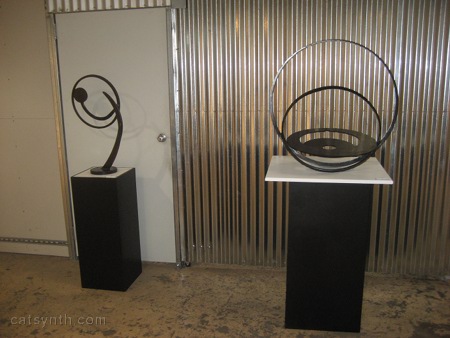
Rebecca Fox. (click to enlarge) It seems that I always end up being drawn to abstract metal sculpture, and thus I ended up again this year atIslais Creek Studios. Some of the artists I saw last year were not showing this time. But I did see Rebecca Fox’s large metal sculptures. Her arrangements of almost perfect circles and other curvilinear forms in arrangements suggest astronomical symbols. The shapes and surfaces have a very smooth, continuous quality to them. They also have a feeling of strength when viewed in person, even some of the pieces composed of thinner circles.
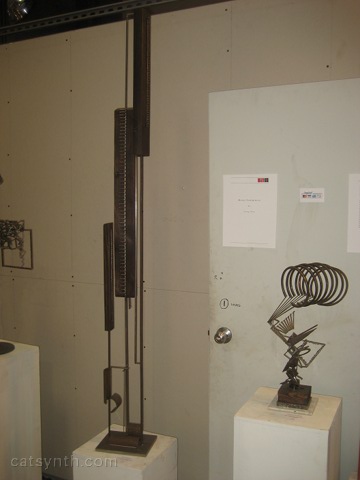
Nearby, Yong Han’s sculptures provided a stark contrast. If Fox’s sculptures are represent simplicity, strength and circles, Han’s are intricate, delicate and very linear. Several of his sculptures featured complex arrangements of wire, bars and rods, sometimes vertical and sometimes at odd angles, and sometimes quite tall. Although not necessarily the tallest of his sculptures, I liked this pair as they reminded me a downtown city block.

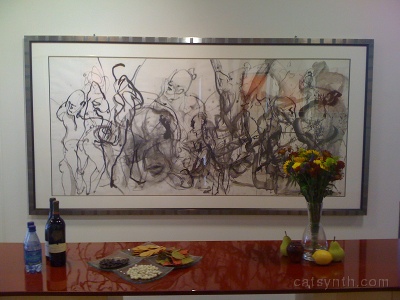
Yang Han. (click to enlarge) Back in SOMA. Reiko Muranaga’s drawings blended figurative and abstract shapes, such as in the large charcoal-and-ink drawing Session. One can focus on either the thick black curving lines, or the figures that emerge from them. This piece in particular seemed to fit quite well with the red table in front of it.

Reiko Muranaga. (click to enlarge) She has also composed some exceptionally large scrolls of her drawings, although these were not on view. Muranaga also presented her Letters to Monet series features soft fields of colors (light reds, oranges, blues) overlaid with very detailed brush strokes suggesting birds or plants.
At Garage Studios on Bryant Street. Alan Mazzetti’s paintings feature a very geometric vocabulary with clearly delineated shapes and textures. Although the linear and rectangular shapes stand out from a distance, up close one can see the the defining elements are the circles. There the large and clearly visible circles, but also the arrays of smaller circles that together form larger objects, and the circles that are hidden in the textures of the paintings.

Alan Mazzetti. (click to enlarge) At SOMA Studios Mark Harris presented an interest mix of purely abstract work from his Letting Go series featuring energetic curved lines, and prints that ranged from abstract to overtly political. Some of his prints were recycled from previous trials, on which he placed text elements including his iconic “signature” shape.
I had initially seen Jeremy Garza’s work as another example of the use of text in abstract art, with his shapes that resembled a sci-fi language. This was apparently a coincidence, though he noted I was not the first person to point that out during the day.
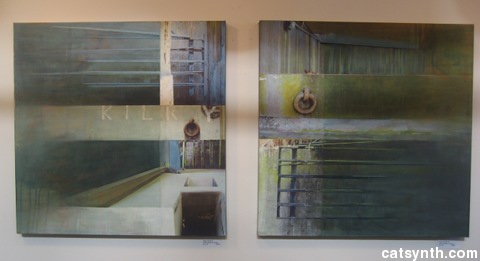
A few artists blurred the distinction between abstract and architectural (actually, several did whether intentionally or not, like Yong Han’s sculptures above). From a distance, some of the paintings in Nanci Price Scoular’s “journeys” series look like abstract color fields with soft muted tones, but on closer inspection they are revealed to be details from structures, such as the “urban still life” pieces featuring rusted iron rings and gates.

Nanci Price Scoular. (click to enlarge) Samantha Ricca also crosses the boundary between abstract and architectural, with one series of paintings featuring surved, organic, almost corporeal shapes, and another featuring featuring straight lines and sharply delineated outlines of structures, such as a ferris wheel. Ricca’s studio was back at Pier 70, and a fitting place to conclude until the next article, which will focus on urban and architectural art.
[Images marked with “catsynth.com” are photographs taken with permission of the artists for use in these artists. Other images are reproduced from artists’ websites with their permission.]
-
Reconnaissance Fly and Noertker’s Moxie at SIMM series
Last Sunday (November 1), Reconnaissance Fly performed at the Outsound SIMM Series.
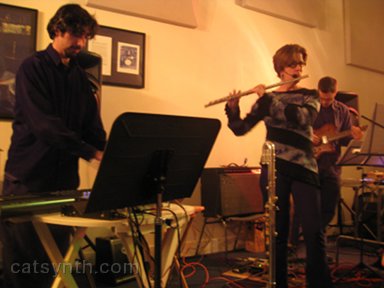
This performance was as a trio, with Polly Moller (Scorpio, and flute and voice), Amar Chaudhary (Pisces, and electronics), and Bill Wolter (Saggitarius, and guitar).

Photograph by Jennifer Chu. Click to enlarge.  We performed four pieces from our “spong” cycle Flower Futures. What is a “spong cycle”? It is a series of pieces based on spoetry, “the deliciously powerful results of robot efforts to evade your spam filter” (as well as the enormous spam queue here at CatSynth). Most spam is banal or poorly written, but occasionally one stumbles upon a particularly beautiful piece of text. We performed four pieces from the eventual full cycle. The two I wrote entitled “Small Chinese Gong” and “Seemed to be Divided in Twain” are improvisational pieces based on graphical scores. You can see an example symbol to right. The interpretation of the graphics can be musical gestures “inspired” by shapes, or a more literal interpretation such as tracing them out on a Korg Kaos Pad – for this performance Bill and I had dueling Kaos Pads in some sections, which produced dense textures or “forests” of pointed sounds that reflected the underlying text.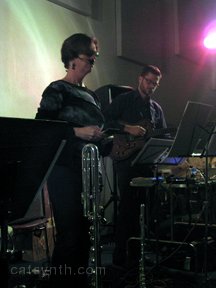
Photograph by Jennifer Chu. Bill Wolter’s “Spam-a-lot” is a combination of improvisational and traditionally written material. The highlight of the piece is the section in the middle concerning “the animal trade in Canada”, ending with a bluesy rock pattern set to “Ca-na-da-a!”, and is probably one of our favorite moments in every performance or rehearsal.
Polly Moller’s “Emir Scamp Budge” is a more idiomatic piece, scored for a standard quartet of keyboard, bass, guitar and voice with a bit of a jazz feel. The text is set to a rolling melody set against a walking bass line and an odd chord progression. It is quite a contrast to the graphical score pieces, and a great excuse to dust off the jazz chops.
It was a pretty solid performance, with all the practice and rehearsal time having paid off. Sadly, this was in all likelihood the last performance that Bill Wolter will be playing with us.
We were followed by Noertker’s Moxie, featuring Bill Noertker on contrabass, Annelise Zamula on tenor sax and flute, Jim Peterson on alto sax and flute, Jenny Maybee on piano, and Dave Mihaly on drumset and percussion. They were marking the release of their new CD druidh lacunae.
The piece, Kamilopárdali, started off very free-form, with lots of detached notes and percussive sounds, including a cloud of metallic-percussion sounds, and Maybee directly playing the strings inside the piano. Gradually, the music became more focused rhythmically and melodically, and then began to alternate between sections of standard modern jazz with rhythms and chromatic lines, and more free-form sections like the beginning. At one point the rhythm disappeared entirely with only sparse hits on the piano strings, drums and bodies of the bass and saxophones. After this, a section with a stronger and tighter jazz melody and rhythm emerged; I believe this was the segue into the piece Athenian Birds.
This was followed by Virage, which Noertker described as having been composed in Hungary and Slovakia in 1995. However, the impression I had of the piece was more East Asian, with lots of pentatonic scales and harmonies set against a latin rhythm. Indeed, one flute melody performed by Zamula sounded exceptionally Chinese, not only because of the scale but also the ornamentation of the notes – there is a particular sound in Chinese music with grace notes or bends on accented notes.
One other piece that particularly caught my interest was Desert Canto. It was described by Noertker as a “beautiful piece”, inspired by photos from Nevada Test Site (site of former atomic-bomb tests) that were “beautiful but also disturbing.” The piece was indeed beautiful, very atonal – but a traditional melodic atonality as opposed to percussive or non-pitched – and had a soft, more dreamlike quality, with frequent cymbal and drum rolls and freer rhythmic structure. You can hear a clip of Desert Canto on the Noertker’s Moxie website.
-
CatSynth pic: Soma’s Solo
From Persiflage on flickr:

We have seen Soma playing synthesizers before.
And try out the soma tag for an interesting mix of what this site is about.