It’s something one may encounter in passing, as part of the design of a larger object. Or it could be a work of art standing on its own. The “is it art?” question is unimportant. What is important is to take time to observe it on its own.
We have two basic shapes. A small circle inside a larger square. The circle is off-center. It makes the white space inside the square seem larger than it would be if the circle were centered, even though the area of the space is exactly the same.
What makes this so captivating, at least to me? It is the simplicity, it’s just enough, and not too much, to arrest the mind and focus on the geometric components. It could be a word in a language I don’t understand. It could also be music, either mostly silence or mostly a continuous, nearly pure tone.
Once one starts looking for these simple components, they can be found anywhere. This was a Wordless Wednesday from last year:
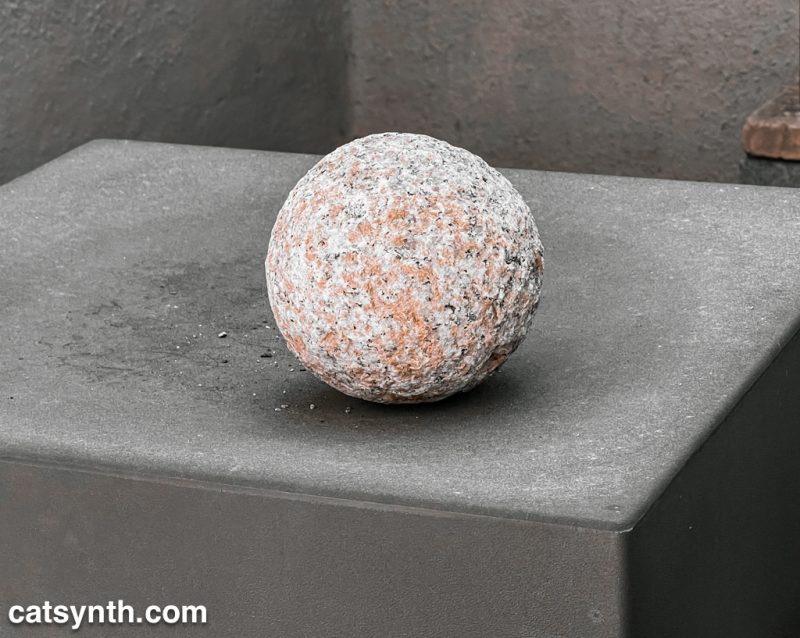
Once again, the relative emptiness other than the sphere and cube holds the focus, and indeed works as an object for a contemplation meditation. The texture of the sphere and the bit of shmutz on the surface of the cube provide one level of additional qualities to observe.
So if one were to add another single object either to the two-dimensional illustration or the three-dimensional photo, what would it be? Please share your thoughts in the comments below.
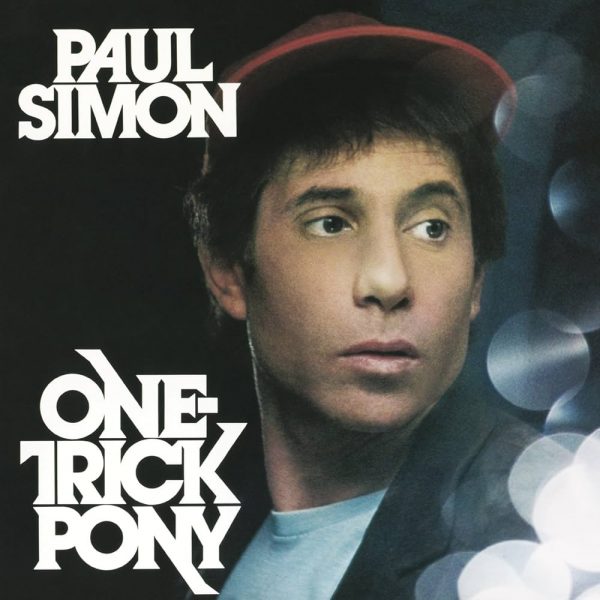
We recently watched Paul Simon’s 1980 film One Trick Pony here at CatSynth HQ. This was his one and only film, which he wrote and starred in. It follows a folk-rock musician Jonah Levin (Simon) who had several big hits in the late 1960s, including an anti-Vietnam War protest song, but now in the late 1970s, he and his band find themselves touring small venues, often riding in a small van around the Midwest, and opening for up-and-coming acts like The B-52s. At the same time, he is struggling with record executives on producing a new album, and with his estranged wife on their relationship and their son.
The film was a commercial and critical flop, and a bit of an obscure artifact of its time. But we at CatSynth really enjoyed it, and were a little confused as to why it was so panned. For one, it features an all-star band that included Simon, bassist Tony Levin (best known for his work with King Crimson), jazz guitarist Eric Gale, jazz and fusion keyboardist Richard Tee (who also did vocals), and drummer Steve Gadd. The original music was a lot of fun, including the bluesy title track played over a disco beat and the catchy “Ace in the Hole”; the band played live in venues like the Agora Ballroom in Cleveland, Ohio. We were rooting for Jonah and the band in their conflicts with the record company, including Lou Reed in his debut film role as a trendy record producer. And even though the studio sessions didn’t go the way they wanted, it was fun to watch the process of recording to tape, adding in strings and backing vocals, and reviewing the takes together.
And perhaps in this synopsis lies the disconnect with critics and mainstream audiences. It’s really a musicians’ film about musicians’ musicians. There was also the setting and the visuals, including life in New York City in the late 1970s, traveling along freeways, and music clubs on the outskirts of cities, all of which appeal to my own personal aesthetic. It also didn’t follow a traditional story arc, but joined mid-way and ended without a real ending, which again is something that appeals to me – recall my fondness for Michelangelo Antonioni’s “trilogy” (plus Red Desert). So while this film did not resonate with the mainstream, it did with us at CatSynth HQ, human and feline alike. We were the real target audience, 45 years after it was released.
Both the in-film story and the context surrounding it also make one think about one’s own journey, and the challenge of making “the music I want to hear” and the “films and videos I want to see”, and hoping others do as well. Sometimes one succeeds, sometimes a little less so. But hopefully one enjoys the work as it continues.
Sunday Newslettes are also on Substack. You can follow and subscribe to us there.
Tonight marks the final night of Hanukkah. A particularly poignant one given the tragedy that unfolded in Australia just one week ago, as people gathered on a beach to celebrate the first night of the Festival of Light.
Honestly, I was not feeling it at all last Sunday. In addition to the many tragic events one after another, I was still recovering from a nasty ailment that had me completely down for the previous week. I was just drained. But I was reminded that it was ultimately important to light the candles, maybe even more so to symbolize both resilience and defiance. It’s a difficult time to be Jewish, just as it’s a difficult time to be queer or trans. Which makes it all the more important to be openly and defiantly Jewish and light these candles for eight nights. No matter how much some people hate us, or kill us, or try to co-opt us for their own nefarious purposes, we are still here, and we are ourselves.
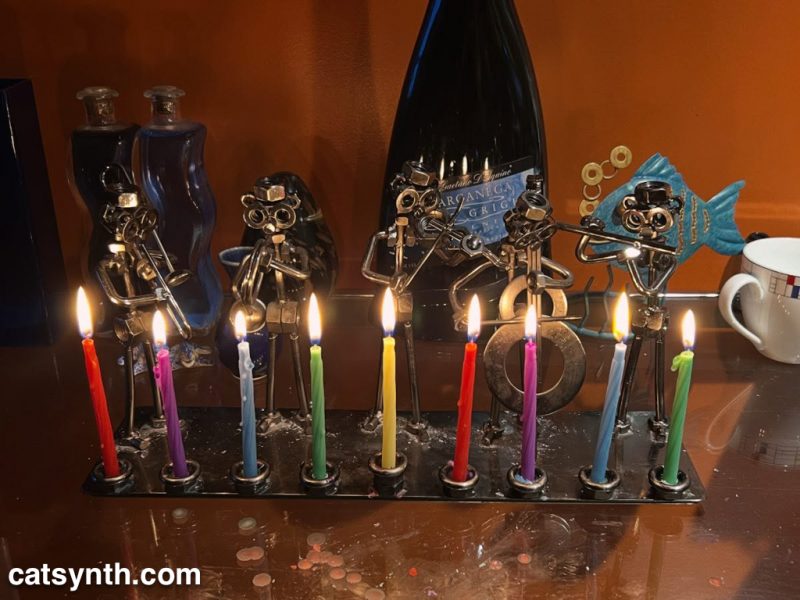
As always, I brought out my somewhat idiosyncratic menorah with musicians fashioned from metal hardware. I think it perfectly characterizes both the music and modernism here at CatSynth. And it seems to be a hit with friends online.
The Hanukkah origin story is itself one of Jewish defiance, but in some ways, a very uncomfortable kind. It celebrates the triumph of religious fundamentalists over the more cosmopolitan Greek/Syrian/Jewish state. If anything, my own celebration in this time is the opposite of the original legend, i.e., as a more cosmopolitan Jew against the more fundamentalist and nationalist forces casting darkness over the United States and other parts of the world at this time.
As the holiday draws to a close, just as we pass the winter solstice, we can look forward to the days once again growing longer and a couple of quiet weeks of calm, care, music, and, of course, cats.
We at CatSynth wish everyone a happy holiday season, however you choose to celebrate!
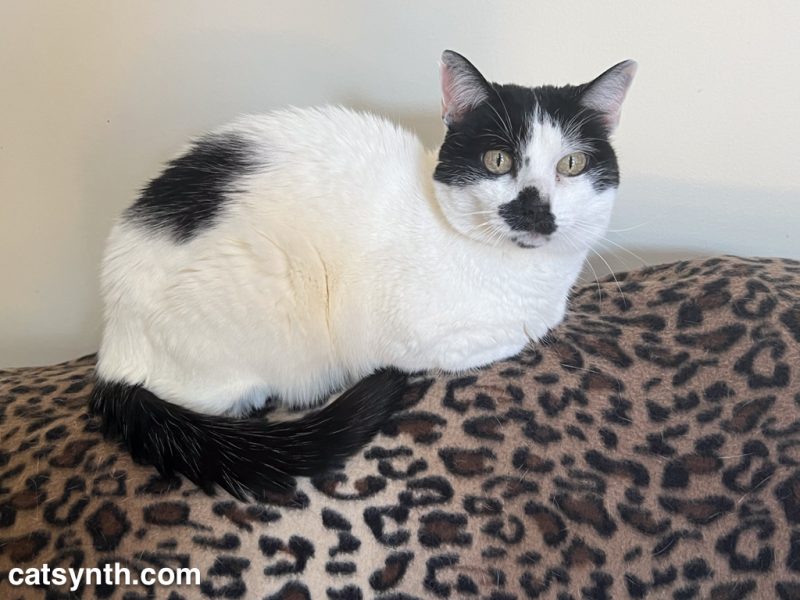
Today marks the 7th anniversary of Sam Sam’s arrival at CatSynth HQ! Please join me in wishing her a Happy Gotcha Day!
As we have related in previous years, Samantha, better known by her nickname “Sam Sam”, had been through a series of homes, including (as I like to say) “out in back of Palmdale where the turkey farmers run”. Our friends who were looking out for her let me know that she needed a new home and knew that I had recently lost Luna. Grief is a non-linear process, and I had not yet been looking to welcome a new cat into my life. But I could say no to this adorable kitty in need. So of course, I said yes, and she made the long trip up from Southern California to join us at HQ.
She was very skittish at first, but soon grew into her new home, and of course, we have loved having her ever since. It’s hard to imagine life at CatSynth without her.
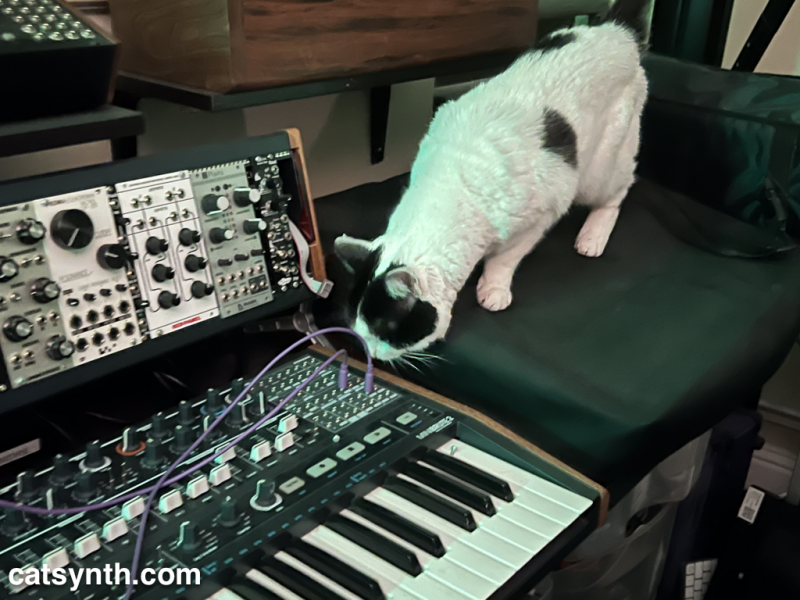
It’s not common for Sam Sam to get up on the desks in the studio, but she does get curious from time to time, as seen in the image above. In recent years, she has also become one of the stars of our Caturday Shorts series on CatSynth TV, along with her frenemy Big Merp.
We certainly hope to share our home and life with Sam Sam for a long time to come.
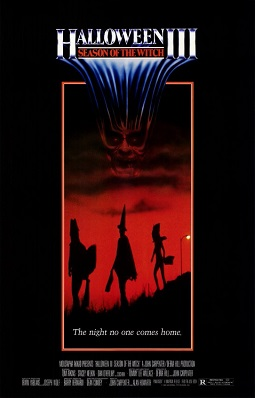
In the spirit of the season, we have been re-watching the original Halloween series of movies. And in some ways, the most intriguing one is Halloween III.
It’s an odd one as it has nothing to do with the first two, or the Michael Meyers saga at all. It’s a standalone story that follows the uncovering of a rather ominous plot by a successful Halloween mask company. In some ways, the movie is a bit of mess, particularly when it comes to characters and storyline. But putting aside those, it is full of some interesting sound an imagery.
This is no more so than in the opening credits. Rather than the iconic 5/4 theme from the first two movies, we open with some low analog-synth tones, and simple pixelated computer graphics that is gradually revealed to be a Jack-o-Lantern.
I was curious how these were done. The synthesizer sounded like a Prophet; the graphics were a mystery. Fortunately, it wasn’t too hard to find out that John Carpenter indeed used a Prophet 10 as the main synth, along with a Prophet 5, a LinnDrum, and an ARP analog sequencer.
I don’t have a Prophet 10 handy. Very few people do. It was a massive synth that was essentially two Prophet 5 engines in a large package with two keyboard manuals and a wooden finish. I did have the opportunity to play one once at the Vintage Synthesizer Museum.
At CatSynth HQ, I have Cherry Audio’s P-10, a great re-creation of the original. We did a review for CatSynth TV back when it came out.
It came with two “Carpenter” presets. One was a beautiful, undulating drone with noise and filter details. The other combined a bass synth with a minor arpeggios. Of course, these referenced not only the Halloween series but also Carpenter’s other films of the era, like The Thing. I had quite a bit of fun improvising with these after watching the film, in particular “Carpenter Soundscape” by our friend James Dyson. I recorded a bit of what I did, which you can see and hear in this short.
“The Halloween III animation was fairly simple. I enlarged the logo that production used for their TV spots and had it printed out on a grid. That made it simple to manually generate X and Y data for the logo. The program that animated the reveal of the scan lines was written in Fortran. I could control the speed of the lines as they animated onto the screen, and did several detail animations of different parts of the logo, as well as the entire pumpkin.”
The program was run on Cromemco Z-2D computer, an early microcomputer that used a Zilog Z80 processor and S100 bus, and ran the CP/M operating system. In many ways, it was similar to the Zenith Z89 that I used as a kid in the early 80s, but Walsh’s Z-2D apparently supported color graphics. I thought it was interesting that he used Fortran rather than BASIC, but either was a perfectly good option for CP/M systems of the time. It would be interesting to recreate this on an emulator, though to get the true effect, one would need to run it with a big old CRT monitor and film it.
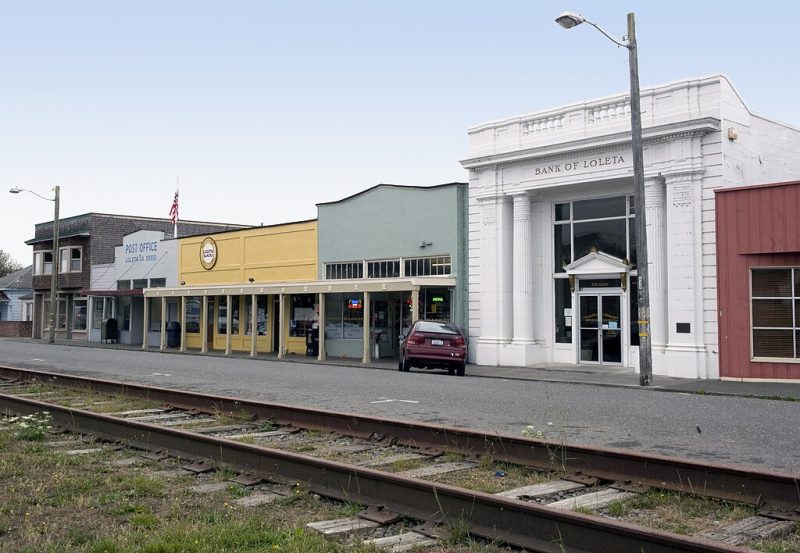
In addition to the opening credits, there was the sinister company town of Santa Mira, a strong visual element, and a character in its own right. Although the town is fictional it was sound in the very real tiny town Loleta, California, just south of Eureka.
It’s been a while since I’ve written an essay or such. It used to be a regular occurrence on the CatSynth blog. Between the photos, I wrote music and art reports, “fun with highways” articles, and the occasional opinion piece. Music, art, and highways all migrated to CatSynth TV, and slowly after that, writing dried up altogether, other than the year-end post and the occasional other short piece.
Thanks for reading CatSynth’s Newsletter! Subscribe for free to receive new posts and support my work.
I’ve wanted to reverse that trend for a while, as there are ideas that don’t lend themselves to videos, music, or the highly compressed bits of communication on social media. But writing always took a back seat to CatSynth TV, to music, and to living life in general.
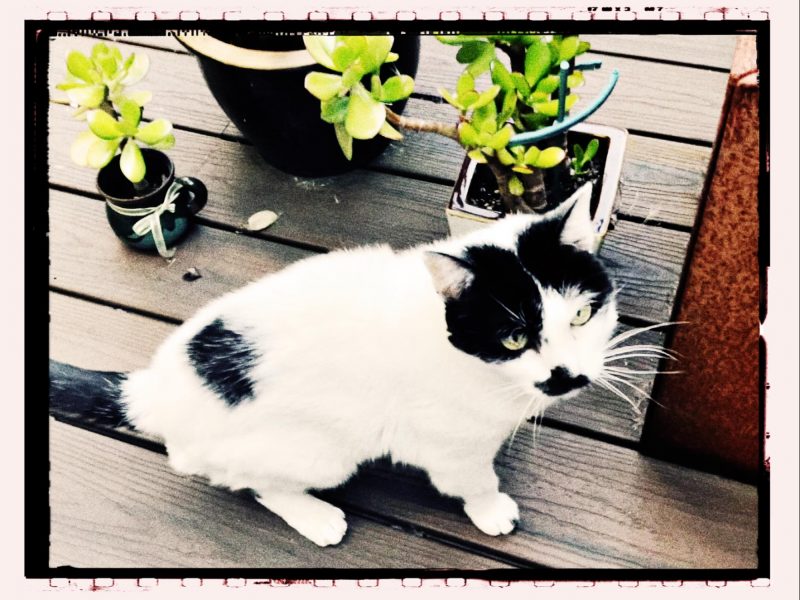
So what is finally getting me off my tuchus, firing up the ancient Tandy m102 laptop and assembling these words that you are reading now? A few factors stand out. One, I am finally starting to observe free time amidst my usual busyness, given a few external commitments this month. Another is that I have started reading *How to Do Nothing* by Jenny Odell, and resonated with her thesis and examples on how to step back from the ever-toxic milieu we find ourselves in. And finally, there is the toxic milieu itself, which lends a sense of urgency to anything that resists it without running away from it entirely. I have my escapes, and we will talk plenty about them in the coming weeks and months. But for now, I think this is sufficient, being present in this moment outside on the patio at CatSynth HQ, typing on my cute little retro computer while my cat Sam Sam enjoys the cool, fresh air.
Please join me here on most Sundays for more wordy thoughts.