One Trick Pony

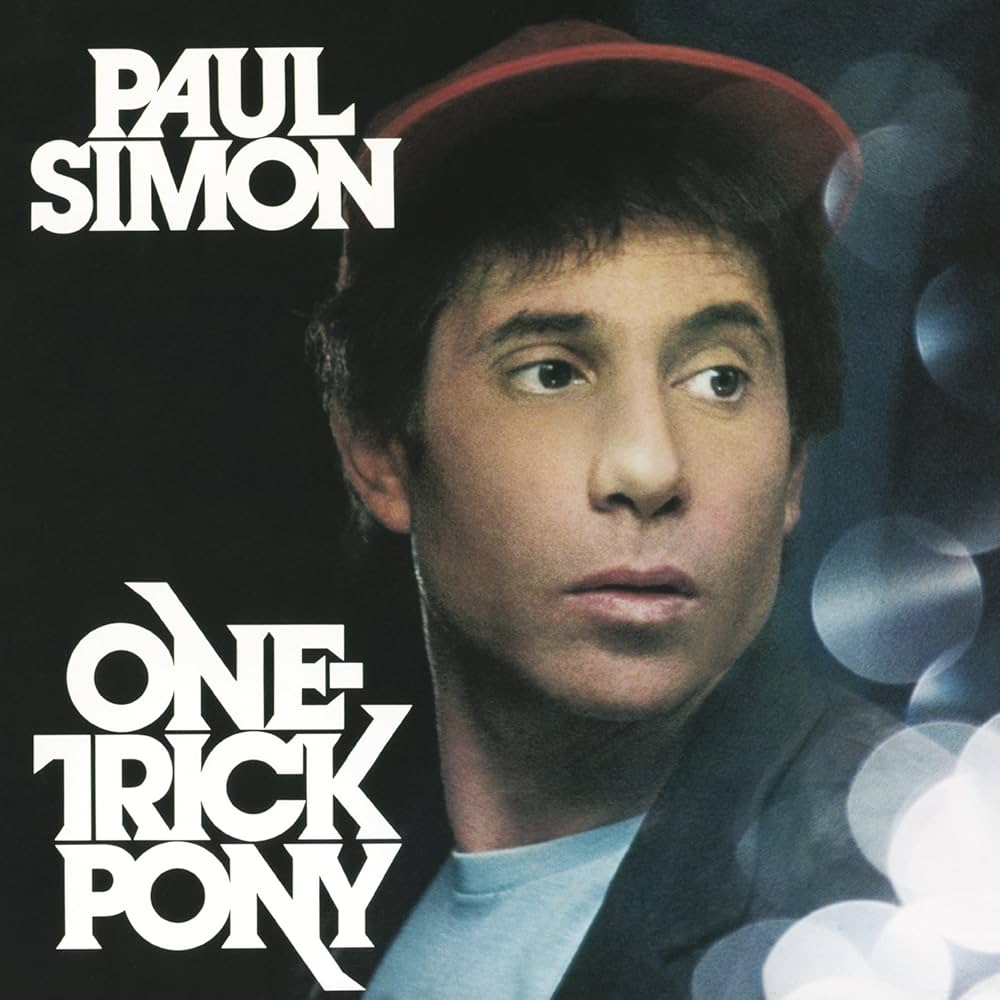
We recently watched Paul Simon’s 1980 film One Trick Pony here at CatSynth HQ. This was his one and only film, which he wrote and starred in. It follows a folk-rock musician Jonah Levin (Simon) who had several big hits in the late 1960s, including an anti-Vietnam War protest song, but now in the late 1970s, he and his band find themselves touring small venues, often riding in a small van around the Midwest, and opening for up-and-coming acts like The B-52s. At the same time, he is struggling with record executives on producing a new album, and with his estranged wife on their relationship and their son.

The film was a commercial and critical flop, and a bit of an obscure artifact of its time. But we at CatSynth really enjoyed it, and were a little confused as to why it was so panned. For one, it features an all-star band that included Simon, bassist Tony Levin (best known for his work with King Crimson), jazz guitarist Eric Gale, jazz and fusion keyboardist Richard Tee (who also did vocals), and drummer Steve Gadd. The original music was a lot of fun, including the bluesy title track played over a disco beat and the catchy “Ace in the Hole”; the band played live in venues like the Agora Ballroom in Cleveland, Ohio. We were rooting for Jonah and the band in their conflicts with the record company, including Lou Reed in his debut film role as a trendy record producer. And even though the studio sessions didn’t go the way they wanted, it was fun to watch the process of recording to tape, adding in strings and backing vocals, and reviewing the takes together.

And perhaps in this synopsis lies the disconnect with critics and mainstream audiences. It’s really a musicians’ film about musicians’ musicians. There was also the setting and the visuals, including life in New York City in the late 1970s, traveling along freeways, and music clubs on the outskirts of cities, all of which appeal to my own personal aesthetic. It also didn’t follow a traditional story arc, but joined mid-way and ended without a real ending, which again is something that appeals to me – recall my fondness for Michelangelo Antonioni’s “trilogy” (plus Red Desert). So while this film did not resonate with the mainstream, it did with us at CatSynth HQ, human and feline alike. We were the real target audience, 45 years after it was released.

Both the in-film story and the context surrounding it also make one think about one’s own journey, and the challenge of making “the music I want to hear” and the “films and videos I want to see”, and hoping others do as well. Sometimes one succeeds, sometimes a little less so. But hopefully one enjoys the work as it continues.

Sunday Newslettes are also on Substack. You can follow and subscribe to us there.
King Crimson returns to the Fox Theater, Oakland

Our incredibly musical two weeks that began with Herbie Hancock concluded with King Crimson’s return to the Fox Theater in Oakland. We at CatSynth saw their last visit in 2017 and were excited to hear what the brought this time around.

It was a pleasure to see King Crimson back in action again, albeit with another lineup change.  This time around, Bill Reiflin was not with the group, and so there was no full-time keyboardist.  His duties were taken over by drummer Jeremy Stacey, and, at times, winds player Mel Collins. Of course, Robert Fripp was there, holding court seated stage left next to his tower of gear, as were longtime members Tony Levin on bass and Chapman stick and Jakko Jakszyk on lead vocals and guitar. Rounding out the trio of drummers were Gavin Harrison and Pat Mastelotto.

The group once again made a great overview of their 50-year history.  I was particularly pleased to hear “Cat Food” from the 1970 album In the Wake of Poseidon played. “Cat Food Cat Food…again!” The music is malleable and adaptable to the current band’s instrumentation and abilities.  Choruses are reharmonized, as was the case with “Cat Food”; vocal numbers are re-arranged into extended instrumental pieces, as in “The Construction of Light”; new melodies were added, as in “Indiscipline”; and so on. There were also new lyrics to the chorus of “Easy Money”. The combination of the three drumsets was even tighter than the previous tour, and more nuanced as well with each playing entirely different parts in a three-voice counterpoint that occasionally coalesced into a massive syncopated thunder. It should also be noted that the drums were a bit lighter because of Stacey’s keyboard duties.

The sound in the first set was a bit challenging at times; the winds and vocals in particular suffered.  Thankfully, this was all corrected going into the second set. And just when it seemed they were going to get through the entire night without playing “21st Century Schizoid Man”, they returned with the tune as their encore, with extended abstract solos and instrumental sections.

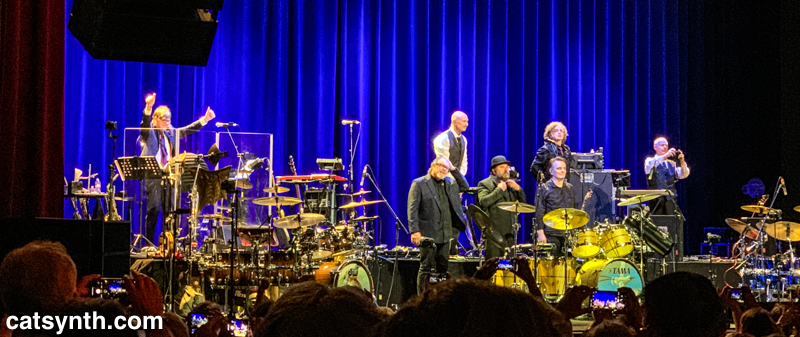
As always, King Crimson is very strict about photography during their concerts, but at the very end, they ritualistically share a moment taking pictures of the audience while we picture them. This time both Tony Levin and Robert Fripp snapped pictures of the audience as we returned the favor.

King Crimson on stage at the end of the show
King Crimson photographs us photographing them

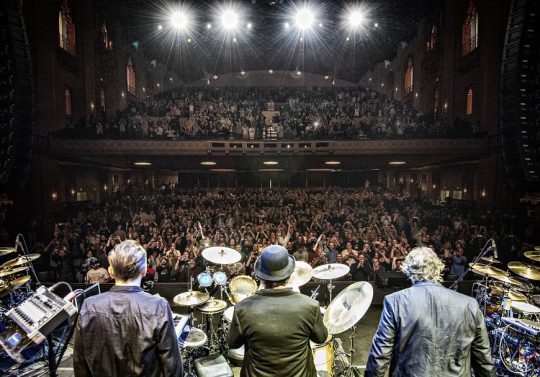
Here is a photo of the audience from Tony Levin’s blog. We are somewhere in the lower left of the orchestra.

Tony photographs the audience
Tony photographs the audience [Tonylevin.com]

[Jason Berry contributed to this story]

King Crimson, Fox Theater, Oakland

King Crimson returned to North America this summer for their “Radical Action Tour”. And we at CatSynth were on hand to see them at the Fox Theater in Oakland. As this was their first North American tour in three years, we were not going to miss a chance to see the band, and Robert Fripp.

The band featured a massive stage lineup – referred to by Fripp as a “double quartet” – that included three drum sets, played by Gavin Harrison, Pat Mastelotto and Jeremy Stacey. Behind them were longtime band members Mel Collins on horns, Tony Levin on bass and Chapman stick, Bill Rieflin on keyboard, and Jakko Jakszyk on lead vocals and guitar. Robert Fripp himself held court on the right side of the stage, with guitar and his array of electronic instruments. Three drum sets might seem a recipe for disaster, but in their hands it was quite impressive. A massive but tightly synchronized sound that dominated but also bended with Fripp’s rhythmic delayed-guitar and other elements.

The concert, although nominally feature their new EP, included songs from the band’s full history and repertoire. They played quite a few “deep cuts” this time around, including a number of compositions from the 1970 album Lizard – Cirkus, and a good chunk of the second side’s suite (“Dawn Song”, “Last Skirmish”, “Prince Rupert’s Lament”. The large band, and especially the full-time keyboards (Rieflin) and horns (Collins) allowed the orchestrations to be heard. The title track from Islands was given a lovely reading.

Although they performed a number of classic Adrian Belew-era compositions, the vocal parts were a bit reduced, as on the opener, “Neurotica”, or eliminated altogether, as on The “ConstruKction of Light”. This is not to take anything from Jakszyk’s vocal performance, which was intense and spirited.

The formal concert ended with a rousing rendition of “21st Century Schizoid Man,” among their biggest hits. Sadly, no “Cat Food” at this particular concert. But the did close with their cover of David Bowie’s “Heroes”, which is also featured on their new EP.

King Crimson has always been very strict about photography during their concerts, but at the very end they ritualistically share a moment taking pictures of the audience while we picture them.

King Crimson on Stage in Oakland

Tony Levin in particular is big on photography and documenting their shows, and has a blog post on the two dates at the Fox in Oakland. If you look really carefully, you might see me in the middle of this rather nice photo he took from the stage.

Tony Levin photographs the audience at the Fox Theater

[Image from TonyLevin.com. Click to see original at Tony’s blog in full size.]

Jason Berry contributed to this story.