We at CatSynth present a few notes from our gallery visits here in San Francisco on the first Thursday of the year.

First up, we visit Micaela Gallery for an exhibition of work by Peter Focault and “friends”. Focault’s large ink-on-paper works build up complex structures from simple lines and strokes. The textures can be come very intricate and dense, such as in this detail from Four Square Squared Series #2. Several pieces also have a very architectural quality, while others such as the Evolution Series #1 have a more organic feel.
In addition to the wall presentation, there was a live performance and creation of a new drawing. This was a collaboration of Focault, musician Jake Coolidge, and Jonathan Grover. Coolidge performed live processed bass guitar with loops and other samples. The audio was then interpreted by a robot that moved with a pen on a surface in response to changes in the sound. The long curving strokes with back-and-forth motions gradually produced an image that was similar in style to completed works. You can see a brief sample in the video below from Jake Coolidge’s blog, along with a more detailed description of the process:
Shannon Ebner’s Signal Hill at Altman Siegel depicted every day objects, some with text, some with symbols like stick figures, some bits of manufactured material, that all convey information or “signals” in contemporary society. I identified with the simple and geometric elements and incorporation of text in her large photographs as well as her sculpture, as well as the sparse presentation by the gallery.

- Shannon Ebner, courtesy of Altman Siegel Gallery
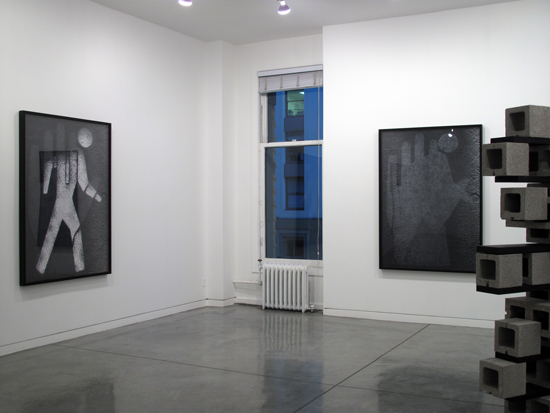
The photographs also had a very three dimensional texture, such as one photograph of an international graphic symbol (included in the photograph above) that one often sees on a very smooth surface.
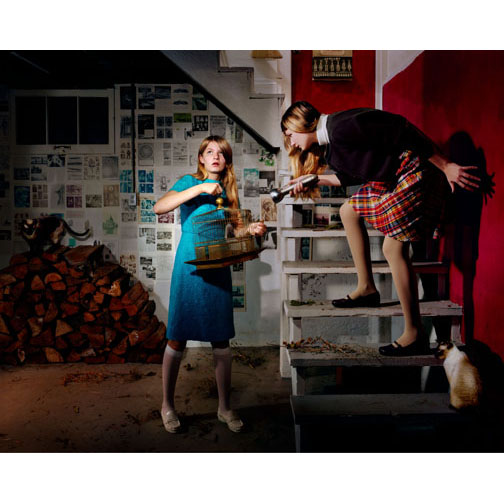
At Robert Koch Gallery, I saw Holly Andres’ Sparrow Lane series. The photographs this series feature a group of adolescent women. The photographs seem to be narrative, as if the girls are exploring and investigating, but they are also disjoint without any real story line. As she explains in this interview, Andres spends a lot of time carefully crafting the images, including the clothing worn by the models and the walls and furnishings of the spaces. The clothing was very well done. Most seemed vintage mid-century and featured skirts and dresses with straight lines and solid colors that gave the characters a modernist “early 1960s” feel. On the other hand, the props and settings seemed more baroque and and did not really hold my interest. The one exception was the The Missing Bird (presented here), which places the characters in a grittier basement covered in media images with a cat in the background. I did find myself contrasting this series with the Dystopia exhibition I saw at this same gallery a year ago – it would be intriguing to see them side by side. (The exhibition will remain on display at the gallery through the end of the month.)
While exploring the photographs at the Koch Gallery, the air from the doorway carried the heavy tones of electric blues. I followed the sounds next door to the Haines Gallery, where a blues band was playing. It turns out the band was led by Mike Henderson, whose paintings were featured in the current exhibition.

I tend to be drawn to minor keys and modes, so minor blues holds a special place in my musical vocabulary. His paintings have geometric shapes with complex textures, overlaid with various line drawings and lettering. Some have a very bright texture akin to a wood surface, while others are dark black with small light shapes and figures. It is interesting to consider the connection between the music and the visual art. Unlike the collaboration described above where the connection was direct, the connection here is more emotional or evocative.
- Stephen Wirtz gallery presented Catherine Wagner presented large highly-detailed prints of specimens from the California Acadamy of Sciences. They were arranged by biological taxonomy, but also visually. From a distance, one can focus on the overall texture, while up close one notices the details of each specimen. Hits by Rick Arnitz featured large canvases, each of which seemed to take on a different geometric theme: brightly colored circles, a texture of red a black vertical lines, stars on a light blue field, etc. I often like discovering pieces from the permanent collection on display in the back room – I recall Ulrike Palmbach’s soft sculptures of cats from a previous visit – this time it was Marc Katono’s Half Light, a large light canvas with very delicate curves and lines. The piece was reminiscent of organic fibers and would have seemed at home among Wagner’s prints.
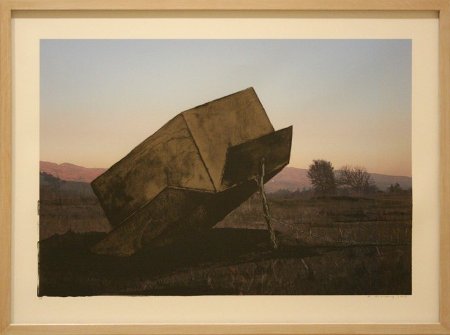
Across the street at Gallery Paule Anglim, I saw Randy Hussong’s Sculpture and Lithography exhibit. All the images were based a large steel box held up on one side by a stick with a chain, essentially a “trap” of sorts. The box itself was shown in the center of the room as a piece entitled Prey and Weight. Along the walls were combination photographs/lithographs based on images of the box in outdoor setting, based on photographs at different times of day. The box is clearly artificial, but it’s coloring and worn texture allow it to merge with the natural environment. Additionally, there was one pure black-and-white lithograph entitled Trap.
At A440 Gallery, Dominic Alleluia’s large mixed media works had a very contemporary feel. They combined large abstract elements, color textures and shapes with energetic dark swirls and waves reminiscent of graffiti. A third dimension in some works included objects and materials such as wooden dowels and metal. I found this video of the “artist at work”, and I thought the music expressed the energy of his pieces the exceptionally small gallery space.
Finally, I would like to mention seeing the exhibition Diane Arbus‘ photographs at Fraenkel Gallery. The exhibition, titled Christ in a lobby and Other Unknown or Almost Known Works by Diane Arbus, were selected by sculpture Robert Gober from a collection of little-known photographs. The photographs, which were relatively small in size, did fit into the context of Arbus’ better known images in that they depicted a wide selection of people, some very everyday and some a bit more challenging.


 They were having some sort of fundraising event with work from several artists. However, I found myself more interested in the permanent exhibit,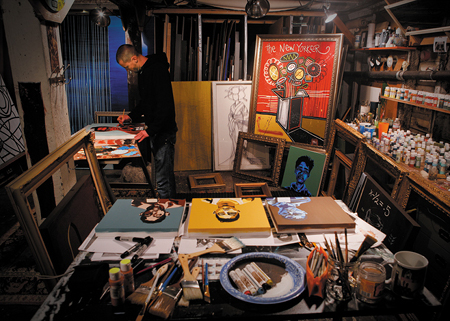

 Afterwards, I did visit LeBrun’s website, and found myself more interested in some of his earlier work, such as the combination of figurative and abstract paintings from 2005 and 2006. There were several works that focused on black and shades of pink. It was interesting to view one of his figurative pieces, such as “high maintenance” next to an abstract work like “take it easy”, as if one is a distillation of the other (small versions of both works are displayed to the right). You can see other works from this series at his
  Our first stop was the offices of Kearny Street Workshop for their
  The prints had a very clean quality, with bold colors, large shapes, and of course text. I particularly liked the works based on Licko’s abstract Puzzler font, with it’s arrangements of dots and other elements into larger complex patterns. One of the large prints (again combining text and geometric elements) also featured a large barcode with a valid ISBN number. Thinking myself quite clever, I performed a quick internet search to find out what it was – I suppose I should not have been surprised that it was issue #67 of Emigre Magazine, although the cover image from the magazine looks nothing like this print.

