Rain and Resurface

I usually try not to be intimidated by the rain here. But it was coming down pretty hard as I wondered the familiar streets of SOMA and South Beach looking for a particular gallery not far from the former Fremont Street overpass that I photographed on a sunnier day. I was trying to catch an exhibit before it closed on Sunday, only to find the gallery itself was closed for the extended holiday weekend.

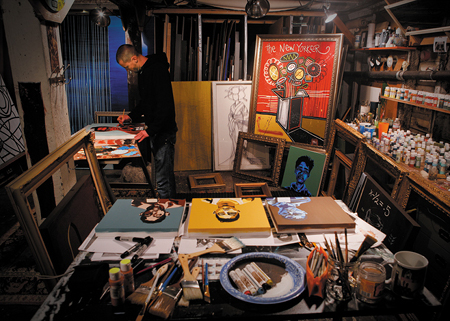
So now I had not only the pouring rain around me, but also a large caption reading “FAIL”. Not a big deal per se, but we did need to get out of the rain. We headed down 2nd Street, looking for someplace that would be at least dry and somewhat comforting, a cafe or a bar that had not opted to close for the holidays. I was surprised to find that 111 Minna was open, and in fact quite well populated. They were having some sort of fundraising event with work from several artists. However, I found myself more interested in the permanent exhibit, Resurface, a solo exhibit by local artist Micah LeBrun. LeBrun had taken a hiatus from his work, which primarily focused on painting, for a year in late 2008 and early 2009 to travel through Central America, Asia, Australia, Africa and Europe. During this time, he focused on photography, and only returned to painting after returning home. The exhibit included examples of his photographs (partially obscured by the art being displayed for the fundraiser). I was more drawn to the stark landscape images, which reminded me of my own adventures in the desert and sparsely populated areas, than to the portraits. Among the paintings, I was also drawn to the non-portrait pieces, such as the large red canvas with the words “the New Yorker”, and another piece featuring an algebraic equation (the solution to which was of course 0.5). Both pieces are visible in this promotional image, featuring the artist in his studio:
[Click to enlarge.]

Afterwards, I did visit LeBrun’s website, and found myself more interested in some of his earlier work, such as the combination of figurative and abstract paintings from 2005 and 2006. There were several works that focused on black and shades of pink. It was interesting to view one of his figurative pieces, such as “high maintenance” next to an abstract work like “take it easy”, as if one is a distillation of the other (small versions of both works are displayed to the right). You can see other works from this series at his online gallery.

Weekend Cat Blogging: Holiday Windows

This weekend, we present some of the cats featured in the Macy’s SF/SPCA Holiday Windows. Every year during the holidays, San Francisco SPCA teams up with Macy’s in San Francisco to feature adoptable pets in the holiday window displays at their main store in Union Square.

Here are couple of kittens in one window:

and this handsome black cat:

Many passers-by in this busy shopping district were surprised and delighted by the live animals in the displays.   We at CatSynth certainly hope that some of these animals, including the cats featured above, find new homes as a result of this program.

To find out more about the program, including when to see the animals and how you can contribute, please visit the official Macy’s SF/SPCA Holiday Windows site.


Weekend Cat Blogging #238 will be hosted by our friends at the House of the (Mostly) Black Cats.

Carnival of the Cats will be going up this Sunday at When Cats Attack!.

And of course the Friday Ark is at the modulator.

Happy Holidays!

Art and music notes. Friday, December 18

Last Friday, I managed to visit four different art and music events in one evening. Below are some reflections from each.

Our first stop was the offices of Kearny Street Workshop for their SF Thomassons Holiday Party. Readers may recall KSW’s APAture Festival and the Present Tense Biennial.

“Thomassons” are architectural elements that exist (or persist) outside of the original intended function, such as an inaccessible door leading out of an upper floor of a building, or a staircase leading to nowhere. The term was coined by Japanese conceptual artist and writer Akasegawa Genpei, and the Thomasson website allows people to upload examples from around the world. We at CatSynth have actually presented several Thomassons in our Wordless Wednesday photographic series, including these stairs leading into the San Francisco Bay. KSW’s “SF Thomassons” project involves photography and performance art centered around Thomasson sites in San Francisco. The party was a preview to coincide with Kaya Press’ publication of the first English translation of HYPERART: THOMASSON, and included a performance-art piece set at one of the largest sites in the city, an abandoned church at Howard and 10th streets that happens to be across the street from KSW’s offices.


After that, it was off to Gallery Six at 66 Sixth Street. The current exhibition, entitled “Every Single Where”, features new works by local artist Pakayla Biehn. The paintings each carried superimposed images that are similar but not identical, as if multiple exposures from a camera. According to the press release, Biehn has a congenital visual disability, and her paintings attempt to “give the viewer an understanding of her own optical condition.” Although they share the common theme, each work was stylistically quite different.

Actually, the work in the gallery that caught my attention was not in the featured exhibition, but on display in the back room from a previous exhibition, a small geometric print entitled “Bird’s Nest” from Charmaine Olivia’s Urban Managerie.


From Gallery Six, we then went to Gallery 16 for an exhibition celebrating the 25th anniversary of Emigre. Emigre was a combination digital type foundry and publisher founded by Rudy VanderLans and Zuzana Licko, and is known both for its typefaces and the design journal Emigre Magazine. The exhibition included examples from the magazine and other designs featuring Emigre fonts.

The prints had a very clean quality, with bold colors, large shapes, and of course text. I particularly liked the works based on Licko’s abstract Puzzler font, with it’s arrangements of dots and other elements into larger complex patterns. One of the large prints (again combining text and geometric elements) also featured a large barcode with a valid ISBN number. Thinking myself quite clever, I performed a quick internet search to find out what it was – I suppose I should not have been surprised that it was issue #67 of Emigre Magazine, although the cover image from the magazine looks nothing like this print.


The final stop was Cafe du Nord for a party and concert celebrating the 50th anniversary of KFJC Radio. This was the last of several events marking the anniversary, including the concert at FLUX53 that I attended earlier in the week.

Because of the busy schedule for the evening, we only caught two of the many bands performing. First was the band al Qaeda (I am sure they were aware the name was already taken). Their music combined driving punk-style drum and guitar elements with experimental electronics elements and electrical noise.

Al Qaeda was followed Arrington de Dionyso. I had seen de Dionyso perform in a trio at FLUX53, but this time he was with his band. Once again, he performed a combination of bass clarinet with various vocal techniques, including throat singing, set against standard rock drum, bass and guitar sounds. On the screen behind the band, increasingly complex black-and-white drawings (or paintings) were being created live.

Pmocatat Ensemble and Chorus, and Weller-Borosque Duo

Last Thursday night, the Pmocatat Ensemble performed again at the Luggage Store Gallery. Pmocatat (pronounced “Moe Ka Tatt”, the “p” is silent) stands for “pre-recorded music on CDs and tapes and things”. The members of ensemble pre-record acoustic material (instruments, voice, environmental sounds, etc.) according to compositional instructions, and then during the performance, improvise with these pre-recorded sounds using standard playback controls: play, pause, fast-forward, rewind, and speed controls. Devices used for playback included CD players, cassette tape players, and iPods/iPhones. This performance featured Matt Davignon, Amar Chaudhary, Suki O’kane, Michael Zelner, Rent Romus and Edward Schocker. It was billed as the “Pmocatat Ensemble and Chorus” as many of the pieces featured vocal material.

Matt DavignonMichael Zelner's iPod TouchAmar ChaudharySuki O'kaneRent RomusEdward Schocker

[Photos by Michael Zelner.]

We opened with a sparse piece, with single-syllable words entering periodically to perform collaborative nonsense phrases. There was a lot of open space between the words, which was filled in with droning instruments later in the piece. This was followed by a free-improvisation with pre-recorded woodwinds, mallet percussion and bell sounds. The result was an expressive performance with rich textures and complex rhythms composed articulated notes from the different instruments.

graphical score for Pmocatat.  Click to enlarge.

graphical score for Pmocatat. Click to enlarge.

My composition contribution was a piece with a graphical score which called for vocal sounds, instrumental and vocal drones, and animal sounds. It for this piece that I recorded clips of Luna last week, and thus she made her “debut” in a new-music concert. Her meows were set against moderately long vocal sounds that arbitrarily “cut off”, followed by a series of very short sounds to represent the tiny scratches in the graphical element. Here, we heard Luna’s clicking sounds that she makes when hunting. For the longer sounds, her purrs were set against various drones. I think was received well, judging by the looks of delight and amusement from various members of audience.

The graphical piece was followed by an interpretation of Pauline Oliveros’ Form Unknown Silences. The sparse texture, with a variety of short sounds interrupting periods of silence, had both a playful and meditative quality. This was followed by a brand new piece featuring guitar sounds set against percussion. The percussion was really following the guitar sounds, with the pa

This being a holiday show, we of course had to conclude with a holiday offering. In this case, it was a rendition of the classic “O Christmas Tree”, with pre-recorded versions of the song sung very slowly, and played back even more slowly and asynchronously, with gaps, pauses and changes in playback speed overtime growing more complex until the artifacts overtook the original.


The Pmocatat Ensemble was preceded by a duo of Ellen Weller and CJ Borosque. The set opened with an atonal “call to prayer” of Weller on a shofar and Borosque on trumpet. The remainder of the set unfolded as an interplay with Weller’s wind instrument and Borosque’s noise synthesizers (and trumpet). Among her instruments was an experimental box with chaotic oscillators and filters – I acquired one of these a few weeks ago but she has gained significantly more proficiency than I have. There were moments with fast saxophone phrases against the synths, and others with Weller’s exceptionally noisy and agressive flute sounds against very finely articulated synth noise. Other moments included undulating unstable waves, a snake charmer flute, and a variety of acoustic and electronic squeaks. The were moments when the music became quite trancelike even as it remained loud and noisy.

Readings at Electric Works, and the Snowball Pond Orchestra, December 7

The evening began at Electric Works for readings from the art issue of The Believer.

We spent a few minutes browsing the gallery at Electric Works, which featured work by Paul Madonna. His large-scale pieces included text that seemed only slightly related to the images, which often featured cartoon creatures, commercial art, and little “alien-monster” finger puppets similar to the ones I keep in my office at work.

Michelle Tea presented a reading from her piece about the fifth marriage ceremony of two “sexy performance artists” as an unauthorized event at the 2009 Venice Beinnale. Her descriptions of their costumes were quite detailed and her deadpan delivery of some their odd statements was amusing.The readings Jeff Chang and Michael Paul Mason seemed more like paper presentations at an academic conference, although I was quite intrigued by Mason’s piece on the disappearance of Ford Beckman, a highly successful minimalist artist who somehow went from the inner circles of the art world to working at a Krispy Kreme Donuts in Tulsa, Oklahoma. The examples of Beckman’s work shown in the presentation suggested the sparse geometry and simple patterns of minimalist work, but also a weathered quality that brings out the underlying materials.

The highlight of the evening was the presentation by Eames Demetrios. Demetrios. He is the grandson of the designers Charles and Ray Eames, a filmmaker, and also the Geographer-at-Large for Kcymaerxthaere, “a parallel universe that shares, to some degree, our physical planet.” After chiding the audience on their woeful state of knowledge of Kcymaerxthaere, he presented some examples of how the history and mythology intersect with our physical world, and his work to recognize significant intersections with commemorative plaques. My favorite observation was the many roads named in honor of Earl Frontage. The presentation concluded with a rousing group rendition of “Kymaerica, Sambamba Dier” sung to the tune of America the Beautiful.

After a brief stop for refreshments, it was off to The Makeout Room for the Snowball Pond Orchestra performing Piece to Celebrate the Proximity of Pearl Harbor Day and the Death of John Lennon, the first conducted composition by kingtone (aka Lucio Menegon). (Some readers my recognize Lucio as the host of the Ivy Room experimental-improv series.) “The piece is a a surround sound minimalist-meets-mayhem piece to celebrate the proximity of two events that managed to wake people out of their collective stupor for a moment or two.”

The first two sections appeared to focus more on Pearl Harbor and the last two more on John Lennon. The opening section featured the guitars, as described above. Later on, much darker guitar and string sounds were set against snare drums that sounded at once militaristic and like a clip from a rock solo, followed by long sustained guitar unisons and complex chords. The music gradually took on more of a rock feel as the narrative moved from Pearl Harbor to John Lennon, with quotations from “Helter Skelter” (from the White Album) towards the end.

You can read more about the performance, and see photos and a video clip at the kingtone website.

Long Night’s Moon concert

This past Thursday I attended the latest installment of the Full Moon Concert series: the “Long Night’s Moon”, in anticipation of the winter solstice.

Both sets played off the theme of the perception of time, perhaps an allusion to the passage of time as one moves through the longest night of the year. However, time is represented and perceived quite differently in each.

The second set was a public performance of the 2009 60×60 compilation, featuring 60 one-minute pieces by 60 different composers in a variety of styles. The performance was very precisely timed, beginning at exactly 9PM with each success piece starting on the next minute until 10PM. A clock projected onto the wall showed the exact time, so one could watch the individual seconds tick while listening to the music. However, within this very precise presentation of time, the perception of time remained fluid. Some pieces seemed significantly longer than others, and the seconds appeared to pass more quickly or slowly. For example, one piece with a lounge/jazz feel seemed to pass more slowly, while several more experimental pieces based purely on timbral evolution seemed to go by much faster. I think it was the quick succession of phrases that made it seem longer, as if the piece was a more standard three-minute duration. Some others, such as #53 and #54 by Andrew Willingham and David Morneau, respectively, went by quite fast.

Indeed, with such short pieces, the transitions between them became significant elements. I particularly liked the transitions between pieces 12, 13 and 14, by Danny Clay, Alvin Curan and Christophe Petchanatz, respectively. Similarly, the transitions between #46 (John Maycraft) and #47 (Les Scott) was very fluid and seamless. Other notable pieces included the toy piano performance in #16 by Jane Wang (I instantly recognized the Jaymar toy piano( and the “meditation” in steel and metallic sounds in #27 by Diana Simpson. I of course instantly recognized the spoetry in Polly Moller’s Abdominal Cyclist Ultra (#36) from my work with Reconnaissance Fly. The frenetic beats in #56 (Arran Krister Kohnson), interleaving of speeches by Barack Obama and Martin Luther King, Jr. in #58 (Ben Boone) and the final “Daddy, what are you doing?” in #60 (Richard Hall) brought the set to an energetic close.

In the preceding set, John Hanes presented a very different perception of time. His piece for the Long Night’s Moon was “an attempt to celebrate the promise of light internet in the darkest night and the rhythm of the turning of the year.” Unlike the 60×60 performance, which made one hyper-aware of the passing of individual seconds, Hanes’ performance invited listeners to “suspend” their perception of time and meditate on the graduation changes in sounds. It began with bells and metallic sounds, which were eventually joined by strong (and synthetic) resonances. A few tones reminded me of prayer bowls. The long tones of the metallic and synthetic sounds formed gradually changing chords and harmonies that suggested a vocal or choral arrangement. Occasionally the rather complex harmonies would suddenly drop out, leaving a unison of different timbres on the same pitch. There were some complex minor harmonies in between the unions, and some points where the harmonies seem to draw to a traditional cadence. All along were ebbs and flowers and timbre and dynamics, with some strong crescendos towards the conclusion of the piece.

This is actually not the first time we have encountered John Hanes at a Full Moon Concert. He also appearned in Myles Boisen’s Past-Present-Future at the Blood Moon Concert in October.

Degeneration / Regeneration, Marina Abramović Institute

Last Friday, I attended the opening exhibition of the Marina Abramović Institute here in San Francisco. The exhibition, entitled Degeneration / Regeneration, featured several live performance pieces and videos, and included an introductory talk eponymous founder, Marina Abramović.

Abramović was a pioneering performance artist in the 1970s; I first encountered her work when briefly studying artistic collaboration in conceptual art of the 1960s and 1970s. (This was the same time that I discovered Gilbert and George.) In her introduction, she was particularly concerned with how contemporary audiences experience “long-duration performance art”, preferably with concentration and without distractions such as conversation or “Blackberries.” As a demonstration, she instructed us on how to walk into the first exhibition space, a very slow and deliberate sequence of “lift, stretch, land and move” repeated the entire way of the lecture area up the stairs to the first exhibition hall. For someone who tends to walk rather fast, this can be difficult.

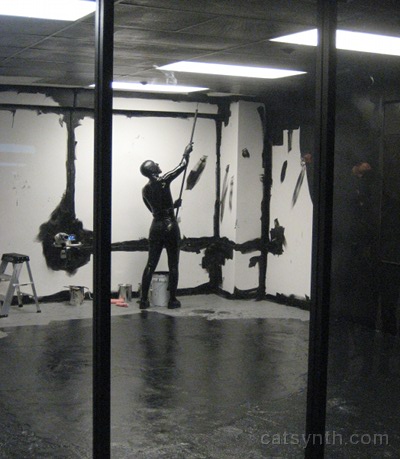
In terms of the pieces themselves, a few stood out in particular. Jennifer Locke was busy in a glass-enclosed space, painting it entirely black. She was herself covered entirely in a black suit as well.

With her were cans of paint, standard commercial painting equipment, and several large containers of Elmer’s glue. It was not exactly clear what the glue was for. We came back a few times to see her “progress” and eventually she had the room completely painted black. At this time, she proceeded to remove her suit and pick up one of the containers of glue. It was then we all realized what the glue was for, as she poured one container after another over her body. I did not stick around to see how this situation resolved itself (no pun intended).

I did like Mattias Ericsson’s pair of pieces. Maybe everything is grey after all covered a kitchen area of the building with black-and-white photographic prints, some of which were displayed openly, and others (particularly tiny 1×1 inch prints) neatly placed in closed boxes or behind cupboards. One could open these spaces and peruse the images, which appeared to chronicle very personal and intimate moments. Readers can get a sense of the images via interactive version. One starts to feel a bit voyeuristic going through them. Ericsson also present a video entitled 1630 photographs, in which he described his photographic process and his vision for his work.

Another featured live performance by Michael Ryan Noble invited audience members to participate by placing clay on his body, an act that is both sculptural and symbolic of burial. Many audience members did participate, and a participants sculpted elaborate clay objects to place on him, such as a dorsal fin.

Overall, it is an exhibition that does push one comfort’s zone (especially the glue). I am often left wondering whether performance art is closer to the visual arts than it is to music and theater, or something entirely different. I find myself wanting to treat it more like visual art, which seems to go against what Abramović stated at the start of the evening.