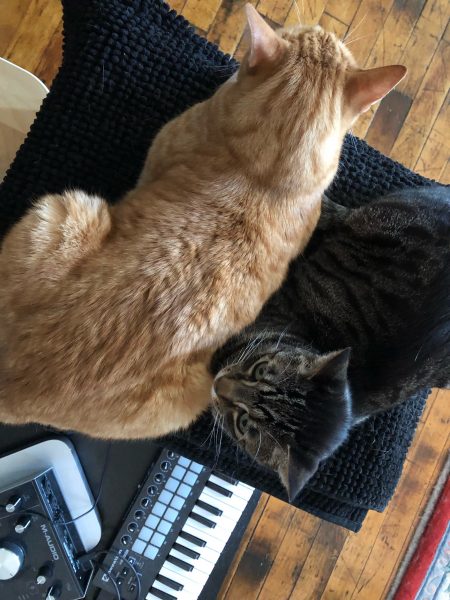
Lee and Perry are relaxing next to a Novation keyboard and M-Audio interface. From our good friends Suki O’kane and Michael Zelner, via reconnecting at the Outsound New Music Summit.
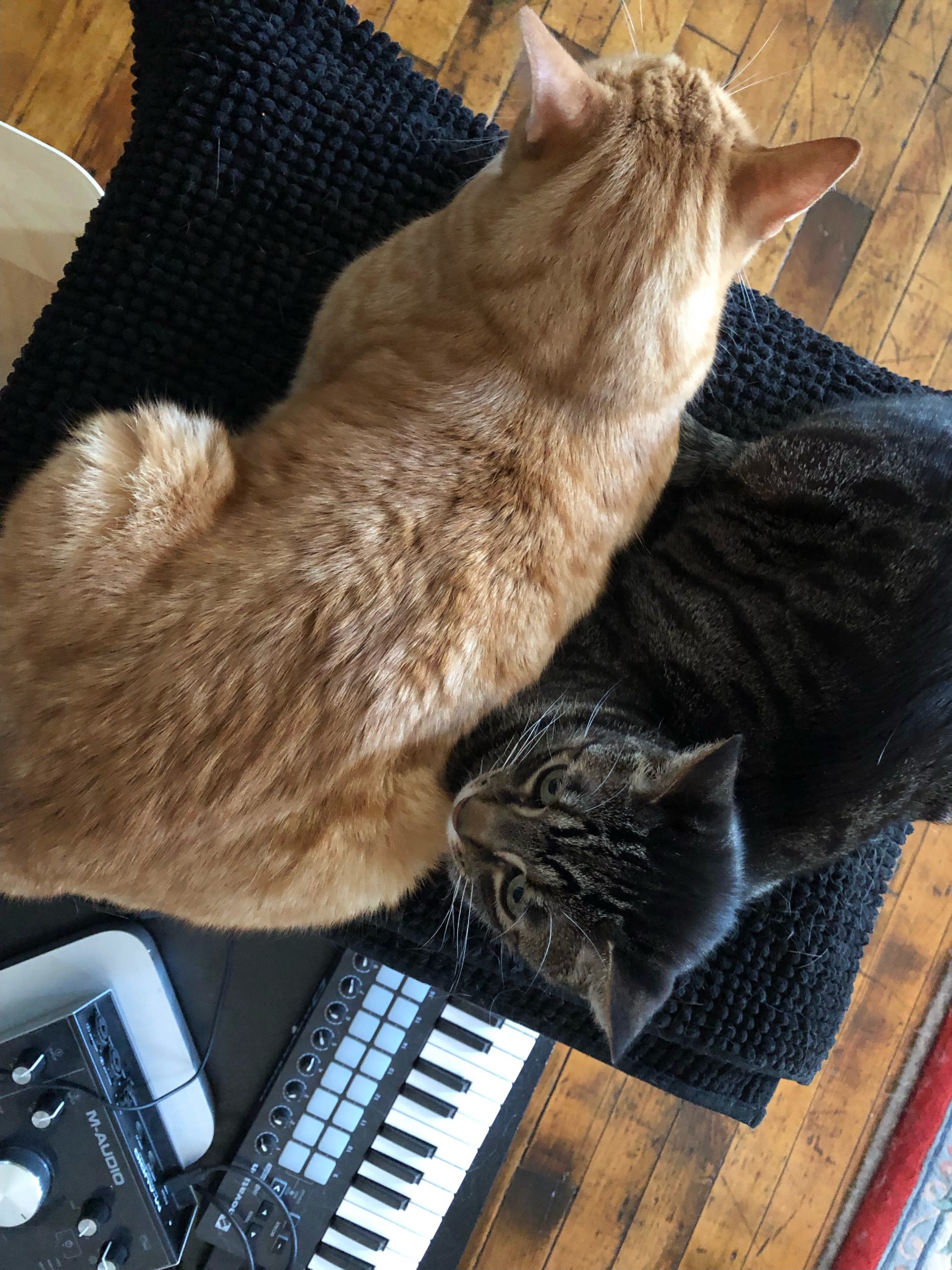
Lee and Perry are relaxing next to a Novation keyboard and M-Audio interface. From our good friends Suki O’kane and Michael Zelner, via reconnecting at the Outsound New Music Summit.
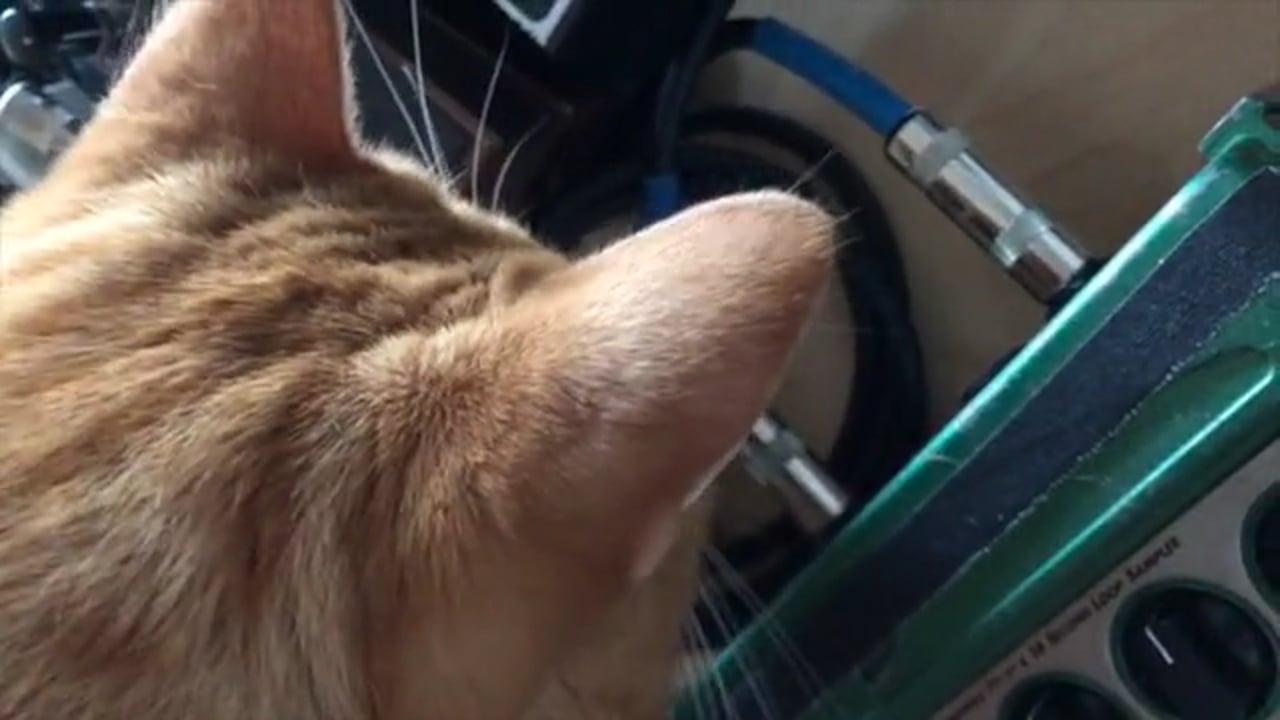
Lee is exploring the music and space around an Eletro-Harmonix 16 Second Digital Delay alongside a few other devices from Boss and Line 16. Submitted by our friend and sometime collaborator Suki O’kane.
Lee Attempting To Understand My Music
Alternatively, Lee Attempting to Find a Small Object He Can Throw On the Floor.
This sort of thing is all the same to Lee.
https://vimeo.com/412562048
It’s been a little over a week since the 2019 Outsound New Music Summit and it seems a good time to look back over all five nights of adventurous musical programming. If you haven’t already seen our summary video with highlights from all ten acts, please check it out.
The concert series kicked off with a performance by the duo B Experimental Band, a large project led by Lisa Mezzacappa (bass) and Jason Levis (drums). They have been performing as a duo for a long time, taking on different challenges as their musical relationship has evolved. The latest is bringing their improvisational focus to a large group, i.e., maintaining spontaneity and musicality of improvisation while herding cats.
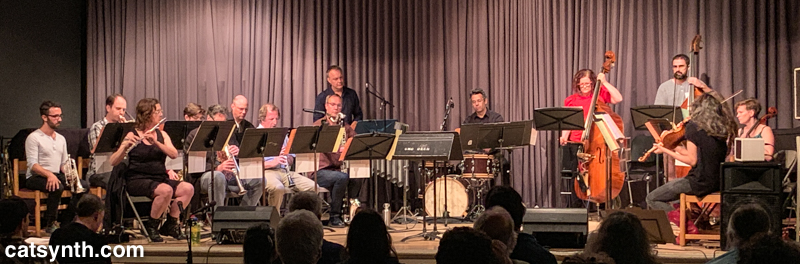
What I most noticed about this set was how sparse and spacious it was. In the first piece, space played an important visual as well as musical role, with different pairs of performers scattered around the concert hall. And towards the end, the full group thinned out to a single solo line from Polly Moller Springhorn on flute. The complete ensemble also included Bruce Ackley, Randy McKean, Cory Wright, and Joshua Marshall on woodwinds; Theo Padouvas and Rob Ewing on brass; and Gabby Fluke-Mogul (violin), Murray Campbell (octave violin), Shanna Sordahl (cello), and Kjell Nordeson on percussion.
By contrast, the second set featuring saxophone quartet Social Stutter was densely packed with rich harmonies and melodies. Composer and bandleader Beth Schenck makes the quartet – which also includes Phillip Greenlief, Cory Wright, and Casey Knudsen – function as a single instrument with some exquisitely beautiful chords and melodic lines. There was also space for each of the members to shine individually, with Knudsen’s fast runs, Greenlief’s unique timbres and keywork, and Wright solidly holding down the foundation on baritone sax. I was quite taken by this performance and now inspired to write my own compositions for saxophone quartet.
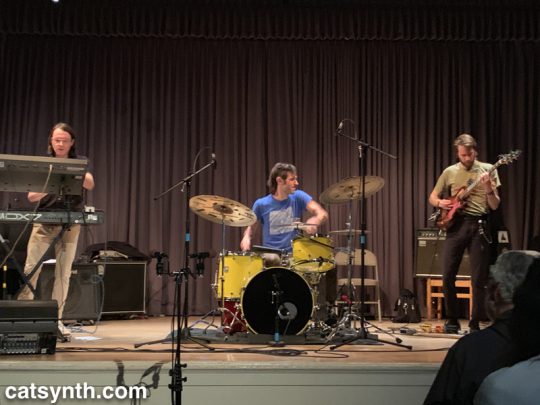
We always aim for a diversity of styles of music and instrumentation throughout the week, loosely categorized into nightly themes. For example, both of the bands that could be characterized as “rock music” were on the same night, but the two groups were still quite contrasting. Gentleman Surfer, a trio featuring Jon Bafus (drums), Barry McDaniel (guitar), and Zack Bissell (synthesizers) delivered a hard-driving set – my favorite moments were those where all three played unison syncopated rhythms complete with silences that were as intense as the sounds.
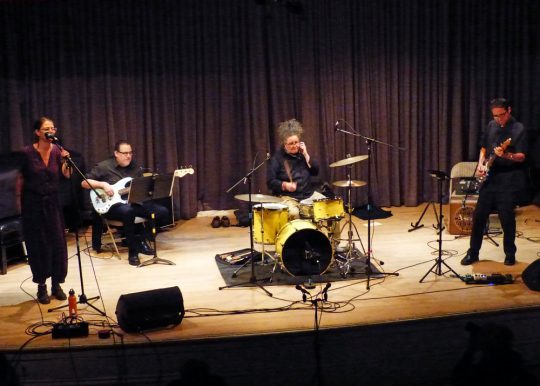
By contrast, Vegan Butcher’s set had a more plaintive, cerebral quality, due in large part to composer and bandleader John Shiurba’s “January Scale” and lyrics taken from his dream state just before waking up. The scale removes C-sharp, A-sharp, and F-sharp from the available twelve tones. This provides some interesting musical challenges. For example, a song centered in the “key” of F would have to avoid B-flat (A-sharp), and some keys like D become challenging indeed! The selection of chords to work around these gives the band’s music the plaintive sound. Their final song was particularly memorable, especially the section where rhythmic chords undergird the lyrics “I’m coming down from my stilts now, baby!” I found myself singing that for days afterward.
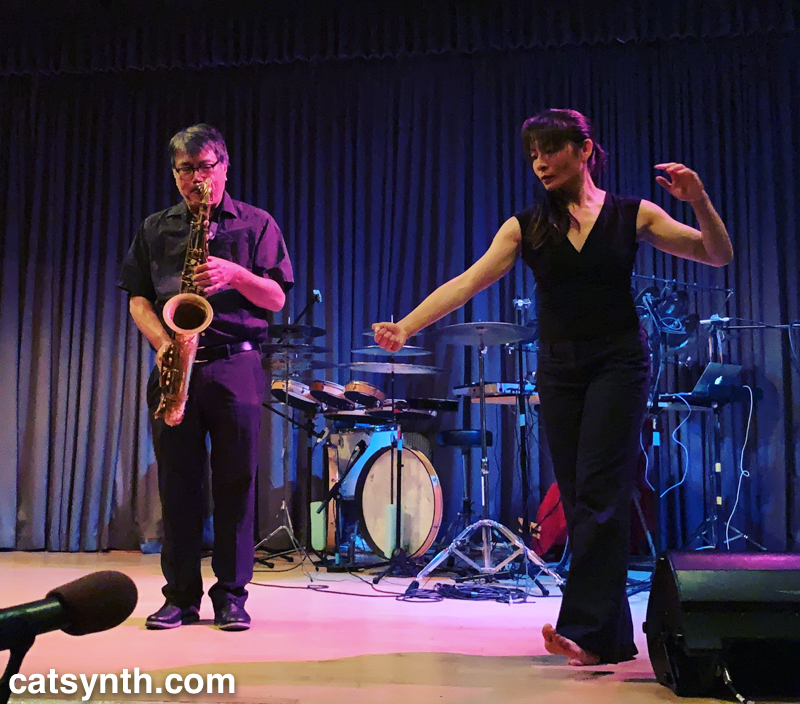
The next night again featured two contrasting sets. First was a very spare improvisation featuring Francis Wong on saxophone and Lenora Lee on dance/movement. Wong and Lee are longtime collaborators and have been working on both improvised and larger-scale compositions for two decades.
This performance, which made use of the space around the hall as well as the stage, was extraordinarily subtle and quiet as both the sound and movement bounced off the silent space – but at the same time forceful in the message it delivered, decrying all forms of violence and discrimination against immigrants and refugees from the Chinese Exclusion Act and the internment center on Angel Island to the images of mistreated children out our southern border today.
As with duo B and Social Stutter, the sparse nature of Wong and Lee’s performance was in sharp contrast to the lush landscapes of Andrea Centazzo’s solo set, with live percussion – drums, gongs, and his signature stacks of cymbals – set against both live and recorded electronics.
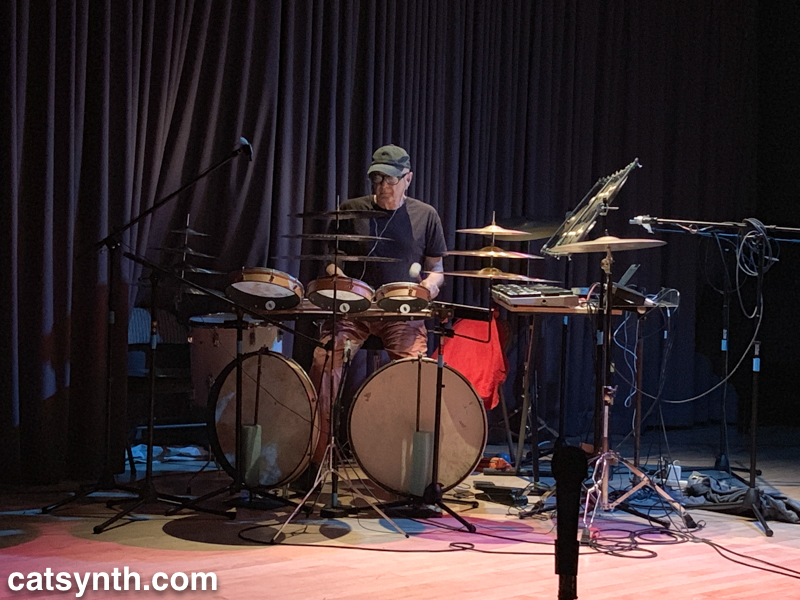
Centazzo’s solo performances often involve multimedia projections with the music. Sadly, this was not able to happen for this concert, but one could still “hear the images” of nature and remote places in his sounds, from the initial thundering drums to the gong array set against what sounded like singing monks.
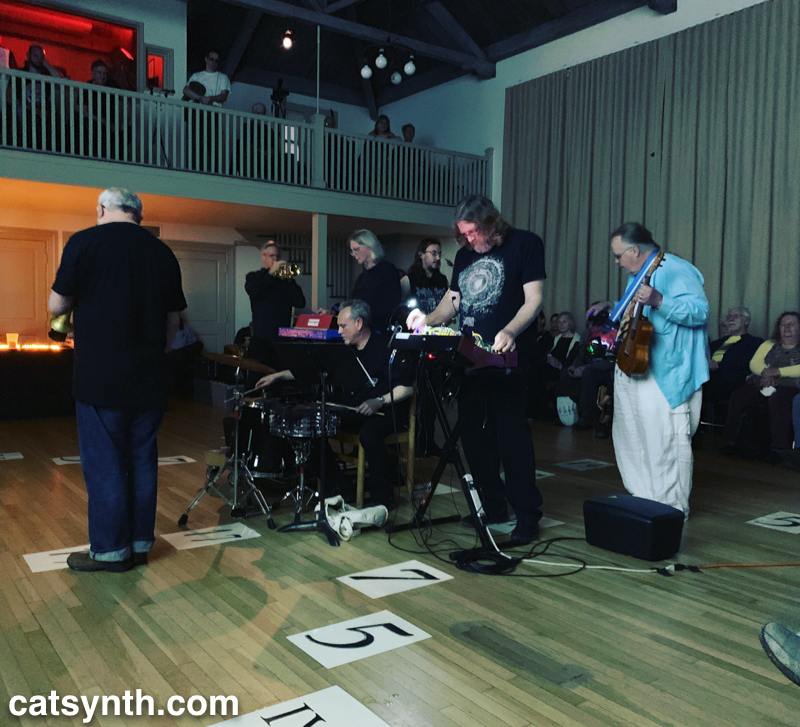
The next night brought Polly Moller Springhorn’s much-anticipated Tomography Fortunae to the Outsound stage, or more specifically to the floor in the middle of the hall as the audience looked on from the edges. Her composition combines a variety of sounds with ritualistic movement and concept, all codified in a graphic score. The most unique element was the fact that all performers had to be named “Tom.” This comes from a longstanding observation that many of the musicians in the Bay Area new-music scene happen to be named Tom (or Matt, or David). The Toms on this occasion were Tom Djll, Tom Dimuzio, Tom Duff, Tom Dambly, Tom Nunn, Tom Scandura, and Tom Weeks.
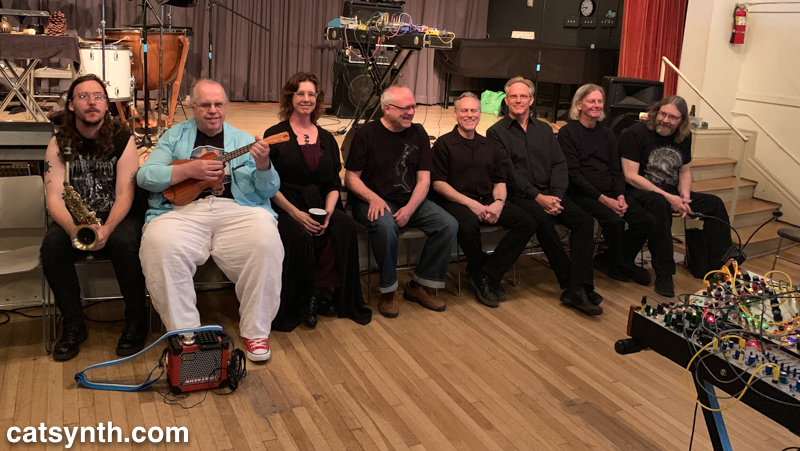
The piece unfolded as a series of three movements, each with more elaborate patterns of motion, ritualistic drawings, and numerical interplace. Most of the music was improvised within that framework, often bringing together pairs or trios of Toms for humorous interplay leading a loud and raucous finale with everyone playing. The whole experience was fascinating and fun.
The next set brought together percussionist William Winant with Zachary James Watkins on guitar and electronics. The two had performed together before, but I still did not know what to expect. The set opened with Winant on pine cone and drum, with Watkins gradually building up high-pitched noisy sounds to fill the spaces in between. The guitar soon emerged with stronger electronic sounds as Winant shifted to his gongs and metal percussion.
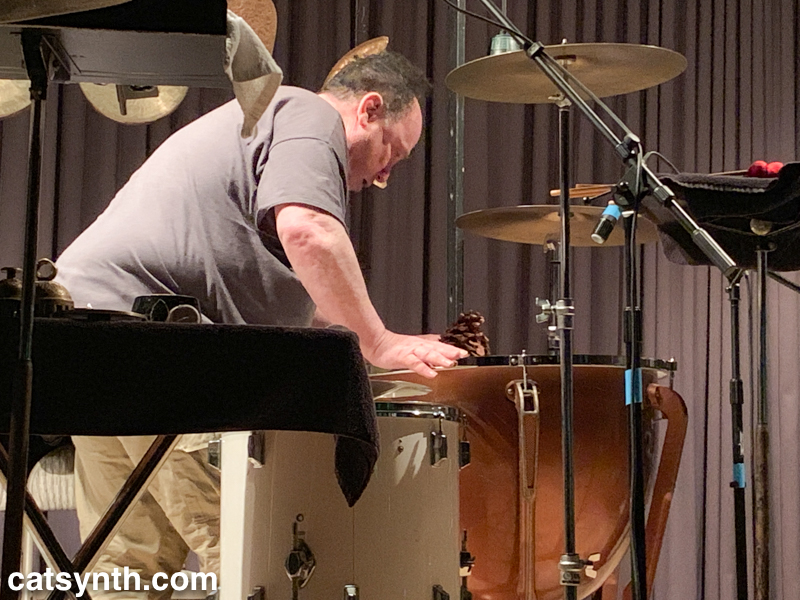
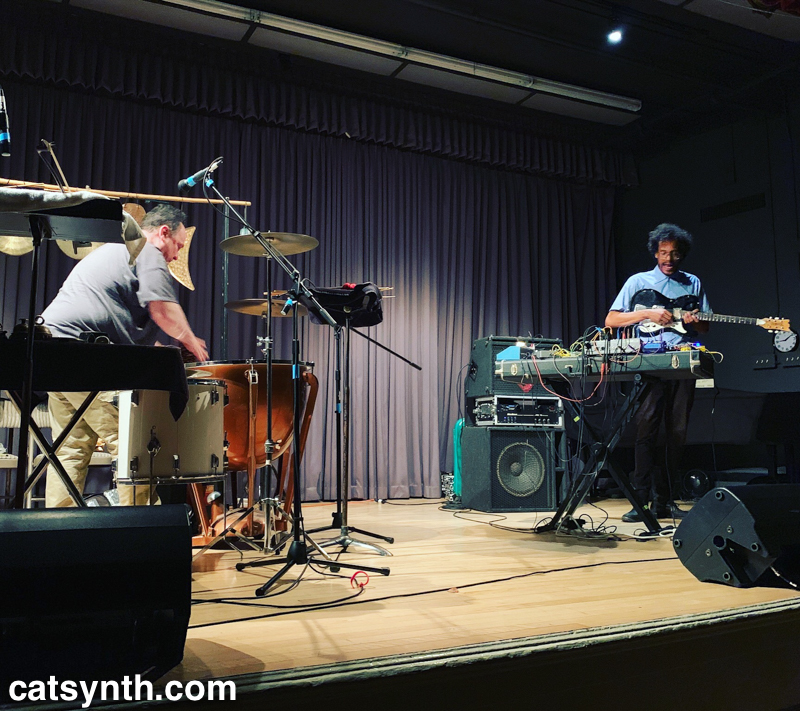
The sounds are fascinating but quite loud (especially for those of us who have maintained our high-frequency hearing) – and this was perhaps the most challenging moment of the entire festival. But things settled down again into a cloud of sound mixing percussion and electronics where the two became entangled.
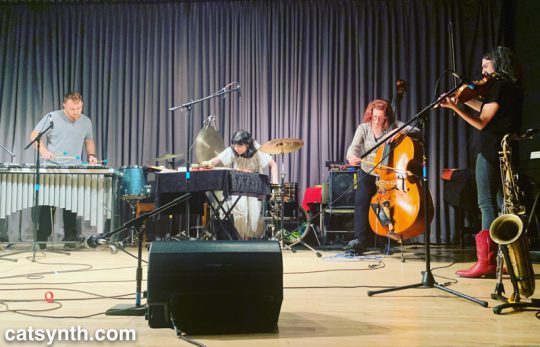
The final night brought two veterans of the summit and of experimental jazz to the stage. Rent Romus (also the executive director of Outsound and the festival) teamed up with fellow woodwind multi-instrumentalist Keith Kelly for Deciduous, a set that unfolded as a collection of short stories, complete with characters, magic, and mischief. They were joined by Nava Dunkelman on percussion, Heikki Koskinen on e-trumpet, Gabby Fluke-Mogul on violin and Lisa Mezzacappa on bass.
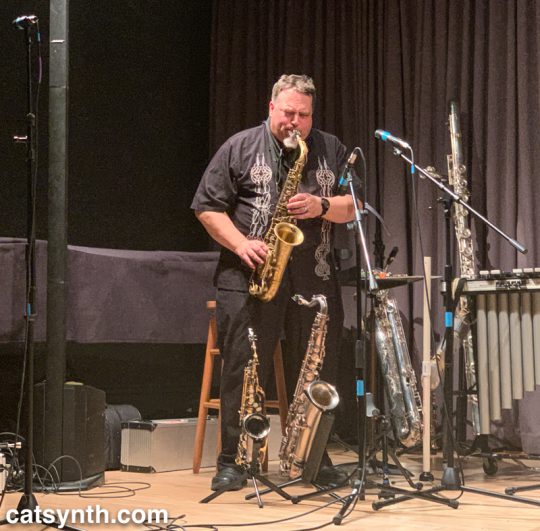
The final set brought back Vinny Golia and his wild collection of wind instruments to the Outsound Stage. In addition the more conventional baritone saxophone and bass clarinet, he also had a contrabass flute, a sopranino saxophone, and a rare G Mezzo-Soprano saxophone (which he describes in our preview video).
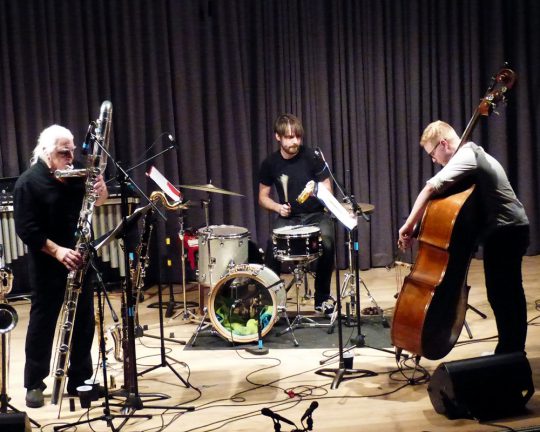
Golia was joined by Miller Wren on bass and Clint Dodson (drums). Originally, our friend Steve Adams was going to join them on saxophones but was unfortunately unable to make it for medical reasons. Fortunately, he appears to be much better and back to performing since then, and we wish him the best.
It’s particularly interesting to be present all nights and hear how the different artists and styles of music follow one another on the same stage. And I am glad to have been a part of it again this year both as a listener and part of the organizing committee.
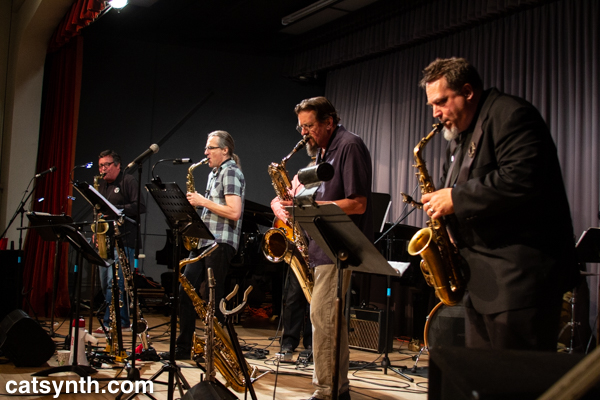
Last Thursday night at the Outsound New Music Summit, musicians and music lovers came together to celebrate the life and legacy of one of our own, Ralph Carney. He was a fixture of the Bay Area new-music scene who could be spotted performing in many groups and venues, and he also enjoyed success and notoriety in popular music with Tom Waits, the B-52s, and others. He is also one of the most infamously colorful characters in the scene. He passed away suddenly at the end of 2017 in an accident, leaving many both shocked and saddened. This tribute concert featured a performance by Rubber City, of which Ralph was a member, and a memorial ensemble featuring local musicians who performed his compositions.
In the week leading up the concert, we had the chance to speak with David Slusser of Rubber City and Phillip Greenlief, who arranged Carney’s music for the memorial ensemble. You can hear from them in these videos.
Rubber City opened the evening with a rendition of Beautiful Ohio, sounding much like they did in the video. It was a fitting opening as Slusser, Carney, and drummer Chris Ackerman were all Ohio expatriates. They were joined by bassist Richard Saunders and reedist Sheldon Brown.
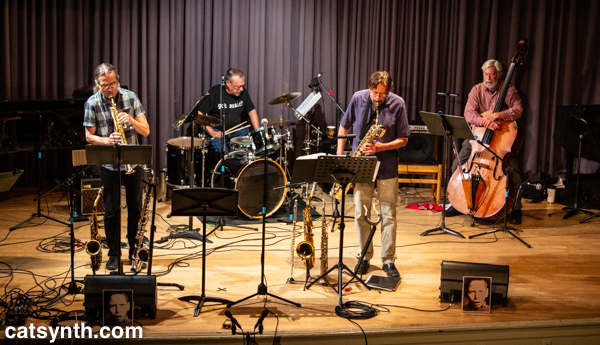
The second piece, a rather bluesy tune, also evoked their Ohio origins and gave Saunders and Brown a chance to shine in solos. The next was much darker and more atonal/arhythmic in nature but still had a very playful quality to it. Another featured Slusser and Brown both playing soprano saxophone at the same time, a rare combination! For the last piece, they set aside the saxophones for bass clarinet and flute.
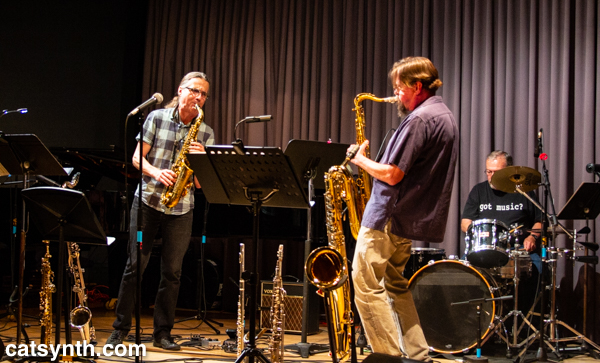
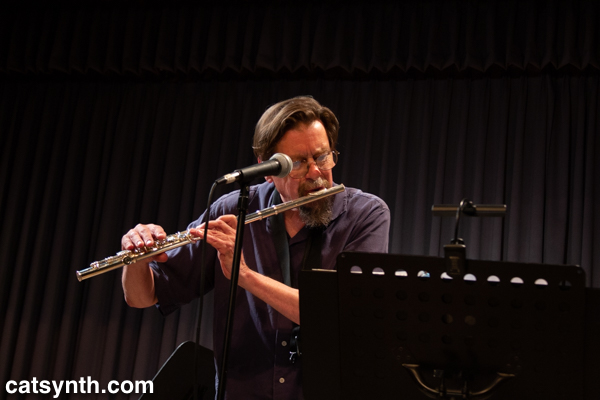
Even during moments of seriousness, there was a lot of fun and energy in the music, which was fitting for the artists on stage as well as the one they were paying tribute to. It was a tremendous performance overall, and one I am not likely to hear repeated soon.
Slusser, Brown, and Saunders returned in the second set for the memorial “octet” that actually had nine members. They were joined by Phillip Greenlief and Rent Romus on saxophones, Suki O’kane on drums, Myles Boisen on guitar, and Karina Denike and Michael McIntosh from Carney’s “Serious Jass Project.” The performance was dominated by the horns in what I dubbed the “wall of saxophone.”
The group began on a somber note with Carney’s Lament for Charleston, written shortly after the massacre at the Emanuel AME Church in Charleston, South Carolina in 2015. But even this dark piece had exuberance and could not fully contain the energy of the large group. From there, they continued on a rollicking trip through Carney’s compositions, including his oddball marches and an old-timey song about driving down Sunset Boulevard in Los Angeles that was sung by Greenlief with great effect.
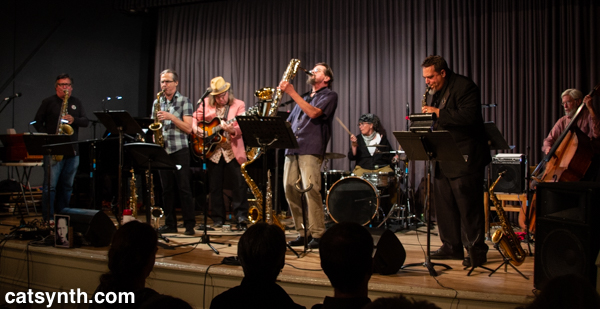
In keeping with Ralph Carney’s wide-ranging musical interests, there were a number of vintage jazz-style and mid-century tunes complete with swaying horn-section choreography. Karina Denike’s singing and vintage presentation added to the overall effect and classic style of the performance.
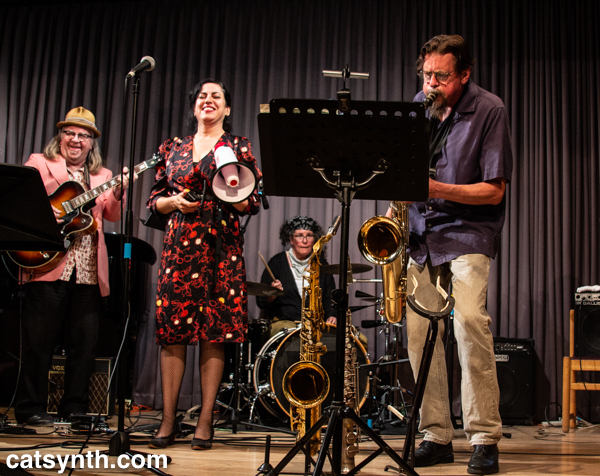
Many of us were simply caught up in the joy of the music and the celebration. Upon reflection, one realizes how different this was from the typical Outsound set with its references to swing, bebop, and early rock-and-roll. But there is absolutely nothing wrong with that – I have long professed that “new” and “experimental” musicians should not feature traditional idioms and structures in their music. This was an unequivocally great show, and the fact that it was on the Outsound stage was all the better.
Both bands played to a full and very appreciative house. Throughout the evening, on stage and in the audience, people shared their memories of seeing Ralph play or performing with him, and how much he is missed. I am confident that he would have loved our musical tribute and celebration, though he probably would have expressed his appreciation in an appropriately dry and confounding way.
The Improv Hootenanny series from the Ivy Room may be gone, but we recently had a “Hootennany Revival” at Berkeley Arts. Lucio Menagon, who started the Ivy Room series, was back in the Bay Area and joined by Suki O’kane and other familiar faces along with new participants. The musical (and visual) artistry is of course the center of the Hootenanny experience, but drinks and lively conversation are also a key part, and there was plenty of these before the formal part of the program began.
The performance opened with a solo set by Henry Plotnik, perhaps the youngest participant I have seen in any of these Bay Area improv events. He made use of the venue’s acoustic grand piano in addition to his electronic keyboard, and effortlessly weaved a set that moved between tonal and inharmonic elements.

[Photo by Michael Zelner.]
Plotnik was followed by a duo featuring veteran improvisers Philip Greenlief and Ross Hammond, on saxophone and guitar, respectively.

[Photo by Michael Zelner.]
Their performance had a sparse but intricate texture, frequency bouncing odd melodic lines or noisy extended techniques between them.
The evening also featured a version of Lucio Menagon’s Strangelet project, with familiar members Suki O’kane on percussion and John Hanes on electronics as well as a relative newcomer to the Bay Area scene Stephanie Lak.

[Photo by Michael Zelner.]
Lak’s contribution contrasted physically and sonically with the other members of the group, who provided the steadily evolving cloud of improvised sounds I remember from previous Strangelet performances. She was completely mobile with a pair of toy megaphones and tiny amplifiers and moved around the stage area freely with bursts of vocal and electronic sounds that floated on top of existing soundscape.
All the sets were accompanied by visuals from the cinePimps (Alfonso Alvarez and Keith Arnold). Using film projectors, they layered abstract film clips along with old B movies on two walls of the space. There were also musical interludes featuring Raub Roy and the TreeJay OctoPlayer. Raub Roy had a collection of hand drums that he excited with balloons expelling air and electric toothbrushes. The effect was something that sounded drum-like but without the usual articulation. You can see part of his performance in this video:
The TreeJay OctoPlayer, a project of Thad Povey and Mark Taylor, featured eight independently controllable platters and styli for vinyl records. During their mini-sets, the performers switched among different records and changed speeds to create a rich and somewhat eerie musical collage. It was also fun to watch the process of working with this towering instrument.

[Photo by Michael Zelner.]
The final set featured Stanosaur with guitar and a wall of large amplifiers. Basically, he played long heavily distorted drones that drove all of the amps to create different beating and phasing effects at rather high volumes. And by “high volumes” I mean ear-splittingly loud! Fortunately, I had my ear protection, and earplugs were made available to the audience. But it was still an intense experience to hear and to feel the effect of this sound, and a fog machine and lasers added a visual element.

[Photo by Michael Zelner.]
In all, it was a fun night of friends and good music, which is something to be valued. I hope we can start another regular improvisation series in the Bay Area with the same degree of casual fellowship and quality musicianship.
Last month, the five members of Reconnaissance Fly took a break from the recording studio to bring their “charmingly incoherent art pop” to the Berkeley Arts Festival in a concert that also featured the band Vegan Butcher.
The evening began with the debut performance the Vegan Butcher, with John Shiurba on guitar, Wil Hendricks on bass, Suki O’Kane on drums, and Val Esway on “occasional voice.” The band played several compositions by John Shiurba, all of which were written in January and exclusively used the “nine-note January scale.” The pieces all had inventive titles like “These Ones Are All Stretched Out And Bifurcated”; and Shiurba stated that he wrote the lyrics before we was completely awake.

[Photo by Michael Zelner.]
The first song started out with a soft repeating pattern with quiet drums and a gentle guitar motive. Just when one thought this might continue indefinitely, loud drum and guitar hits announced the arrival of full-on rock mode. There was guitar with distortion and minor harmonies over a slow driving rhythm, overlaid with oddly modal melodies. The overall effect was reminiscent of psychedelic rock of the late 1960s and early 1970s – indeed, I thought I heard a bit of Nico / Velvet Underground in Val Esway’s vocals. You can hear the band for yourself in the following video:
Then it was time for Reconnaissance Fly to take the stage. From the start, our energy and vibe was quite different from Vegan Butcher’s dreamy and otherworldly sounds. Our current set based on spoetry (spam poetry) jumps around from style to style quickly, and has an overall humorous character. We opened as we usually do with “Small Chinese Gong”, which set the tone. You can hear a brief excerpt in this video:
All the recent studio work has paid off for live performances. We were much tighter on the challenging medley “Electric Rock Like A Cat / sanse is crede nza” than in previous performances, including those tough unisons. “As Neat As Wax” always stands out in live performances, too. This was also first time in a while that we included “The Animal Trade in Canada” in our live set, with a much stronger interpretation than in the past.

[Photo by Michael Zelner.]
Reconnaissance Fly features Chris Broderick on woodwinds (clarinet, bass clarinet and saxophone), Amar Chaudhary on keyboards and electronics, Polly Moller and voice and flute, Larry the O on drums, and Tim Walters on bass and electronics.
Overall it was a great show for both bands. For those of you who didn’t have a chance to hear it live, we will be playing together again on August 24 at the Starry Plough (also in Berkeley), along with Jack O’ The Clock.

Tomorrow night, Reconnaissance Fly will take a break from the studio for a live performance in Berkeley. We will be sharing the bill with our friends Vegan Butcher.
The Berkeley Arts Festival space is located at 2133 University Avenue, Berkeley, CA USA.
BAND BIOS:
Reconnaissance Fly is a band of composers who have reclaimed the best spam poetry (“spoetry”) for humanity, deploying jazz, progressive rock, funk, samba, free improvisation, a small Chinese gong, and an arsenal of wind instruments against the dastardly internet robots.
The five members of Reconnaissance Fly are Chris Broderick playing clarinet, bass clarinet and C-melody saxophone; Amar Chaudhary with keyboard and electronics, Polly Moller with flute, bass flute and voice; Larry the O on the drums, and Tim Walters on bass guitar and electronics. When not playing live around the Bay Area they are recording their debut album Flower Futures, awakening their inner Peter Frampton, and denouncing pineapple pizza.
http://reconnaissancefly.bandcamp.com/
Vegan Butcher plays music of John Shiurba. Only music written in January is allowed. The nine note January scale is used exclusively. The lyrics were written accidentally before John was completely awake. In addition to John on guitar, Suki O’Kane plays drums, Wil Hendricks plays bass, and Val Esway occasionally sings.
Suggested ticket donation is $10 at the door.
I have to admit, I like our music being described as “charmingly incoherent art-pop.” I hope we continue to use that.
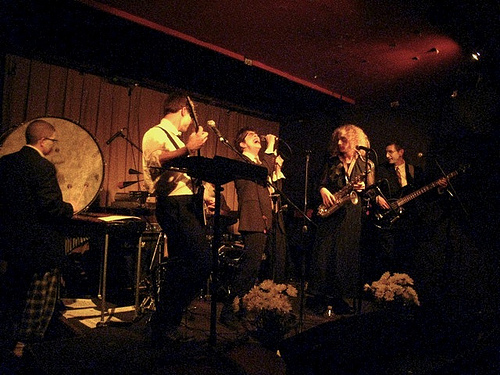
Today we look back at ReCardiacs Fly’s show at the Hemlock Tavern in San Francisco last month. It was a great show of music in prog and post-punk styles together with experimental/avant-rock groups PG13 and Surplus 1980.

The evening opened with PG13, the “power trio” of Phillip Greenlief (saxophone), John Shiurba (guitar), and Thomas Scandura (drums). I had originally heard them a few years back at the Skronkathon. They did have the loud-rock-trio thing down at the time, but in the intervening time they have become more finessed and detailed without losing that original intensity.

[Photo by Michael Zelner.]
They opened with driving syncopated rhythm and power chords. The rhythmic textures brought all three instruments (saxophone, guitar and drums) together. This was undeniably rock – held together by Scandura’s drums – but later sections did have a more jazz-like quality, which I thought worked when done with sudden changes in volume and texture. I of course did like that one of their songs (composed by Greenlief) was The Totally Unbelieable but Absolutely True Adventures of George Cleaver the Cat. Loud music with complex rhythms about cats works for me any day.

[Photo by Michael Zelner.]
After PG13, it was time for us to take the stage. For those who have not read the previous ReCardiacs Fly articles, we are (possibly the only) tribute group for the UK avant-prog band Cardiacs. We model our line-up after the original band, and don suits and creepy theatrical makeup reminiscent of their appearance in the 1980s. This music is complex and intense, and challenging to play, but a lot of fun for us and for the audience when we pull it off. A few songs came out quite well at the Hemlock, in particular “Burn Your House Brown”, which you can see in this video:
“In a City Lining” also came out quite well. On a technical level, the sound was the best we have had for any ReCardiacs Fly show, with the mix between the amps, speakers and acoustic space balanced so that we could hear everyone even in the loud parts. And we were quite loud, appropriately so.
As always, the performance was full of energy, and we got a great response from the modestly sized but enthusiastic audience. The full lineup of the band features Polly Moller on lead vocals, Masc Laspina on guitar, Chris Broderick on saxophone, Tim Walters on bass, Amar Chaudhary on keyboard,
Moe! Staiano on drums, and Suki O’kane on percussion.
The final set features Surplus 1980, a post-punk project led by Moe! Staiano with a rotating cast of band members. This evening features Moe! together with Bill Wolter and Melne Murphy on guitars, with Thomas Scandura returning on drums and Jason Hoopes on bass.

[Photo by Michael Zelner.]
The band was incredibly tight rhythmically and harmonically, as if they had been playing these songs together for years. In particular, there is the challenge of getting all three guitars to be in sync, which they were able to do, will Bill Wolter front and center. And the group’s lyrics were often quite funny (this in the context of our just completed Cardiacs’ set). It’s difficult to recall any particular line at this point, but they definitely worked at the time. Most of the musical techniques were standard but with complex rhythms and phrases, but Wolter did have quite an array of effects pedals, and during one of the final songs Moe! pulled out a vinyl record which he proceeded to use on his guitar like a pick and destroyed in the process (the record, not the guitar).
Overall, it was fun night of loud rock music from friends and colleagues whom I usually here in more overtly experimental contexts. I hope our bands will get a chance to play together again sometime.
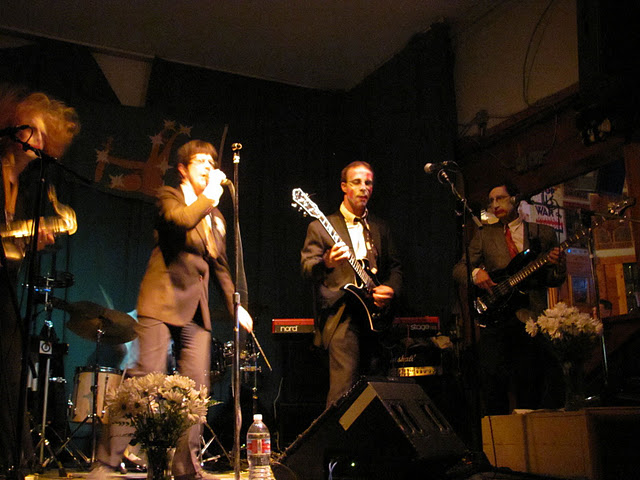
After our first ReCardiacs Fly performance this past spring, we were hoping for an opportunity to perform again. That opportunity came (and went) at the beginning of December as part of an energetic night of music at the Starry Plough in Berkeley that also featured Wiener Kids and Dominique Leone.
ReCardiacs Fly is the coming together of several members of Reconnaissance Fly (Polly Moller, Amar Chaudhary, Tim Walters, Chris Broderick) with Moe! Staiano, Marc Laspina and Suki O’kane as a tribute to the UK band Cardiacs. We performed a full set of Cardiacs songs – the four from the previous show as well as several new ones – with as much authenticity and energy as we could. Much of the work in learning these songs involves mastering the complex meter and rhythm changes that can often be quite unpredictable, and we spent a lot of time practicing in preparation for the show. And the work paid off. I thought R.E.S. in particular came out well, but you can hear for yourself in this video:
[Videography by Marjorie Sturm.]
I am still not sure what R.E.S. stands for.
I also thought Wooden Fish on Wheels came out well – it’s not as hard musically as R.E.S. and some of the others, as it stays in a relatively steady 4/4 ska-like rhythm. I would like take another shot at getting Burn Your House Brown and In A City Lining (both of which I quite like) up to the same level. Overall, however, it was a great performance, and we had a very enthusiastic response from the large crowd at the Starry Plough.

[Photo by Tom Djll.]
As one can see from the above photo, Polly was definitely getting into the character of lead singer Tim Smith. Most of our digital cameras cannot keep up.
The evening opened with Wiener Kids (Jordan Glenn, Aram Shelton and Cory Wright). They are one of the more unusual trios, with Glenn on drums and Shelton and Wright on reeds. As a result, their music has a very sparse texture, which they use to great effect for complex rhythms and lines. I found myself caught up in the patterns with lots of syncopations and unisons and empty space. Every so often they would come together into one jazz-like idiom or another before spreading out again with their unique texture.
Wiener Kids were followed by Dominique Leone together with Ava Mendoza, Aaron Novik and Jordan Glenn pulling double-duty by appearing in two out of three bands. And they were quite a contrast, with thick textures and rich harmony and a more song-like quality, but equally tight in terms of rhythm and phrasing. I found myself particularly interested in Aaron Novik’s use of bass clarinet as the equivalent of a bass guitar, complete with electronic effects.
This won’t be the last ReCardiacs Fly show, as we already have one planned for March in San Francisco. But until then, it’s back to some of the other musical projects. We conclude with an image of some flowers that fulfilled their deranged-rock destiny that evening.

[Photo by Michael Zelner.]
June began with a particularly strong electroacoustic and noise performance at the Luggage Store Gallery in San Francisco with Myrmyr and Tiny Owl.
Myrmyr is the electroacoustic duo of Agnes Szelag and Marielle Jakobsons, and their performance was in anticipation of the release of their new album Fire Star. Their work incorporates strings (in this case, electric violin and cello along with other instruments) and advanced electronics. I have heard and reviewed Myrmyr before, but this set was perhaps the most beautiful I have heard from them. Set amongst a dizzying array of electronics and wires, it opened with a series of struck string sounds that invoked the sounds of strings in South Asian or East Asian music. Szelag’s voice emerged over a series of rich arpeggios and became part of the texture via live looping. The complex harmony resolved to a long major-seventh chord, after which the strings became harsher and more percussive. Amidst pitch and delay effects, a plucked cello entered in counterpoint to the voice and other instruments. The overall effect was quite tonal and dream-like, and gave me the impression of glass objects.

[Myrmyr. Photo by Michael Zelner.]
The next piece started with strings, both plucked and tapped and used as a live-looping source. A rhythmic pattern formed from the loops, which built up in complexity and volume with lots of distortion. Over time, the distorted sounds became clearer and more ethereal as the strings cut out and left only the bells and electronic effects. These were in turn displaced by more liquidy sounds and the return of cello and violin, this time bowed. The piece featured interesting harmonies and vocals.
The final piece was from the soon-to-be released album. It became with a drone, with harmonium sounds and voice building up into a rich texture. As they fade out, a plucked string instrument (possibly guzheng after reviewing Myrmyr’s website) enters on a minor pattern. The sound was accompanied by bells and distortion effects. The music built up to a big recognizable chord that was unresolved. Another build-up followed, this time with voice that turned into a rich harmony with a particularly plaintive violin line.

[Tiny Owl. Photo by Michael Zelner.]
Myrmyr was followed by Tiny Owl, a band consisting of Matt Davignon (drum machines and synthesizers), Lance Grabmiller (computer and synthesizers), Suki O’Kane (percussion), and Sebastian Krawczuk (double bass and objects). Their performance consisted of one long constantly evolving piece. It opened with an impromptu round of “Happy Birthday” for Matt Davignon (it was indeed his birthday) that appropriately elided to a series of glitchy noise sounds. Soon the bass drum and cymbals and string bass entered. The overall undulating timbre seemed very insect-like, but there also bits of melody that came and went in opposition to the overall swells and dips in the sound. One gesture that I particularly liked involved drum machine “gurgling” set against bass. The gurgling sounds, which formed a complex timbre, were gradually slowed down to the point where it became a series of rhythmic elements – moments like this always make me think of Stockhausen’s Kontakte II. Eventually, they merged back into the overall ambient sound. Over time, the overall texture became busier, but also more drone like, with high pitches and even some screeches eventually emerging. Pitched noises moving up and down like factory machinery were set against a drum rhythm reminiscent of “Wipe Out” (that very insistent sixteenth-note rhythm that every young percussionist attempts to play). As the percussion (drums and objects) grew more rich, so the electronics became more intense with bursts of machine noise and longer notes with strange harmonics. The section of louder sound and more complex rhythm grew to a climactic point and suddenly faded out with just a low rumble and a sparse texture of percussive sounds. This part of the performance was drier, with more punctuated elements and scratching sounds. During a gentle rise in pitch and volume near the end of the performance, the sound seemed to merge with a passing siren on Market Street. (It wouldn’t be a Luggage Store Gallery performance without at least one siren incorporated into the music.)
The show concluded with both groups uniting for short jam. It was fun to hear the combined sounds: noise drones punctuated by strings, and at least one more siren from the street.