
Tag: chelsea
-

Whitney Museum: New Building, Frank Stella, Archibald Motley and more
Since my last visit to New York, the Whitney Museum opened its new building in the Chelsea neighborhood of Manhattan, and so it was of course a high-priority stop on this visit.
The first work of art on encounters is the building itself. The overall style neither attempts to mimic the warehouses of the Meatpacking District nor projects the dissonance of some of the other intriguing buildings along the High Line. But it does open up to the neighborhood and the city, making that part of the show along with the formal art.

The main exhibition was a massive retrospective of works by Frank Stella which took up the entire 5th floor of the museum and featured his iconic large and colorful paintings as well as more recent works that veered towards the sculptural. One of the major themes is how over his long career he has shifted his focus and come up with new ways of working in the medium he still refers to as “painting.”

His most recognizable works are the large-scale colorful cutout paintings. The earlier examples contain elements of abstract expressionism and the emerging minimalism, but then modified by cutting out the shapes to make irregular canvases, freeing panting from being simply “colors spread onto a rectangular surface”. Nonetheless, my favorite examples of this phase are still geometric and stark.

[Frank Stella. Chocorua IV]From straight lines, we move to curves, which further modify the boundaries of a painting. And then came the radical step of taking a painting outside of the flat plane by cutting, bending, and layering pieces.

[Frank Stella. Gobba, zoppa e collotorto]While the placement and combinations of shapes may be complex, the shapes themselves remain simple and the whole composition abstract. I found this phase of Stella’s work to achieve its most refined form in La penna di hu.

[Frank Stella. La penna di hu, 1987-2009. Mixed media on etched magnesium, aluminum and fiberglass.]It seems natural to ask whether such works are paintings or sculptures. Stella himself comes down squarely on the side of viewing them as paintings. This is true even for his most recent series of work that feature large metal constructions without color.

Stella has also embraced technology throughout his career including new materials and machines. Most recently that includes 3D printing.
It was great to see both his most famous paintings alongside the more surprising elements of his constantly evolving work in this large exhibition. As Stella is still alive, there may be more to come.
The top floor of the museum features a retrospective of works by Archibald Motley. Motley was a prolific and influential painter who came to prominence in the first half of the 20th century. The exhibition focuses on his works portraying African Americans in serious portraits and lively cultural scenes from the Jazz Age and Harlem Renaissance in the 1920s and 1930s. While the portraits are detailed and striking, it was his scenes of colorful musical spaces that most resonated with me.

[Archibald J. Motley Jr. (1891–1981), Blues, 1929. Oil on canvas, 36 × 42 in. (91.4 × 106.7 cm). Collection of Mara Motley, MD, and Valerie Gerrard Browne. Image courtesy the Chicago History Museum, Chicago, Illinois. © Valerie Gerrard Browne]Motley was well known in his time, but faded later compared to other painters of American life and scenes (think Edward Hopper). Because his work depicts an American community often overlooked and his style is more modern and pushing away from realism, it is great to see him getting reintroduced through exhibitions such as this.
The galleries featuring pieces from the permanent collection were also “new” in the new space. Among the themes that permeates the museum’s collection are scenes of the city and industry. There is Joseph Stella’s Brooklyn Bridge (a poster of which hangs at CatSynth HQ) but also John Marin’s less-well known Region of Brooklyn Bridge Fantasy with a very different take on the same subject.

[Joseph Stella. Brooklyn Bridge]
[John Marin. Region of Brooklyn Bridge Fantasy, 1932.]In terms of industrial imagery, among the strongest were Kay Sage’s surrealist piece and Elsie Driggs’ Pittsburgh. Both pieces, at least to me, have a very optimistic view of the city and progress even if others of our current time would see them as bleak.

[Kay Sage. No Passing, 1954]
[Elsie Driggs. Pittsburgh, 1927]It’s also worth noting that some of the strongest images of these themes were done by women, something that inspires me in my own work into this subject.
The 6th floor featured works from the collection of Thea Westreich Wagner and Ethan Wagner, some of which will be come part of the Whitney’s permanent collection and some of which will go to the Centre Pompidou. It focuses American and international art from the 1960s to the present, and demonstrates the wide variety of media and concepts employed during this period. Minimalist works abound, such as Sean Paul’s series featuring arrangements of black shapes on a white background with implied complexity.

[Sean Paul. Arrangement 17, 2011]There are also many works featuring technology. Some are the obligatory works with the light (that I do quite enjoy), but one of the more confounding pieces was by Aaron Flint Jamison. It featured two wooden boxes with multiple computers and a shelf of printed sheets. Were the computers the art, or were they just functional elements to support the concept?

[Aaron Flint Jamison. Half Matrix Vessel (part of “Manifold to Half Matrix” installation), 2013]There was of course more traditional modernist painting, such as Charline von Heyl’s piece Boogey.

[Charline von Heyl (b. 1960), Boogey, 2004. Acrylic, oil, and charcoal on canvas. 82 1/16 × 78 1/8 (208.4 × 198.4)
Promised gift of Thea Westreich Wagner and Ethan Wagner P.2011.472. Courtesy of the artist and Petzel, New York]

Overall, this was a great visit and a chance to see a new museum in a favorite neighborhood of mine. One question that I had was what would be the fate of the old midtown Brutalist building that housed the museum for decades. Fortunately, it appears that it will survive, and the Metropolitan Museum of Art plans to use it for some special exhibitions. I hope to be able to see one in the future.
[Images without “catsynth.com” watermark courtesy of the Whitney Museum of American Art.]
-
Chelsea Galleries, December 2013
My visits to New York almost always include an afternoon wandering the galleries in the Chelsea neighborhood. And I was able to get back again this year and see how the neighborhood had rebounded from Sandy last year. The area was hit hard with flooding, and last November many galleries were closed, while others were physically open as crews removed drywall and ran industrial fans. There was little outward evidence of the damage this year, save for a musty aroma in a couple of galleries. Thus, the focus was on the art itself.
The major event in the neighborhood appeared to be Yayoi Kusama’s solo exhibition at David Zwirner. The large exhibition including both paintings by Kusama as well as several installations. A large video installation Manhattan Suicide Addict featured the artist with bright red hair and outfit greeting visitors in front of changing psychedelic patterns. Nearby was a visually captivating immersive installation Love Is Calling featuring light, sound, sculpture and mirrors. The experience within the space was disorienting, but not at all disturbing with the large softly curving forms and cool colors.

Because of the limited space inside, access to the installation was limited. However, there was no line for Love Is Calling when I visited, while the wait for Infinity Mirrored Room – The Souls of Millions of Light Years Away, 2013 was several hours long. There was no wait at all to see Kusama’s paintings, which while equally loud, had more of a cartoonish or folk-art quality to them compared to the overt technological nature of the installations.

A surprise discovery was Piece of Silence, an exhibition of new drawings, paintings and sculptures by Sandra Cinto at Tanya Bonakdar Gallery. Among the major themes in her show was music, and indeed the entire lower gallery featured a series of elaborately illustrated cellos and other musical instruments mounted onto walls covered in musical staff systems. The illustrations featured elaborate naturalistic landscapes and water, themes that were also used into Cinto’s other sections of the exhibition. As the gallery was not too crowded, it was possible to linger in the stark gallery and take in the “silence.”

We then go from something unexpected to something completely as expected. There wasn’t much surprise in Richard Serra’s monumental sculptures at Gagosian Gallery’s two Chelsea locations, but they are nonetheless favorites of mine for the scale, metal texture and industrial quality. (I have heard is work derided as macho in the past, but that is a topic for another day.) At the 21st Street location, there was a single installation made from huge undulating sheets of rusting metal. One could walk through and explore the interior spaces, which ranged from round chambers to narrow passageways.

The pieces at the 24th Street, by contrast, were very linear in nature. I did particularly like this set of rectangular slabs.

Michel de Broin’s sculptures at bitforms featured industrial elements, but on a human scale and constructed from existing utilitarian (or formerly utilitarian) objects. Tires, utility boxes, broken light bulbs, are all fair game in de Broin’s work, which is arranged quite minimally and efficiently around the gallery’s space. There is also a playful quality to these pieces.

Found machinery and industrial objects are also the essential elements of Hidden Tracks, a solo exhibition by Reinhard Mucha at Luhring Augustine. The large pieces in the exhibition included working elements such as model railroads and old TV screens playing videos of similar industrial apocrypha.

In reflection, the industrial and the technological dominated the art that I focused on during this particular tour. But that is not surprising. It also was a major part of Michael Light’s photography exhibition at Danziger Gallery. The show focused on human technology set against the natural landscapes of the western United States, as seen from the air. That included several images of large freeway interchanges, including some classics from California and Arizona that we have included in our “Fun with Highways” series here at CatSynth.

As always, my Chelsea gallery walk ended with a visit to The Red Cat for a Manhattan and some samples from their menu. This time, that included a season soup with sausage confit that was highly recommended by my server and definitely worth enjoying slowly between sips of the cocktail and reflecting the days activities.
-
Chakras and Homebrews at Performa 11
During my visit to New York, I had the opportunity to check out a few events from the Performa 11 biennial. I had a great experience, too years ago, and wanted to check out the final weekend. My time this year was quite limited, but I did have a chance to attend a few events.
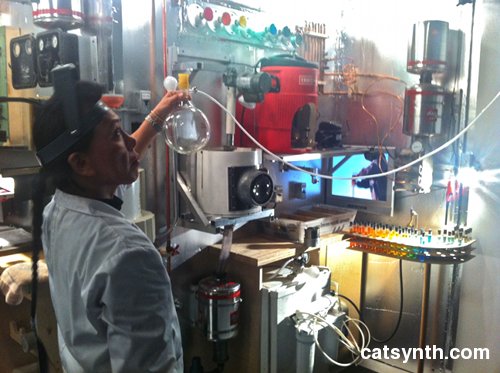
The artistic highlight of my brief visit was a piece by Mika Rottenberg and Jon Kessler called SEVEN, which took place at Nicole Klagbrun Project in Chelsea. It was described as “a chakra sauna channeling chromatic body fluids from New York to Cradle of Humankind in Africa.” There are seven chakras, which correspond to areas of the bodies and states of being in Hindu and Buddhist traditions (you can look up tons of information on this if you’re curious), with an addition of colors of the spectrum in some recent practices, particularly in Western societies. The installation consisted of a full scale urban spa, with exercise area, working sauna and a lab with a bizarre combination of equipment and a technician who appeared to be running the show:

At the same time, the installation featured a video from an arid landscape in Africa. It is the combination of both the live installation and the video that becomes interesting. In the video, a succession of people in the African landscape extract cylindrical cores of mud from the parched ground. These are given to a local man in a small hut, which he then places into a bizarre looking contraption. When he turns it on, the core suddenly appears in the local lab in a similar looking piece of equipment. These are then placed in the sauna. Meanwhile, in New York, people take turns on an exercise bike, which both powers the sauna and helps the participant work up a sweat as they take turns moving from the bike to the sauna. The participants are assigned colors from the chakras/spectrum in succession, and their perspiration from the sauna generates a vial of “chakra juice” of that color, which is then collected.

This process repeats slowly for each of chakras, with the participants in Africa bringing the mud to the machine and the local participants generating the colored vials in the sauna. The synchronization between the installation, live performance and video is very well done, and does give the illusion that these events are happening together in real time through some process we don’t quite understand.
When all seven chakras are filled, the set is then sent back through the device to its counterpart in Africa in the video. At this point, the video completely takes over and we see the purpose of this ritual. If anything, the conclusion was perhaps the least convincing part of the piece, as it seemed a bit forced compared to the surrealism and illusion created by the synchronizing the video and live performance. But overall, it was a strong piece and I’m glad I made the trip over to the west side to see it.
Back at the Performa Hub in SOHO, I spent some time at the brew pub, where a variety of beers from local homebrewers were on tap.

I particularly liked a couple of spicy brews featuring chili, but there were also some great seasonal beers with pumpkin and cinnamon. In addition to the beer itself, it was an opportunity to interact with artists, the brewers and other visitors. Attending art events in New York can sometimes be a lonely affair, so it was a nice change of pace. In my haste to get to the next event, I misplaced my list of the beers (along with my copy of the Occupied Wall Street Journal I picked up earlier in Zuccotti Park), so I don’t have exact info to share with readers. If I find something online, I will update.
Overall, I did not get to see as much as I did in 2009, and it did not have the same abstract/modernist/future-retro vibe that it did two years ago, but overall it was a good experience and a good start to my week in New York.