Homecoming and Adoption Anniversary

I returned home from China and Japan today. There is still much to relate, from the last stops in Shanghai and Tokyo. But today we pause to recognize that this homecoming on June 10 is also Luna’s adoption anniversary, or “Gotcha Day”.

The timing just worked out so we could both return home to celebrate. But first, it’s time to find a familiar comfortable place to rest.

Please join me in wishing Luna a happy “Gotcha Day.”

Summer Palace and Temple of Heaven, Beijing

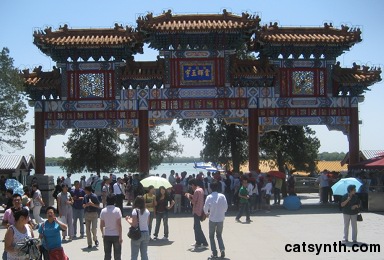
On the northwest corner of Beijing is the Summer Palace, or Yihe yuan (颐和园).

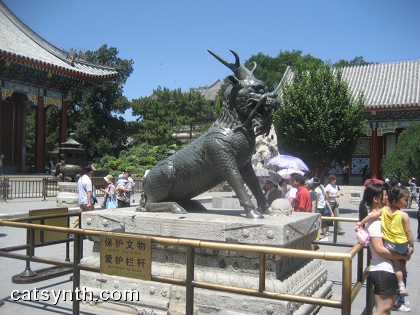
It is quite a contrast to the dense network of buildings and courtyards of Forbidden City, and is dominated by the “natural” elements of of Kunming Lake and Longevity Hill – “natural” is in quotes as the lake and hill are at least partly artificial. Along the hillside are a series of impressive buildings leading up to the Tower of Buddhist Incense. Other palaces and gardens ring the lake, with similar architectural and sculptural elements:


[click to enlarge]

In its present incarnation it is more of a park than a palace, with locals and tourists boating on the lake, or having picnics in the gardens and pavilions along the side. However, the main attraction remains the buildings of Longevity Hill. At the base, one enters a court and the Cloud-Dispensing Hall, and can look upward towards the tower up the hill.

From there, one climbs a series of covered and exposed stairways, navigating a series of buildings on the hillside:


[Click to enlarge]

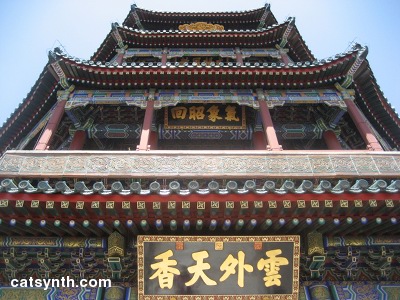
The courtyard of the Temple of Buddhist Virtue at the top of the stairs is relatively tight, and only offers extremely vertical views of the tower:


[Click to enlarge]

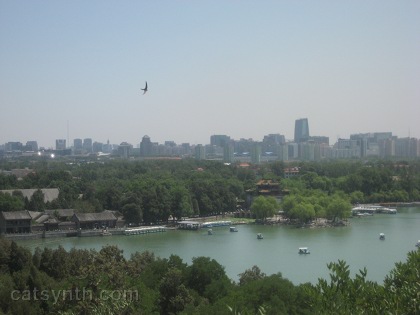
One does, however, get a specular view of the lakeside and southeast towards the city center of Beijing.


[Click to enlarge]

The Summer Palace has quite a history. It was destroyed during multiple invasions in the 19th Century and was rebuilt around 1900 in its current form.

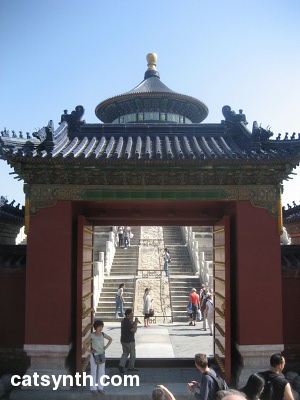
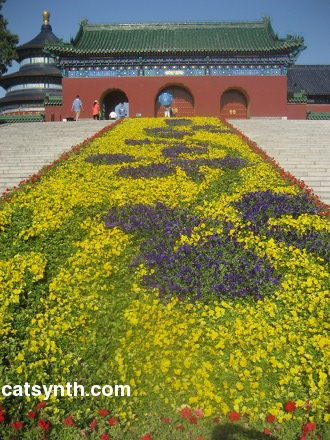
Back in the city center is the Temple of Heaven.

[click to enlarge]

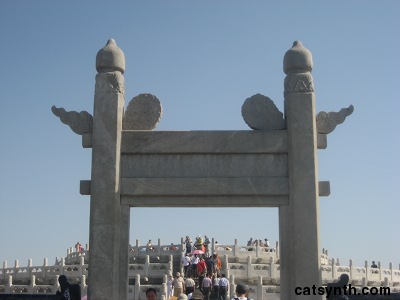
The most prominent building, the circular triple-gabled building depicted in the pictures above, is the Hall of Prayer for Good Harvests. Harvests seems to have been a major focus when the temple functioned as a location for ceremonies performed by the emperor. However, the most important structure, from a ceremonial point of view, was the Alter of Heaven, a tiered circular mound at the southern end of the complex:


[click to enlarge]

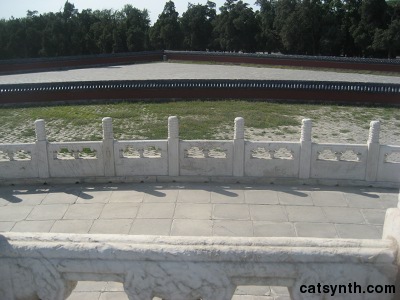
Unlike the more architecturally prominent buildings, which have gone through extensive maintenance and renovation, the mound seems to have gone to seed a bit, with lots of grass and weeds coming up the ground. For me, however, this actually makes for interesting photography, as I tend to like buildings that in a bit of disrepair.


[click to enlarge]

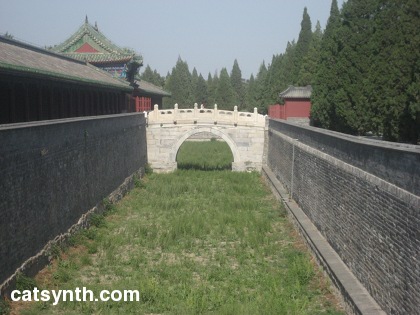
I found more buildings in various states off to the side of the main axis of the complex, such as this dry moat with weeds growing:


[click to enlarge]

This area of the complex was nearly empty, no tourists and very few locals, and walking around here among more quiet and less maintained buildings was quite comforting, especially after the intensity and the crowds of Beijing.

The Forbidden City

The first stop on my weekend trip to Beijing was the Forbidden City.

The Forbidden City was the Chinese imperial seat of power from the Ming Dynasty to the Qing Dynasty. It is really is a “city” rather than a palace. It is huge and contains hundreds of buildings, and in three hours I was only able to cover part of it. This article presents only a small sampling of what I saw.

The Forbidden City is surrounded by a moat and walls, with towers at the corners:

Inside the walls are a patchwork of courts and buildings, of which Hall of Supreme Harmony is the largest and most iconic:

The people in the crowd (which is relatively modest for China) should provide some sense of scale for the size of the buildings and the courtyard. At this scale, the architecture seems relatively streamlined and spare, but a closer look reveals intricate details in the buildings, as well as the networks of stairways and paths.

The above architectural details are more intense, in terms of color and complexity, than those I had seen previously in the other cities. Other imperial and religious buildings in Beijing share a similar style.

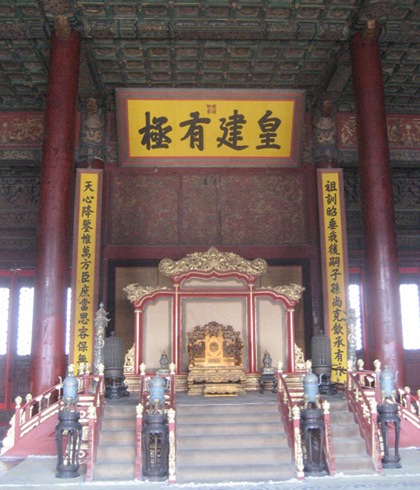
Views such as this may be recognizable to some readers who have seen documentaries, or films like The Last Emperor. Another image I did recall from seeing film many years ago was the imperial throne:


[click to enlarge]

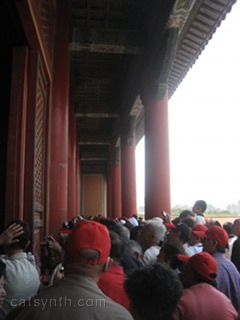
It was actually a challenge to get a good look at the throne or other significant building interiors, much less attempt to photograph them, because of the ubiquitous crowds:

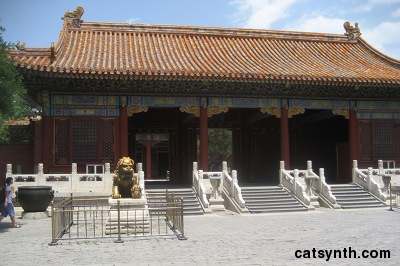
One could escape from the crowds for a bit by staying out in the middle of the courtyards, or venturing into the maze of side buildings. Wandering the side areas was quite interesting, around a narrow corridor one could easily find another whole court and buildings, “palaces within palaces”, such as Palace of Heavenly Purity with it’s golden lions in front:


[click to enlarge]

Tucked inside the warren of side courts were numerous gardens, similar to those I saw in Suzhou and Wuxi. Some were similarly small an intimate, and seemed like pleasant oases. There was also the imperial garden, which contained this rather large rockery topped by a pavilion (closed to the public), which like it could be at home in a Lord of the Rings movie as much as a Chinese imperial palace.

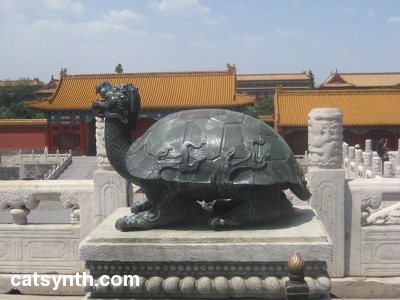
Scattered throughout the complex were numerous statues, such as the lions protecting palace, entrances and dragons, and other artifacts from the imperial courts:


[click to enlarge]


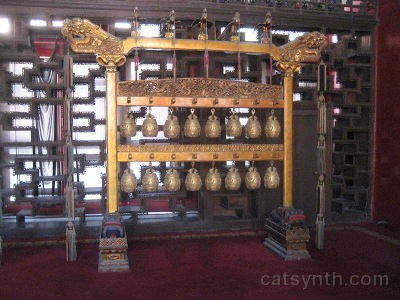
[click to enlarge]

I would have liked to try out those bells.

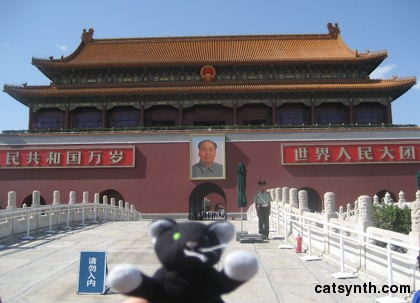
At the southern entrance is Tiananmen Gate, which now bears the portrait of Chairman Mao:
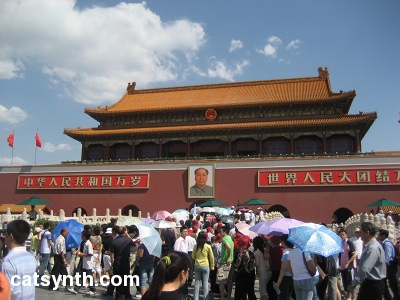
I of course could not resist having Zip pose for a “Mao and mao” photo (one of a few I have taken during my trips to China).


[click to enlarge]

Liang Shan Buddha

In the hills not far from Wuxi stands 88-meter tall Liang Shan Buddha:

To get a sense of just how immense this statue is, consider the people on the staircase in the photo.

Looking down from the base of the Buddha, one can see the expanse of the valley and temple complex below:

In the temple courtyard, there is a scale replica, which one can view in alignment:

There is also a full-size copy of the Buddha’s hand. One is supposed to walk a full circuit while remaining in contact with the hand for good luck, and the wear from countless visitors is clearly visible.

I did the full circuit around the hand, and we’ll see how that works out…

The Liang Shan Buddha is not an ancient construction, but rather recent project sponsored by the Chinese government with some private donations. There is a certain over-the-top feel to the entire complex, almost like a Buddhist amusement park, with a huge parking lot, busses, etc. They have also built a large “palace” with rather gaudy devotional art. The huge circular meditation hall in the center was less ornate, with it’s arrangement of seats and geometric design, though they did have a constantly changing light show in the domed ceiling:

Not being a Buddhist, I don’t really have much interpretation of these aspects of the center. But certainly, the giant Buddha itself is impressive.

Wuxi and Lake Tai

The city of Wuxi is to the north of Suzhou, along the huge Lake Tai, or Taihu 太湖, the “grand lake”.

Like Suzhou, Wuxi has several traditional Chinese gardens, with the added bonus of being along the lake front. The Liyuan gardens (really, more of a park) had several ponds and pavilions:


[click to enlarge]
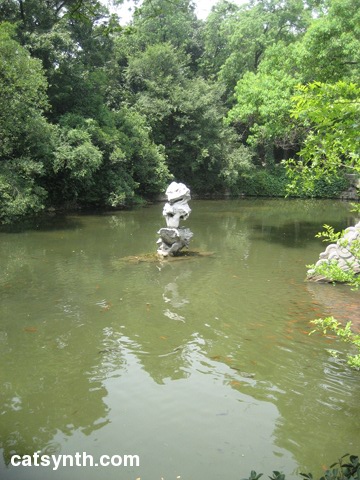
Musicians were performing traditional Chinese music in this pavilion, one of four on a large pond representing the seasons:

The garden is one the shore of Lake Tai, and just beyond the ponds and pavilions are views of the lake:

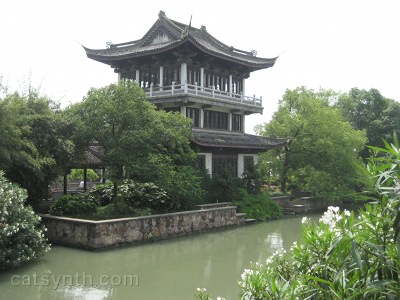
< One can see another contrast of old and new, with the traditional architecture of the waterfront restaurant in the foreground and the sleek and modern bridge in the background. Compared to the Liyuan garden, Turtlehead Garden was more “natural”, with wooded hills and views of the lake, including this iconic spot:
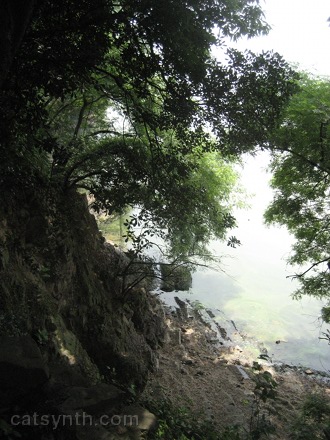
The garden did include the traditional “planned” elements, such as ponds filled with koi and rockeries, but a short walk leads one to far more natural scenery such as wooded hills overlooking the lake.


[click to enlarge photos]

I was fascinated by this one abandoned building in an overgrown wooded area:
< a href="http://www.ptank.com/wordpress/wp-content/uploads/2009/05/turtlehead_abandoned_c.jpg">

I was able to walk around it and get glimpses from different sides, but could not get any closer.

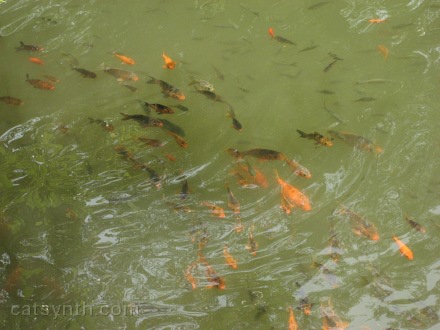
Feeding time for the koi:

I suspect it’s always feeding time for the koi, especially when there are children around.

Of course, at this point it was also feeding time for us, before making the trip to the giant Liang Shan Buddha.

Suzhou Museum and Zhong Wang Fu

On Saturday morning, I visited the Suzhou Museum. I have been in the area around the museum, which includes the old canals and the Humble Administrator’s Garden, but never had the time until now to venture inside.

The museum is more a culture and heritage museum than an art museum. Its collection is primarily traditional Chinese items, though it does have a contemporary art wing as well. For me, however, the main attraction was the building itself. It was designed by the architect I. M. Pei, whose family has long resided in Suzhou.

The museum’s architecture incorporates the shapes and elements the adjacent traditional gardens and palaces, including its own gardens, pools and rockeries, but stripping away the ornaments and focusing on the lines and geometry. This extends to the interior as well:

Overall, the architecture and design of the museum was quite photogenic, and readers should look for more examples in future photo series, and of course “Wordless Wednesday.”

One exhibit recreated a traditional Chinese study, and suggest that traditional elements of Chinese design can fit very easily into a modern context:

I wish my office looked like that.

I did take some time to see a few of the traditional artifacts, including several examples of animal figures such as this black-and-white jade cat:

Before the new museum building opened in 2006, it was housed in the neighboring Zhong Wang Fu, a traditional Chinese mansion with gardens and courtyards. The grounds and buildings have been restored and remain open to the public:

One can observe which elements were incorporated into the new building, and which ones were not.

CatSynth in China Part 3, plus Japan!

Well, my third trip to China in less than half a year begins and the end this week. So for the next couple of weeks, expect fewer cats and synths, and more photos and thoughts from China. Even if it is the latest in a string of work-related trips, there are still plenty of things to explore in such a vast and complex country. And as a bonus, I will also be spending a couple of days in Tokyo! I expect Japan to be a different experience altogether. Expect high technology, modernism, crazy highways and urban landscapes, and of course cats.

During this trip, Luna will be boarding at the same place she stayed during our CatSynth HQ construction adventure. It’s always a bit sad to leave, but good to know that she will be well cared for.

room: PIPES

On Sunday, I attended the room: PIPES featuring Polly Moller, Pamela Z and Jane Rigler. The Room chambre series, hosted an produced by Pamela Z, take place in the Royce Gallery, an “intimate performance gallery” in the Mission District of San Francisco. The room: PIPES performance featured performances that incorporated flutes.

Before the start of the performance, we were treated to a welcome by “Ellie”, the freight elevator in the building that houses the Royce Gallery. While some music purists might be appalled to have a freight elevator included in a performance, I found it quite charming to incorporate an element of the industrial setting.

Polly Moller presented a new work, Three of Swords. The performance included an arrangement of Tarot cards, a timer and a series of candles to mark sections of the piece. In each selection, a card was drawn, and the music was an improvisation based on that card. The music focused on extended flute techniques; for example, the first draw led to an improvisation with the head of a bass flute using microtones, overblowing, whistles, clicks and other inspiring sounds. The one section of the performance that stood apart from the others was the drawing of the Three of Swords, illustrated to the right, which launched a very detailed but very expressive description of the human heart.

Pamela Z‘s playful and energetic performance did not feature flutes, but instead focus on voice. It began with live looping of tonal and harmonic singing (look up “live looping” here on CatSynth for a primer if you’re not familiar with the technique), and gradually moved to more extended vocal techniques, including clicks, screeches (with electronic processing), whispers, etc. The video in the background displayed an interior of an old industrial or loft space, empty except for a trunk that appeared and disappeared at various times. Sometimes it was open, to reveal drawers and messy clothes.

Jane Rigler opened her set with a virtuosic flute and electronics piece and the welcoming statement “Do not fear the microphone and piccolo.” She then performed her piece A la pintura, inspired by Robert Motherwell’s paintings, which were in turn a response to Spanish poet Rafael Alberti’s poems celebrating painting. Motherwell’s paintings, both as stills and as animations, were projected during the performance, and there were also moments where text was projected, presumably excerpts from Alberti’s poems. Motherwell’s paintings are quite abstract, focusing on textual elements and geometry. To have these images along with strong flute-and-electronics music (a favorite instrumental combination of mine) was a treat.

The performance concluded with a trio improvisation of all three performers. In addition to the flutes and voice, Polly Moller broke out her “tone nut” (doughnut-shaped wind instrument), and Pamela Z played the popular Ocarina iPhone instrument. It’s always interesting to hear how such disparate musicians play off of one another, and this group improvisation could have kept going on for a bit longer…