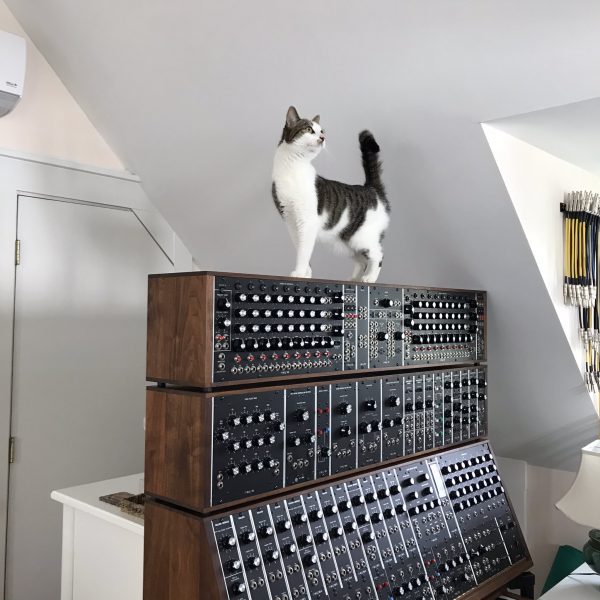
This cat proudly shows off a Moog modular. Queen of Moog, indeed!
From Reed Hays on Twitter, submitted by our friend and follower George Kelley. You can always submit your CatSynth pics via @catsynth on Twitter.

This cat proudly shows off a Moog modular. Queen of Moog, indeed!
From Reed Hays on Twitter, submitted by our friend and follower George Kelley. You can always submit your CatSynth pics via @catsynth on Twitter.
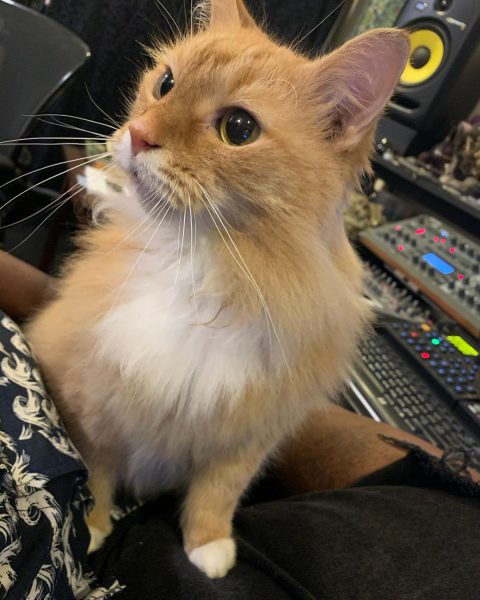
Meet Willow, who shares a studio with @puxflux in Portland, Oregon. They have been together for over 15 years, since Willow was a kitten, and clearly enjoy making music together.
Identification of the synths left as an exercise to the reader.
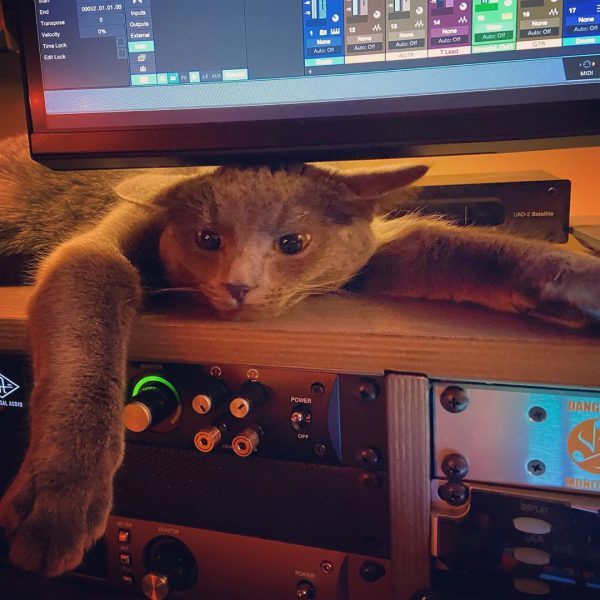
Someone apparently cranked up the compression on both the mix and this cat using a Universal Audio system with Apollo interface. From Universal Audio’s Twitter, found by our friend and Twitter follower @GazouilleurFou.
Mix so dialed…even the cat compressed 😺
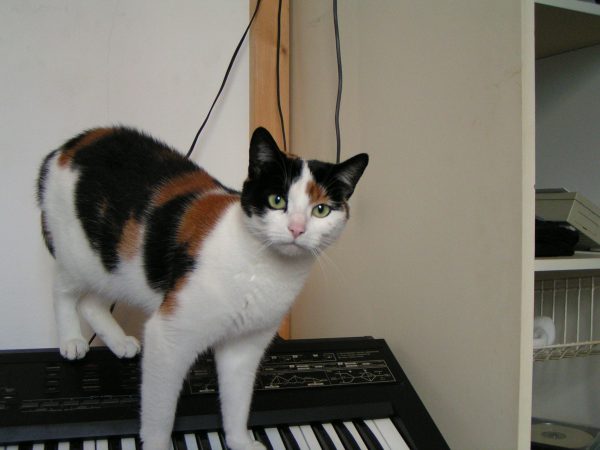
Beautiful calico cat atop a Roland D-50 synthesizer. From Yuri de Haer via Facebook.
The D-50 was Roland’s flagship and most popular synthesizer in 1980s. It employed so-called “linear arithmetic synthesis”, which combined sampled (PCM) transients with a variation on subtractive synthesis, including resonant low-pass filters. It also had a joystick. It remains a popular instrument for its pads and other characteristic sounds. Roland released a re-creation of it for their “Boutique” line, the D-05.
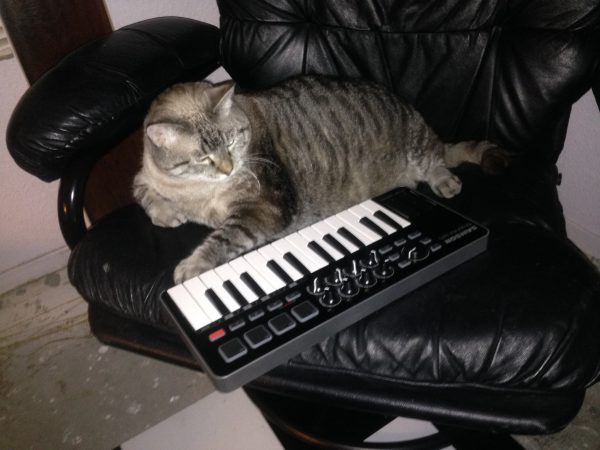
Jojodakat lounges with a Samson MIDI controller, getting ready for a solo synth jam. Submitted by Stephen Hammond via our Facebook page.
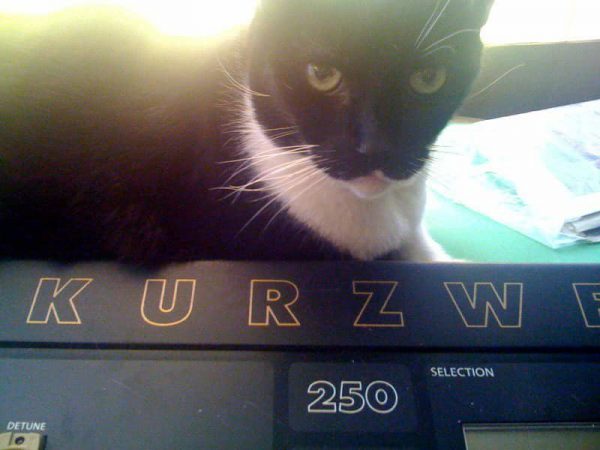
A handsome tuxedo cat introduces the Kurzweil K250 synthesizer. By Jamie Breustedt via Facebook.
The K250 was the first of the Kurzweil’s “K” series of synthesizers in the 1980s and 1990s. Released in 1984, it was among the first to allow ROM-based samples to be layered and played on a keyboard – although the Synclavier and Fairlight CMI already offered sampling at this time. But it did have features such as variable rates and 16-bit sources that gave it the ability to play long samples and get closer to that holy grail of sampling a grand piano – indeed the K250 was supposedly inspired by a bet between Ray Kurzweil and Stevie Wonder on whether he could make a synthesizer that sounded like a “real piano.”
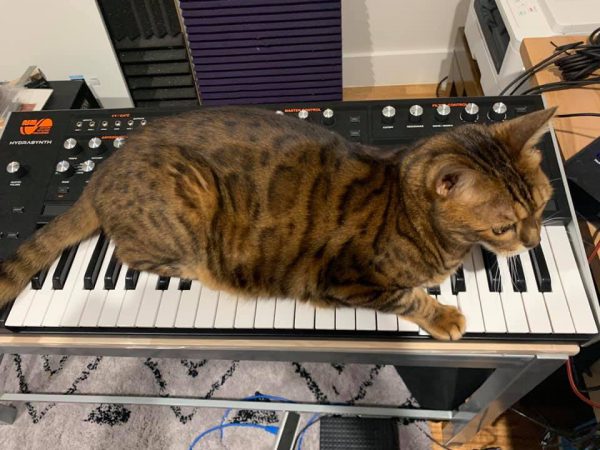
Cute cat atop an ASM Hydrasynth. From Luke Chable via Facebook.
The Hydrasynth was one of the more exciting instruments to come out of at the start of this year, with three oscillators with a rich set of wavetable operations and a polyphonic-aftertouch keyboard. We featured it in our NAMM coverage on CatSynth TV.