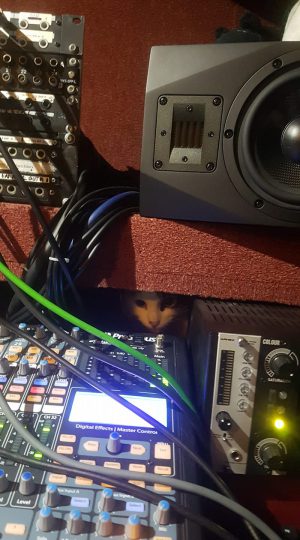
CatSynth Pic: Space Echo RE-201

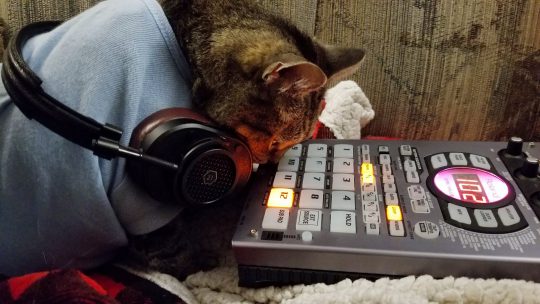
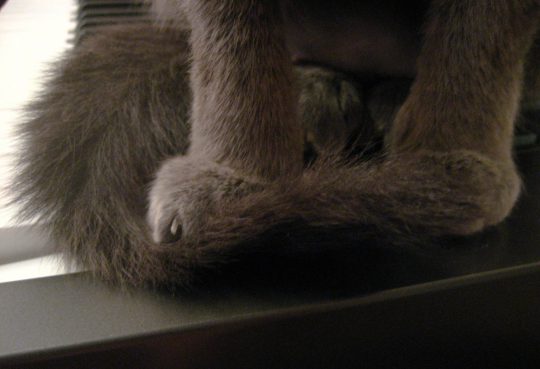
Biggie Smalls contemplates a vintage Roland Space Echo RE-201. From Brandon Fitzsimons via our Facebook page.

“What’s making that noise in there??”

The RE-201 continues to be prized by musicians for its sound. It is actually a true tape-echo machine (plus a spring reverb).

[Ikutaro] Kakehashi’s breakthrough development came in 1974 with the RE-101 and RE-201 Space Echo units, which used the standard 1/4″ tape of the open-reel variety, but made as one, continuous loop. It uses no reels of any kind; the tape is transported via a capstan drive. The tape loop is contained in a loose, constantly moving jumble in the tape chamber (also known as the tape tank) under a plastic panel which protects the tape and keeps it from getting tangled. The design resulted in lower levels of noise, wow, and flutter, and cut down on tape wear.[1] Replacement tapes were sold as well, named RT-1L.[2]
There are several control dials on the device that alter such aspects as tape speed, repeat pattern (an 11-position rotary switch), one instrument and two microphone inputs, a single analog backlit VU meter for all three inputs, wet/dry mix for both echo and reverb, and intensity (number of repeats), that can be adjusted to a user’s liking; and bass/treble controls to EQ the sound of the repeats (not the dry signal), as well as dry and effected “Echo” output jacks with a switch for output setting (-10, -20, -35db levels.)

https://en.wikipedia.org/wiki/Roland_RE-201

It is interesting to read this as I have been working extensively of late with the Magneto tape-echo simulator module from Strymon. You can see our review of the echo mode in this recent video.

CatSynth Pic: Marcel and TB-303

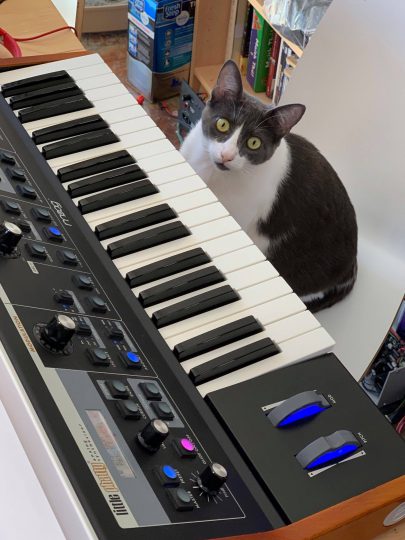
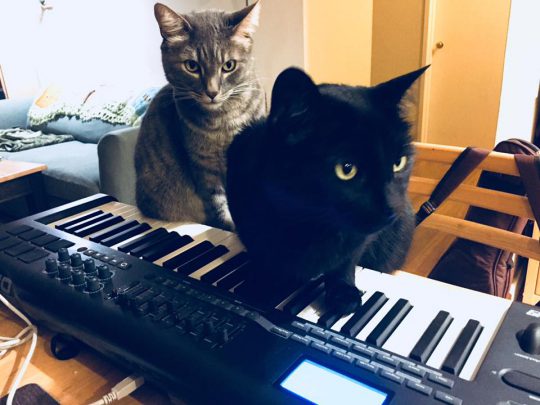
Yesterday was “303” day – the date is 03-03 whether you use American or every-other-country format. And our friend Marcel is posing with a genuine Roland TB-303 for the occasion.

From Eric at polynominal.com via Facebook.

The TB-303 has become a prized instrument, so much so that multiple hardware and software clones have been created to meet the demand. Roland even came out with a TB-03 for its Boutique line.

Codex Seraphinianus

We at CatSynth have been fascinated with the Codex Seraphinianus long before this beautiful edition made its way to CatSynth HQ.

The Codex is a masterpiece of book art by Italian artist, architect and industrial designer Luigi Serafini. It is an illustrated encyclopedia as a handwritten manuscript with hand-drawn color illustrations depicting a surreal imaginary universe of objects, creatures and concepts.

Most interesting of all, it is written in a completely invented script.

The script, consisting of squiggles and dots, sometimes detached and sometimes cursive, resemble a Western, Semitic or South Asian script, but one entirely of Serafini’s own imagination. It is easy to pick out repeated letters, such as the “E-like” character with one dot in its lower section; and curve-on-a-stem that appears to serve as a singular character in many portions of the first book.

Even without knowing the full meaning of the script or the illustrations, one can start to discern meaning. For example, on this page it is pretty clear that this creature tends to wilt (perhaps even suffer) in rain, but thrives in sunshine. (This is something I can sympathize with.)

Serafini himself has declared the writing in the Codex to be asemic, without a specific structure or meaning. And while I take him at his word, one cannot help but construct meaning from both the images and the writing. I have long been fascinated by other alphabets and writing systems and been able to find patterns (and even learn them to some degree) independent of the languages they represent. For example, I was able to learn a bit of the Tamil script when traveling in South India in my youth, though I never learned the sounds or the language. Similarly, I began to pick up Sinographic characters in my time in China but with no knowledge of how to pronounce most of them.

It is in this vein that I have begun to read the Codex from its start, treating it as a pure work of art with text and illustration as its medium. It’s actually a pleasurable and captivating experience to pour over the text and spot the patterns without being confined by the need for meaning. I made it through the first book (plants and anthropomorphic flora) and a bit into the second (animals). It is the fourth book (physics, chemistry) and the fifth (machines) that I most curious to “read” in depth, but I will take my time to get there.

Zemirot (Experiments with Video Synthesis)

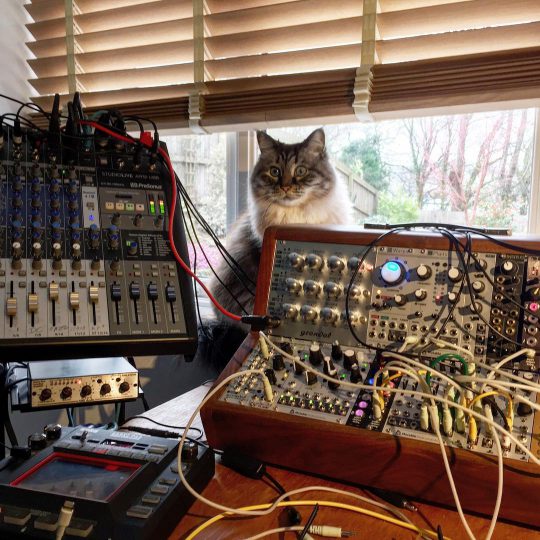
I have been quite intrigued by video synthesis for a while, and finally getting around to doing something with it. Today, we present Zemirot, our first simple video-synthesis piece.

This was done using Vizzie2 in Max/MSP. And while it is extremely simple, that is to a certain degree the point, at least with this piece and others in what I expect will be a series.

CatSynth Pic: Finnegan and Ensoniq Samplers

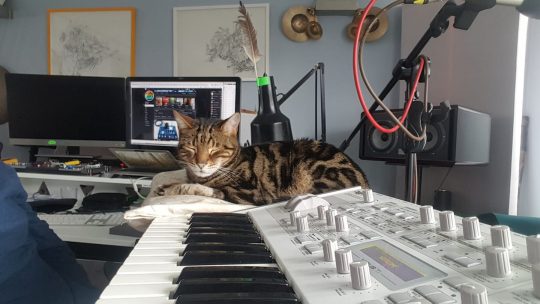
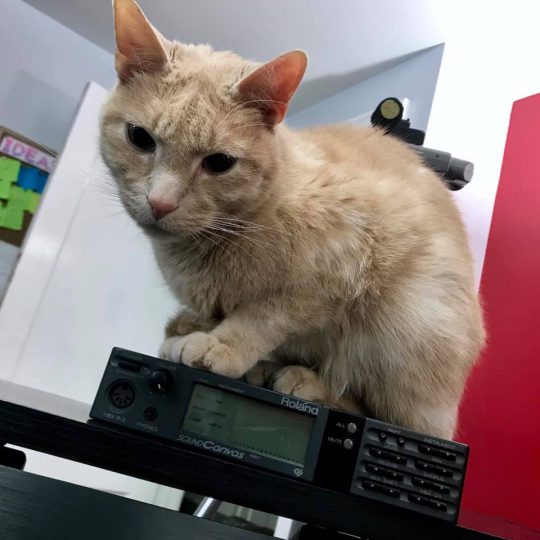
Finnegan shares his latest composition on a pair of Ensoniq Samplers. Submitted by Greg Cole via our Facebook page.

samplers rather than synths but this is Finnegan who spends most days in the studio with me…’helping’.

We at CatSynth are quite familiar with Ensoniq’s venerable line of sampling workstations. I got an EPS in 1989, and then upgraded to an ASR-10 a few years later. The latter is still in storage here at CatSynth HQ.

Fun with Highways: California 99 and 198

The ride back from NAMM is usually an uneventful straight shot up I-5 from Los Angeles towards San Francisco. But I found myself making good time, and in a mood for a bit of exploration – not to mention an opportunity to rack up more routes on my Highway☆ app – so I decided to try something different. I decided to follow California Highway 99 as it splits off from I-5.

CA 99 takes a more easterly route than I-5 and connects to the major towns and cities of the Central Valley. A stretch in the northern part of the Central Valley was featured in our recent CatSynth TV Episode 99, but the southern part largely remained unexplored outside the immediate vicinity of Bakersfield (where it intersects CA 58). So much of the highway was new.

That southernmost section was, to put it bluntly, rather sad. The road is narrow, bumpy, and crowded. The landscape was dotted with a mixture of fields, run-down housing developments, and strip malls. And the sky was smoggy with an unhealthy yellow hue. But the afterglow of our most successful NAMM show to date along with the spirit of exploration gave a level of joy to the experience. At Visalia, I decided to turn off and head west onto California Highway 198.

If 99 was a bit of a cluttered and bumpy mess, 198 was the opposite: a pair of smooth straight lines cutting through farmland with sparse development. It began as an expressway but soon turned into a full-on freeway in Kings County as we headed toward Hanford and then on to Lemoore, where we intersected with Highway 41 in a major interchange. A few years ago, I had seen it from the perspective of Highway 41 and mentioned it a post at that time.

There is something strangely fascinating about the island of small towns sitting at the northern edge of dry endorheic Lake Tulare. I can’t quite put my finger on it, but it is strong enough to inspire a story line and possible writing project that I work through in my mind when I have trouble sleeping at night. We will see if anything comes of it.

Past Lemoore Naval Air Station, 198 narrows to a small two-lane route, and becomes significantly less interesting. My mind shifts to the story on the radio about people whose altruism goes to extreme lengths, including a man in India who founded and nurtured a growing community for people with leprosy while putting himself and his family (including two young children) at risk; and a couple who kept adopting more and more children while having less time and attention for their older biological and adopted children. These drives can be seen as incredibly caring and generous, but I also wondered if they were a bit pathological – indeed, the seeming lack of concern for others affected as they pursued their extreme altruism seemed to be mark of a sociopath.

Heading west on the narrow section of CA 198, we approach Interstate 5 again. This is, however, a spot infamous to north-south travelers for its offending aroma. It turns out the infamous small at the Coalinga junction of I-5 and CA 198 comes from the gigantic Harris ranch and feedlot. It only got worse after turning north onto I-5, but soon enough it was behind me and a not-too-long road to San Francisco remained ahead.

See more of California and many other fascinating places in our Highway☆ app, available on the Apple App Store and Google Play Store.

Highway☆ on the Apple App Store
Highway☆ for Android

Weekend Cat Blogging with Sam Sam: A Comfy Spot on the Bed

It’s been a busy – and cold – time at CatSynth HQ. So it’s not surprising that human and feline alike are seeking warmth and comfort. Sam Sam has taken to sitting on my side of the bed, even rushing to grab the warm spot when I get up.

In the photo above, we see her enjoying a bit of posh comfort on fluffed-up bedding. It’s good to be the cat!

She especially likes it when I leave dirty clothes there, as it adds my scent. I came home after a long day at work to find her curled up on top of them and quite contented.

I suspect she was a little lonely during the day, and perhaps a bit cold as well. It’s been a dreary February, as we have stated before. But it drawing to a close next week, and the skies are becoming a bit brighter. We at CatSynth look forward to the arrival of spring (honestly, it can’t come soon enough).