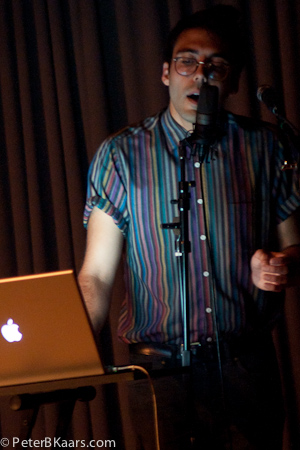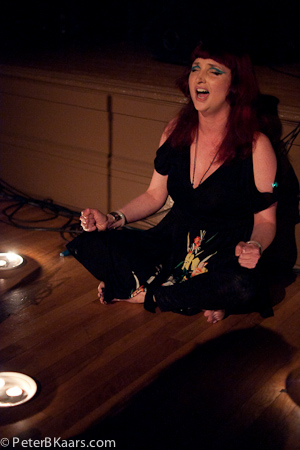
The Outsound Music Summit continued last Friday with “The Art of Composition”, performances of new works by Krystyna Bobrowski, Gino Robair, Andrew Raffo Dewar and Kanoko Nishi. I had heard these four composers discuss their work at the panel session a few days earlier. Now it was time to hear their music.
There was an impressive array of equipment on the stage. Much of it was for Krys Bobrowski’s two pieces.

Balloons have definitely been a big theme of this year’s summit. (Tom Djll featured a balloon in the previous night’s concert, and Tom Nunn featured them in his instrument the following night) In this case, the balloon was used as a resonator in Bobrowski’s Lift, Loft and Lull. Gino Robair struck the “gong”, the large metal rectangle, and brought the balloon close to it. The combination of the balloon’s acoustics and the connected microphone produced a unique resonance effect (and a clever use of acoustic and electronic effects). Against this, Bobrowski played a wildly curved orange horn-like instrument made from kelp that brought to mind a shofar.
The second movement brought the duo together on a single instrument, a large metallic xylophone-like instrument where long tubes were resting on…balloons(!). At first, they played the instrument in a standard way, producing percussive melodies with mallets. But over time, they began to explore different sounds of the instrument, such as rubbing the tubes, and also producing a sound that suggested a motorized device. They also placed different preparations on the instrument to invoke different effects and articulations.
You can see an excerpt of the performance in this video:
Bobrowski and Robair also performed a piece featuring the composer’s glass glass instrument in a duet with wine glasses. I had last heard Bobrowski play gliss glass at the benefit dinner. It was interesting to hear the instrument contrasted with the wine glasses.

[Bobrowski and Robair. Photo: PeterBKaars.com.]
Robair played them traditionally, rubbing the rims to produce strong resonances, but also used tapping and splashing in the water as percussion. The gliss glass vessels, by contrast, can be drained and filled while they are played, resulting in pitch-bend effects that were put to strong use in the piece. There was lots of complex phrasing as well as eerie harmonies and unexpected sound effects. At times, the harmonies were more anxious and expectant, while at other moments they approached romantic tonality.

[Andrew Raffo Dewar’s Interactions Quartet. Photo: PeterBKaars.com.]
Andrew Raffo Dewar’s Interactions Quartet presented Dewar’s new piece Strata, which was inspired by a series of paintings by Argentine artist Eduardo Serón. You can see examples of Serón’s work in this video. His abstract paintings – which I, too, found musically inspiring – feature simple shapes and colors in tight compositions. These simple but powerful visual elements were reflected the clean acoustic notes and sounds of the music. It started out very sparsely, with individual disconnected notes on each instrument. Individual notes became short phrases, and eventually slightly longer lines that intertwined in an undulating counterpoint. The music was quite meditative, with the modal quality and contrapuntal texture, but also had a strong emotional undercurrent. One interesting moment featured the saxophone (Dewar), oboe (Kyle Bruckman) and marimba (Gino Robair) converging into a single pitch range and timbre. Eventually, the complex rhythms coalesced into a single triple meter with a strong driving rhythm anchored by John Shiurba’s percussive guitar and metric beating of ankle bells by Robair. Above the metric foundation one could hear playful descending lines. After staying together rhythmically for a while, the different lines and instruments went their own ways, with various shakers, harmonics on guitar and english horn, and an impressive passage of multiphonics by Dewar on soprano sax – all still remaining within a strong sense of counterpoint.
Kanoko Nishi presented her original graphic scores as interpreted Tony Dryer on contrabass and Italian guitarist and visual artist IOIOI. It would have been interesting to see Nishi’s graphical scores, but the darkened room and minimal setting left ample opportunity for imagination. We did get a taste of what we were in for as Tony Dryer was setting up and soundchecking his equipment, and we were treated to several ear splitting bursts of loud feedback. The performance itself, however, began quite subtly with Dryer bowing very quietly on the bass. Every so often, there would be a louder scraping sound on the bass before returning to minimal levels. Then, all at once, there was a loud hit followed by a long LOUD sustain and feedback. These deliberate and had a great tone, but it was still very loud. When it finally cut out, it was like shutting off a very loud engine – there was even the rumbling slowing to a series of clicks. This was followed by a loop of low-frequency bass notes at a modest volume, which settled into a bit of a groove with noisier sounds layered on top. Eventually, higher electrical noises and squeaks overtook the sounds of the bass. Dryer concluded by playing the stand of the bass (now resting horizontally) with what appeared to be an instrument string.
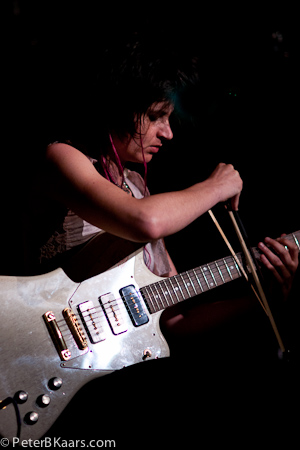
[IOIOI. Photo: PeterBKaars.com.]
The performance then transitioned seemlessly to IOIOI, who was also set up in front of the stage with minimal lighting. She began with long sustained notes in a tonality that sounded Middle Eastern, both in terms of the scale and the use of microtones and pitch bends. Things quickly grew louder, with high screeching tones and loud sustained tones that obscured the otherwise beautiful detailed guitar technique. As things quieted down a bit, I was able to focus more on the fine details, such as bends metallic resonances. IOIOI employed preparations in her guitar at times, such as chopsticks, that gave the instrument a more raspy, percussive sound. She also used bowing that yielded a vigorous passage of scratching tones. Overall, a virtuosic display.
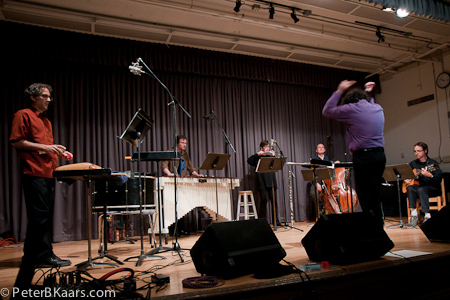
[Ensemble Aguacalientes. Photo: PeterBKaars.com.]
Gino Robair returned for his third appearance of the evening, this time to present his Ensemble Aguacalientes, featuring Polly Moller on flutes and ocarinas, John Shiurba on guitar, Loren Mach on marimba, Jim Kassis on percussion and Scott Walton on bass. Aguacalientes is “a musical suite based on scenes captured by Jose Guadalupe Posada in his politically charged engravings of late19th -and early 20th-century life in Mexico”, many of which feature skulls and skeletons, or calaveras. In keeping with this source, the instrumentation of the ensemble reflects Mexican folk and popular music, including the ocarinas and percussion. The piece began with a very sparse texture, where short melodic lines on the flute headjoint were punctuated by percussion hits. Soon an array of other percussion, including a guiro, and the guitar and bass joined in, with numerous rhythmic lines set oddly against one another. The ocarina lines were longer and more traditionally melodic, but with the instrument’s distinctive sound. There were interesting timbral moments, such as a sinister interplay between harmonics on the bass and guitar, and a more gentle combination of string-bass and bass-flute harmonics. I did find myself listening to the polyrhythms that emerged at various points during the piece, and for the more idiomatic moments that channeled the Mexican subject matter.
Overall, it was a strong concert, and seemed well received by the large audience. I was also left thinking about the often boisterous debate in the Bay Area new-music community between composition and improvisation. Having heard the improvisation-centric and composition-centric nights of the summit back-to-back, I am struck by how much similarity there was – one could have interleaved pieces from both nights into a single concert and ended up with a result that was musically consistent.