From matrixsynth. Can you spot the cat?
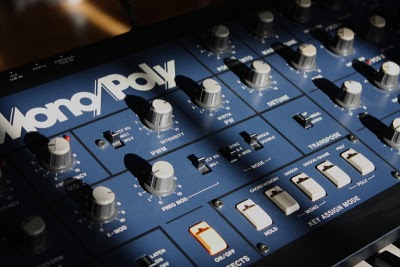


From Lee Tizzard, via matrixsynth:
“Included in these pics [of the CS-01 and documentation] is a captioned pic of Charlotte the cat revealing a common misnomer about the little cs-o1 ‘analogue”‘synth.”

The original post includes some photos of the manual:

You can see more as well as some discussion of MIDI-retrofitting the CS-01 on the post on matrixsynth.
Last Friday I attended a talk featuring Max Matthews and a new conceptual work by local artists as the Gray Area Foundation for the Arts (GAFFTA). GAFFTA is an intriguing new organization and space for the intersection art, design, sound, and technology. They are “dedicated to building social consciousness through digital culture.”
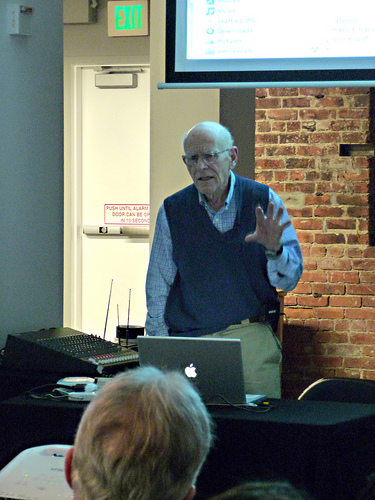
Max Mathews. Photo by Vlad Spears
I had last seen Max Mathews, considered by many to be the “father” of computer music, at an 80th birthday tribute at the Computer History Museum in 2007, and before that delivering the keynote address at ICMC 2006. It is great to see him still going strong and engaged with technology and supporting others’ creative work. His talk primarily focused on his work at Bell Labs, and in particular the history and technologies surrounding his 1962 computer rendition of the song “Daisy Bell” (aka “Bicycle Built for Two”). It was an early example of physical modeling synthesis, where sections of the vocal tract were modeled as tubes, and sound generated directly from physics equations. His version of the song was popularized in the film 2001: A Space Odyssey, although Mathews revealed that the version Kubrick used in the film was not his recording. He also presented another famous example of computer-generated vocals, a performance of the “Queen of the Night” aria from Mozart’s The Magic Flute. This piece used formant synthesis in which focus on recreating spectral characteristics of the sounds (i.e., the formants that characterize vowel sounds) without necessarily modeling the physical processes that allow humans to create those sounds. The voice is quite compelling (if a bit dated), and demonstrates that the most realistic sounds are not necessarily those generated from physical models.
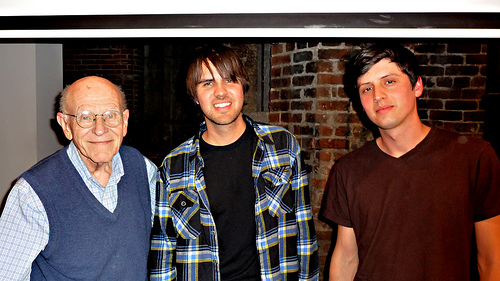
[Mathews, Koblin and Massey. Photo by Vlad Spears.]
Mathews’ presentation of “Daisy Bell” served as an introduction for a new project “Bicycle Built for 2000” by Aaron Koblin and Daniel Massey. Koblin has been working on a series of conceptual pieces that utilize the Amazon Mechanical Turk, a framework for harnessing human intelligence to solve large problems. There are some things that humans are quite efficient at and computers are very poor at, such as recognizing distorted text (think of the CAPCHA codes that we all deal with on websites, including here at CatSynth). The Amazon Mechanical Turk, which derives its name from an 19th century hoax where a supposedly mechanical chess-playing machine turned out to be a human hidden inside a box, provides a framework and API for defining tasks to be solved by humans, recruiting people to work on them, and then compensating them for their efforts according to a fixed budget. One of Koblin’s pieces provides the instruction to “draw a sheep” for a few cents. He then collected the resulting drawings of various sheep (and non-sheep) from around the world and compiled them into a larger mosaic work, The Sheep Market. You can see the overall mosaic as well as click on individual sheep and even see an animation of how they were drawn by the individual contributors.
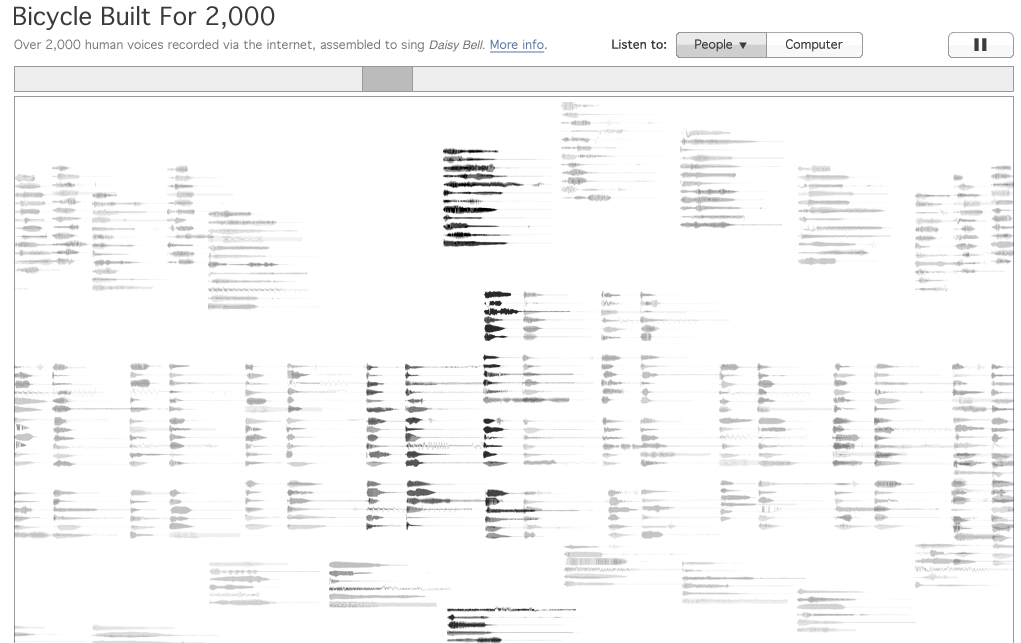
[Screenshot of Bicycle Built for 2000, by Aaron Koblin and Daniel Massey. Click to enlarge.]
For “Bicycle Build for 2000”, Koblin collaborated with Daniel Massey on a work that focused on sound and music. The Max Matthews rendition of Daisy Bell was decomposed in a sound segments no longer than one syllable, and for each segment an Amazon Mechanical Turk task was created for someone to sing back the sound. Koblin and Massey then reassembled the sounds to re-create the song as sung by the participants. The initial version, in which only one singer was used for each component, was almost unrecognizable, though quite interesting. A larger version which included a chorus of voices on each segment better represented the original qualities of the song, and clearly recognizable. You can hear the full version at the project website, along with an interesting visualization of the assembled recordings. The fact that the larger ensemble produced a more recognizable result, essentially averaging out the various sung renditions, is perhaps an example of the oft touted “wisdom of crowds”.
There is also a slightly more ominous set of questions from these works concerning exploitation of individuals who don’t know the overall purpose of their tasks, or about hive mentality and such, but I still find it quite interesting and am inspired to try out the Mechanical Turk for a future art project.
For Weekend Cat Blogging, we present some new and interesting views of Luna:

Even though she is partially hidden by the blinds, this has instantly become one of my favorite portraits. I really like the focus and the color contrast.
This photo captures Luna in mid-paw, claiming ownership of the office chair.

It’s rare that I have been able to get motion like that before, and I would consider this a happy accident. And although Luna likes to own things, she is willing to share as well. We are sitting on the chair together to write this.
Weekend Cat Blogging #251 is hosted by Pam at Sidewalk Shoes, where Smudge has a very nice black-and-white portrait.
The Carnival of the Cats will be up this Sunday at One Cats Nip.
And the Friday Ark is at the modulator.
I heard this report last night on Fresh Air, and then went to read the original article at the Southern Poverty Law Center. Here are some not-so-fun statistics:
It’s easy to forget sometimes, but your friends here at CatSynth could be targets for such groups. Far less of a danger than an auto accident, statistically speaking, but still…
Another from Synthiefrau on YouTube, submitted by vlern via facebook:
From carbon111’s blog via matrixsynth:

Carbon111 also presents a new track title Silver Thread, which you can hear on his blog. The track was composed using an Ensoniq Fizmo, Waldorf Q, Korg Oasys and Digidesign’s Boom softsynth.
I recently visited two openings for artists I met at Open Studios last fall and whose work reflects my interests in highways, architectural images and the urban landscape. The artists take very different approaches, and the shows were in very different parts of the city – but having both openings on the same night was a great opportunity to see them together and simultaneously reflect upon the city itself.
First, I stopped in the relatively quiet West Portal neighborhood for a show at the Greenhouse Cafe featuring Sonja Navin. Navin draws on her architectural background to capture familiar images of the city in her paintings. Perhaps the most “familiar” image was the King Street off-ramp from I-280 in her large painting entitled 280.
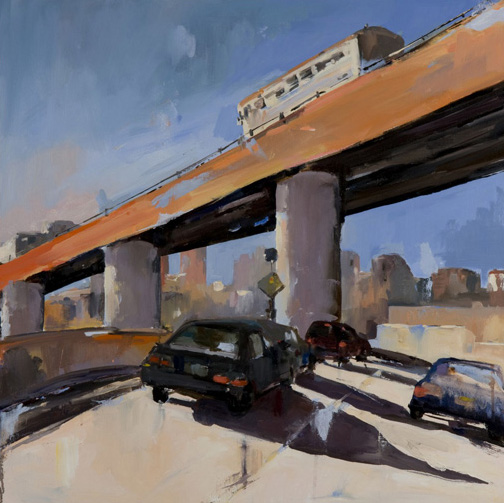
[Sonja Navin. 280. Photo courtesy of the artist. (click to enlarge)]
Navin experienced this interchange the way many of us do, i.e., being stuck in traffic, and thus had the opportunity to visualize it in detail. She also had a painting East on N which featured a familiar view along the N-Judah metro line in the Sunset district.
Although her subject matter is often architectural in nature, her painting style features large brush strokes and irregular areas of color rather than the straight lines and precision of architectural drawings. She also had several figurative paintings, and some such as In The Haight combine both character and street elements.
Navin’s exhibition, which also features artist Kacie Erin Smith, will be on display at The Greenhouse Cafe, 329 West Portal Avenue in San Francisco through April 30.
After brief ride over Twin Peaks, I found myself descending into the Mission district for an opening at City Art Gallery, where I was particularly interested to see new works by Mike Kimball.
Like Navin, Kimball’s interpretation of the urban landscape distills it down to basic elements, but his prints and paintings feature very clean lines and simple geometric shapes. One example is his Maritime Plaza, which I immediately recognized (it is a favorite out lunch spot of mine).
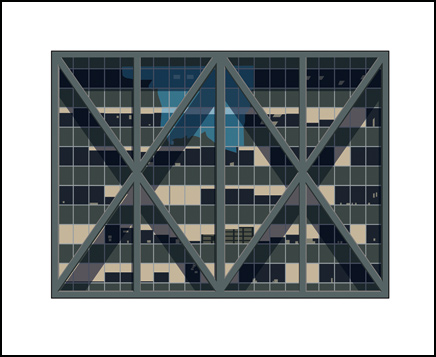
[Mike Kimball. Maritime Plaza. Image courtesy of the artist. (click to enlarge.)]
Like the building it represents, the image is framed by the triangules and X-shapes of the seismic bracing. This was one of the first buildings to use this technique, which is now a familiar site on buildings in the Bay Area.
In Division Street, Kimball represents another familiar sight from daily life, the interchange of I-80 and US 101 that sits above Division Street in SOMA. The image is composed of very simple curves and lines and solid colors, from which one can distinguish the elevated structures of the highway and the shadows they cast, as well as details such as the markings (and probably graffiti) on the sides of the trailers.
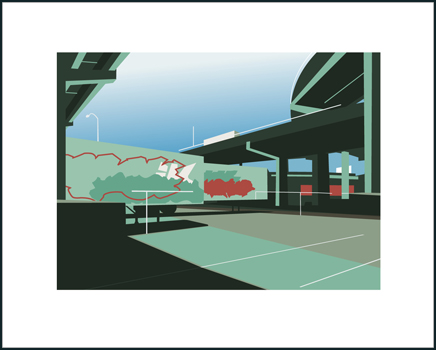
[Mike Kimball. Division Street. Image courtesy of the artist. (click to enlarge.)]
Trucks and trailers also feature prominently in Kimball’s work. His “Truckograph” series features a similar graphic quality to Division Street. His larger work Meditations on a port looks at the stacks of trailers at the port as an abstract collection of boxes. Kimball bridges the industrial and abstract in this work – close up, one can see the writing and metal texture, but from a distance one simply sees the colored squares.
Kimball’s current exhibition will be on display at City Art Gallery, 828 Valencia Street, through March 28.

