Weekend Cat Blogging and Photo Hunt: Three

For Weekend Cat Blogging and today’s Photo Hunt theme of Three, we present a trio of images taken with our new camera:

The glass coffee table at CatSynth HQ has been a mainstay for themed photos, and it presents several representations of the number three:

There are the triangular elements with three sides, and there are the three glass surfaces.  I wish there were only three objects on the table instead of four, but you take what you get.  This picture was taken from above with a telephoto lens, and I really like the detail on the glass, particularly the refraction of the square patterns.

Next, we try out a portrait lens on our resident model:

Notice the overall detail and the color of Luna’s green eyes.  For a rather weak connection to the theme of three, there are three chairs present in this picture.

So now we go out into the world.  It does seem that spring has arrived, and we are ready for new adventures:


Weekend Cat Blogging is hosted by Billy Sweet-Feets with Nicholas

Photo Hunt 205 is hosted by tnchick. This week’s theme is “Three”.

The Carnival of the Cats will be up this Sunday at When Cats Attack.

And the Friday Ark is at the modulator.

On Kawara, MAR. 16, 1993

Today, we consider a work from the Today series by conceptual artist On Kawara. Since 1966, he has created many paintings in this long series, each consisting of the date the painting was created in simple white lettering set against a black background.

By coincidence, the San Francisco Museum of Modern Art (SFMOMA) has in their collection MAR. 16, 1993 from On Kawara’s series:


[On Kawara, MAR. 16, 1993 from the Today series.  San Francisco Museum of Modern Art, http://www.sfmoma.org.]

I have seen it several times in the past, but when I wandered though the museum’s 75th anniversary exhibition a couple of weekends ago, there it was again. And there is no way I would pass up mentioning it today.

Pi Day

We at CatSynth once again join others in recognizing Pi Day today.  This time, Google is joining in as well with one of the special “Google Doodles” on their front page:

The image very nicely captures many of the well-known geometric and trigonometric properties of π in an abstract representation of the Google logo.

Of course, I tend to me be more curious about some of the more esoteric properties that interrelate to other parts of mathematics.  For example, consider  seemingly unrelated Gaussian Integral.

This is the area underneath the Gaussian function which is usually associated with normal distributions probability and statistics. The interrelation of π and e, which we have presented in previous years, is at play again here.

The approximation of the square root of π is 1.77245385…, and like π itself, is a transcendental number. In addition to its appearance in the Gaussian Integral and the Gamma Function (which we also presented on a past Pi Day), it plays an important part of the ancient mathematical problem of Squaring the Circle, that is constructing a square with the same area as a circle using only a compass and a straight edge. Because the square root of π is transcendental, it suggests that Squaring the Circle is in fact impossible. But that probably won’t stop some people from continuing to try.

Weekend Cat Blogging and Photo Hunt: Spiral

The theme of this week’s Photo Hunt is spiral, a shape that appears frequently in art, mathematics, nature, and of course in Luna’s expressive tail.

This is an old photo with a much younger Luna in our former home in Santa Cruz.  It is one of the best examples of the tight curl she often forms in her tail.  Here is a more recent example:

The spirals in Luna’s tail are all about motion, and often difficult to capture in a still photograph. However, you can see them very clearly in the recent videos from our performance.

With respect to music, a spiral was also one of the symbols I used in my recent piece for conduct your own orchestra night:

This is the classic Archimedean spiral, defined by the formula r = aθ. Essentially the distance from the center increases proportionally to the angle as one “spirals out” from the center. There are other formal mathematical variations on the spiral, such as Fermat’s spiral, which I find visually interesting.

Is mathematics, music and cats not a fine way to start the weekend?


Weekend Cat Blogging #249 will be hosted by our friends LB and breadchick at The Sour Dough.

The Photo Hunt is hosted by tnchick. This week’s theme is spiral.

The Carnival of the Cats will be hosted this Sunday by Kashim, Othello and Salome.

And the friday ark is at the modulator.

Conduct Your Own Orchestra Night

Last Thursday, I participated in Outsound Presents Conduct Your Own Orchestra Night at the Luggage Store Gallery. During the course of the evening, several conductors took turns conducting an “orchestra” of improvising musicians for ten minutes. Each conductor took a very different approach, using a variety of gestures, instructions and symbols to guide the performers.


[Bob Marsh conducts the orchestra.]

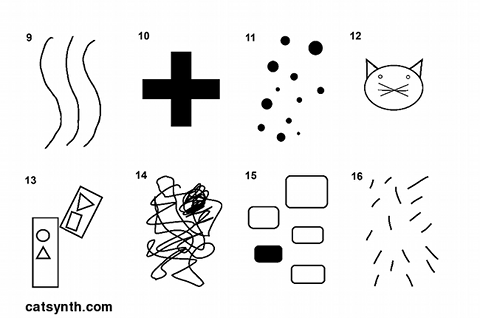
As with other recent guided-improvisation pieces, I used a graphical score for my conducting. The performers were each given a set of 16 graphical symbols. During the course of the performance, I held up large cards each containing one of the symbols, directed either at individuals, groups or the ensemble as a whole.

You can see some of the symbols below:

[Click to enlarge.]

This is the second page of the 16 available symbols, generally these were the more complex. Viewers might notice that symbol 12 is a cat. Like other symbols, I expected to be interpreted relatively freely – but by coincidence percussionist Ann O’Rourke had a cat-shaped metal CD rack as an instrument, so it became a very obvious cue for her to play the “cat.”

Ann O’Rourke’s piece was based entirely on pairings of words, such as “fearful/choppy” and “fearful/flowing” or “hesitant/slow” and “confident/fast”. The orchestra was divided in half, with one side receiving one pairing and the other side receiving the other pairing.

Brandan Landis’ conducting was more physical/body-oriented. He did not use any visual cues (textual or graphical), but instead used dramatic body movements to guide the orchestra. Some of these were rather intense and the piece ended with his collapsing on the floor.

Mark Briggs used short rhythmic patterns and cues to individual performers to build up a complex rhythmic texture. I was given a very simple repeated pattern to perform, which allowed me to remain immersed in the overall rhythm of the piece.

Tom Bickley led the orchestra in a very sparse and beautiful piece with individual sounds from cued performance set against silence. It was the sparse texture that made this among my favorite pieces of the evening, musically speaking.

Bob Marsh used his own instructional cards and gestures to conduct the orchestra, and contributed his own vocal performance on top.

Other conductors included CJ Borosque and Matt Davignon, who used a combination of instructional cards, including one that instructed a performer to make a loud sound when Matt pointed a finger gun and shot him/her.