Tag: don buchla

  • Don Buchla Memorial Concerts in San Francisco

    Don Buchla Memorial Concerts in San Francisco

    This past weekend, April 22 and 23, a series of concerts and panels took place at the Gray Area Foundation for the Arts in San Francisco. It was in the midst of a busy and event-packed weekend (including the March for Science which we have already written about), but as Don Buchla was someone that I not only admired but knew personally, it was important to be there.

    Buchla lives on though his many innovative musical instruments, and a pop-up museum was set up in side room of the theater showcasing many of them.

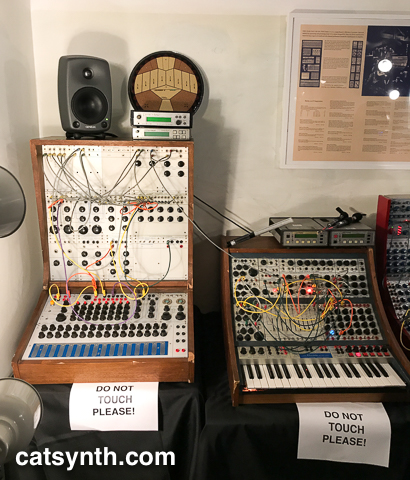
    Buchla 100 and 200 series

    On the right of this photo is an example of Buchla’s iconic 200 series modular synthesizer, probably the instrument for which he is best known. On the left is the rarer 100 series, originally commissioned by electronic-music pioneers Ramon Sender and Morton Subotnick of the San Francisco Tape Music Center. Neither the of these early modular series had a traditional piano-style keyboard, nor were they based traditional subtractive-synthesis architecture of oscillators, filters, and amplifiers in that order, but rather a mix of traditional synth modules with unique waveshapers, low-pass gates. The latter is probably the most recognizable as the “Bucha sound” but the variety of musical sound expression from this instruments continues to be very wide and the ethos of his work can be seen in the current renaissance of sometimes esoteric modular synthesizers. You can read more about his work and philosophy on this tribute website.

    There were also some instruments I had not seen before, including the Buchla Touché and the 700 series / MIDAS.

    Buchla Touche and MIDAS systems

    These were more conventional in the sense of having a keyboard and a more fixed topology, but were still quite versatile in terms of their software. They certainly have a very vintage 1980s look, especially with the computer monitors and graphics.

    The evening concert began with tape pieces by George Lewis and a premier of a new piece by Laurie Spiegel.

    Laurie Spiegel

    Spiegel’s piece had a dark but sparse quality, with discretely positioned sounds and timbres.

    The live performances began with Laetitia Sonami performing on a custom gestural controller.

    Her work is often focused on live movement and gesture and indeed has been an influence on my own performance practice with the theremin. But Sonami is adept at very subtle motion with seemly precise affects on the sound output.

    The live performances continued with Bob Ostertag, who controlled live music and video from the center of the hall.

    Ostertag’s sound is quite distinctive independent of the particular instruments in use, usually noisy and hard driving. And this performance was no exception – indeed, I was able to instantly recognize the sound as his when it started, even without being able to see him at first in the darkened space. The music however, did have dynamic range and timbral variation that gave it a narrative contour. The video was abstract, but again with a bit of an urgent quality that kept things moving forward.

    Morton Subotnik’s music is in many way the opposite of Bob Ostertag’s. It is quiet and very subtle, focused on small points and details in time.

    Morton Subotnik

    It was spare, almost severe, but listening closely one can appreciate many of the timbral details. The changes are musical but on a different scale than one is accustomed to. The frequencies timbres are complex even while the amplitudes are low, and it is listening to these and the slight percussive elements that punctuate the music that one begins to hear how it fits together.

    In between the live performances there was a tribute video for Don Buchla, featuring images as well as interviews with him. There were also cameos by a great many people I know in the electronic-music world. It was very touching, but also quite humorous, all in keeping with Don’s character.

    The concert continued until late at night – in some ways, it was set up more likely a crowded nightclub or impromptu electronic-music party than a traditional concert. It was great to see it so well attended – the room was packed with people standing or sitting on the floor, but it did make focused listening a bit of a challenge at times. I was unfortunately not able to stay for the whole night, so missed a few live sets, including from friends Marielle V. Jakobsons, Tom Dimuzio, Matt Ingalls, and Richard Devine. I do hope to see them live again soon.

    I also hope this is not the last event we have to celebrate the life and work of Don Buchla. I personally still feel like I have only scratched the surface of his instruments as a performer and listener.

  • NAMM 2017: Moog Music Tribute to Synthesizer Pioneers

    This year our friends at Moog Music, Inc. had a very different sort of booth. Instead of the usual array of gear for demonstration, the space was bare and stark, with a simple kiosk and a wall dedicated to the many synthesizer players and innovators we lost in 2016.

    It was a rough year for the synthesizer community. Among those we lost were Pauline Oliveros and Don Buchla, both of whom were memorialized here on CatSynth and whom I had known in person. There were also images and statements for Keith Emerson, Bernie Worrell, Isao Tomita, and Jean-Jaques Perrey.

    Visitors were invited to wander the space in contemplation or with a mix of music from the artists on classic Walkmans. Visitors could also leave social media tributes to one or more artists and have an opportunity to win one of several current Moog instruments, including a Werkstatt, Mother-32 and even a new Model D.

    We didn’t win, but were very touched by the way Moog used their space to pay tribute to the many heroes we lost in 2016. It was a unique and moving experience at this year’s NAMM show.

  • R.I.P. Don Buchla (1937-2016)

    2016 has not been a good year for our musical heroes. And we have just lost one more, Don Buchla.

    Don Buchla at SFEMF 2010
    [Photo by Michael Zelner]

    Don Buchla was producing his first synthesizers about the same time that Robert Moog released his earliest models. But he took a very different approach, eschewing keyboards and other traditional interfaces to make a truly radical instrument. This led to some describing “East Coast” and “West Coast” schools of synthesizers – something that we at CatSynth largely reject. But there are nonetheless characteristics that set apart Bucvla’s instruments, such as the use of metal plates as controls; the ubiquitous use of low pass gates (LPGs) as sound units; the crispier/crunchier sound compared to Moog-inspired synths; and the visual beauty and oddness of the instruments. Indeed, they have appeared on CatSynth many times – follow this link to see a few.

    In addition to his synthesizers, Buchla also created numerous controllers, such as the Thunder, Lightning, and Marimba Lumina. Indeed, I was introduced to Buchla’s instruments and the man himself through David Wessel at CNMAT, who used the Thunder extensively in his performances. My personal memories of the two of them together mostly revolve around the wine-and-beer-fueled gatherings after formal events at CNMAT, ICMC conferences or elsewhere. They would talk endlessly but anyone else could chime in, and occasionally Don and I would have a sidebar, less often of a technical nature than lamenting strictures in one institution or another, or non-musical scientific concepts. Overall, however, he was often a laconic presence, off in a corner or just off frame, but then fully engaged when the moment arrived.

    Buchla and Roger Linn
    [Buchla sighting at Roger Linn’s NAMM booth in 2015]

    It was rare to see him perform. I did get a chance to do so at the

  • 2010 San Francisco Electronic Music Festival

    A few weeks ago I attended two performances at the San Francisco Electronic Music Festival. I did live tweets at the time, and now present a more detailed and reflective account.

    The performances took place at the Brava Theater in the Mission District. There was also a satellite event at the de Young Museum which unfortunately I was not able to attend.

    The festival opened with a piece by Benjamin Bracken. The stage was set with a series of guitars each facing its own amplifier. The guitars were excited (i.e., made to resonate) by “a process of using feedback of specific sets of harmonic partials.”

    [Benjamin Bracken. Piece for Unplayed Guitars.]

    The piece began with a low rumble and drones. The sound grew denser, sometimes forming a minor harmony, and other times distinct beating patterns were audible between the long tones. Later on, the drones became higher in pitch and more “anxious” sounding and were mixed with other sounds, including something that sounded like metal objects being rubbed against one another, or bowed strings. The sound gradually became louder and more all encompassing, sometimes resolving back into a single harmony or pitch, and sometimes into a series of perfect intervals, along with some more more metallic and bowed sounds.

    [John Chowning.  Photo by Michael Zelner.  (Click to enlarge)]

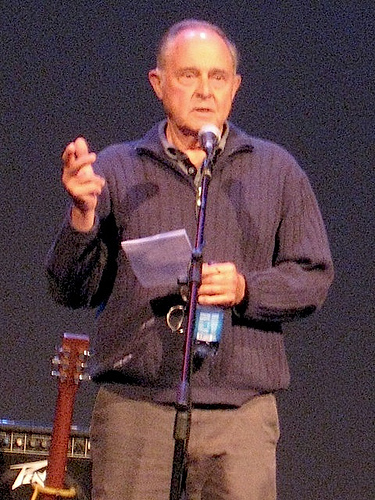
    Bracken was immediately followed by John Chowning, who came out to talk to the audience before his set began. Many readers are undoubtedly familiar with Chowning as a pioneer in sound synthesis,and his invention of modern FM synthesis. But Chowning is also an accomplished composer and his pieces are quite beautiful. Turenas made extensive use of both FM synthesis and his early work moving sound sources in 360-degree sound space. Indeed the piece seemed to be composed of tiny particles of sound that seemed both natural and synthetic at the same time, and which were moving very strongly around in space.

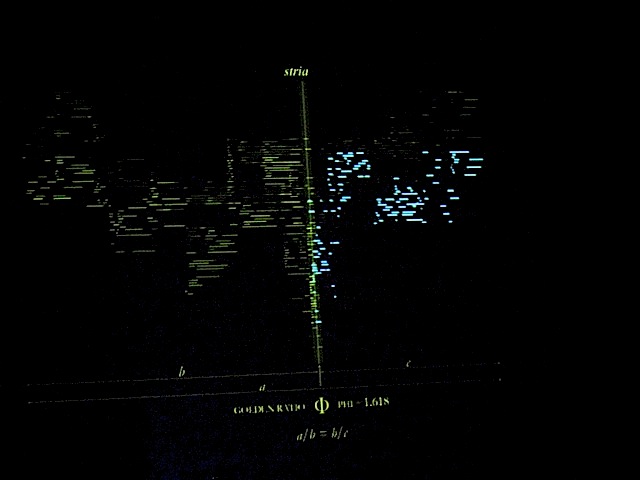
    [John Chowning’s stria.  Photo by Michael Zelner.  (Click to enlarge)]

    Chowning’s second piece stria was originally composed and presented in 1977 at IRCAM in Paris. It is based on the golden ratio, which plays a strong role in mathematics, visual art and also how we perceive narrative in music as well as storytelling. Chowning took this a step further by basing the ratios of frequencies in the sounds themselves on the golden ratio, and using a 13-note scale to express the resulting timbres. While this results in sounds that seem inharmonic (or “clangorous” as the program notes describe it), it also provides a certain order to the piece. The music was accompanied by a visual that should the spectral composition of the piece, as well as the golden section in the temporal development (bringing it back to its traditional application in narrative.)

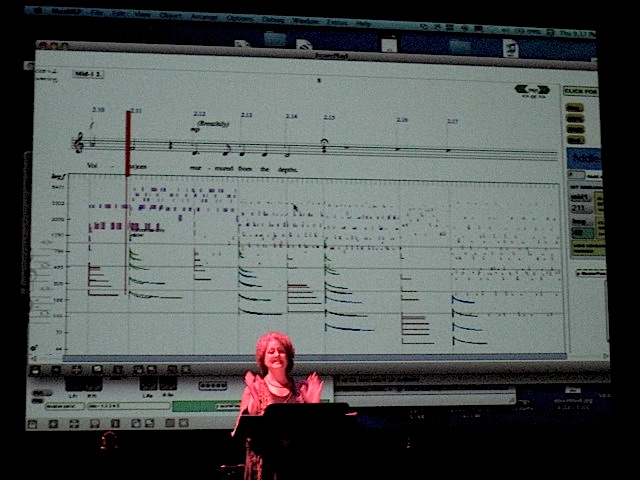
    [Maureen Chowning in Voices v.2. Photo by Michael Zelner. (Click to enlarge)]

    The third piece was a more recent composition Voices v.2, and featured soprano Maureen Chowning on voice. Pitches from her voice were tracked by a program written in Max/MSP and used to control FM synthesized sounds that are then remixer the voice and spatialized into the auditorium.

    As Maureen Chowning was singing the piece, the Max/MSP program plus the score were projected onto the screen behind her, where the audience could see the efforts of John Chowning cajoling the program into behaving itself in real time.

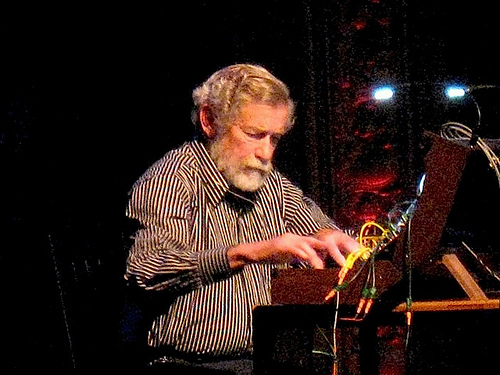
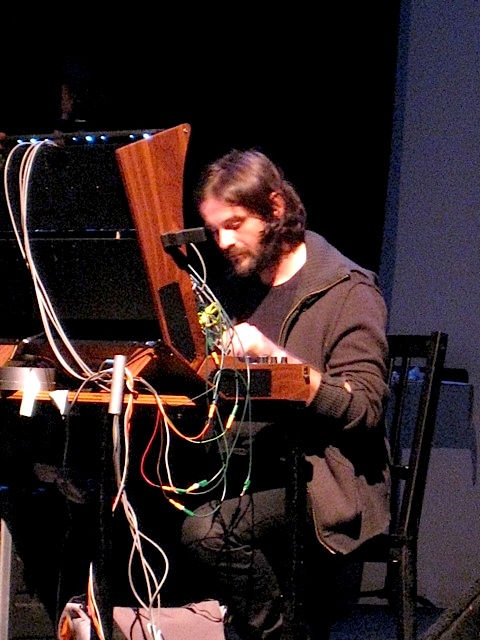
    The final set featured another pioneer in synthesis, Don Buchla, who continues to mahis Buchla analog synthesizers to this day. He was joined by Alessandro Cortini (aka “blindoldfreak”), who may be familiar to readers for his sonoio project.

    [Don Buchla and Alessandro Cortini.  Photos by Michael Zelner.  (Click to enlarge)]

    They began the set with a piece for “dueling Buchlas” by Cortini entitled Everything Ends Here. It opened with low notes and filtered analog drones, followed by sounds that were more windy and wispy before becoming more defined. There was a pattern with suspending major harmonies, then loud noises, moments of massive distortion, and then very low “sub bass” tones.

    The next piece, Buchla’s En Plein Vol began as a standard piece for percussionist (Joel Davel) with a marimba, cymbals, temple blocks, gongs and other conventional instruments. At some point during the performance, Cortini wandered onto the stage. He lingered nearby, and then very conspicuously walked off with one of the temple blocks. He and Nannick Bonnel continued to come by and remove instruments. However, as each item was pilfered, Davel continued to play the same sound in the empty space, as if it was still there. This trick was likely accomplished by using synthesized sounds controlled by a Buchla Lightning. The piece continued in comical fashion until all the instruments and eventually the performer himself were removed from the stage.

    Buchla and Cortini returned to the stage in full Carnaval attire. Buchla set in motion a pattern with a frantic jumping rhythm and an out-of-tune sequence of soft analog waves. Gradually, the music became more percussive and rhythmic, and on the screen were scenes of Carnaval percussionists. A parade of masked performers began to descend into the theater from the back, often stopping to “play” with the audience (I’m pretty certain it was Gino Robair who had a little fun with me as I attempted to “live tweet” what was unfolding). The music became a combination of synthetic drumming sounds, whistles and noisemakers. After a few rounds that did truly resemble a mini Carnaval parade, the performers ascended to the stage and formed a large semi-circle for the final piece Parabolic Trajectories.

    The performers all donned large comical sunglasses – which did elicit a bit of laughter from the audience. Buchla then started up the main instrument for this piece, an old fashioned popcorn maker. As the performance drew to a close, randomized percussive sound (and mildly burnt odor) of the popcorn filled the theater.


    I also attended the Saturday performance, this time as a volunteer usher. In between my ushering duties (which mostly consisted of holding a really cool flashlight and occasionally asking someone not to bring their food or drink into the theater), I was able to see and hear the full show.

    Joseph Hammer opened the program with Road Less Traveled, An improvisation-based composition featuring sound loops and other found sonic material. The intention was to build in a senepse motion and narrative with the changing sound palette, a “journey with uncertainty as thr goal.” Musically, the loops at the beginning were more folk-rock samples (which in a tweet I suggested required the medical gloves that Hammer was wearing.) Over time, the source material incorporated more funk and classic R&B, which worked better for me.

    Stephan Mathieu performed an extended version of Alvin Lucier’s Music with Magnetic Strings, in which the strings of an Ottavino Virginal, a small Renaissance clavier, were set into vibration by five electromagnets. The result was a sound image that was at once very Tarkington and simple, but also full of complex details such as beating patterns between sustained tones. There were also plucked strong sounds (at least as far I was able to discern) and also an ebow placed on top of the strings at one point in the piece. The very minimal structure and sound of this set may have been a challenge for some listeners. For me, I think I was in just the right mood to be receptive to something like this where I could completely defocus.

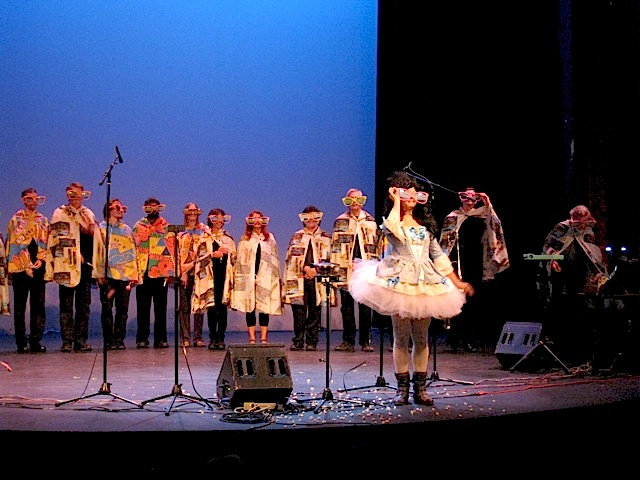
    The final performance of the evening and of the festival was by Caroliner Rainbow.  The group describes itself as “an Industrial Bluegrass/Experimental/Noise conceptual art Costume Rock band.”  I am still not entirely sure what “industral bluegrass” is, but the aural and visual experience is certainly unique.  The first thing one notices is the large and elaborate stage set.

    [Caroliner Rainbow]

    The colors, shapes and textures seemed to be somewhere between psychedelic and urban graffiti, with bright fluorescent hues. For some of the performers, it was challenging to tell where the set ended and the costumes began, until one saw the performers’ motions, which ranged from standard performance gestures (e.g., guitars, drums) to odd back-and-forth rocking. The performers and stage did seem to function as a single entity.

    Musically, the performance was something between noise and experimental punk rock, with big flourishes of piano, organ, drums, guitar and electronic noises. These seemed to come in bursts rather than as a single long phrase. Some friends of mine had seen them perform years ago, with one of the more memorable moments between a squeaking fiddle – this was present in this performance in between some of the other sounds and gestures.

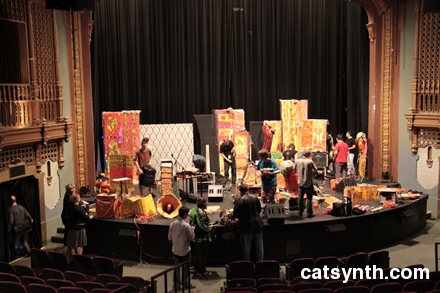
    After the festival concluded, there was still the challenge of dismantling such a large set. We close with a few of the staff and volunteers getting started:

    [Post SFEMF.  (Click image to enlarge)]

  • CatSynth at SFEMF Eleven

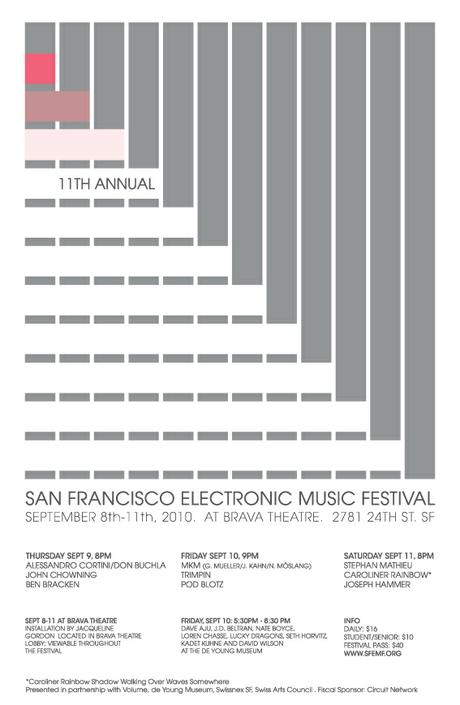
    Click to enlarge SFEMF poster

    The 11th San Francisco Electronic Music Festival will be happening today through Saturday and I plan to be there for at least the performances tonight and Saturday. Once again, I will be live-tweeting and readers can follow on Twitter @catsynth or via the #SFEMF tag. So those not in the Bay Area can follow along vicariously – though I encourage local electronic-music enthusiasts to attend in person.

    The performance tonight includes a collaboration of Alessandro Cortini, whose videos and images we have been featuring here on over the past coulee of months, with Don Buchla. Also performing are another synthesis pioneer John Chowning, and Ben Bracken. You can see the full schedule for the event here.