

Photography
Wordless Wednesday: Carolina Street

Wordless Wednesday: Yan’an Elevated Road, Shanghai

Wordless Wednesday, Cooper Square, New York

Lights on the 7 Subway Line

 Some lines in the New York City subway system use diamonds and circles to differentiate between express and local, respectively. This is the case on the 7 (Flushing) line as well. However, I while most trains simply carry the appropriate sign, the trains on this line used lights instead, creating a unique effect:

As far as I know, this is only line which features these lights. The picture above illustrates the green circle representing the local train. Below is a red diamond representing the express:

I was not particularly happy with the second photo, but it does illustrate both the red light and an interesting side-effect that I observed: the reflection of these bright colored geometric lights on the windows both from other trains and within the car itself. I found myself watching the colored shapes dance, and contrast with a few of the passengers sitting in the car or rushing along the platform. Not mesmerized per se, the way a cat reacts to a light pointer, but still focused. I don’t know if anything will come of it besides this brief post.
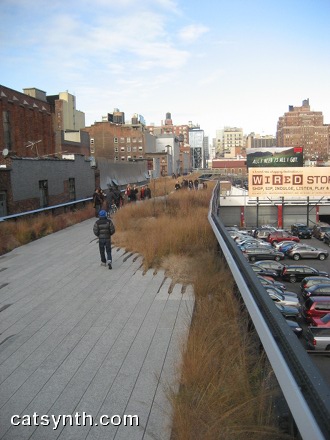
Wordless Wednesday: High Line

Degeneration / Regeneration, Marina Abramović Institute
Last Friday, I attended the opening exhibition of the Marina Abramović Institute here in San Francisco. The exhibition, entitled Degeneration / Regeneration, featured several live performance pieces and videos, and included an introductory talk eponymous founder, Marina Abramović.
Abramović was a pioneering performance artist in the 1970s; I first encountered her work when briefly studying artistic collaboration in conceptual art of the 1960s and 1970s. (This was the same time that I discovered Gilbert and George.) In her introduction, she was particularly concerned with how contemporary audiences experience “long-duration performance art”, preferably with concentration and without distractions such as conversation or “Blackberries.” As a demonstration, she instructed us on how to walk into the first exhibition space, a very slow and deliberate sequence of “lift, stretch, land and move” repeated the entire way of the lecture area up the stairs to the first exhibition hall. For someone who tends to walk rather fast, this can be difficult.
In terms of the pieces themselves, a few stood out in particular. Jennifer Locke was busy in a glass-enclosed space, painting it entirely black. She was herself covered entirely in a black suit as well.
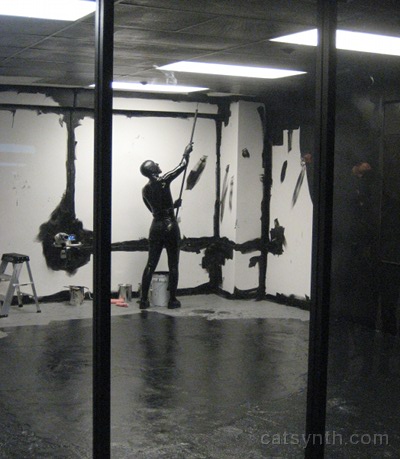
With her were cans of paint, standard commercial painting equipment, and several large containers of Elmer’s glue. It was not exactly clear what the glue was for. We came back a few times to see her “progress” and eventually she had the room completely painted black. At this time, she proceeded to remove her suit and pick up one of the containers of glue. It was then we all realized what the glue was for, as she poured one container after another over her body. I did not stick around to see how this situation resolved itself (no pun intended).
 I did like Mattias Ericsson’s pair of pieces. Maybe everything is grey after all covered a kitchen area of the building with black-and-white photographic prints, some of which were displayed openly, and others (particularly tiny 1×1 inch prints) neatly placed in closed boxes or behind cupboards. One could open these spaces and peruse the images, which appeared to chronicle very personal and intimate moments. Readers can get a sense of the images via interactive version. One starts to feel a bit voyeuristic going through them. Ericsson also present a video entitled 1630 photographs, in which he described his photographic process and his vision for his work.
Another featured live performance by Michael Ryan Noble invited audience members to participate by placing clay on his body, an act that is both sculptural and symbolic of burial. Many audience members did participate, and a participants sculpted elaborate clay objects to place on him, such as a dorsal fin.
Overall, it is an exhibition that does push one comfort’s zone (especially the glue). I am often left wondering whether performance art is closer to the visual arts than it is to music and theater, or something entirely different. I find myself wanting to treat it more like visual art, which seems to go against what Abramović stated at the start of the evening.


