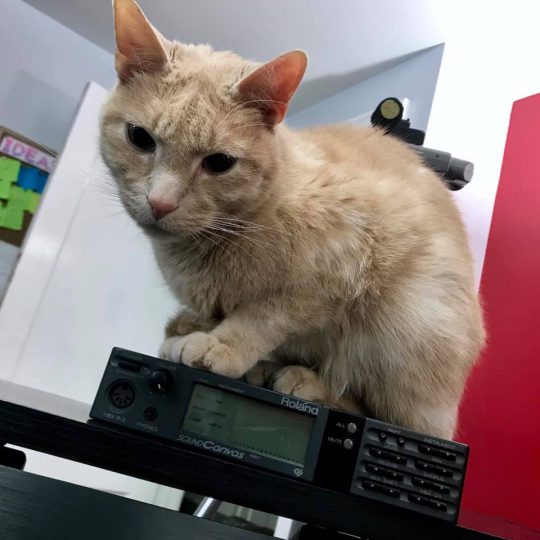
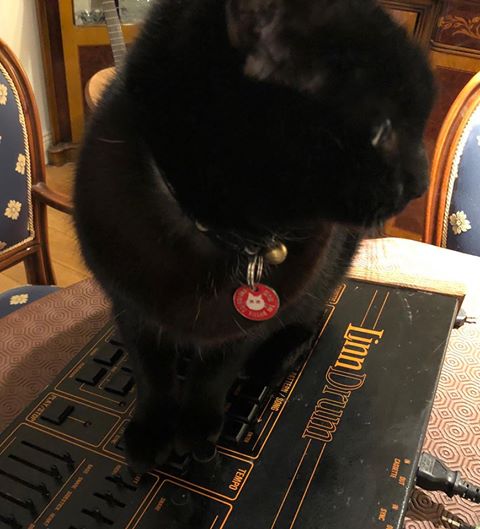
Meet Isosceles the cat, who sits atop a Roland Sound Canvas synth module. Submitted by Carl Peczynski via our Facebook page.
Roland Sound Canvas modules were pretty common in the 1990s. I had a Roland SC-7, which functioned as an outboard synth for my Windows PC at the time. It’s pretty still somewhere in storage at CatSynth HQ.
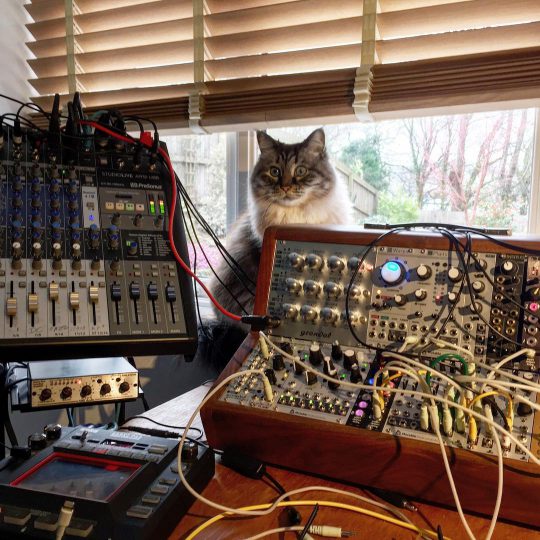
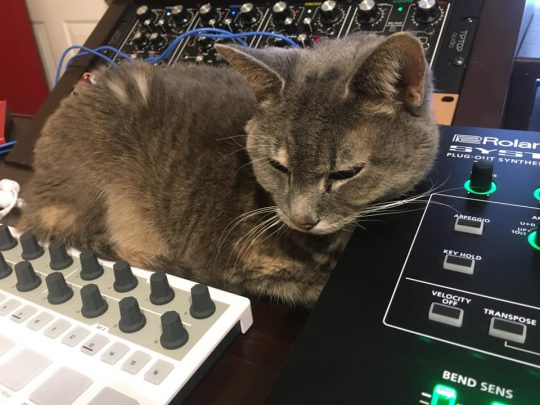
Martika found a nice spot behind the modular synth and control panel. We also espy a Korg Kaoss pad nearby. From Mark Harrop via our Facebook page.
Martika enjoys the VU…She likes to lodge herself on the ledge behind the small modular because she knows its difficult to move her from there. And she knows she’s not normally allowed in the studio
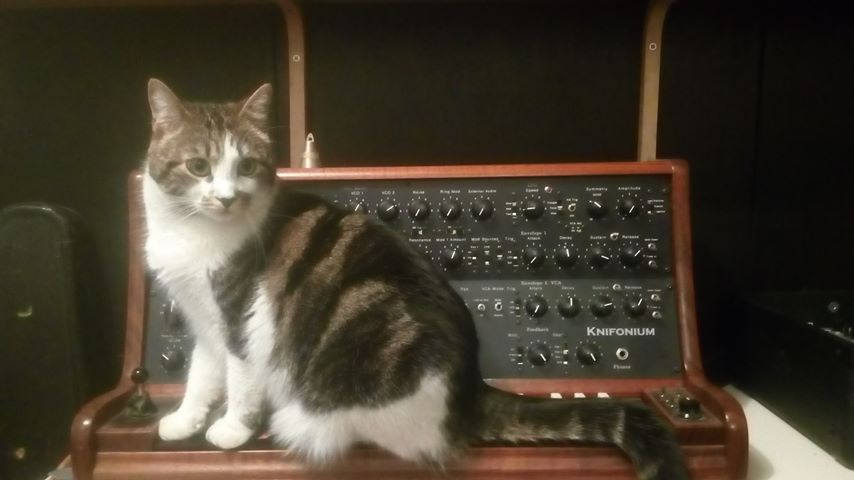
Jackie sits atop a Knifonium synthesizer at Åghström Production Studio in Brussels, Belgium. Submitted by Nicolus Ripitus via our Facebook page.
Exceptional synth under an exceptional pussy cat
We at CatSynth agree on both counts! Jackie is quite regal posing on the synth. And I had never heard of the Knifonium before, but upon visiting the website it sounds quite unique.
Knifonium is a 26 tube monophonic synthesizer with two oscillators, a 4th order ladder filter and a ring modulator.
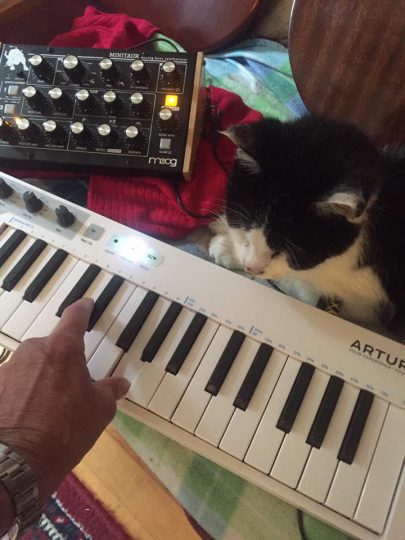
Mojo the cat looks on as a musical performance with an Arturia Keystep and Moog Minitaur unfolds. He seems to quite enjoy it. Submitted by Bruce Oliver via our Facebook page.
Mojo was my little buddy for 17 years. He loved synth sounds but would vacate the room if you picked up a guitar!
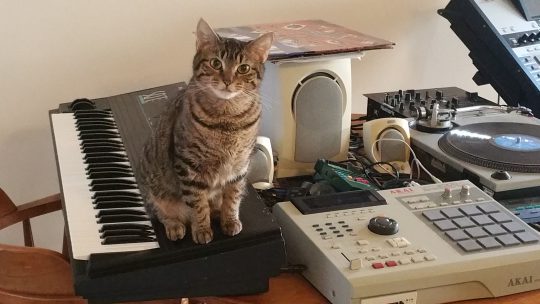
Kasey finds a comfy spot between a Roland Plug-Out system, Roland modules, and an Arturia Beatstep Pro. Submitted by Chris Bentley via our Facebook page.
Kasey the cat. Passed away at the age of 19 back in August 2017 but used to love to hang out on my desk while I was tinkering in the studio.
We are very sorry to hear of Kasey’s passing, and our hearts go out to Chris as the rest of Kasey’s family. A wonderful studio cat who lived a long and loved life 💕
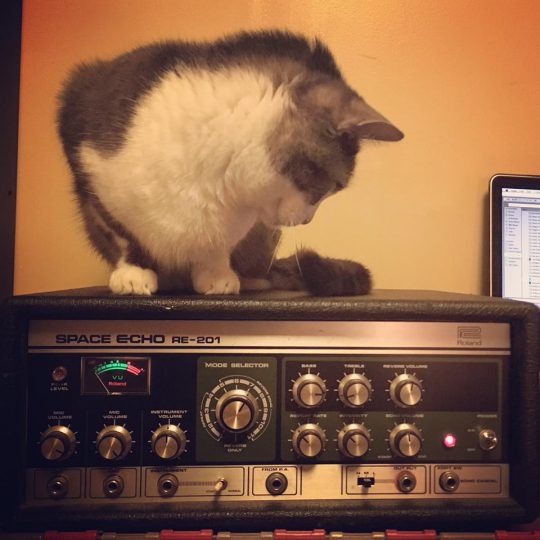
Biggie Smalls contemplates a vintage Roland Space Echo RE-201. From Brandon Fitzsimons via our Facebook page.
“What’s making that noise in there??”
The RE-201 continues to be prized by musicians for its sound. It is actually a true tape-echo machine (plus a spring reverb).
[Ikutaro] Kakehashi’s breakthrough development came in 1974 with the RE-101 and RE-201 Space Echo units, which used the standard 1/4″ tape of the open-reel variety, but made as one, continuous loop. It uses no reels of any kind; the tape is transported via a capstan drive. The tape loop is contained in a loose, constantly moving jumble in the tape chamber (also known as the tape tank) under a plastic panel which protects the tape and keeps it from getting tangled. The design resulted in lower levels of noise, wow, and flutter, and cut down on tape wear.[1] Replacement tapes were sold as well, named RT-1L.[2] There are several control dials on the device that alter such aspects as tape speed, repeat pattern (an 11-position rotary switch), one instrument and two microphone inputs, a single analog backlit VU meter for all three inputs, wet/dry mix for both echo and reverb, and intensity (number of repeats), that can be adjusted to a user’s liking; and bass/treble controls to EQ the sound of the repeats (not the dry signal), as well as dry and effected “Echo” output jacks with a switch for output setting (-10, -20, -35db levels.)
https://en.wikipedia.org/wiki/Roland_RE-201
It is interesting to read this as I have been working extensively of late with the Magneto tape-echo simulator module from Strymon. You can see our review of the echo mode in this recent video.
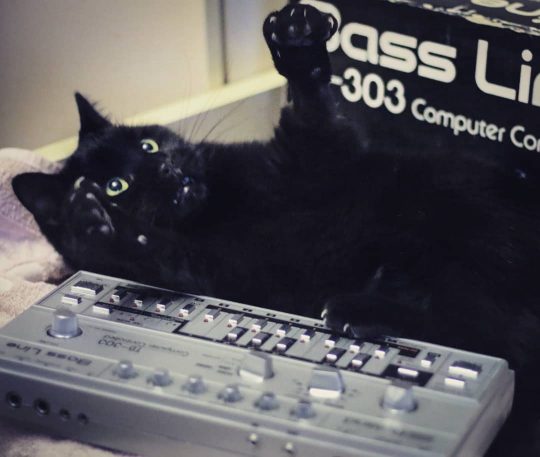
Yesterday was “303” day – the date is 03-03 whether you use American or every-other-country format. And our friend Marcel is posing with a genuine Roland TB-303 for the occasion.
The TB-303 has become a prized instrument, so much so that multiple hardware and software clones have been created to meet the demand. Roland even came out with a TB-03 for its Boutique line.
I have been quite intrigued by video synthesis for a while, and finally getting around to doing something with it. Today, we present Zemirot, our first simple video-synthesis piece.
This was done using Vizzie2 in Max/MSP. And while it is extremely simple, that is to a certain degree the point, at least with this piece and others in what I expect will be a series.