
Author: catsynth
-
CatSynth Pic: Ensoniq Fizmo

By Crawling Wind via gearslutz.
“Savu prefers the Ensoniq sound!”
There are actually some Ensoniq sounds that I miss, though I was able to re-create most of them in E-MU Emulator X.
If you have cat-and-gear photos, you can submit them to us via our Facebook page, tweet us @catsynth or contact us.
-
CatSynth pic: Piano kitten

Bon alors, mi ré ♪ ♫♪♫
Submitted by Polly Moller via Facebook. You can read more about our most recent collaboration here, and find out the latest on our band Reconnaissance Fly, including our upcoming show on October 8.
-
Weekend Cat Blogging with Luna: Modernist Poses

Luna has long been comfortable in her modernist surroundings, at it is a common subject of her weekend visits to CatSynth. In the photo above, she is striking one of her attention-getting cute poses against the circular geometry of the rug and the angular lines of the glass table.

In those photo, she has a more elegant pose, the classic “reclining cat” from many works of art. But she also has a little bit of attitude and disdain her expression, probably directed towards me for snapping pictures.
The Carnival of the Cats will be hosted by Ritzi iInfidel.
And the Friday Ark is at the modulator.
-
CatSynth Pic: Dave Smith Instruments Evolver
-

A Tale of Two Duos
Today we look back at duo performances from the middle of September: an electro-acoustic spoetry performance with Polly Moller, and a punk-themed Pitta of the Mind performance at Bay Area Ladyfest. Musically, conceptually, and socially, these were contrasting experiences, but both very rewarding. Both duos combined voice with live electronics, and both involved my feminine persona . They also provided opportunities for different styles of playing and collaboration.
Ode to Steengo is a piece based on spoetry (spam poetry) derived from Harry Harrison’s “Stainless Steel Rat” series. Polly Moller and I performed it several times as an electro-acoustic duo in 2008 and 2009, and then later in our band Reconnaissance Fly. We reprised the piece for our duo performance at The Nunnery in San Francisco on September 15. It was a more expansive interpretation, with more instrumental breaks and live processing of voices. It was also different in that I used the analog modular for the electronic parts. The Make Noise Echophon was great for processing Polly’s vocals and wind instruments. And overall, I thought this was our best performance of this piece to date. The technology, timing and overall musicianship were strong, and we both had a good time while playing. You can enjoy it in its entirety via the video below:
Amar Chaudhary / Polly Moller Duo: Ode to Steengo, The Nunnery 9-15-2013 from CatSynth on Vimeo.
The performance by Pitta of the Mind at Bay Area Ladyfest in Oakland was something altogether different. Maw Shein Win and I interpreted several classic punk-rock songs as “art-damaged” music and spoken word performances. Musically, this involved a mixture of idiomatic and freeform improvisation on electric piano, mixed with some odd synth sounds. As with Steengo, the performance itself was a lot of fun, and in this case we made that a deliberate and overt part of the show. This was especially apparent in our final piece, an interpretation of The Ramones’ “Sheena is a Punk Rocker” where we invited the audience to sing along with us.
Pitta of the Mind at Bay Area Ladyfest: The Ramones “Sheena is a Punk Rocker” from CatSynth on Vimeo.
Both performances were well received by the audiences, which filled their respective venues, and of course I hope to do both again. Pitta of the Mind already has two more performances scheduled this year, and of course Polly and I perform together quite often. It is a good reminder to make time for duos as a specific performance format even while spending much time on solo work and on full-size bands.
-
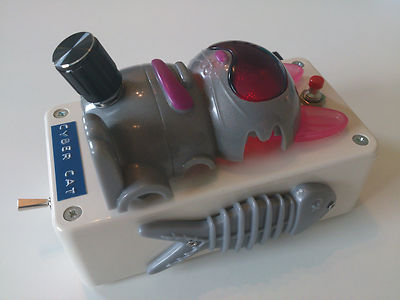
CatSynth video: Circuit Bent Cyber Cat by freeform delusion
Cyber Cat – rehoused McDonalds toy – it doesn’t say a lot but I just had to circuit bend it!
switched mono 1/4inch jack output
Momentary button to trigger each sound
Pitch Up/Down Control
Warp switch.fd. online
Facebook – freeform delusion
Twitter – https://twitter.com/freeformd
eBay – Search for – Circuit Bent
My older Circuit Bending channel – http://youtube.com/eecoukAlso on matrixsynth.
Note: if you want to bid on this, you might find yourself going up against me 🙂
-
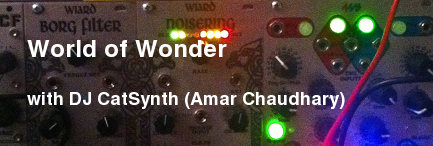
New Podcast: World of Wonder with DJ CatSynth, September 26, 2013
The latest, and second-to-last, episode of the World of Wonder is up and posted for your listening pleasure.
For a complete playlist, please visit Spinitron.
This show will be coming to an end soon, with a final show on October 10. It has been a great experience, but no longer sustainable given an increasingly frequent performance schedule, maintaining this site, and making sure to set aside enough time each week to take care of myself and Luna. It is possible that I will start up an independent podcast in 2014, so stay tuned…


