
Pitta of the Mind and Mezzacappa-Phillips Duo, Luggage Store Gallery

Today we look back at my latest performance with Pitta of the Mind at the Luggage Store Gallery in San Francisco, a show that also featured a set by the Mezzacappa-Phillips duo.

Pitta of the Mind is my music-and-poetry duo with poet Maw Shein Win. It was our fourth performance as a duo, and probably our most polished to date. As with our previous performance at last year’s Skronkathon, we selected a color as the overarching theme for the set. That time it was silver, this time it was blue, which was reflected in our costumes, props (including a little blue tree), and the content of some of the poems. The selections were a bit darker and melancholy than at the Skronkathon, and overall the set had a more serious feel. There were, however, humorous moments in both words and interpretive dance moves from Maw. For the music behind the poems, I used a variety of iPad apps including Sunrizer, Animoog and Bebot. The challenge was to provide sound that fit with the poems without overpowering them.


[Maw Shein Win. Photo: PeterBKaars.com.]

After the main course of our poetry-and-music set, I played a solo improvisation on the analog modular system as dessert.


[Photo: PeterBKaars.com.]

A subpatch with the E350 Morphing Terrarium from Synthesis Technology, the Make Noise Maths, and the KOMA Eletronik SVF-201 filter formed the foundation, with other modules patched in and out during the course of the performance. I was aiming for noisy rhythmic patterns, and sometimes succeed, while at other times allowed the sound to move in the direction of longer drones or unstable chaos.
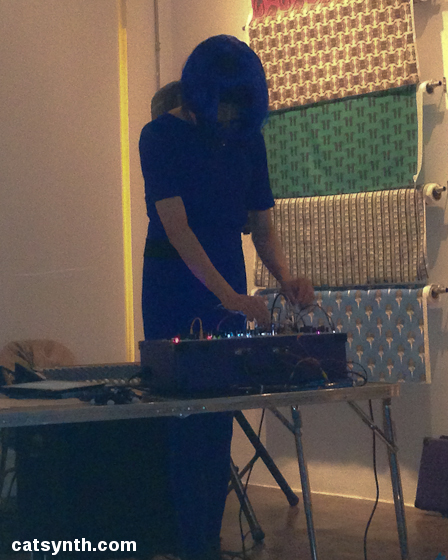

[Click to enlarge.]

The set was well received by the small but appreciated audience, and we got quite a few positive comments for both words, music and our coordinated blue outfits.

Lisa Mezzacappa and Noah Phillips opened with with a set of improvised music for upright base and guitar, respectively. Both are virtuosic improvisers, and I expected good things from their set. They explored a wide variety of extended techniques, some percussive and some more drone-like, and moving freely between more structured and free-form rhythms. Overall, the timbres, harmonies and textures were quite beautiful and visually evocative.


[Noah Phillips and Lisa Mezzacappa. Photo: PeterBKaars.com.]

Interestingly, this was not the first time we shared the bill with the Mezzacappa-Phillips duo. We were all together at a show in Oakland in 2011. I’m glad we had the change to perform together again.

New Podcast: World of Wonder with DJ CatSynth, January 30, 2013

Better late than never, here is the podcast for my January 30, show.

World of Wonder with DJ CatSynth, January 30, 2013

12:00AM-12:10AM (10:00) Richard Devine “York Capacitor” from Risp LP (2012) on Detroit Underground

12:10AM-12:17AM (6:55) Signal “Wismut” from Robotron (2007) on Raster-Noton

12:17AM-12:25AM (7:52) Brigit Uhler & Gino Robair “Capacitance Blubber” from Capacitance Blubber (Single)

12:26AM-12:35AM (8:38) Dewanatron “Cooling Period” from Irregular Hours, Vol. 1 (2006) on Obedience School Music

12:35AM-12:40AM (5:36) Mitchell Akiyama “Strategies for Combating Invisibility” from Small Explosions That Are Your’s to Keep (2005) on Sub Rosa (Belgium)

12:40AM-12:59AM (18:12) TaTE “El toque de silencio (The call for silence)” from Ph: 0439544574 (2003)

01:00AM-01:05AM (5:00) Amar Chaudhary “Under the Weather (analog modular improvisation)” from Under the Weather (analog modular improvisation) (Single, 2013)

01:05AM-01:09AM (4:15) Pierre Schaeffer “Cinq Cinq études de bruits /1948 – Etude noire” from Schaeffer : L’Œuvre musicale (CD)

01:09AM-01:30AM (21:33) Iannis Xenakis “Bohor” from Electronic Music (1962)

01:31AM-01:49AM (18:27) Karlheinz Stockhausen “Stockhausen: Kontakte – Part 2” from Stockhausen: Kontakte (CD, 1992) on Wergo

01:49AM-01:57AM (8:06) Richard Devine “Reneanalogueseq” from Risp LP (2012) on Detroit Underground

01:57AM-01:58AM (0:56) Ilkae “Camai” from Pistachio Island (2001) on Merck Records


Tune in tonight at midnight PST on KUSF in Exile (San Francisco Community Radio) to hear co-host Matt Davignon’s program, or look for the podcast here.

NAMM: Analogue Haven

The visit the Analogue Haven booth is another of the annual pilgrimages at the NAMM show. The highlight of my visit this year was a performance by Richard Devine on a system consisting exclusively of Make Noise modules.

This virtuosic performance showed what these modules are truly capable of with practice. The music moved between rhythmic staccato textures and longer resonant tones in multiple layers. It was also a showcase for the DPO, Make Noise’s oscillator, which was the only tone generator in this system. I have a Make Noise Maths and an Ecophon, and the performance inspired me to practice these along with the other modules to get more complex musical results.

Analog video is looking like a potential area of creative expansion, and LZX Industries was prominently demonstrating their video modules. Here we see our mascot being processed live.

One thing I would like to see more in video synthesis is interaction between analog audio, video and control signals.

On the opposite end from the modules was the massive Schmidt Eightvoice Polyphonic Synthesizer. A beautiful looking instrument with an interesting set of filters inspired be Moog and Oberheim:

This synthesizer is truly a labor of love by its creator Stefan Schmidt, who spent many years on this project. It remains to be seen if it will sell.

Other quick views from around the Analogue Haven booth included this demo of modules from Snazzy FX:

Percussion modules and a novel sequencer from Delptronics:

And the distinctive orange controls of the Harvestman modules.

There were three new releases from Harvestman, including a new Hertz Donut.

And the distinctive clean white design of Koma Elektronik, including the SVF-201 Vactrol Filter module and their infrared controller.

It is great to see the popularity of the analog instruments and new designs coming each year. If there are any drawbacks, it is that the field of available modules and effects boxes has become quite bewildering, and that the Analogue Haven booth is always quite crowded.

NAMM: Visionary Instruments

Oakland-based Visionary Instruments presented their new guitar-based MIDI controller at NAMM. Guitar-controllers are nothing new, but one is quite advanced, going beyond simple conversion of basic guitar fingering to include a wide variety of modern controls, including accelerometers and pressure sensitive pads in addition to an array of knobs, sliders and buttons.

Here we see Moldover demonstrating the basic version of the guitar. (We have reviewed Moldover’s performances in San Francisco in past articles.) You can see a little bit of the guitar in action in this video:

There was also a model with twelve strings and a more traditional finish. That one also had a built-in “e-bow”, which was a nice feature.

In addition to the controller, Visionary Instruments makes “video guitars” with embedded video screens. The main model has a stylized, curving shape, but I particularly liked this metallic retro model:

For those who look at such details, the video is Nigel Tufnel from Spinal Tap.

In addition to the quality of the instruments, it nice to see an innovative company from the Bay Area (and Oakland in particular) represented here.

NAMM: MIDI at 30

MIDI (Musical Instrument Digital Interface), the protocol that we use to connect musical instruments together, has officially been around for 30 years now, and the occasion was being marked with an exhibit at NAMM:

There were some of the earliest instruments as well as those demonstrating how it is being used today. The Yamaha Disklavier series was quite prominent, as an instrument that is both acoustic and a MIDI device at the same time. There was also the Prophet 600, a forerunner to the Prophet 12 we reviewed yesterday and the first commercially available instrument to implement MIDI.

In the middle, between “1983” and “2013”, were a few of the devices I remember from the mid-1980s.

I had a Yamaha box (a sequencer) with the same beveled shape as the TX7 pictured here. And I was quite interested in the Atari ST computer, though was never able to get one. Both devices seem quite primitive today. Unlike the analog synthesizers that we have been reviewing, earlier digital devices don’t seem to hold up as well. Nonetheless, the MIDI protocol itself is still vital for much electronic music-making, despite its well-documented limitations in speed and resolution.

NAMM: Buchla “The Electric Music Box”

The Buchla booth may not be that large at NAMM, but it is hard to miss with its colorful array of patch cords and distinctive control panels. They introduced a new instrument labeled “The Electric Music Box”:

Basically, it looks like a new version of the classic Buchla Music Easel. It fits neatly in a suitcase and sports simpler and more intuitive controls than the standard Buchla 200e series, but still provides for quite complex sounds. At least the way it was set up when I tried playing, the sounds were more traditionally instrumental, especially when compared the SKYLAB next to it with the typical crunchy multi-event space sounds that one expects from a Buchla. A nice little instrument, though, both sonically and visually.

NAMM: Dave Smith Instruments Prophet 12 and Mopho X4

Dave Smith Instruments is one of my perennial stops at NAMM. This year they introduced two new keyboard instruments, the Prophet 12 and Mopho X4.

The Prophet 12 is gorgeous, but is also a powerful synthesizer. It’s odd to think of twelve voices of polyphony as a lot, but then one must consider that DSI synths are often monophonic. I did of course have to get my hands on one of these:

It plays very smoothly, both from the keyboard and while turning the knobs. I particularly liked the tuned feedback combined with both the highpass and lowpass filters. It was simultaneously a nasty sound but also very polished and playable.

The Mopho X4 was also fun. It is basically a four-voice version of the popular monosynth with a new physical design:

It plays like the original Mopho, very punchy and thick. It doesn’t quite have the smoothness of the Prophet, but it is not supposed to.

As usual, I wouldn’t mind having one of these myself, but they don’t come cheap. We will have to see…

NAMM: The large and small of it (Nektar and Nord)

I tend to oscillate between the very large and the very small when it comes to instruments. On the small scale, I stumbled upon these tiny controllers from Nektar Technology.

These tiny controllers seemed like perfect companions for the iPhone and iPad – and they are quite cute. (Use the stuffed cat for a sense of scale.) The keyboard and continuous controllers both have a small modular footprint, slightly wider than an iPad. I might have gotten either or both, if they were available. Nektar hopes to have these out later this year.

While it is great to be able to show up at a gig with just an iPad, a controller like those from Nektar, and a couple of cables, sometimes one needs a real keyboard. And those aren’t getting any smaller. The Nord Stage 2 is the latest incarnation of my heavy but reliable workhorse keyboard:

The electric pianos (and the primary reason I got the Stage) were the same as ever and felt great. But what is different from the previous version is the synth section, which is now more akin to the Nord Wave. I could definitely use that feature. There are also improvements to the acoustic piano modeling, but that is more incremental. I don’t think I would replace my Stage EX at great expense for these features, though. There are some new acoustic pianos available for the older model, which I will try out at home.

NAMM: Ear Protection (Etymotic and Vic Firth)

We open our blog coverage of NAMM with our reminder to everyone about protecting one’s ears. The show floor itself can get quite loud, but that’s usually mild compared to what we put our ears through at concerts and rehearsals. This is something I am especially concerned with as I am in two very loud post-punk bands. This year, the company Etymotic Research is presenting new filtering earplugs, and Vic Firth offered complementary editions to members of the media:

The earplugs are designed to reduce overall sound level while preserving frequency response, which allows one to more easily hear speech and musical detail. I using them right now and they do cut background noise, though it is not yet a full test.

When the noise meter hits one hundred, watch out.

World of Wonder with DJ CatSynth, January 16, 2013

A bit tardy uploading last week’s show to the podcast channel, but here it is. Playlist below.

12:00AM-12:03AM (2:33) Nina Simone “I Put A Spell On You” from I Put A Spell On You (MP3, 2006)

12:03AM-12:13AM (9:48) Myrmyr “Golden Ashes” from Fire Star (CD, 2012)

12:13AM-12:18AM (5:18) Pauline Oliveros “DIGIACC Flight” from DIGIACC Flight (MP3, Single)

12:18AM-12:22AM (4:08) Damero “1-1+1-1+1-…=1/2” from Happy In Grey (2007) on BPitch Control

12:22AM-12:32AM (10:19) Colleen “Everything Lay Still” from The Golden Morning Breaks (CD, Rock, 2005) on The Leaf Label

12:33AM-12:35AM (2:00) Bill Withers “AIN’T NO SUNSHINE” from Lean on Me The Best of Bill Withers (CD, Album, Private, 1994) on Columbia (us)

12:35AM-12:39AM (3:19) The Books “Contempt” from Thought for Food (Remastered) (2011) on Temporary Residence Ltd.

12:39AM-12:57AM (18:50) Asmus Tietchens “Teilmenge 42” from Z-Menge (2006) on Line

12:59AM-01:02AM (3:39) I Monster “Daydream in Blue” from The Chill Out Room (MP3, 2010)

01:02AM-01:03AM (1:01) Ilkae “Sushifruit” from Pistachio Island (2001) on Merck Records

01:03AM-01:28AM (24:48) PGT “DOME” from Temporary Habitations (CD, 2008) on Loochtone

01:28AM-01:33AM (4:03) Aloe Blacc “I Need A Dollar” from Good Things (CD, Album, 2010) on Epic (usa)

01:33AM-01:42AM (9:33) Four Tet “UNSPOKEN” from Rounds (CD, Album, Private, 2003) on Domino (UK)

01:42AM-01:49AM (7:16) Xinlisupreme “COUNT DOWN” from Murder License (Rock, 2002) on FatCat Records (USA)

01:49AM-01:59AM (9:33) David Dunn “Ennoia 2” from Four Electroacoustic Compositions (2002) on Pogus