

no editions – live video series 2009
A little inspiration for things to come in 2010:
no editions – live video series 2009 August 17 New York from no editions on Vimeo.
I saw this via an article on PLANET magazine. Primarily a fashion article reviewing Christian Niessen and Nicole Lachelle’s No Editions label, but tt seems to intersect with various ideas of my own at this particular time, the combination of electronic music with visual experiments. The clothing becomes a canvas for the video, which in turn records people wearing the clothing.
Rain and Resurface
I usually try not to be intimidated by the rain here. But it was coming down pretty hard as I wondered the familiar streets of SOMA and South Beach looking for a particular gallery not far from the former Fremont Street overpass that I photographed on a sunnier day. I was trying to catch an exhibit before it closed on Sunday, only to find the gallery itself was closed for the extended holiday weekend.
So now I had not only the pouring rain around me, but also a large caption reading “FAIL”. Not a big deal per se, but we did need to get out of the rain. We headed down 2nd Street, looking for someplace that would be at least dry and somewhat comforting, a cafe or a bar that had not opted to close for the holidays. I was surprised to find that 111 Minna was open, and in fact quite well populated.  They were having some sort of fundraising event with work from several artists. However, I found myself more interested in the permanent exhibit, Resurface, a solo exhibit by local artist Micah LeBrun. LeBrun had taken a hiatus from his work, which primarily focused on painting, for a year in late 2008 and early 2009 to travel through Central America, Asia, Australia, Africa and Europe. During this time, he focused on photography, and only returned to painting after returning home. The exhibit included examples of his photographs (partially obscured by the art being displayed for the fundraiser). I was more drawn to the stark landscape images, which reminded me of my own adventures in the desert and sparsely populated areas, than to the portraits. Among the paintings, I was also drawn to the non-portrait pieces, such as the large red canvas with the words “the New Yorker”, and another piece featuring an algebraic equation (the solution to which was of course 0.5). Both pieces are visible in this promotional image, featuring the artist in his studio:
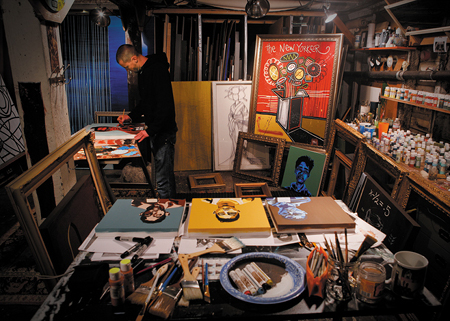

 Afterwards, I did visit LeBrun’s website, and found myself more interested in some of his earlier work, such as the combination of figurative and abstract paintings from 2005 and 2006. There were several works that focused on black and shades of pink. It was interesting to view one of his figurative pieces, such as “high maintenance” next to an abstract work like “take it easy”, as if one is a distillation of the other (small versions of both works are displayed to the right). You can see other works from this series at his online gallery.
CatSynth pic: Happy Times
From Retribution Body on flickr, via matrixsynth:

“I’m very happy with the new rig. It’s very West Coast Serge / Buchla compared to the ARP, it’s a very different beast. I’m looking forward to doing some serious recording with it.”

“Once again, Ernie is very helpful.”
You can see more on the associated flickr set.
Weekend Cat Blogging: Holiday Windows
This weekend, we present some of the cats featured in the Macy’s SF/SPCA Holiday Windows. Every year during the holidays, San Francisco SPCA teams up with Macy’s in San Francisco to feature adoptable pets in the holiday window displays at their main store in Union Square.
Here are couple of kittens in one window:

and this handsome black cat:

Many passers-by in this busy shopping district were surprised and delighted by the live animals in the displays. We at CatSynth certainly hope that some of these animals, including the cats featured above, find new homes as a result of this program.
To find out more about the program, including when to see the animals and how you can contribute, please visit the official Macy’s SF/SPCA Holiday Windows site.
Weekend Cat Blogging #238 will be hosted by our friends at the House of the (Mostly) Black Cats.
Carnival of the Cats will be going up this Sunday at When Cats Attack!.
And of course the Friday Ark is at the modulator.
Happy Holidays!
Wordless Wednesday: Morning Sunshine

CatSynth pics: Kitteh can has moogs
From softestthing on flickr:

There are several other pictures in the “kitteh can has moogs” series featuring Harrison (aka “harry potterbelly”). You can see the all of them here:


I realized that we have actually met this cat once before, in “kitteh can has modz”.
Art and music notes. Friday, December 18
Last Friday, I managed to visit four different art and music events in one evening. Below are some reflections from each.
 Our first stop was the offices of Kearny Street Workshop for their SF Thomassons Holiday Party. Readers may recall KSW’s APAture Festival and the Present Tense Biennial.
“Thomassons” are architectural elements that exist (or persist) outside of the original intended function, such as an inaccessible door leading out of an upper floor of a building, or a staircase leading to nowhere. The term was coined by Japanese conceptual artist and writer Akasegawa Genpei, and the Thomasson website allows people to upload examples from around the world. We at CatSynth have actually presented several Thomassons in our Wordless Wednesday photographic series, including these stairs leading into the San Francisco Bay. KSW’s “SF Thomassons” project involves photography and performance art centered around Thomasson sites in San Francisco. The party was a preview to coincide with Kaya Press’ publication of the first English translation of HYPERART: THOMASSON, and included a performance-art piece set at one of the largest sites in the city, an abandoned church at Howard and 10th streets that happens to be across the street from KSW’s offices.
After that, it was off to Gallery Six at 66 Sixth Street. The current exhibition, entitled “Every Single Where”, features new works by local artist Pakayla Biehn. The paintings each carried superimposed images that are similar but not identical, as if multiple exposures from a camera. According to the press release, Biehn has a congenital visual disability, and her paintings attempt to “give the viewer an understanding of her own optical condition.” Although they share the common theme, each work was stylistically quite different.
Actually, the work in the gallery that caught my attention was not in the featured exhibition, but on display in the back room from a previous exhibition, a small geometric print entitled “Bird’s Nest” from Charmaine Olivia’s Urban Managerie.
From Gallery Six, we then went to Gallery 16 for an exhibition celebrating the 25th anniversary of Emigre. Emigre was a combination digital type foundry and publisher founded by Rudy VanderLans and Zuzana Licko, and is known both for its typefaces and the design journal Emigre Magazine. The exhibition included examples from the magazine and other designs featuring Emigre fonts.
 The prints had a very clean quality, with bold colors, large shapes, and of course text. I particularly liked the works based on Licko’s abstract Puzzler font, with it’s arrangements of dots and other elements into larger complex patterns. One of the large prints (again combining text and geometric elements) also featured a large barcode with a valid ISBN number. Thinking myself quite clever, I performed a quick internet search to find out what it was – I suppose I should not have been surprised that it was issue #67 of Emigre Magazine, although the cover image from the magazine looks nothing like this print.
The final stop was Cafe du Nord for a party and concert celebrating the 50th anniversary of KFJC Radio. This was the last of several events marking the anniversary, including the concert at FLUX53 that I attended earlier in the week.
Because of the busy schedule for the evening, we only caught two of the many bands performing. First was the band al Qaeda (I am sure they were aware the name was already taken). Their music combined driving punk-style drum and guitar elements with experimental electronics elements and electrical noise.

Al Qaeda was followed Arrington de Dionyso. I had seen de Dionyso perform in a trio at FLUX53, but this time he was with his band. Once again, he performed a combination of bass clarinet with various vocal techniques, including throat singing, set against standard rock drum, bass and guitar sounds. On the screen behind the band, increasingly complex black-and-white drawings (or paintings) were being created live.
Fun with Highways: Springfield Interchange (“The Mixing Bowl”)
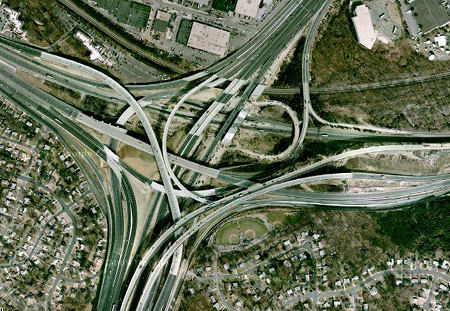
Reader Beth @ 990 Square recommended that we check out “The Mixing Bowl” on the Washington D.C. Beltway. Here it is:
[Click to enlarge.]


 The Springfield Interchange (as it is more formally known), is in northern Virginia and connects I-95 coming from the south to the beltway (I-495, left to right in the image) and I-395 north to downtown Washington, D.C. Part of the reason this interchange looks as complex as it does is that it was recently rebuilt, and contains the “ghosts” of the old interchange. Consider the following diagram:

[Image from Wikimedia Commons.]
The blue lines are the current interchange, while the red lines represent the pre-construction roadways. As one can see, several of the “red” pieces are still visible, such as the loop and ramps in the upper-right quadrant.
It seems the construction is not completely done, particularly along the beltway where there is still a lot of work going on. Or at least that was the case when I traveled through the interchange late on a Sunday night this past summer and got stuck for several hours.
KFJC 50th Anniversary at Flux 53
Last Tuesday I attended performance celebrating the 50th anniversary of KFJC radio at FLUX53 in Oakland.
 The evening opened with a trio of Arrington de Dionyso, Gino Robair, and Bob Marsh. The set began with the drone of an electric harmonium, the space was then filled with the chirping of Marsh’s performance on Alesis Airs, Robair’s percussive and chaotic Blippo Box sounds, and de Dionyso’s reed instruments. All the sounds, acoustic and electronic, had a similar quality, and seemed to come together in a pattern I would describe as “yodeling”. This was followed by a combination of low reed tones and bass synthesizer sounds, both of which had complex overtones again masking the separation between acoustic and electronic.

During the next portion of the set, de Dionyso performed on a double-reed instrument that I am pretty sure was a nadaswaram, a South Indian instrument similar to the Indian shehnai, but larger. Surprisingly, it sounded more like a saxophone than what I would expect (based on my familiarity with the shehnai and double-reed instruments in general), and was set against bass synth tones and more “liquidy” sounds. The sounds evolved into a drone layered with scratches and bending notes, and then into something more evocative of old space or science-fiction music, with descending synthesizer timbres. From this mixture, a minor harmony eventually emerged.


Robair then brought out his “signature cymbal”, and played bowed metallic resonances against gurgles and whispers. de Dionyso sang into various resonant objects as well, such as a partially filled metal water pitcher, and the detached bell of a bass clarinet.
There was more of the “space harmonies” and drones, groans and static. And vocal syllables against machine-like sounds, softer percussive synthesizers and metallic resonances. The sounds faded out, leaving just the original harmonium droning. Then suddenly there were bells and loud “skronking” (fast-moving loud notes), and then the set was over.
In the intermission, Walter Funk presented the Hologlyphic Funkalizer, an installation that uses a video synthesizer to interpret audio signals and project them onto an oscilloscope. I had actually seen a previous performance at the 2008 Edgetone Music Summit where Funk also played in the duo Kwisp. This time I was treated to a more detailed presentation and explanation of the technical details, including the Max/MSP programs that generated the audio signals and the analog video synthesizer. You can see visual examples at his website.
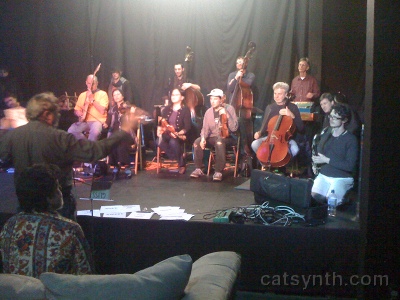
The LARGE ensemble, which was indeed large, performed a series of conducted improvisations, with Gino Robair and Bob Marsh alternating as conductors. Marsh conducted the piece in dramatic fashion. It began slowly with atonal pitches, squeaks, bends and glissandi on various instruments. The woodwinds began to add more “pointed” notes, with some short runs and phrases. The full ensemble then came to a loud stop followed by silence; then back to more of the longer notes from the beginning, then another loud hit and silence. This repeated a few times. Out of last silence emerged guitar scratches and harmonics set against scraped percussion, eventually joined by plucked string basses with bending notes, then the smaller string instruments. The texture grew dense again with long notes followed by faster runs. The music became loud and energetic and “argumentative”. And then it stopped.
[click to en-LARGE]
The next piece, conducted by Robair, had a sparser texture that seemed to focus on individual timbres of the instruments and specific sounds. It started with analog synthesizers and noise generates (Travis Johns) set against fast gurgling trumpet (CJ Borosque). They were soon joined by string bass and guitar also playing faster tones, while the violins faded in with a long steady-state tone. I could envision the ensemble being played as if it was a synthesizer rig rather than a series of separate instruments and performs. The texture grew thick, with some deep bass electronic sounds set against the strings; then it grew sparse again, with drums, trombone and bass clarinet. After some jazz-like runs on the basses, the ending centered around loud multiphonics and overblown tones from the bass clarinet.
The next piece started off like a standard from the 20th century classical repertoire, with detached pitches, atonal harmonies and percussive sounds. The music carried the tension and anxiety of a film score. Eventually the whole ensemble crept in. I also particular liked a section with clanging metal percussion against a very low synthesizer drone.
Robair then introduced the next piece as “Stretched out Xenakis in G.” It very quickly lived up to its name, with very slow pizzicato glissandi, and drones set against percussion scrapes. It was interesting to watch some of the instructional cards being used in the conducting, some had very literal musical meanings like “louder”, “soft”, “sweet”, “fast”, but others had more unusual instructions like “subvert.” Eventually, the ensemble settled into a textural equilibrium with everyone playing at once, and then instrumentals were replaced by voices singing in such a way to keep the existing texture going. The voices and instruments moved towards subtle harmonies or unisons (which I realized were of course all on on near G). Against this harmonic structure I heard the scraping sounds from Tom Nunn’s skatch box. The texture of the music grew more complex, and was then suddenly replaced by a violin solo of a minor melody that sounded quite Eastern European.
At this point, Marsh again took over conducting, and both he and Robair alternated every few minutes while the music continued uninterrupted. There were sections featuring mallet percussion, and squeaks on a soprano saxophone set against Nunn’s scratches, and a big “drum solo”. Later on, the mallet percussion rhythms took on a jazz feel in terms of syncopation and harmonies, an effect that was augmented by the presence of guitar chords. The texture eventually grew noisier again, with noise generators and loud, excited playing by the whole ensemble. The instrumental ensemble again became a chorus of voices, this time sounding a bit drunk. As the music grew software, Marsh held up the final instructional card: “God is in the details.” After this, the music came to a loud finish.