Forced Togetherness Fridays: Quiet and Independent

The job-search and interview process is often full of strange twists and turns, and you often can’t tell in advance which company and role will end up being “the one”, and which ones won’t.  Even within a single job interview, that can be the case, as in the story told in this week’s article.

The office, a loft space in an older building, was gorgeous.  It was bright and minimalist, with lots of glass and metal details.  The furniture in the waiting area had a mid-century modernist vibe.  There was definitely an integrated aesthetic to the place – even extending into the bathrooms – and it was one that I liked.  There were also some concerning signs.  It was crowded, and particularly in the engineering sector, people seemed to be sitting a little too close together for my comfort.  I got the sense during the interviews that collaboration was highly valued – they even seemed to be proponents of the dreaded practice of pair programming in which pairs of software engineers formally work together on a problem.  Now there is nothing wrong with working together, getting an extra pair of eyes on a piece of code, but only when it’s informal and infrequent.

But the technical portions of the interview put me at ease.  The questions were challenging and esoteric, but I was able to handle most of them, even surprised my interviewers in getting a couple of tough Android questions right.  As a bonus, the interviewer from outside the domain asked questions about mathematics and high-performance signal processing which gave me a chance to show off a bit.  So when I got the call back a day later from the recruiter that I had impressed them technically and that they wanted me to come back in for the next steps I was excited and put aside my concerns.  The next steps involved having lunch with the Android team and meeting one of the co-founders.  The lunch went well – it was great to see that my potential teammates included two other women – and I felt relaxed, even a bit boisterous as they asked about my music and such.  The meeting with the co-founder/CTO was a more serious affair, but also positive.  He had an affable but businesslike and direct manner, and at the conclusion of our conversion he said he could see me working there – he also shared that while they offered lunches, as a policy they did not offer dinners, as they wanted to encourage people to go home and spend time with their families, etc.  This seemed sober and civilized, especially in comparison to where I had come from before.  And a final boost of confidence came as I was leaving and ran into the interviewer from the first round who had asked me the mathematics and low-level computing questions – he said he was definitely pulling for me.

There was only one more step: meeting the other co-founder/CEO, whose main focus would be to test for cultural fit.  I had some trepidation about that, but I respected their process, and I felt good enough about the previous rounds that I wasn’t too worried.  As soon as he entered the conference room where I was waiting, I could tell this was going to be very different.  Compared to everyone else I had already spoken to, including his co-founder, he had a very awkward manner.  He seemed to avoid eye contact with me, and his voice had a very flat contour – classic characteristics of someone who is “on the spectrum”, at least in the popular imagination.  It’s always a little weird for me to be more expressive one and the one who carries the energy for the conversation, but I did my best.  However, when in the middle of talking about myself and my work I mentioned that I like to work “quietly and independently” his body language went from flat to sullen.  He then asked what I meant by that, and I tried to answer truthfully and analytically, but it was clear this was the wrong thing to have said.  “Quiet and independent” was not going to be a cultural fit.  And a few days later, I got the notice that I was turned down.  They did not cite a reason or give any feedback, but it was clear in my mind that it most likely came down to those three little words “quiet and independent” in that last interview.

The question remains why?  Why would a culture of hyper-collaboration, proximity, and interaction trump getting things done?  I don’t have the answer to that, but I suspect they saw my professed independence as a liability for their organization.  A bit more sinister, I was left wondering if my response was seen more negatively because I was a woman.  I have observed that cultures that put a premium on teamwork and collaboration seem to expect women to be “even more so”; and that women are treated more severely for being contrarian or pushing back.  Again, I don’t know whether that played a role in this instance, but there were other instances where it most certainly did, and I will share in a subsequent article.

As for this particular job search, the same day I was notified that I was turned down for this position, I had an interview for another that led to an offer that turned out to be one of the best overall work experiences I have had.  As I said at the start, you never know how things will turn out.
Star Wars Day: Tookas in Forces of Destiny

Last year on May the Fourth, we shared a bit about felines in the Star Wars universe.  In particular, the many species of tooka, a small animal with cat-like appearance and behavior that was featured in both the Rebels and Clone Wars animated series.  Tookas also make an appearance in the new Forces of Destiny animated shorts.  In one episode, Jyn Erso saves and befriends a tooka that has adopted by a girl as a pet.

We at CatSynth love these short videos in the Forces of Destiny series.  Most of the attention has gone to their featuring of the women in the franchise, but they also cleverly weave together characters from different stories over the timeline.  We will have more to say about this series in a future article.  But for now, May the Fourth Be With You! (Oy vey!)

CatSynth Pic: Carmen and Malekko Manther

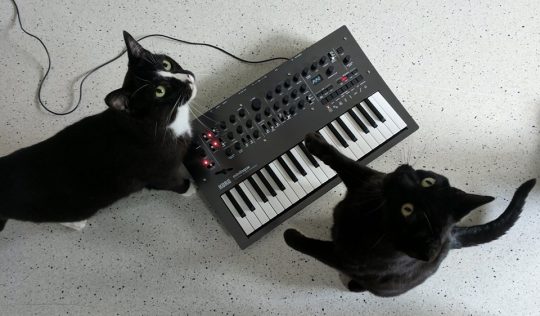
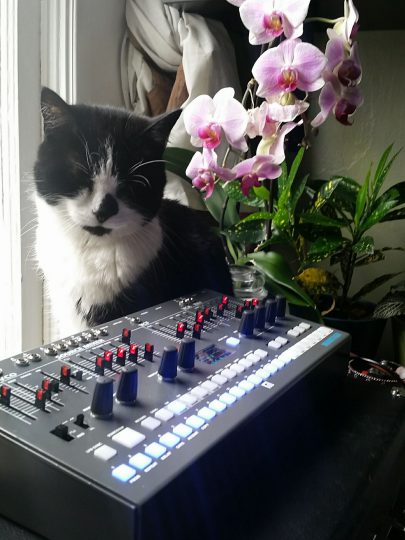
Carmen and Malekko Manther

Carmen returns, this time with the new Malekko Manther tabletop synthesizer, courtesy of Julia More, aka The Synth Witch.  A bit on the manther from Malekko’s website:

MANTHER is a full featured, tabletop monosynth with an analog signal path, an advanced 64-step digital sequencer and onboard delay. The heart of this beast is a coveted CEM 3340 based VCO IC chip. The analog filter is based on an ssm2044 chip. The Source Mixer allows for total control over the Square, Triangle, Saw, Tri Shape, Noise and Sub levels and waveforms also include individual outputs. Dial everything from heavy basslines to screaming leads to stomping kicks. Manther growls like no other!

You can all of Carmen’s appearances on CatSynth via this link.  There is also a little of the Manther in this video from NAMM.

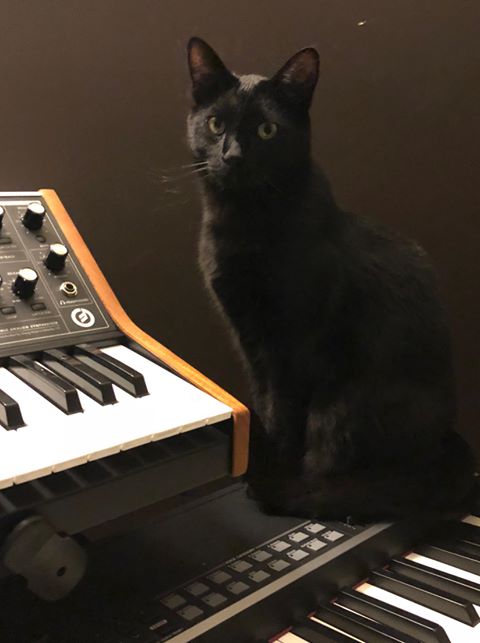
CatSynth Pic: Zook and Moog Sub 37 (and Yamaha CP4)

Today we have Zook posing next to a Moog Sub 37 synthesizer and atop a Yamaha CP4 stage piano.  Submitted by Scott Blasko via our Facebook page.

This is a beautiful photo, and the lighting and texture are incredible!  We can see Zook’s black fur, expression, and silhouette even against the dark background and the dark surface of the keyboard.  Well done!

House of Dreams Cat Shelter, Portland (with CatSynth pics)

Our Volt Divers Cat-tastic edition show in Portland this past month raised funds for House of Dreams, a no-kill cat shelter that specializes in older cats and those with medical conditions that may make them more challenging to adopt out.   I had the chance to visit the shelter and made this video from the experience.

House of Dreams is, quite literally, a house at a non-disclosed location in Northeast Portland.  Most of the space is dedicated to the cats, who have can move about freely in their respective rooms.  We saw cats doing what cats do: play, interact, eat, and nap.  And they certainly get a lot of love and attention from the all-volunteer staff.

The is a separate section of the house for cats who have tested positive for feline leukemia (FeLV).  FeLV-positive cats to have special medical needs, and should be with other FeLV-positive cats, but they can still lead happy and full lives.  Indeed, a couple of the most playful cats I met while I was there were in the FeLV section.

This is Snowball, probably the biggest ham among the cats.

These “CatSynth pics” of the cats at House of Dreams were taken by our friend and Volt-Divers host Jeph Nor, a synthesizer virtuoso in his own right and human companion of Runkl.

This is Sassy, who definitely had an attitude to match her name.  (She appears at the end of our video giving us a “look” 😸).   Below is sweet Spice.

Flicka was one of my “tour guides” who followed me around.

Flicka from House of Dreams cat shelter

All the cats seemed pampered and well-loved by the staff.  They had lots of personal attention (if they wanted it).   Plus, the entire space was immaculate and full of furniture and toys to both stimulate and comfort the cats.  As a small shelter focusing on cats with special needs, they have fewer overall adoptions – each one is a celebration, though often a farewell to a friend that the volunteers have grown to love.  But they do have a good track record of adopting out, and often keep in touch with their “alumni” and human caregivers.

We at CatSynth were happy to visit and support them, both through our video and through the Volt Divers show.  If you want to find out more about House of Dreams, including information on donations, please visit their website.


Weekend Cat Blogging with Sam Sam: E-MU

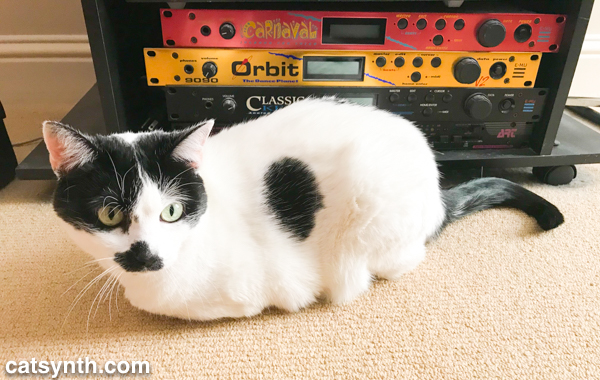
Sam Sam has her usual spots, but sometimes she sits down in unexpected places.  For example, yesterday she entered “kitty loaf” mode in front of an overflow shelf just outside the studio that continued several old E-MU modules.

Sam Sam with E-MU Carnival, Orbit and Classic Keys

The E-MU Orbit, Carnival and Classic Keys are all variants of the first generation Proteus.  The Orbit, in particular, was iconic in its time, but all rather obsolete now.  I do still use my Proteus 2000 module (a Vintage Pro with Mo’Phatt and Beat Garden expansion ROMS) quite often – you never know when you might need a few lines of Mellotron flute or strings or a classic highly-filter-swept drum loop.  There are other ways to get these musical elements, but the P2K remains quick and accessible.  The Morpheus also still has a place of honor in the studio.

Proteus 2000 (Vintage Pro) and Morpheus

Both of these later-generation E-MU instruments had more to offer, especially the z-plane filters that the Morpheus took to the extreme.  These days, I do find myself experimenting with the Morpheus Eurorack module from Rossum Electro-Music more than the old E-MU box, which is just the z-plane filter with CV-controlled parameters.  Even after using it extensively in recent shows, I still have a lot to learn and practice with it.

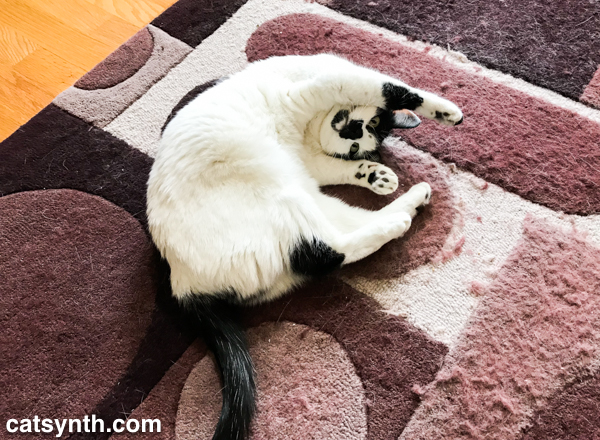
When we’re not up in the studio, Sam Sam enjoys spending time on the living room rug and perfecting her patented “scratch-and-roll” move.

Sam Sam scratch-n-roll

I have too many photos of her in this pose now, it’s just hard to resist.  Of course, what she wants is not a photo, but pets and then brushing.  I am more than happy to oblige.

Forced Togetherness Fridays: Working to death, and when long hours work well.

One of the most commonly cited factors in workplace stress and dissatisfaction is long hours.  Long hours and late nights can cause many problems, some of them are direct impacts on the mind and body of the worker, but then it also ripples out to others through work-family balance, evening and nightlife industries, art, and more.  In an interview about his new book, Jeffrey Pfeffer describes these issues and how they are literally killing American workers.   We will discuss his book in more detail once I have read it – but something in the interview particularly spoke to me: the insidious ways that companies and leaders turn long hours into a virtue, or even a “cause”, rather than a business necessity, and make resistance a question of character instead of productivity.

Companies also play to our egos. They say, “What’s wrong with you? Aren’t you good enough? We’re a special organization. We’re changing the world and only certain people are going to be up for the task.” Who wants to admit they’re not good enough?

I have certainly come across examples of long-hours-as-cultural-virtue in my career.  It is especially appalling when the pressure for long hours in the office involves a lot of play time.  I have felt stuck with an office full of people who stop working but just won’t leave – instead, they start playing games, goofing off, but together as a team.  The pressure to at least pretend to conform by sticking around is strong and also stressful on mind and body.

But there are times when long hours of work are necessary, and when it’s necessary for getting things done, it can be made into an experience that is not only lower stress but even enjoyable its own way.  I illustrate this with an example from own recent experience and then unpack why it worked out well.  Our CEO had a major demo for a group of potential investors and business-development opportunities that was scheduled on short notice.  There was a specific list of features and improvements needed to our mobile app and they were needed in about 48 hours.  With this deadline and set of goals in hand, I made the decision – with the support of the VP of Engineering – to take it on myself because it played to my strengths and style: quick, efficient, targeted.  I got to work on it immediately and was able to focus – in part because the VP (who was also my immediate boss) ran interference for me on some of the usual distracting nonsense.  I enjoyed the challenge of working towards the goals and getting the tasks done one after another in sequence on my own.  Indeed, I didn’t notice at first that it was getting late and that the office was quiet and nearly empty except for myself, my boss, and two other colleagues who generally shifted their work days later than the rest of us (I don’t know why, and I also don’t care why).  When one of them distracted me, my boss ran interference again, and I was able to get things in a good place by the time I left at 8:30 PM.  I wasn’t physically and emotionally drained the way I had felt in other times at other jobs, but tired in a satisfied sort of way, as one does after a music performance or exercise.  The next morning, I came back refreshed and completed things around noon, with the somewhat slapstick scene of my loading it onto an iPhone and my boss and I wading into the middle of a busy San-Francisco street to hand it to the CEO as he rode by in an Uber (or Lyft, it doesn’t really matter here).  The aftermath was positive affirmation both from myself and my superiors.  At least for the remainder of that day.

So what made this instance of long hours work?  First, it was targeted towards specific goals that were challenging but doable.  I had autonomy to figure out how I was going to get them done – how to set up the challenges for myself – and to then execute.  And I was largely left alone to complete them.  The long hours were a side effect of my own choices, not something forced by social pressure or a sense of workplace virtue.  And when I found myself working late, it was quiet and those that were there were there for the sake of work, not because the team was their life.

What extrapolate from this personal story is that one of the ways we may be able to improve the workplace and make it physically and emotionally healthier is through more autonomy and less “team virtue” and social coercion.  We all what to get things done – most of us, at least – but we need to be able to figure out for ourselves how best to do that.

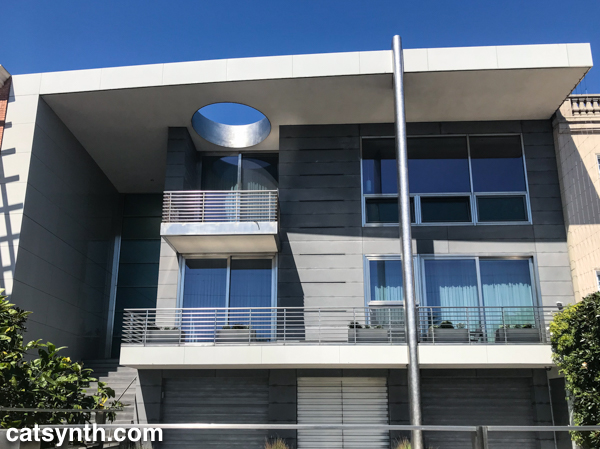
Wordless Wednesday: California Modernism (Pacific Heights)

To me, this modernist home in the Pacific Heights neighborhood of San Francisco represents the height of “California Cool” of the 1950s and 1960s (even if it was probably built more recently).  It stood out from the more conservative brick-and-stone mansions to either side.