We continue our tour of primary states with a visit to South Carolina. It is an interesting state, and if Google Analytics is to be believed, we have quite a few readers there (South Carolina has been in the top 15 U.S. states for visitors for a while). It is also a place I personally visited in the recent past.
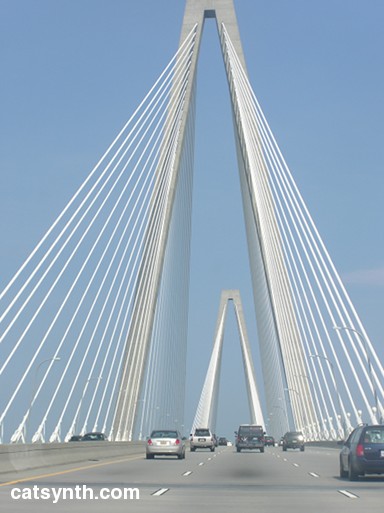
We begin on US 17 as it exits Charleston on the Arthur Ravenel Jr. Bridge, otherwise known as the “Cooper River Bridge.”
This beautiful bridge opened in 2005, and its clean modern geometry is in stark contrast to the much more traditional architecture of Charleston. I could help but focus on it even when surrounded by the historic buildings of the city’s waterfront and shadows of the Civil War. I think it’s a great addition to the city’s skyline. One of the other things I most remember about Charleston is that it was hot and humid in August, which suited me fine. The heat and humidity was personified by the ubiquitous Spanish moss.
Heading north on US 17 past the bridge, the landscape and texture changes dramatically. Small commercial buildings dot the side of the highway sporadically as we enter the Lowcountry. For a while, the highway is close to the coast – it is really 17 rather than US 1 that is coastal highway in the southeastern U.S. – as it winds between forests on one side and coastal islands and marshes on the other.
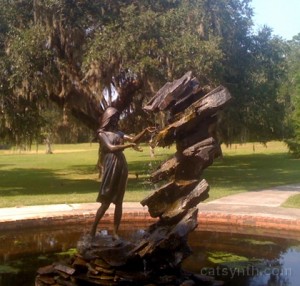
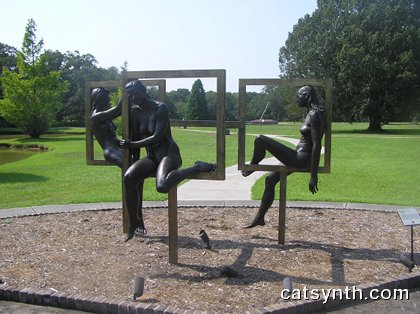
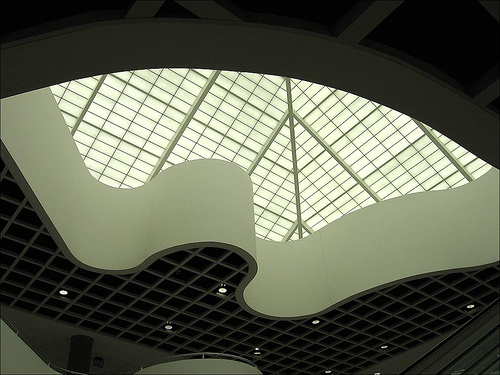
As the highway approaches Myrtle Beach, one can stop at Brookgreen Gardens, which has a large collection of sculptures in a landscaped setting. Their focus is on a combination of sculpture by American artists and local flora of the Lowcountry region. Most of the sculptures were figurative, but within this context there were a variety of styles and subjects, including some that combined abstract and modern elements.
The second sculpture (with the three female figures and the squares) is St. James Triad by Richard McDermott Miller. Unfortunately, I don’t have the information for the first sculpture.
In the Monday (January 16) Republican debate, the “I-73” corridor was mentioned, though I cannot recall amidst all the ranting what the context was. But a quick Internet search suggests that the unbuilt I-73 is supposed to begin at U.S. 17 just north of Myrtle Beach and follow SC 22 and then split off and head northwest, crossing I-95 and then into North Carolina. It looks like there is not only a “future I-73” in the Palmetto State, but also a “future I-74”. Who knew?
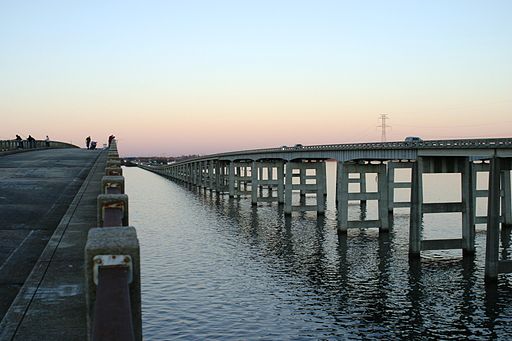
Back in Charleston, one can head west on I-26 towards the interior of the state. We cross I-95, which crosses the state as part of its role as the major north-south highway along the east coast. It does cross Lake Marion on a long causeway, where an older bridge next to the highway serves as a pedestrian walkway and fishing pier. Traveling over the causeway in 2009 heading to Charleston, I assumed this was an inlet rather than an inland lake, and did not realize how far away we were from the ocean.
[Pollinator at the English language Wikipedia [GFDL (www.gnu.org/copyleft/fdl.html)], via Wikimedia Commons]
Back on I-26, one eventually gets to Columbia, the capital and largest city. A spur, I-126 takes you from the main freeway into downtown.
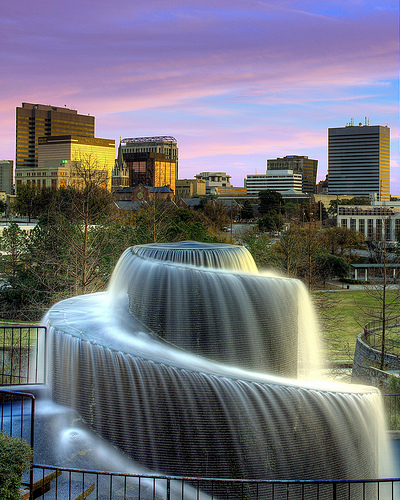
[Photo by silicon640c on flickr. Attribution 2.0 Generic (CC BY 2.0)]
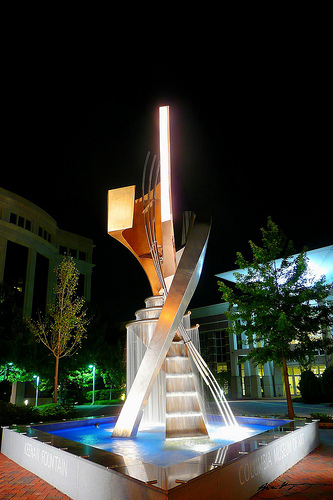
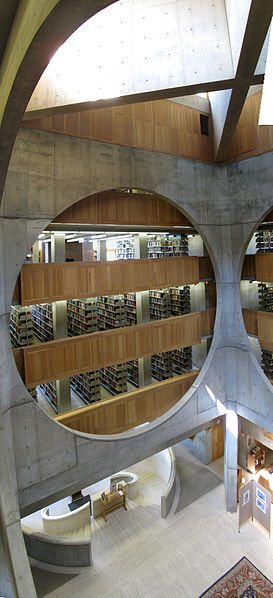
The view above is from Finlay Park overlooking the downtown skyline. It is a relatively recent feature of the city, only about 20 years old. The main library in Columbia also dates back to this time, and features a very modernist design. And only a block away on Main Street, the Columbia Museum of Art, with the sculpture Apollo’s Cascade in its front plaza.
[Photo by huggingthecoast on flickr. Attribution-NonCommercial-ShareAlike 2.0 Generic (CC BY-NC-SA 2.0)]
[Photo by sayednairb on flickr. Attribution-NoDerivs 2.0 Generic (CC BY-ND 2.0)]
These elements stand in stark contrast to the city’s more traditional architecture, starting with the state capital itself; and also to some of the darker moments of its history. Columbia and the surrounding area were devastated at the end of the Civil War. It does not seem like there are many scars left in the city itself (readers, please correct if I am wrong about this), but just outside the city US 76 are the eerie ruins of Millwood Plantation.
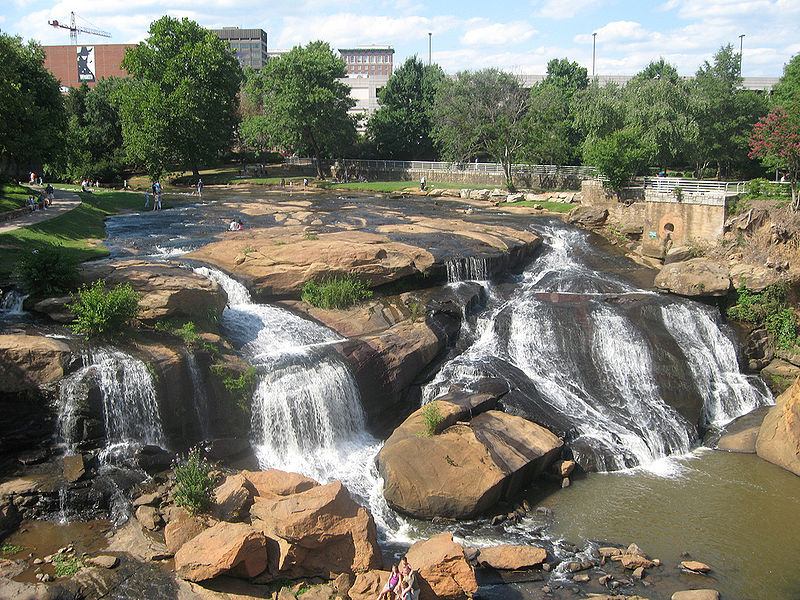
We continue northwest from Columbia on I-26, eventually veering off onto I-385 towards the city of Greenville in the northwest corner of the state. The highways goes all the way into the downtown, where it continues as a “business spur” that ends at US 29. A few blocks south is one of Greenville’s major features, a natural waterfall that runs through the town center:
The region around Greenville and Spartanburg has a reputation as being more conservative even in a conservative state. Admittedly subjective, but probably an effect of the proximity to Bob Jones madrassa University. But Greenville itself does have a progressive community that we hear about through a friend and fellow blogger Daisy Deadhead, and even its own Occupy movement, which you can read about.
And, finally, I would be remiss if I did not mention Barnwell, South Carolina. It’s a bit out of the way, due south of Columbia and due west of Charleston, but it is the birthplace of one of my musical heroes, James Brown. I am proud to have what I am sure is the only computer-science doctoral dissertation that cites him as a reference.
Once again, we at CatSynth will be at NAMM show! You can follow along with my adventures at the show starting Friday here on the blog or on Twitter by following @catsynth (hint: now is a good time to start following).
As with my previous visits, the focus will be on electronic-music gear, both new technologies and music-making opportunities, and some of the older analog technologies that have made a comeback in recent years. I will certainly be looking at the boutique modular offerings with great interest. But I am always on the looking for the esoteric and unexpected.
If there’s anything you would like to see covered, or anything you are curious about, please let me know.
Napping appears to be the order of the day (isn’t it always), and Meowza has staked out a good spot, on his human’s lap. But it’s mutually beneficial. Human acts as cushion and cat acts as space heater.
At Jan’s Funny Farm, Percy and the other cats decide to get a nice gift for Jan. Fortunately, they have sense not to select a cat bed.
At Animal Shelter Volunteer Life, they are celebrating the gifts of new homes for many of the cats, including Diamond pictured above. The PAWS shelter has been able to place a great many cats into new homes in both December and January!
At Pam’s Sidewalk Shows, the crew invites readers to submit their own captions for this week’s picture (shown above). Be witty, be creative, and leave them a suggestion.
Truffle and Brulee are taking it easy this Sunday, and have some advice for their mom that spending time with them will be healing. We at CatSynth agree that time with cats been be very good for one’s health.
And a bit of “WCB Apocrypha.” Susan St. Clair is a regular visitor for Wordless Wednesday and the Weekend Photo Hunt, which was part of yesterday’s post. But her photo hunt image is too cute not to include in this round-up.
We will continue to update through the end of Sunday, Pacific Standard Time, so if you would like to participate, please leave a comment below.
For Weekend Cat Blogging and Photo Hunt, we present this photograph of Luna with the Luna II microphone from M-Audio. The Luna mic has a very distinctive circular shape, and combined with the stand and the beanbag chair support this week’s Photo Hunt theme of Circular
The Luna is a recording mic (i.e., for good recordings in the studio and not for amplifying voices/instruments during band practice), so it only comes out when needed. I was setting up to do a recording for a collaborative project and Luna came and planted herself on the chair. Which is quite reasonable, as it is undeniably her spot.
Weekend Cat Blogging #345 is hosted by…well, it looks like it is hosted by no one. So we at CatSynth are happy to step in and if you would like to leave your entry in the comments below, we will append an impromptu round-up to this post.
Today we look at the last show I attended in 2011. On December 29, Outsound Presents featured a pair of duos at the Luggage Store Gallery: Hare and Arrow, and Charm and Strange.
Hare and Arrow was a duo of musical-instrument maker Sung Kim and David Dupuis. I had the opportunity to hear Kim perform on his instruments several times during 2011, but I found this performance to the the most musical. The instruments were of course quite interesting sonically as well as visually, but the music held its own with having to be conscious of this. The set started with a combination of scratchy noise and feedback, but then moved to more traditional bowed sounds and glissandi. The combination of harmonies and relatively gentle noise had a plaintive quality. Over time, the music grew noisier and darker, and more animated. You can hear a short clip of the set in this video:
There were some interesting moments as the piece continued, including a clarinet-like timbre from one of the string instruments and a jazzy bass line. The second piece was more percussive, with plucked strings and striking of the instruments. As a result, it had a more sparse texture. Towards the end, Kim set aside the instrument to manually control the effects pedals for an electronic conclusion to the set.
It was then time to transition to Charm and Strange, an electronic-music duo of Julia Mazawa and Sharkiface. During the intermission, I found myself quite curious about this bright red device. It definitely had the look of a Ciat Lonbarde instrument (i.e., like the kitten-nettik that I have somewhere at CatSynth HQ).
It turns out it is a combination of oscillators and loop processors, although in this performance it was mostly used for the latter. Plus, the red color matched Sharkiface’s shawl. And they both contrasted nicely with the leopard-print table cover.
The set opened with a looping sound and a texture that was industrial, ambient and machine-like. Mazawa, who was performing on an iPhone, appeared to be controlling the loops and applying turntable-like effects. Over time, different looped sounds came in. It was only after the performance that I found out that the sampled sound sources were actually from Hare and Arrow’s set. Simultaneously, Sharkiface played the red instrument, both using the raw contacts and applying jumper cables at various points. A syncopated rhythm emerged, with environmental sounds set against machinery. It then turned to a more turntable-like pattern with metric scratching. There were repeated string phrases (i.e, from Hare and Arrow), hissing sounds, and loud machine noises. The loops seemed to have similar lengths, but set at different phases to create rhythmical effects. Other pieces featured chaotic noise that reminded me of circuit-bent instruments (though I think the sounds were coming from the iPhone), a steady pulse set against more random wobbling sounds, and a section where Sharkiface played the red instrument more expressively, almost melodically.
You can hear a tiny bit of their set in this video:
The video clip is rather short (only a few seconds). I’m not sure why that is all I have of the video, but it is what it is. And I hope to hear more performances from them in the future.
Demo.
The Koma pedal has a gate and a very short delay.
At the end of the delay range the Koma gets in a kind of a bit-crusher sounding effect.
This is not often found at a analog pedal.
This is because Koma has modded the chip!
Also on matrixsynth, where you can see more videos and find out about the KOMA Elektronik “YouTube yourself!” Competition. They are going to be at NAMM next week.
via KOMA: “By the way, we love cats in videos! ;-)”
We continue our series this season with a visit to the Granite State. New Hampshire typifies what we think of as “northern New England.”, with a mixture of old factory towns and mills, forested mountainous wilderness and rocky coastline.
We begin on this rather oddly named bit of highway south of Nashua called the “Circumferential Highway.” It’s not really circumferential of anything, except maybe an argument. But it does connect us to a major highway, the Everett Turnpike, as we head north through the state. I actually have visited Nashua. It was (gasp!) 20 years ago when a college friend invited me to tag along with him to go up to New Hampshire and volunteer for a presidential candidate I had barely heard of named Bill Clinton. The main thing I remember about walking around the town was that it was very cold. And it also looked a bit more gritty and rundown than the some of the more recent images I have seen.
Traveling north on the Everett Turnpike we come to the state’s largest city, Manchester. The turnpike merges with I-293 and heads north along the river, passing by downtown and the old mill buildings of the Amoskeag Manufacturing Company. This was a huge enterprise in its day, and apparently had the largest cotton textile plant in the world in the late 19th century. The company went under in the 1930s, but the buildings remain. You can see the rather narrow I-293/Everett Turnpike along the river just in front of the red brick mill buildings. Many have found new uses for contemporary industries as well as residential and commercial development.
[Image from Wikimedia Commons.]
Manchester is also home to the Currier Museum of Art. It’s plaza includes the sculpture Origins by Mark di Suvero.
It seems like variations on his “weird red thing” (aka Joie de Vivre) from Zuccotti Park are everywhere. After our Iowa article last week, a reader on DailyKos recommended a sculpture garden in Des Moines that also contains a di Suvero piece. I wonder how many more we might encounter as this series continues. The Currier also manages the Zimmerman House, a Frank Lloyd Wright masterpiece in the northern part of the city.
New England was apparently quite a hotbed of modern architecture in the middle of the 20th century, and many of the designs make Frank Lloyd Wright’s look conservative by comparison.
An avid highway enthusiast who goes by the name “FreewayJim” on YouTube has a fun time-lapsed and annotated view of the drive north on the Everett Turnpike and I-293 through Manchester as I-293 merges back into I-93 towards Concord. It turns out this is his hometown, so he brings a bit of knowledge about what has changed, and especially what has not changed on these roads.
I-93 continues north from Concord and winds its way gracefully into the White Mountains region. Here we see the rugged northern New England wilderness, another defining feature of the state. Cosigned with US 3, I-93 continues north into Franconia Notch State Park, where it narrows to just one lane in each direction, a rarity for an interstate highway.
The park includes among other things the former site of the Old Man in the Mountain. This natural feature on Cannon Mountain symbolized the state. It is part of the state highway shields. It is on the state’s commemorative quarter. It is on the state’s license plates. And it came crashing down off the cliffs one night in 2003. It sounds like there was a great sense of loss for the state when this happened. A memorial is currently being built at the base of the mountain, which will feature large granite elements representing both the formation itself and the state’s identity.
One can leave I-93 here and head eastwards on NH 112, the Kancamagus Highway through the White Mountains. In addition to having a great name, the roadway provides scenic vistas of the mountains and forests (especially dramatic in the autumn) as well as rocky rivers and covered bridges.
[Click images to enlarge.]
It seems like New Hampshire has quite a few covered bridges. I was actually in this area once as a kid (even more than 20 years ago). It was quite beautiful, but even in summer the water in the river was cold.
Highway 112 ends at the town of Conway, which I knew sounded familiar for some reason. It is in fact because of the Animal Rescue League of New Hampshire’s shelter in the town. I think I crossed paths with them once via Weekend Cat Blogging. In any case, they have some nice cats available for adoption if you are in northern New England.
UPDATE: Speaking of cats, we would be remiss if we did not head north from Conway on Highway 16 to Mount Washington. This summit has famously high winds and all around terrible weather, but it is quite an experience to visit (on that same childhood trip I was picked up off the ground by a gust of wind). Plus, they have an official observatory cat, Marty. He is one in a long line of Mount Washington cats, about whom you read more here. Marty’s predecessor, Nin, was there for quite a while and posted this article in 2007 when Nin retired.
Returning to Manchester, one can head westward or eastward on NH 101. To the west, the highway is a local road that winds its way to the town of Keene. I only learned about Keene through these great photo an abandoned factory. It seems to not fared as well as its larger counterparts in Manchester and Nashua, but the ruins are quite beautiful as a photographic subject, especially with the snow.
East of Manchester, 101 is a large highway heading towards the coast. It passes by Exeter, a town with a prep school that many of my college acquaintances attended. But more interestingly, the academy includes this modernist library designed by Louis I. Kahn:
[Photo by Pablo Sanchez via Wikimedia Commons. (Click to enlarge.)]
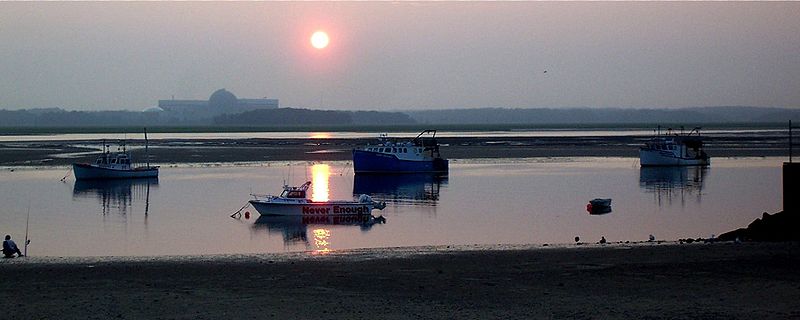
101 eventually hits the coast at highway 1A, just north of Seabrook. Although the beaches along this shore are quite scenic, I know them mostly from the history surrounding the Seabrook Nuclear Power Station. In 1977, the Clamshell Alliance staged what we would now refer to as an “occupy protest” on the construction site of the plant. Nonetheless, at least one reactor of the plant was built. If I didn’t know what it was or the dangers surrounding nuclear energy, I would actually think of it visually as a positive contribution to the landscape, contrasting with the low horizon, dunes, wetlands and ocean, as in this photo from along 1A:
And I think this sunset is a perfect way to conclude this short trip to New Hampshire.


 Heading north on US 17 past the bridge, the landscape and texture changes dramatically. Small commercial buildings dot the side of the highway sporadically as we enter the Lowcountry. For a while, the highway is close to the coast – it is really 17 rather than US 1 that is coastal highway in the southeastern U.S. – as it winds between forests on one side and coastal islands and marshes on the other.