Weekend Cat Blogging #299

Weekend Cat Blogging #299 will be hosted here at CatSynth.  It’s like hosting #300, but one less. This comes in the midst of a busy weekend, including a performance tomorrow night and preparations for a big concert one week from now, but with some proper rest we should be ready to handle everything.

As usual, to participate please leave a comment on this post with a link to your contribution, or you can tweet us @catsynth with hashtag #WCB.  (Note that we won’t get to the round-up until Sunday due to the performances and other commitments.)

And now let us get on with the round-up.

Cats love boxes.  It’s a well-comfirmed fact.  But if one needs even more evidence, check out this cute cat-in-a-box picture courtesy of Pam’s Sidewalk Shoes.

It looks like there is a campaign underway at Mom’s Sunday Cafe concerning someone’s desire for a new yellow truck with gray interior…or perhaps just an interesting color fashion statement:

Jules is a very patient model for his mom’s experiments with Photoshop at Judi’s Mind of Matter.  I do like the direction the image is going, pushing the contrast to an extreme, where only Jules and the wall sockets are visible.

Luna and Zulu T Katt share a photo of Zulu enjoying a drink in the faucet.  It’s interesting how some cats seem to enjoy running water while others do not – nowhere near the universal appeal of boxes.

We will continue with the round-up later this afternoon.

The Cats of Wildcat Woods have taken a more subtle approach to Photo Hunt: Mostly Black.  The tabbies and tortoiseshells including Woody, Chica and Joey all have black as part of their markings.  They are also looking for a home for mostly black cat Avon.  Please click on her Petfinder link to find out more info.

At Meowsings of an Opinionated Pussycat, Elvira is enjoying her three two play cubes.

It looks like the last two have suffered from some rather enthusiastic clawing. She looks so innocent in that picture, though.

Finally, Tsunami is The Mighty Hunter Create with Joy:

We recognized Tsunami’s photo from this past Wordless Wednesday.

That concludes the Weekend Cat Blogging roundup for now. Thanks for being patient, and for the supporting words on the music events this week (last night’s performance in Oakland went quite well).

Stefan Kirkeby, Amy Ellingson and Book Release at Gallery 16

Back in January I attended the opening for an exhibition by Stefen Kirkeby and Amy Ellingson at Gallery 16 here in San Francisco. The work of both artists focused on prints and printmaking in its various forms. The show also served as the release party for the gallery’s 16th anniversary book.

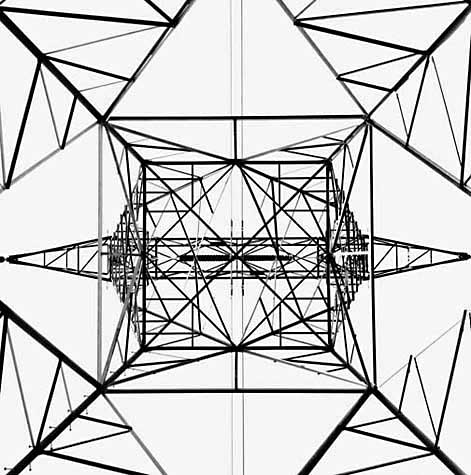
Stefan Kirkeby’s photographs have a very minimal and geometric quality, and celebrate these elements in everyday architecture and infrastructure. The prints on display also featured a variety of techniques. Particularly interesting were the series of gravures along one wall. The gravures are made using copper plates to “etch” the image onto paper. In terms of subject, each of the photographs focused on a single geometric element. Up Lift (Venice, CA 2007) featured concentric round solids, while Boxed (also from Venice, CA) featured in square inset. There were also areal views of fields with rectangular patterns, some mechanical contraptions, and in Sun stones (Japan 2008) a large stone cube on tiles that remind me of the distinctive floor of . Perhaps the most striking was Dead Center (Arizona, 2000) which distills the view (looking up from the center of a power-line tower) into a symmetric and seemingly algorithmic arrangement of straight lines.

[Stefan Kirkeby. Dead Center. Image courtesy of Gallery 16. (Click to enlarge.)]

There was also a much larger scale version of Dead Center entitled Dead Dead Center. In addition to the scale and use of a different printing technique, the image was inverted (i.e., white on black). Both versions work well, and highlight the . The power lines are a rich source for Kirkeby, who also presented a series of closeups of the wires at various angles, with evocative titles. The close-ups and high contrast makes these very abstract and bring to mind some of the minimalist and industrial-inspired paintings of early 20th century. I think part of the attraction of the pieces involving regular shapes and straight lines is that they draw ones attention to elements in the real world that have the simplicity and calm of computer-generated or machine-generated object.

Also on display were prints by Amy Ellingson. We have seen and reviewed examples of Ellingson’s work at earlier exhibitions. The pieces in this exhibition all featured the same flattened oval shape that appeared prominently in her previous work, arranged in regular 3-by-3 grids. They serve as areas of contrasting color and texture between foreground and background, and sometimes as windows of sorts.


[Amy Ellingson, Unitited #5 (2011). Image courtesy of Gallery 16.]

In Inverse Title 11, the oval shapes have a light color and bright texture in contrast to the main black field, almost like cut-out areas. In a series of larger untitled works, the shapes are more like overlays against a translucent color field with soft textures, as in Unititled #5 (shown above).


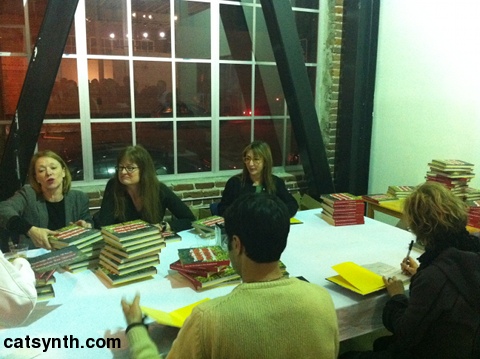
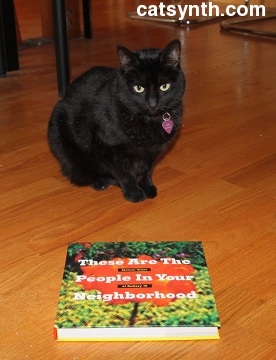
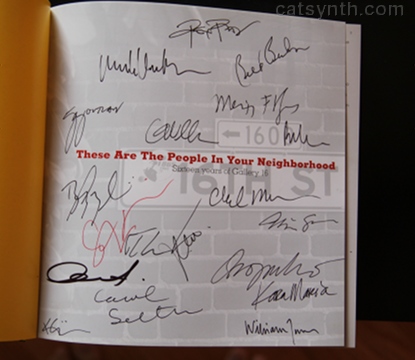
This exhibition also marked the release of Gallery 16’s 16th anniversary book These Are The People In Your Neighborhood. As part of the event, several of the artists featured in the book were on hand for a group signing.

I did of course have to get a copy, with as many signatures as I could get during my brief time at the event.

[Click images to enlarge.]

The book is a mixture of writing and images documenting the many artists and events over the gallery’s history in San Francisco. It was initially located at 1616, 16th Street (in the Poterero Hill neighborhood) before moving to its current location in SOMA. Leafing through the book one can the emphasis on print and although there is a wide variety of styles, I did see a lot of works that represent my own interest in modernist and minimal art (as exemplified by this exhibition) and urban themes such as infrastructure or graffiti/cartoons.

Kearny Street Workshop and SOMArts: A Sensory Feast

Art in general, and the art reviewed here at CatSynth in particular is very focused on sound and sight. “A Sensory Feast”, an exhibition co-presented by our friends at Kearny Street Workshop and SOMArts Cultural Center, expands into other senses, including touch, smell and taste. Each piece in the show touches in one way or another on the subject of food, sometimes directly with scents and textures, sometimes indirectly through memories, metaphors and cultural contexts.

[Sita Kuratomi Bhaumik, MCDXCII, chocolate wrappers, sugar, curry powder, and acquired objects, 2010.  Press image courtesy of Kearny Street Workshop.]

Aroma along with taste and sight featured prominently in Sita Kuratomi Bhuamik’s site-specific installation MCDXCII (1492). The central material of the installation, curry powder, can be very powerful – cooking with it will fill a room with its scent, touching it leaves a lingering yellow stain. Here the artist has blanketed surfaces with both intricate floral patterns on the ground and abstract geometric textures on the wall. In the middle is a bench covered in a combination of gold wrappers and curry. The installation also referenced one of the most powerful and captivating food substances of all: chocolate.

Curry also featured prominently in a sound piece by Brandon Bigelow. Sound is a bit more detached from food than the other senses, but is nonetheless interesting to hear “sound of a curry dinner” decomposed electronically. As a musician, I tend to get more into the structure of the sounds themselves rather than the source – I would not have necessarily placed the sounds in the context of food without the associated description – I mostly thought of it as an escape from the other senses during the opening.

[Yosh Han, installation view with perfume bottles.]

Yosh Han’s fragrance bar was all about scent. Guests were invited to sample and choose on of her scents to carry on a cardboard mustache. It was clear that the scents evoke very strong identifications, some seemed more “right” than others, but there was still room for surprise. My initial assumption is that I would find the strongest resonance with the “Intellectual”, which did evoke cooler colors and flavors (rosemary was one of several components); but upon trying the “Bon Vivant” I immediately knew it was right. The scent had layers of spice and tomato, in other words rather fiery. And while I don’t really associate myself with jeux de vie, it did fit with my being a “pitta” in Ayurvedic terms. Maybe the sense of smell tells us things we otherwise overlook or hide.

Amy M. Ho’s Collection of Food Costumes focused on the tactile sense through fabric. It was quite popular, with people takings turns embodying a pineapple or a slice of pizza (just don’t ever put the two together, as pineapple pizza is an abomination). In addition to the human costumes, she did have at least one intended for cats.

[Amy Ho, Food Costume for a cat.]

I thought this durian for cats was very cute, though I doubt I could convince Luna to wear it.

A cat also featured prominently in Catcakes, one of several works by Kira Greene.

[Kira Greene, Catcakes, 2010.  Image courtesy of the artist.]

The piece is an interesting play on space and dimension. The cat, fish and surrounding elements are very flat and reminiscent of Asian paper cutouts. The plate of three cupcakes, however, is very three dimensional, and realistic enough to evoke the sugary texture and aroma. Nonetheless, I did see the cat first, texturally camouflaged but very prominent with its blue color.

In 2002 Diet as a Periodic Table, Arthur Huang recorded and classified all the food he ate in 2002 into a table with three-letter abbreviations and numerical and spacial classifications reminiscent of the chart we know and love from science classes. There different classifications for diffent foods, such as fruits, vegetables, meats, condiments, etc. I tried to follow the color and number pattens and had fun with some of the symbols: “Pzz” for pizza, “Ccc” for chocolate chip cookies, and “Cos” for a cosmopolitan among many others. The piece fed into my interest (no pun intended) in statistics and information as artistic material.

Rounding out the exhibition were Jean Chen’s Food Coloring Photographs and live tattoo applications during the opening; a rather pornographic video featuring fruit by JD Beltran, Vita and Bryan Hewitt and Emannuelle Namont-Kouznetsov; and a presentation from the National Bitter Melon Council including videos, small cultures a manual “Better Living through Bitter Melon”. I know this vegetable by the name “bitter gourd” as a very strong Indian side-dish to be enjoyed in small doses.

The exhibition will remain open through Thursday, February 24 with an artist talk and closing reception that evening.

Fun with Highways: Madison, Wisconsin

Between Facebook stats and popular uprisings, there is a lot of “fun with highways” to be had. And who knew that the next Middle Eastern country to face large-scale protests would be Wisconsin?

We begin in the eastern section of the capital, Madison, where no fewer than three major interstate highways converge, I-90, I-94 and I-39. Appropriately, the interchange is called the “Badger Interchange”. It also includes state highway 30, a short freeway that connects into downtown Madison.

Highway 30 ends at US 151, which traverses the isthmus that holds downtown Madison and separates lakes Mendota and Monona. I don’t know of too many other cities concentrated on an isthmus like that. Certainly, the location between the two lakes makes for interesting views and architectural opportunities. Consider this view from Lake Monona featuring the State Capitol building book-ended symmetrically by large buildings and standing behind Frank Lloyd Wright’s Monona Terrace.

[Photo by Emery on Wikimedia Commons.]

The area is anchored by the State Capitol complex and the University of Wisconsin. The area between the two along State Street seems a bit like familiar streets in Berkeley or sections of northern Oakland – or maybe more like Austin, TX. In addition to numerous restaurants, bars, cafes, galleries and places to hear live music, it too has a reputation as a liberal/progressive center. It also might be a place to play if and when I ever do an upper-midwest tour.

Of course, it is currently also the sight of large-scale protests against the current governor’s plan to strip most collective bargaining rights from state workers. Thousands of protesters have been camping out in the state capitol building and out filling the streets. Here are some images:

[Photos by Lost Albatross (Emily Mills) on flickr.  Shared under Creative Commons license.]

One thing to remember about Wisconsin in February is that it is cold. Even colder than the really irritating freezing cold rain we have been having in San Francisco over the past few days. It makes the protests all the more impressive (and in fairness, the counter-protesters in support of governor also have to brave the cold weather).

Weekend Cat Blogging and Photo Hunt: Silhouette

This week’s Photo Hunt theme is silhouette, which is something that often happens with photos of Luna by chance if not by intention.

It is often a product of Luna’s black fur that the lighting extremes at CatSynth HQ.  But it can lead to interesting results.  I like the contrast of Luna’s black silhouette to the bright chrome and glass reflections in this next photo:

This was taken back on New Years Day.


Weekend Cat Blogging #298 will be hosted by Samantha and Clementine at Life from a Cat’s Perspective.

PhotoHunt 253 is hosted as always by tnchick. This week’s theme is Silhouette.

Carnival of the Cats will be up this Sunday at When Cats Attack!.

And the Friday Ark is at the modulator.

UC Berkeley Regents’ Lecturer Concert at CNMAT, March 4

The next event in my UC Berkeley Regents’ Lecturer appointment is coming up soon! This time it is a full concert of my compositions, including at least one new one that I have promised to write.

Look for at least one “Preparing for upcoming performance” post over the next couple of weeks. If I plan ahead properly it won’t have to be a “Preparing for tonight’s performance”.


Friday, March 4, 8PM
Center For New Music and Audio Technologies (CNMAT)
1750 Arch St., Berkeley, CA

CNMAT and the UC Berkeley Regents’ Lecturer program present and evening of music by Amar Chaudhary.

The concert will feature a variety of new and existing pieces based on Amar’s deep experience and dual identity in technology and the arts. He draws upon diverse sources as jazz standards, Indian music, film scores and his past research work, notably the Open Sound World environment for real-time music applications. The program includes performances with instruments on laptop, iPhone and iPad, acoustic grand piano, do-it-yourself analog electronics and Indian and Chinese folk instruments. He will also premier a new piece that utilizes CNMAT’s unique sound spatialization resources.

The Regents’ Lecturer series features several research and technical talks in addition to this concert. Visit http://www.cnmat.berkeley.edu for more information.


There is another performance coming up earlier than that, at Rooz Cafe in Oakaland on February 26. My upcoming performance schedule is always available here.

Fun with Highways: Piscataway, NJ

Today we visit another of the locales featured on our Facebook Insights, which provides geographical data about where our page receives its “likes”, etc. New York remains our top city, but some interesting other towns made the list as well, including Piscataway, New Jersey.

Piscataway is in Middlesex County in central New Jersey at the southern edge of the New York metropolitan area. The main highway running through the area is I-287, which connects to I-95 and the New Jersey Turnpike to the east, and then travels north and west into northern New Jersey and then back into New York. It is also served by Highway 18, one of the frequent limited-access highways that cover this part of the state.

Unlike Saint Catherines, Ontario, which we profiled a couple of weeks ago, it is possible to draw a specific connection to Piscataway. Just south along Highway 18 is New Brunswick, which is home to the Alfa Art Gallery and the Omega Sound Fix festival from last November. If you have not read the original article from that event, I recommend following this link. The area supports an art and music scene via its proximity to Rutgers University.

Like many towns in this part of the U.S., Piscataway has a long history, dating back to the late 1600s.  It is listed as “one of the first five New Jersey settlements” (I am not sure what the significance of “first five” is).  It has morphed from a more rural community to an established suburb that has been featured in real-estate sections in the New York Times, CNN and elsewhere.

I also have read and personally experienced the area in Middlesex County as one of the highest concentrations of South-Asian Americans (aka “Indian Americans”) in the U.S. I have had relatives in and around the area for years (and I will further embarrassing them at this moment).