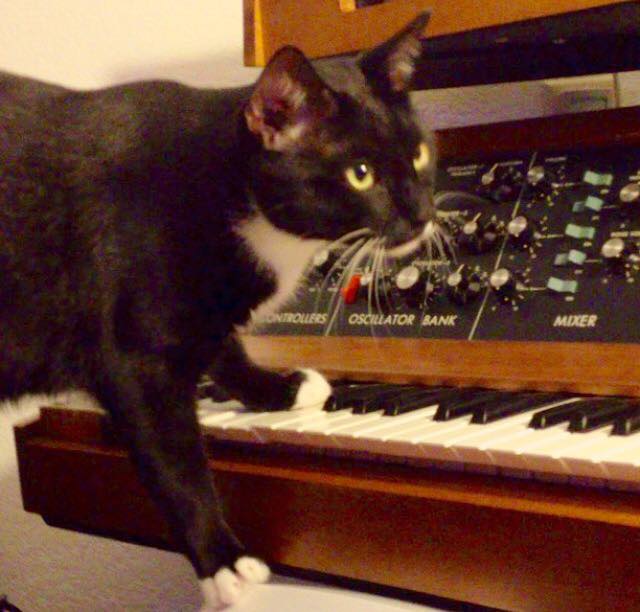
Cute cat playing a Minimoog Model D synthesizer. Submitted by Steve Peglar via our Facebook page.

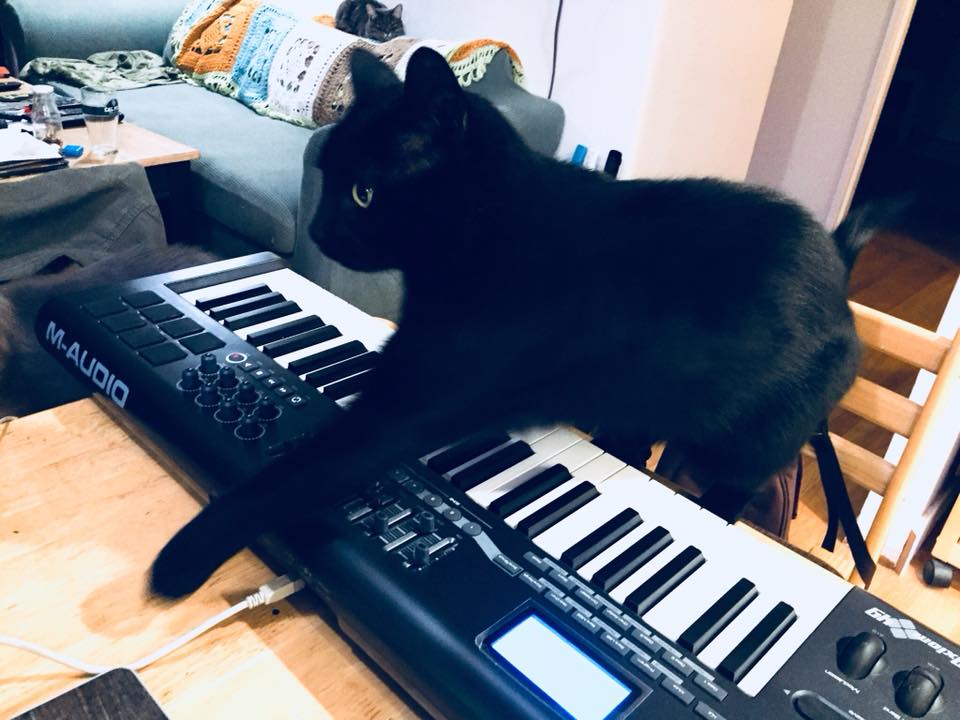
Our new friend Shadow returns for a solo on his M-Audio Axiom keyboard. Submitted by Anne Corwin via our Facebook page.
My boy Shadow likes the heavy beats.
You can see Shadow’s debut last week along with his brother Brodie in this post.
We introduce two new kitty pals today: Fluffy and Hissy. They are outdoor kitties who live in the Temescal neighborhood of Oakland, California.
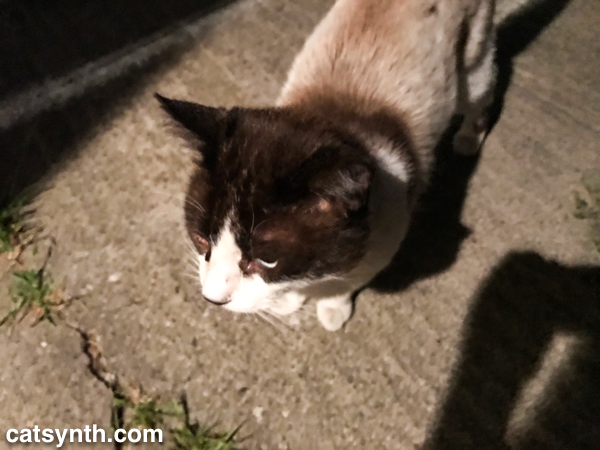
This is Fluffy. He is a big fellow, and quite friendly. As far as we know, he lives outdoors full time, but he is very comfortable around humans, especially when they provide food.
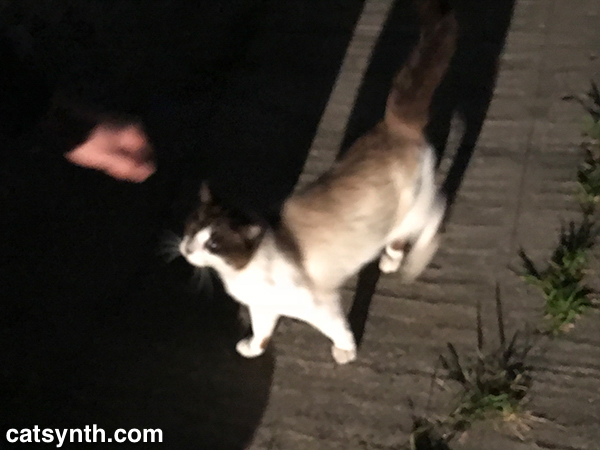
By contrast, Hissy is much more skittish around people, and it is quite difficult to photograph her.
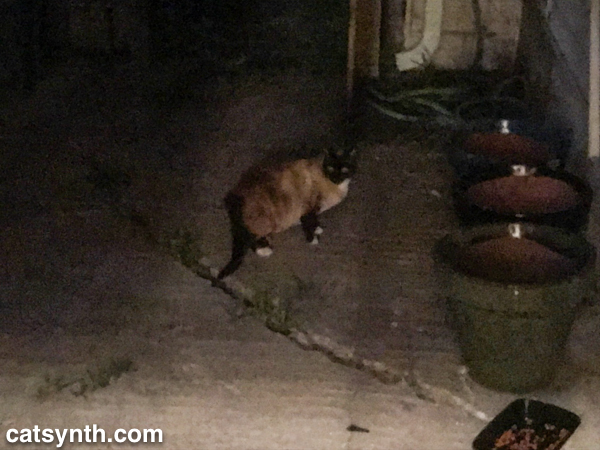
Usually, Hissy backs away, but if one does get close, she lives up to her name.
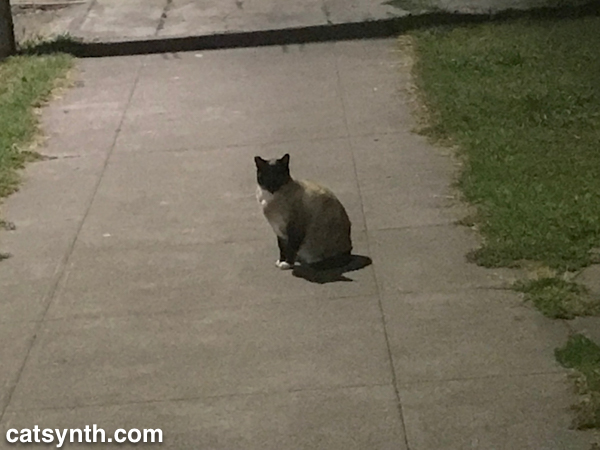
Both Fluffy and Hissy seem to be healthy and well fed in comparison to some of the street cats I have encountered in the neighborhood, so they probably have a network of food and safety options, beyond our “satellite office” in the neighborhood.
We hope to get some better photographs of them soon.
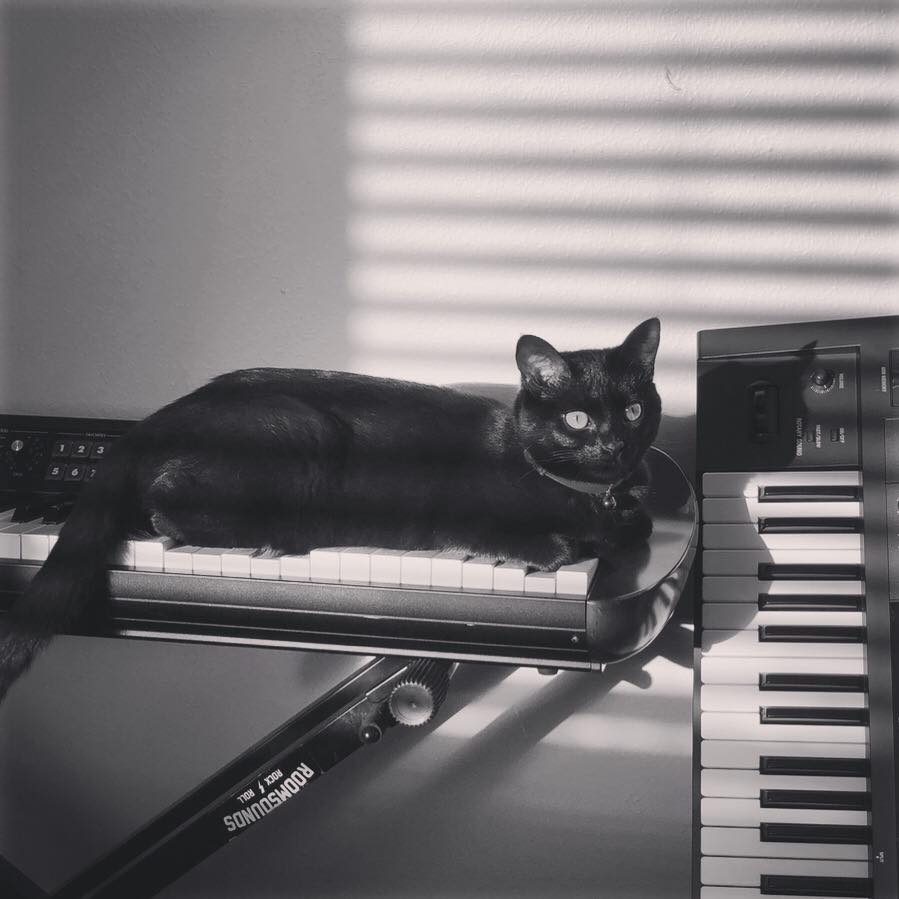
Beautiful black cat Luna strikes a “noir” pose atop one keyboard and next to another. Submitted by Matthew Vasquez via our Facebook page. I really like the way the stripes of light play against the keyboards, which in turn heighten the black cat’s figure.
This is Luna is not our Luna, but looks so much like her! You can read our more recent tribute to the late great Luna of CatSynth here.
Identification of the synths/keyboards left as an exercise to the reader.
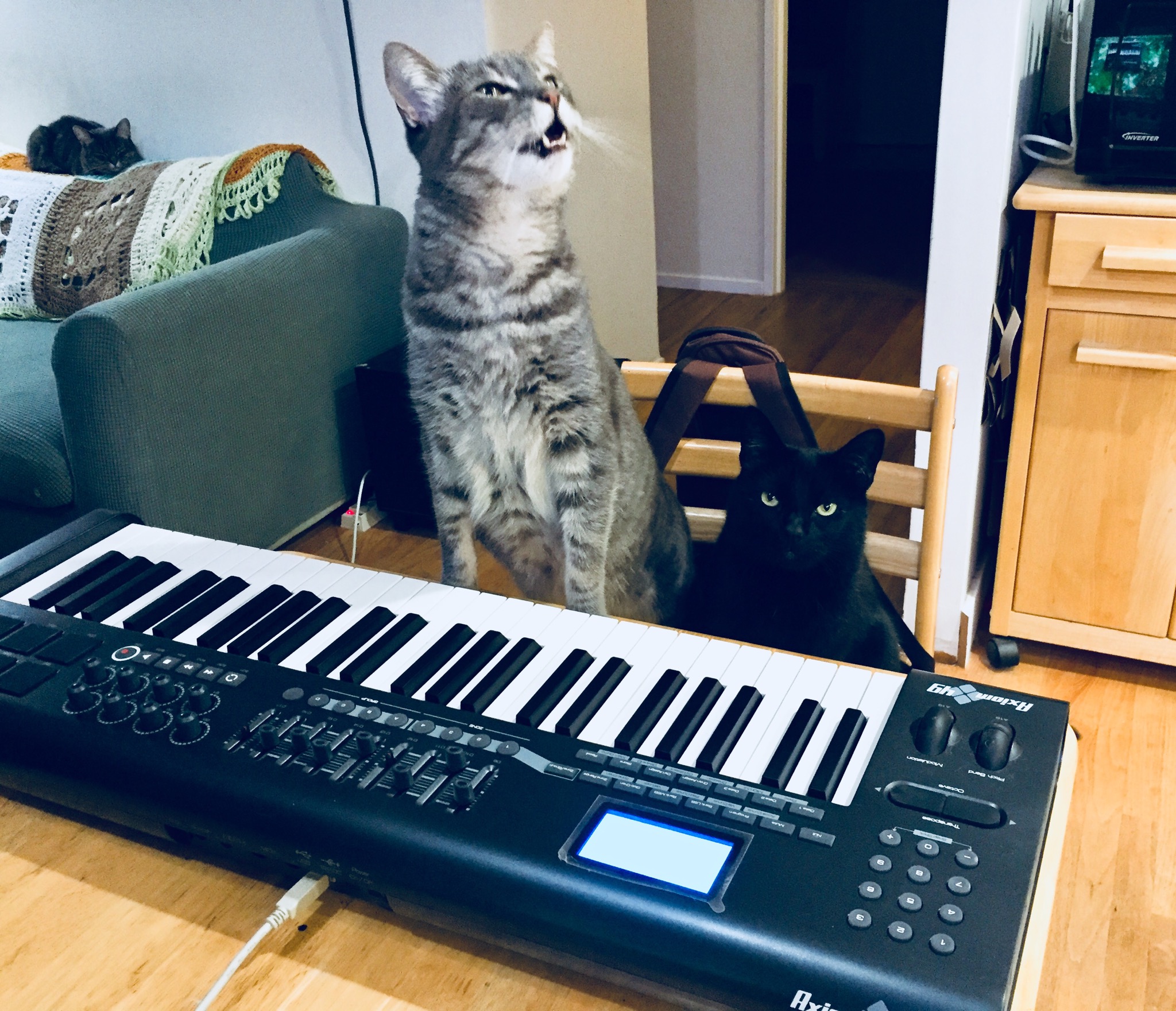
Meet Shadow and Brodie, two new synth-cat friends. Here we see them singing along to a tune played on an M-Audio Axiom keyboard controlling an off-screen synth or software instrument.
Submitted by Anne Corwin via our Facebook page.
It’s been a stressful few weeks for us at CatSynth. Not bad per se, just stressful. During times like this, I often lie down to reduce psychic entropy and practice disintegration of thought. And Sam Sam is often lying down next to me.
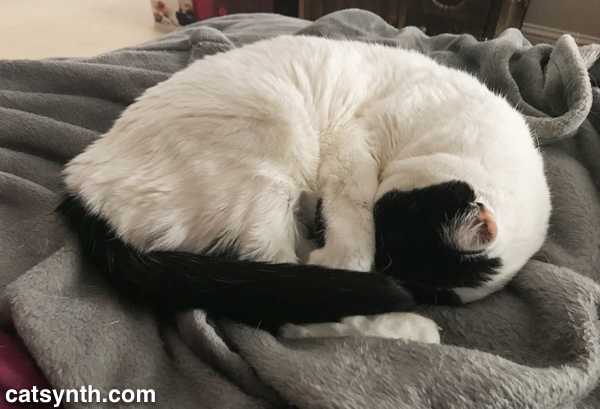
Like most cats, Sam Sam is quite good at napping. One might even say she is an “expert sleeper”, but that might cause confusion with one of the modular-synth manufacturers we sometimes feature. She does have her own unique way of curling up, though, pull her tail close to her head and sometimes even grabbing it with her paw. It’s adorable, and it never fails to make me smile.
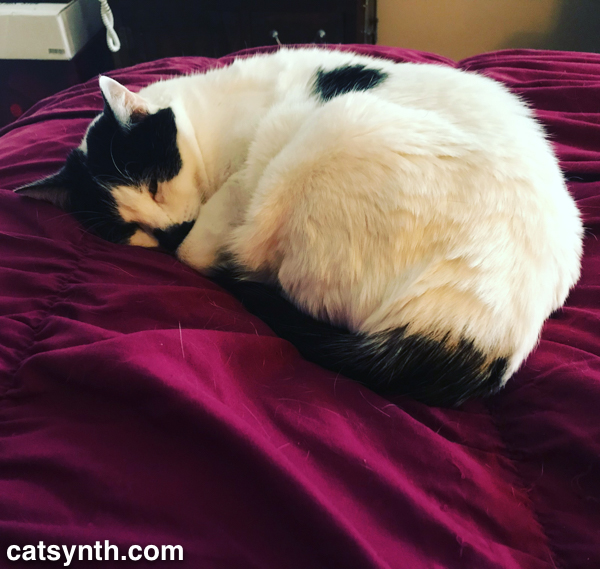
She enjoys the soft blankets, either the burgundy or gray. But she almost always chooses the same corner of the bed. This is not surprising, as all of us at CatSynth are creatures of habit.
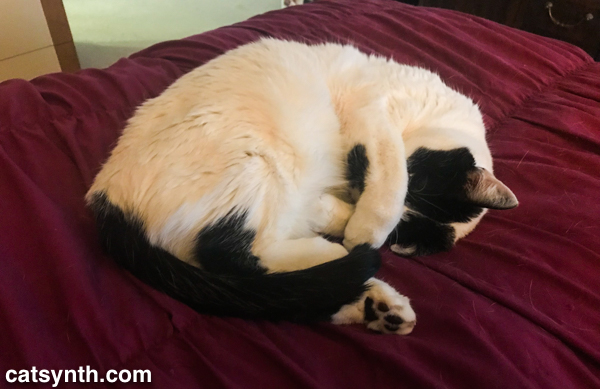
We hope you all have a relaxing and enjoyable weekend. For us, it will be a bit stressful once again, but with very focused study and practice on both the technological and musical fronts. But I will do my best to keep Sam Sam’s example in mind as I work through it. We can learn much from our cats!
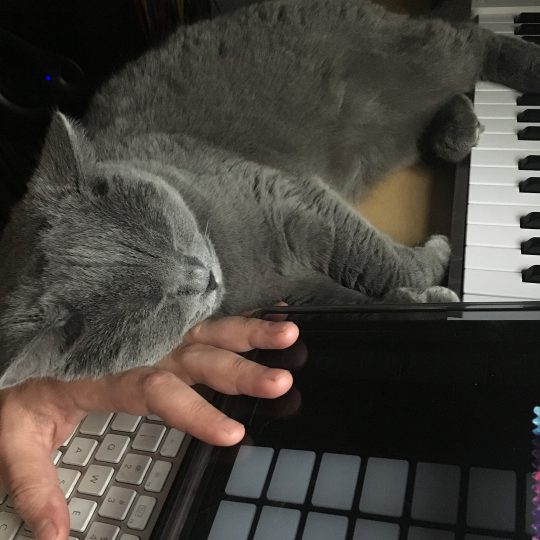
Zelda the Grey returns, with an Ableton Push controller and Arturia Keystep. From skaterdays on Instagram.
@zelda_the_grey is sleeping on the job again in the music studio.
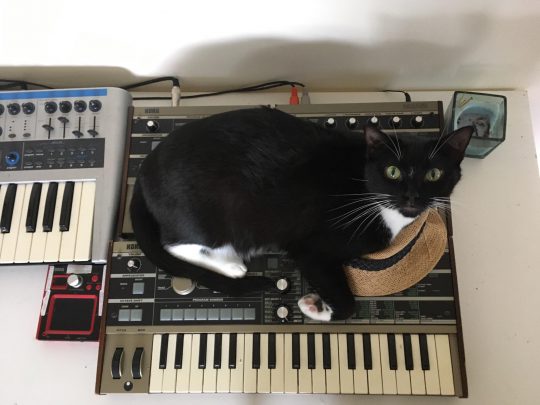
Dave (we’re pretty sure it’s Dave), sitting on top of a microKORG synthesizer. Actually, two microKORGs! That expression is priceless 😸
From Karl Lee Avery via Facebook.
We also espy a familiar red Korg Mini Kaoss Pad. We have one of those around here somewhere.
Cat rings a service bell to that is fed into an audio signal chain as part of this ambient electronic composition.
By Andor Polgar on YouTube, via matrixsynth.
The signal path: Poes rings the service Bell for food, the microphone picks up the sound, which then goes through a stereo volume pedal (it’s for attenuating the chewing sounds). Make Noise Maths is used as an envelope follower, which controls the sound of the Erica Synth Black Wavetable Oscillator.
https://instagram.com/_andormade
http://andor.cool
We at CatSynth absolutely adore this video and feline performance. And we are thinking about ways to get Sam Sam into a live synthesizer performance 😸
June 10 was Luna’s Gotcha Day. For many years, it was one of the most joyous days of the calendar. Since her passing in 2016, it has been challenging and melancholy. There is rarely a day when I don’t think about my special little girl and soulmate of almost 12 years.
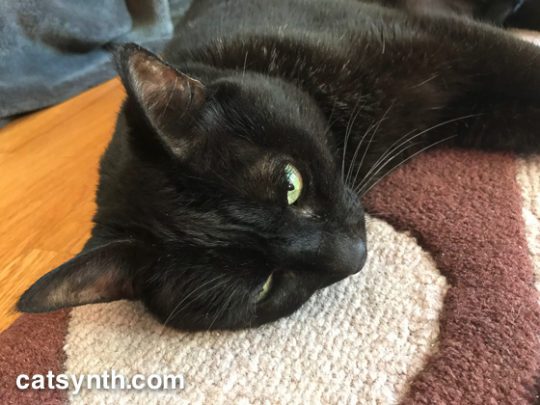
Grief is a nonlinear process. The memories of her life, and of her loss, have mostly been integrated. I can casually see pictures on a regular basis of her and remain in the moment, but scrolling back through them in a deliberate process this morning brings some tears. CatSynth HQ is very much Sam Sam’s now, and we respect her territory (and spoil her rotten while doing so). Yet even she sometimes seems to sense a presence of a former kitty in some of the corners and crevices that defy cleaning.
There is so much I miss about Luna. Her beauty and elegance, her shy but sweet nature.

And she was fiercely territorial, especially when it came to me. She did not like to share, but she made me feel very loved. She could sit patiently while I made weird sounds in the studio. And despite being a “strictly indoor” cat, she loved going outside on the patio after we moved to San Francisco.
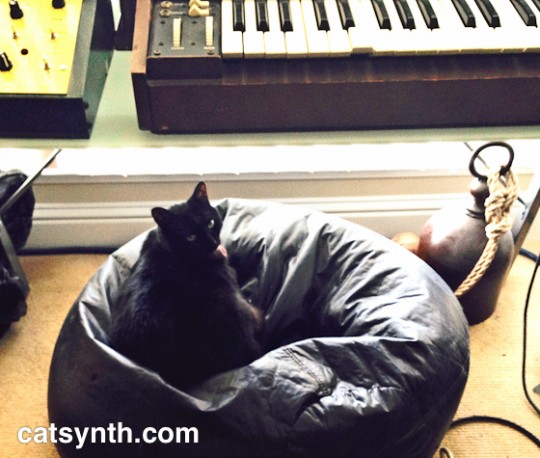

Regular readers know I am not at all religious. And I don’t have a particular notion of an afterlife. But I do like to sometimes think about Luna taking her place among those I have lost over the years, mostly human friends and family. The visualization is of them all standing and waiting patiently, a little black cat in front of the much taller people. I also take comfort in the Rainbow Bridge, and in the community of cat bloggers who have loved and lost over these many years.
I do not expect that the grief will ever disappear entirely. And that’s ok. We continue.