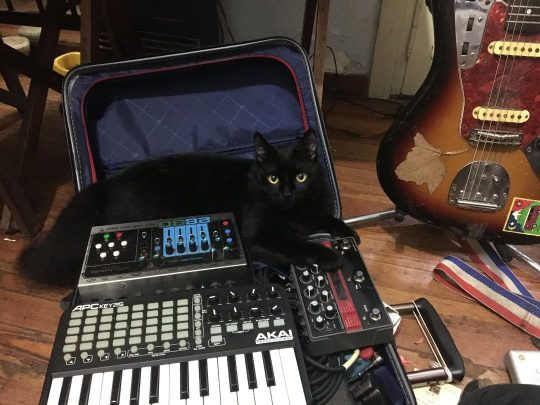
Star Wars Day: Tookas in Forces of Destiny

Last year on May the Fourth, we shared a bit about felines in the Star Wars universe.  In particular, the many species of tooka, a small animal with cat-like appearance and behavior that was featured in both the Rebels and Clone Wars animated series.  Tookas also make an appearance in the new Forces of Destiny animated shorts.  In one episode, Jyn Erso saves and befriends a tooka that has adopted by a girl as a pet.

We at CatSynth love these short videos in the Forces of Destiny series.  Most of the attention has gone to their featuring of the women in the franchise, but they also cleverly weave together characters from different stories over the timeline.  We will have more to say about this series in a future article.  But for now, May the Fourth Be With You! (Oy vey!)

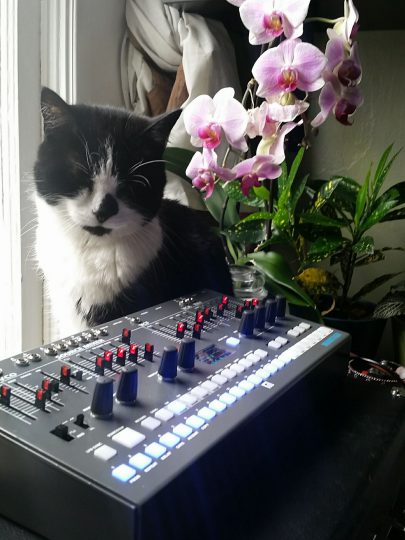
CatSynth Pic: Carmen and Malekko Manther

Carmen and Malekko Manther

Carmen returns, this time with the new Malekko Manther tabletop synthesizer, courtesy of Julia More, aka The Synth Witch.  A bit on the manther from Malekko’s website:

MANTHER is a full featured, tabletop monosynth with an analog signal path, an advanced 64-step digital sequencer and onboard delay. The heart of this beast is a coveted CEM 3340 based VCO IC chip. The analog filter is based on an ssm2044 chip. The Source Mixer allows for total control over the Square, Triangle, Saw, Tri Shape, Noise and Sub levels and waveforms also include individual outputs. Dial everything from heavy basslines to screaming leads to stomping kicks. Manther growls like no other!

You can all of Carmen’s appearances on CatSynth via this link.  There is also a little of the Manther in this video from NAMM.

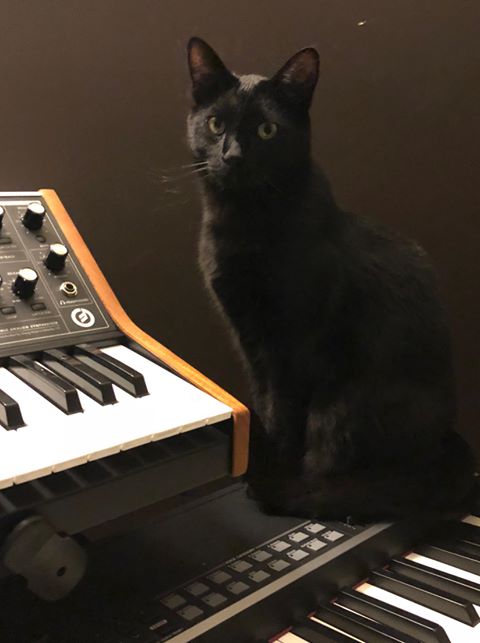
CatSynth Pic: Zook and Moog Sub 37 (and Yamaha CP4)

Today we have Zook posing next to a Moog Sub 37 synthesizer and atop a Yamaha CP4 stage piano.  Submitted by Scott Blasko via our Facebook page.

This is a beautiful photo, and the lighting and texture are incredible!  We can see Zook’s black fur, expression, and silhouette even against the dark background and the dark surface of the keyboard.  Well done!

House of Dreams Cat Shelter, Portland (with CatSynth pics)

Our Volt Divers Cat-tastic edition show in Portland this past month raised funds for House of Dreams, a no-kill cat shelter that specializes in older cats and those with medical conditions that may make them more challenging to adopt out.   I had the chance to visit the shelter and made this video from the experience.

House of Dreams is, quite literally, a house at a non-disclosed location in Northeast Portland.  Most of the space is dedicated to the cats, who have can move about freely in their respective rooms.  We saw cats doing what cats do: play, interact, eat, and nap.  And they certainly get a lot of love and attention from the all-volunteer staff.

The is a separate section of the house for cats who have tested positive for feline leukemia (FeLV).  FeLV-positive cats to have special medical needs, and should be with other FeLV-positive cats, but they can still lead happy and full lives.  Indeed, a couple of the most playful cats I met while I was there were in the FeLV section.

This is Snowball, probably the biggest ham among the cats.

These “CatSynth pics” of the cats at House of Dreams were taken by our friend and Volt-Divers host Jeph Nor, a synthesizer virtuoso in his own right and human companion of Runkl.

This is Sassy, who definitely had an attitude to match her name.  (She appears at the end of our video giving us a “look” 😸).   Below is sweet Spice.

Flicka was one of my “tour guides” who followed me around.

Flicka from House of Dreams cat shelter

All the cats seemed pampered and well-loved by the staff.  They had lots of personal attention (if they wanted it).   Plus, the entire space was immaculate and full of furniture and toys to both stimulate and comfort the cats.  As a small shelter focusing on cats with special needs, they have fewer overall adoptions – each one is a celebration, though often a farewell to a friend that the volunteers have grown to love.  But they do have a good track record of adopting out, and often keep in touch with their “alumni” and human caregivers.

We at CatSynth were happy to visit and support them, both through our video and through the Volt Divers show.  If you want to find out more about House of Dreams, including information on donations, please visit their website.


Weekend Cat Blogging with Sam Sam: E-MU

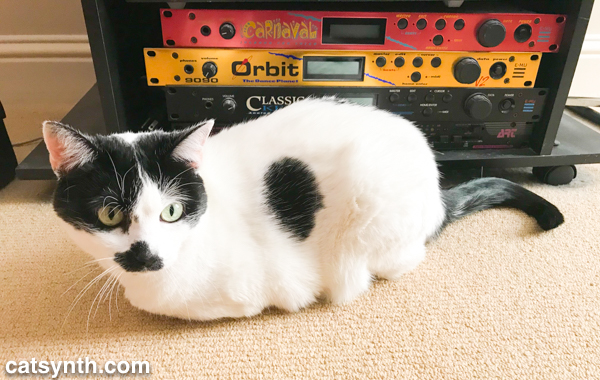
Sam Sam has her usual spots, but sometimes she sits down in unexpected places.  For example, yesterday she entered “kitty loaf” mode in front of an overflow shelf just outside the studio that continued several old E-MU modules.

Sam Sam with E-MU Carnival, Orbit and Classic Keys

The E-MU Orbit, Carnival and Classic Keys are all variants of the first generation Proteus.  The Orbit, in particular, was iconic in its time, but all rather obsolete now.  I do still use my Proteus 2000 module (a Vintage Pro with Mo’Phatt and Beat Garden expansion ROMS) quite often – you never know when you might need a few lines of Mellotron flute or strings or a classic highly-filter-swept drum loop.  There are other ways to get these musical elements, but the P2K remains quick and accessible.  The Morpheus also still has a place of honor in the studio.

Proteus 2000 (Vintage Pro) and Morpheus

Both of these later-generation E-MU instruments had more to offer, especially the z-plane filters that the Morpheus took to the extreme.  These days, I do find myself experimenting with the Morpheus Eurorack module from Rossum Electro-Music more than the old E-MU box, which is just the z-plane filter with CV-controlled parameters.  Even after using it extensively in recent shows, I still have a lot to learn and practice with it.

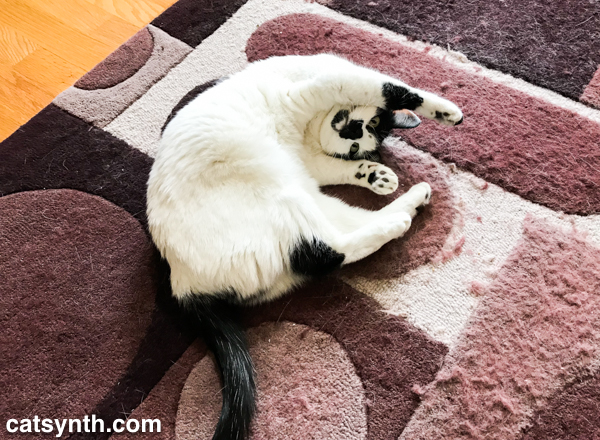
When we’re not up in the studio, Sam Sam enjoys spending time on the living room rug and perfecting her patented “scratch-and-roll” move.

Sam Sam scratch-n-roll

I have too many photos of her in this pose now, it’s just hard to resist.  Of course, what she wants is not a photo, but pets and then brushing.  I am more than happy to oblige.

The Return of Wild Cats on Earth Day


After several years, we at CatSynth are resuming our tradition of sharing wild cats on earth day.  Those who follow our Facebook page are regularly treated to photos and videos of wild cats.  We share a few favorites, along with some of our own.

A personal favorite of ours is the fishing cat (Prionailurus viverrinus).  It is unique in that is adapted for swimming and hunting in the water.  The sleek fur, streamlined shape, and folded ears attest to this adaptation.
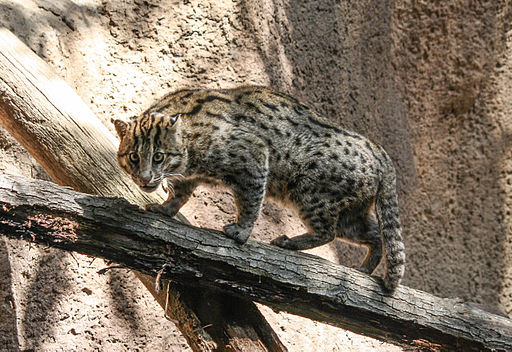

[By Bernard Gagnon [CC BY-SA 3.0 or GFDL], from Wikimedia Commons]

The fishing cat has discontinuous populations in rainforests of South Asia and Southeast Asia. It is listed as Vulnerable, primarily due to habitat destruction. The Greensboro Science Center in Greensboro, North Carolina, recently posted this video featuring a mother fishing cat teaching her kitten their aquatic heritage.

Another lesser-known cat is the oncilla (Leopardus tigrinus).  It is among the smallest of wild cats, similar in appearance to but significantly smaller than the well-known ocelot.
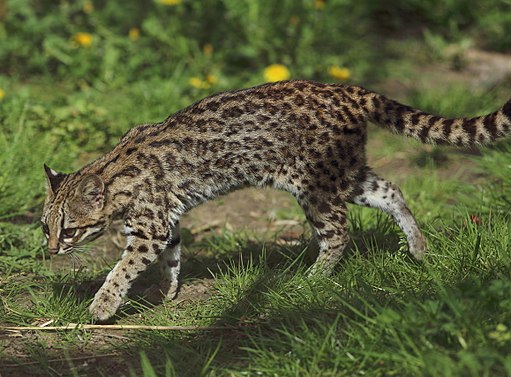
oncilla
[By Groumfy69 [CC BY-SA 3.0], from Wikimedia Commons]

The oncilla lives throughout Brazil as well as the highland tropical forests of Colombia, Ecuador, and Peru. There is even a recorded separate population in Panama. It is listed as Vulnerable in IUCN classification, mainly due (once again) to habit loss.

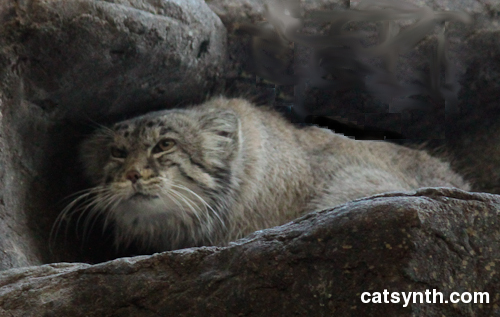
Both of these cats and many others have a similar spotted look that works well in their forested environments. Our old pal the Pallas cat (Otocolobus manul), also known as the manul, is quite a different beast altogether. It has a squat shape, fluffy fur and a gray color that are suited to its cold rocky environment in Central Asia. Here is a manual I encountered at the Prospect Park Zoo in New York some years ago.
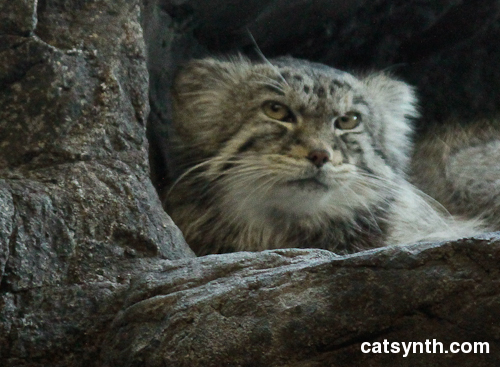
pallas cat

pallas cat

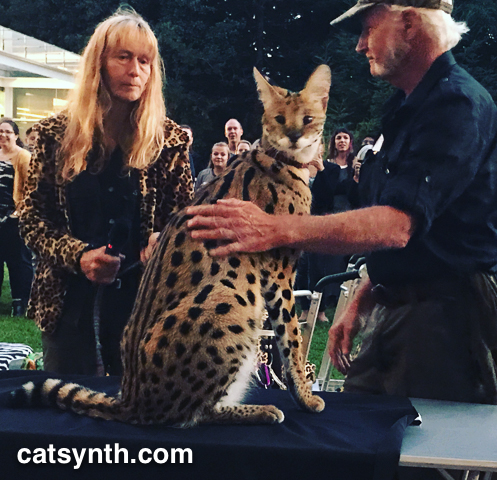
More recently, we attended the Feline NightLife at the California Academy of Sciences, and got to see many wild cats courtesy of Safari West, including this beautiful serval.
serval

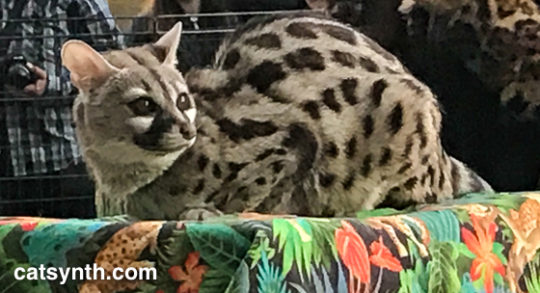
While not endangered, servals have been frequently been captured and bred as exotic pets.  They do, however, remain wild predators and their domestic captivity usually goes badly for human and feline alike.  As our host from Safari West said, “they do not make good pets, but they will eat good pets.”  Below is a “cat” that actually is not a cat at all, but a separate genus, the genet.  If they had not told me, I might have guessed it was a fishing cat.
genet

Sadly, Safari West was affected by last year’s devastating Tubbs fire in Sonoma County.  Several structures burned, and the co-founders lost their own home.  Fortunately, most of the property was spared and the animals all made it through the conflagration safely, and Safari West reopened for tours and programs in late November.  You can read more about their experience (and find out how to support them) here.

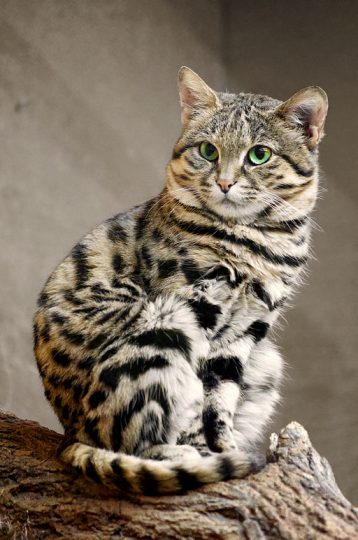
We conclude with our friends at ISEC Canada, an organization dedicated entirely to the conservation of small wild cats.  They have many projects underway, including a study of the black-footed cat, another lesser-known small wild cat from southern Africa.  It’s esimated range covers parts of Namibia, Botswana and South Africa.

[By Patrick Ch. Apfeld, derivative editing by Poke2001 [CC BY 3.0], from Wikimedia Commons]

The black-footed cat is adorable, and its face closely resembles many housecats.  But once again, this is a wild animal and does not belong in a domestic setting.  We applaud the work of ISEC Canada and other organizations who study and help to preserve them in their wild habitats.