Fun with Highways: Saint Catharines

Facebook provides a number of interesting statistics about fans, one of which is the cities (or metropolitan areas) in which they reside. The top cities for CatSynth are not surprising: New York City is #1, with San Francisco and other Bay Area communities high on the list. But one has consistently stuck out among the top cities: Saint Catharines, Ontario, Canada. Today we pay tribute to this rather surprising enclave of CatSynth Facebook fans in our own unique way: a “Fun with Highways” article.

Saint Catharines is located in the Niagara region of Ontario, on the southwest edge of Lake Ontario, not far from Niagara Falls. It’s official nickname is the “Garden City” and is unofficially nicknamed “St Kitts” by people in the area (thanks to regular reader Sue St. Clair for providing this insight).

The city is served by two major highways (known as 400-series highways in Ontario): highway 406 and the Queen Elizabeth Way (QEW), which connects Buffalo, NY and Niagara Falls to Toronto. The QEW has an interesting history, not only for its name but also its distinction as one of the oldest divided highways in Canada. Below one can see the Garden City Skyway portion of the QEW spanning the city’s other historic transportation feature, the Welland Canal.

[Public domain image via Wikipedia]

One of the first long road trips with my family growing up went through Niagara Falls and Toronto, and I’m sure I passed through Saint Catharines on the QEW with little notice, despite my penchant for staring out the window and observing road signs. One tragic story of the QEW in Saint Catharines involves the death of hockey star Tim Horton in an automobile accident – I mostly know about him not from hockey but as the eponymous late owner of the chain where my friends in Canada go to get their daily coffee.

Interestingly for a highway article, Saint Catharines is also home to the headquarters of the provincial Ministry of Transportation – or rather a headquarters of the Ministry of Transportation, as there seem to be several. Of course, the city is also home to many parks and gardens as the name would imply. One more iconic is Montebello Park.

[Public domain image via Wikipedia.]

The pavilion in the photo above overall has a very classic appearance that one would see in many town parks from this era. But that one structure on the left also evokes a more modernist aesthetic with its unadorned smooth curves. There is something very 1960s about it. Additionally, Montebello Park has a significant connection to Central Park in New York City which I leave as an exercise to the reader.

Transbay Terminal overpass demolition

I often walk by the overpasses that connect (or once connected) to the soon-to-be-defunct Transbay Terminal here in San Francisco, including the Fremont Street “bridge to nowhere” and the curving elevated road over Howard Street. Both have been featured in Wordless Wednesday photos on CatSynth the posts Fremont Street Overpass and Shine.

[Click the above images to visit the original posts.]

The bridge to nowhere used to connect the Fremont Street exit off of I-80 to the Transbay Terminal. The Fremont Street ramp, which included the last remaining pieces of the Embarcadero Freeway, was truncated and left this bridge hanging. It was a particular favorite “architectural feature” of mine in the city, and in fact qualified as a “Thomasson” or hyper art structure in that was present and maintained but served no purpose.

The elevated road over Howard Street continued to function as a bus entrance to the terminal.

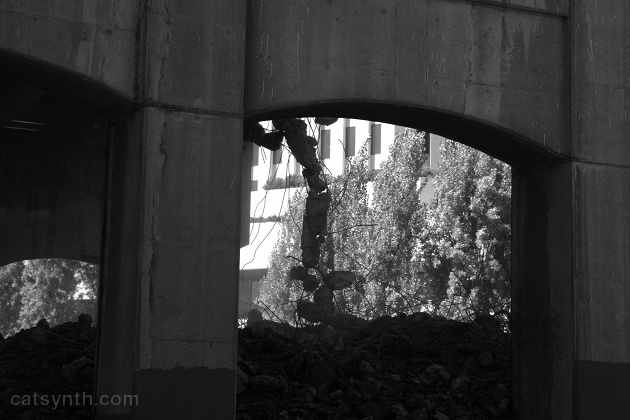
This past week both structures were demolished, as part of the project to replace the entire Transbay Terminal with a new modern transit center. Thanks to a tip from a close friend, I went to shoot some photos of the demolition in progress.

The Fremont Street bridge is completely orphaned on both sides. Only the single arch remained.

In the second photo, one can see the “Buses Only” ramp that temporarily replaced the bridge. That ramp was completely gone already.

The Howard Street overpass was being dismantled in pieces.

One could see the metal skeleton amidst the remaining concrete sections.

Here is a short video of the Howard Street overpass demolition in progress:

By Monday, the Fremont Street overpass was completely gone. And Howard Street structure will be gone soon as well. It is sad to so them go. For me, they were landmarks, part of the architectural landscape of the neighborhood. However, in a city where people get upset easily about architectural changes and preserving landmarks, these seem to have gone largely unremarked upon. I am glad I got a chance to see the demolition and take photos before they were gone. Indeed, some of the images can be quite beautiful in their own way. There is something about aging and decaying urban infrastructure, even when it is being reduced to a pile of concrete rubble and twisted rebar. But I would have rather seen it preserved – I wonder if San Francisco can ever do anything as creative with its old infrastructure as New York did with the High Line.

I may post more images in the near future.

Fun with Highways: CA 77, Oakland

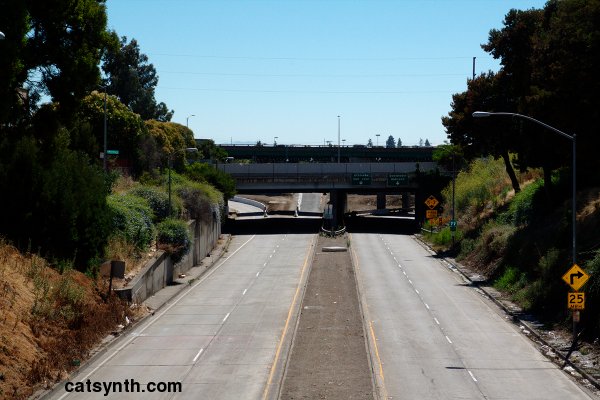
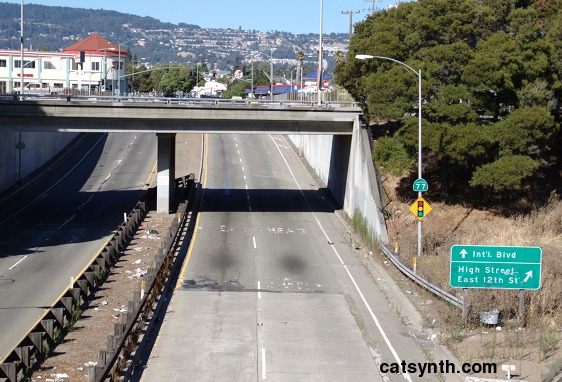
While shooting photos in an industrial section of East Oakland with a friend a few weeks ago, I came across a surprising section of highway that i had not noticed in the past.

[Click to enlarge.]

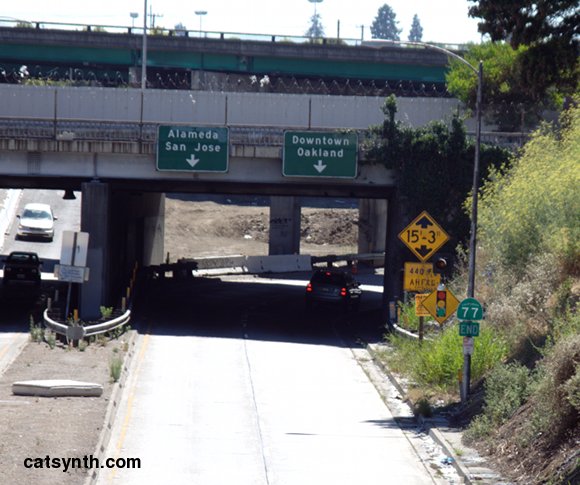
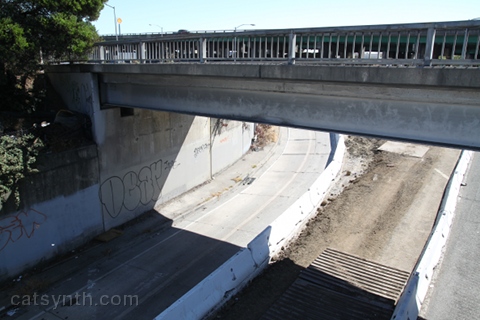
It turns out this is CA 77, a short freeway that stretches from International Boulevard, of the main streets in East Oakland, to I-880, and is one of the shortest in the state. It starts at a street intersection with International Boulevard (CA 185), passes underneath San Leandro St and the elevated BART tracks and connects onto I-880 via the ramps (which mark the highway’s end).

The overhead signs are actually hanging from a rail overpass, which I had walked along and was a rich source of photographic material, including a recent Wordless Wednesday photo with graffiti.

Although there is a direct connection from the end of CA 77 to I-880, the converse is not true. There is not even a mention of highway 77 at the closest exist (High Street). However, it looks like there is a lot of construction going on at the now rather old and dilapidated interchange, so there might be a direct and signed connection in the future.

Going east from the San Leandro Street and BART overpasses, the highway has a single intermediate exit to East 12th Street. It then tilts upwards to meet International Boulevard at a traffic light.

[click to enlarge]

International Boulevard (CA 185) used to be known as East 14th Street, and was a rather infamous (and dangerous) corridor in East Oakland. Changing the name 1996 did not really change the situation. But from what I understand, it had been getting better, at least until the recession.

According to the California Highways site, CA 77 is intended to continue further east to I-580, but it appears this is neither constructed nor signed on surface streets.  They also mention that the stretch of freeway had been signed as CA 185 until 2008, and in fact I do recall once or twice seeing a sign to that effect when taking BART sound from Oakland years ago.