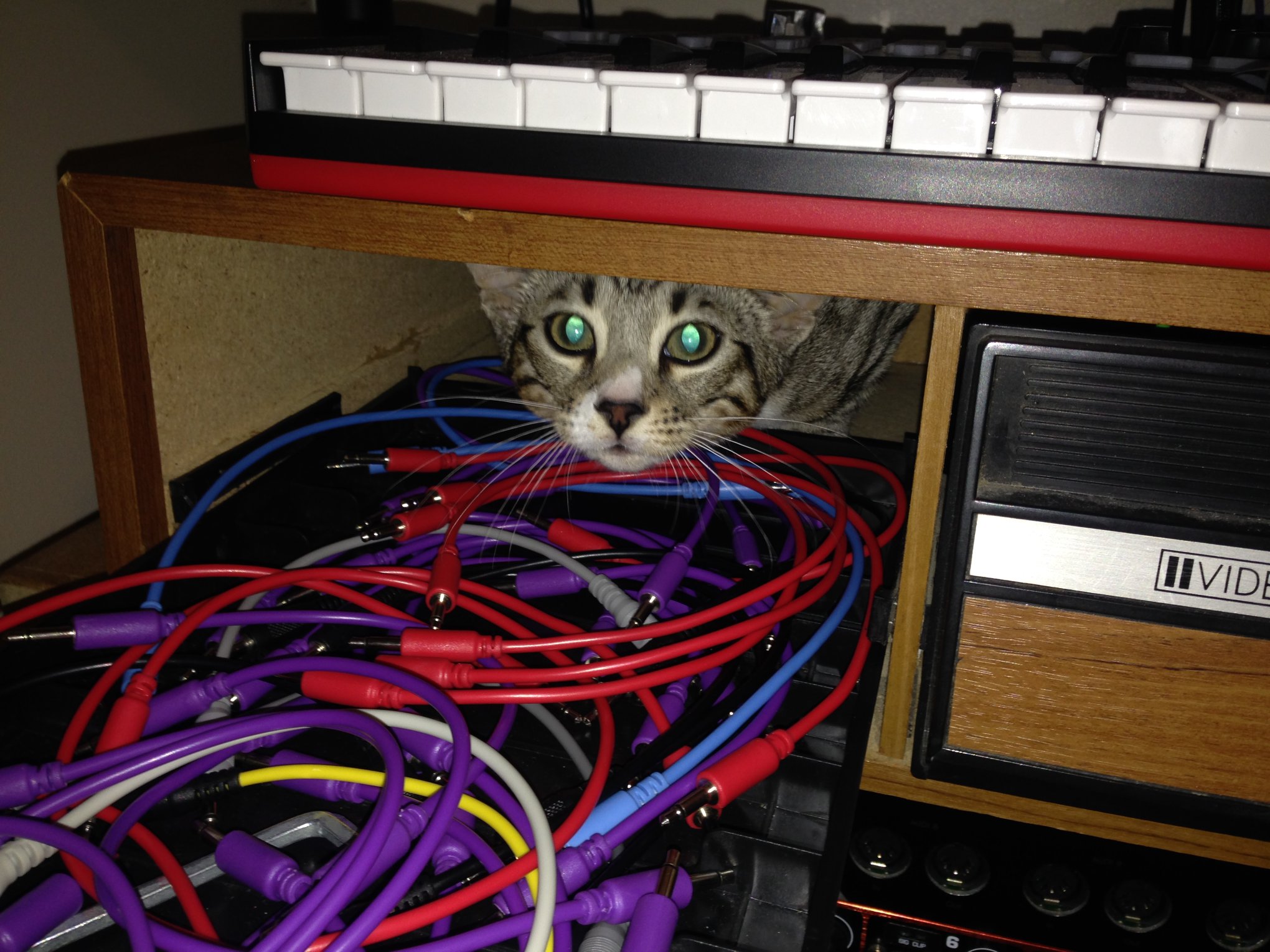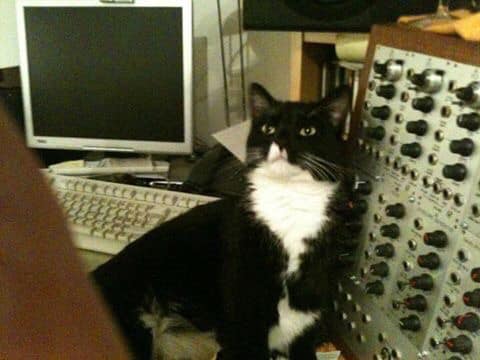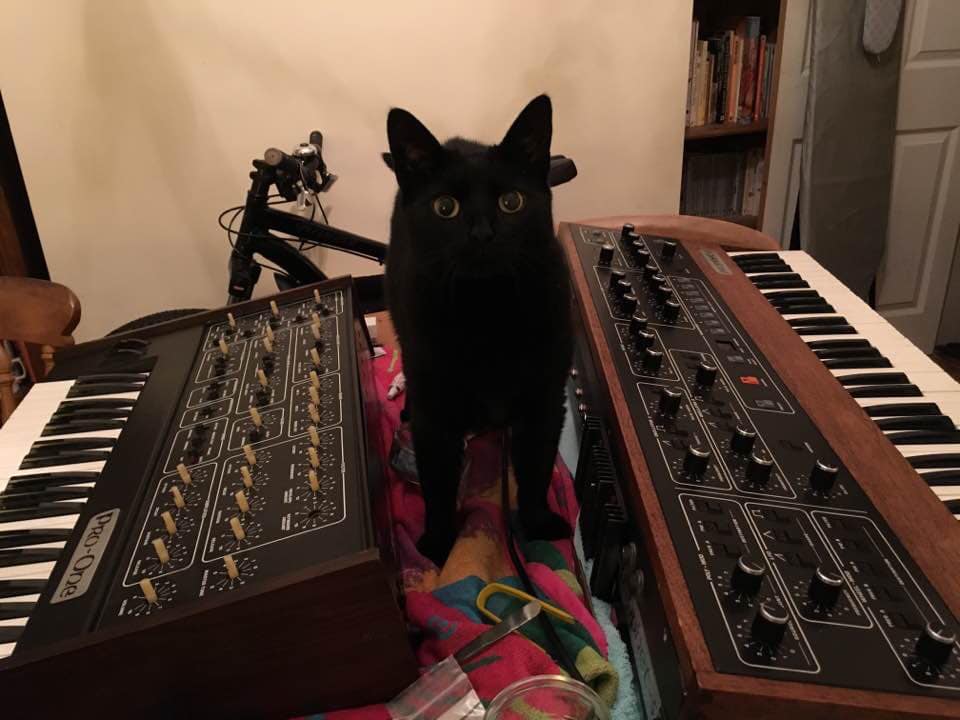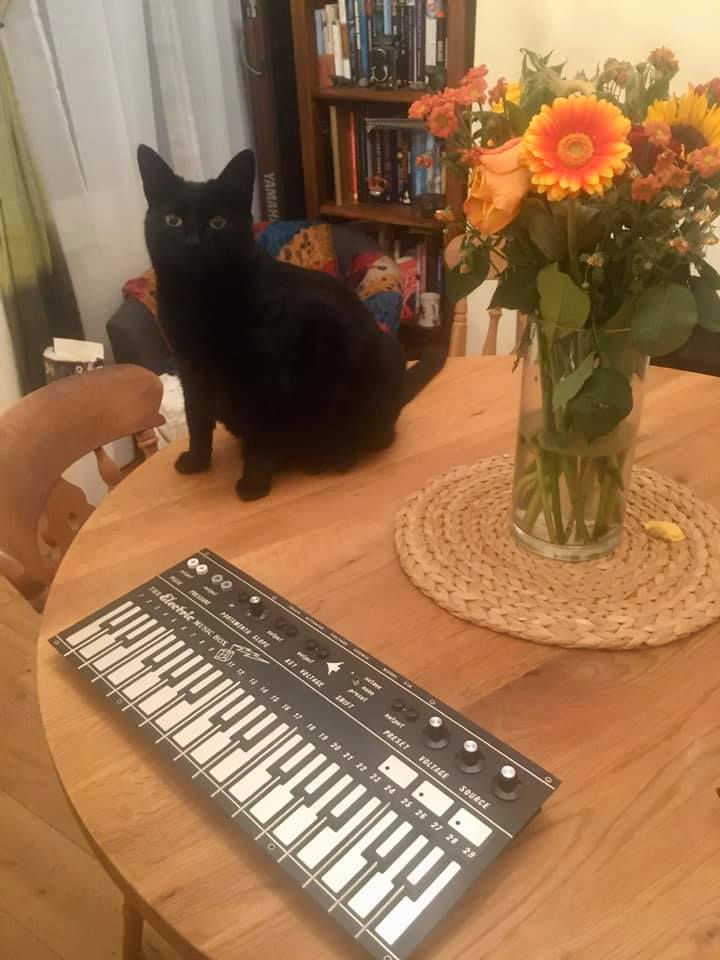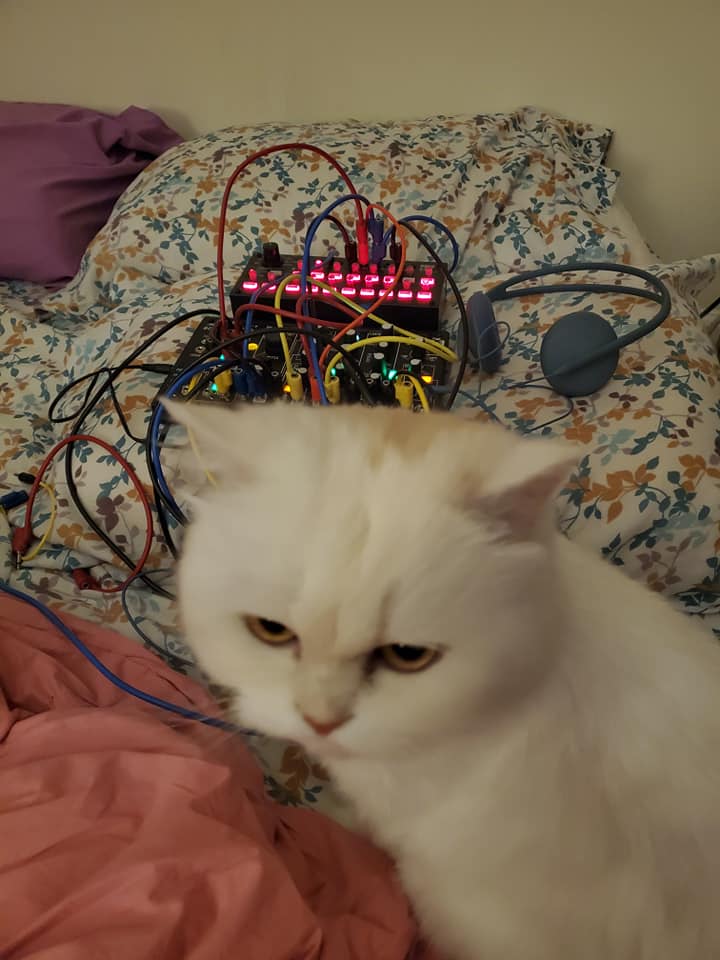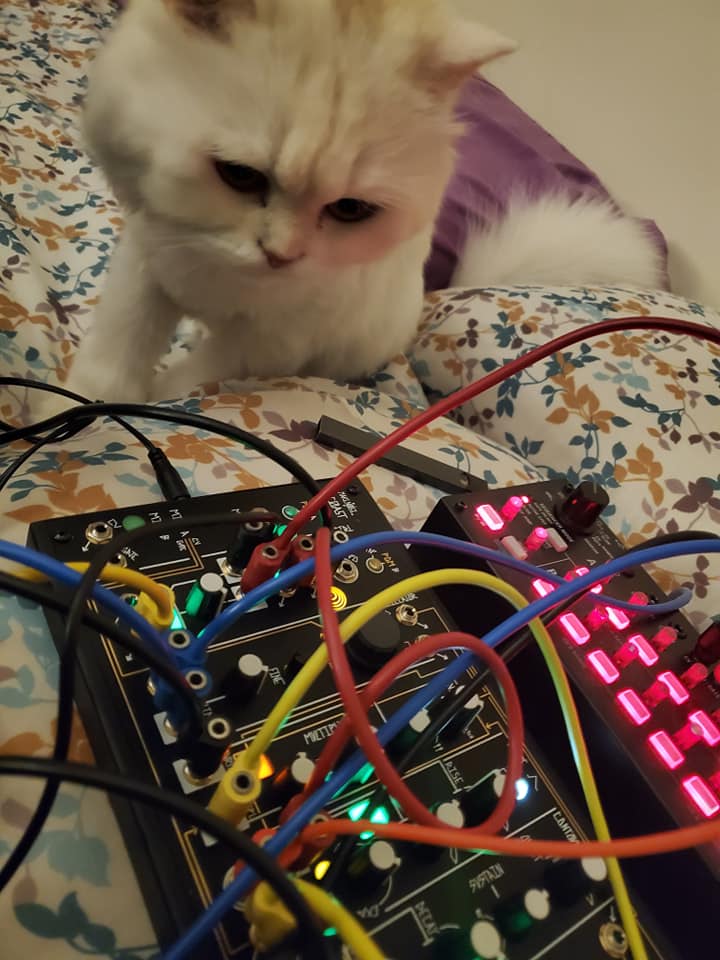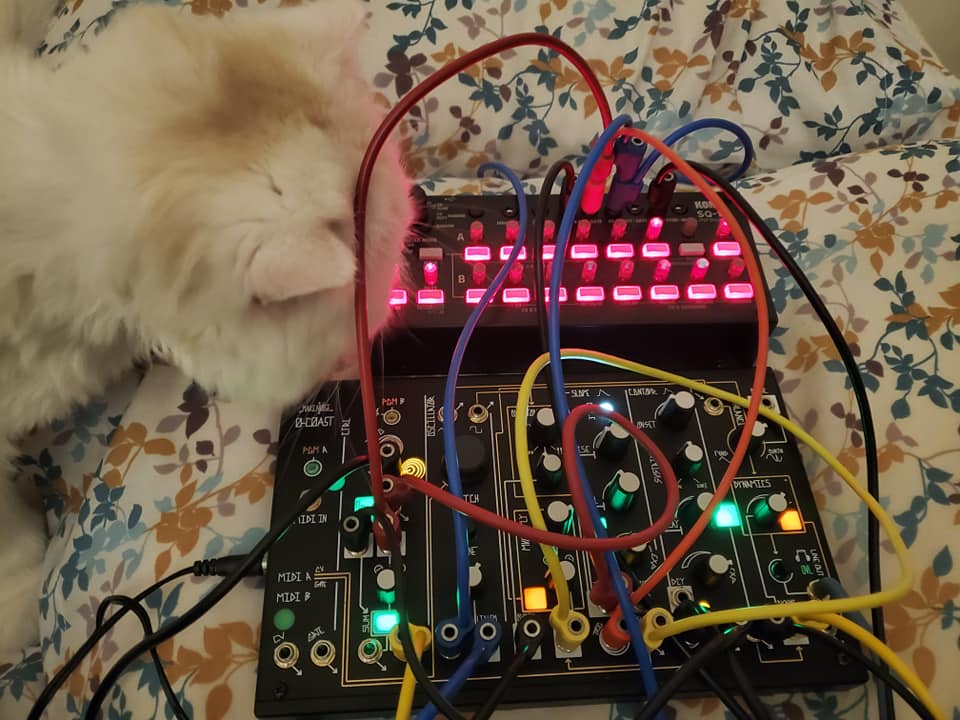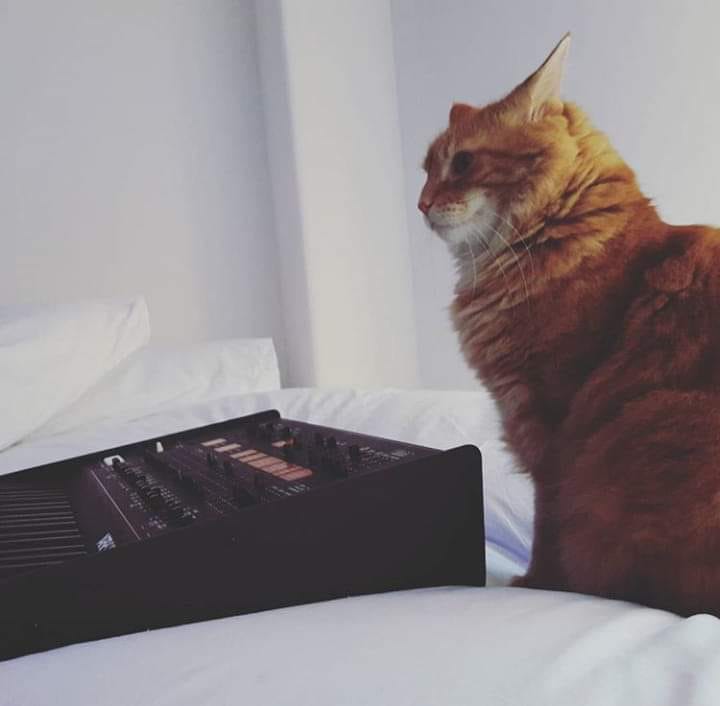
Cat posing with a Korg Arp Odyssey synthesizer. From Jenna Leigh-Raine via Facebook.
Modelling for Korg. Ha
We’ve long been intrigued by the Korg Arp Odyssey since it came out – you can see our NAMM review when it was first released. But we don’t have one of our own…yet.
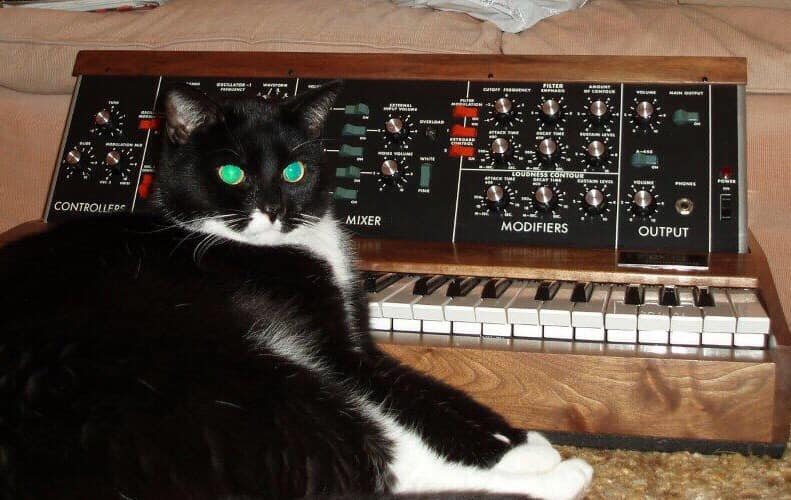
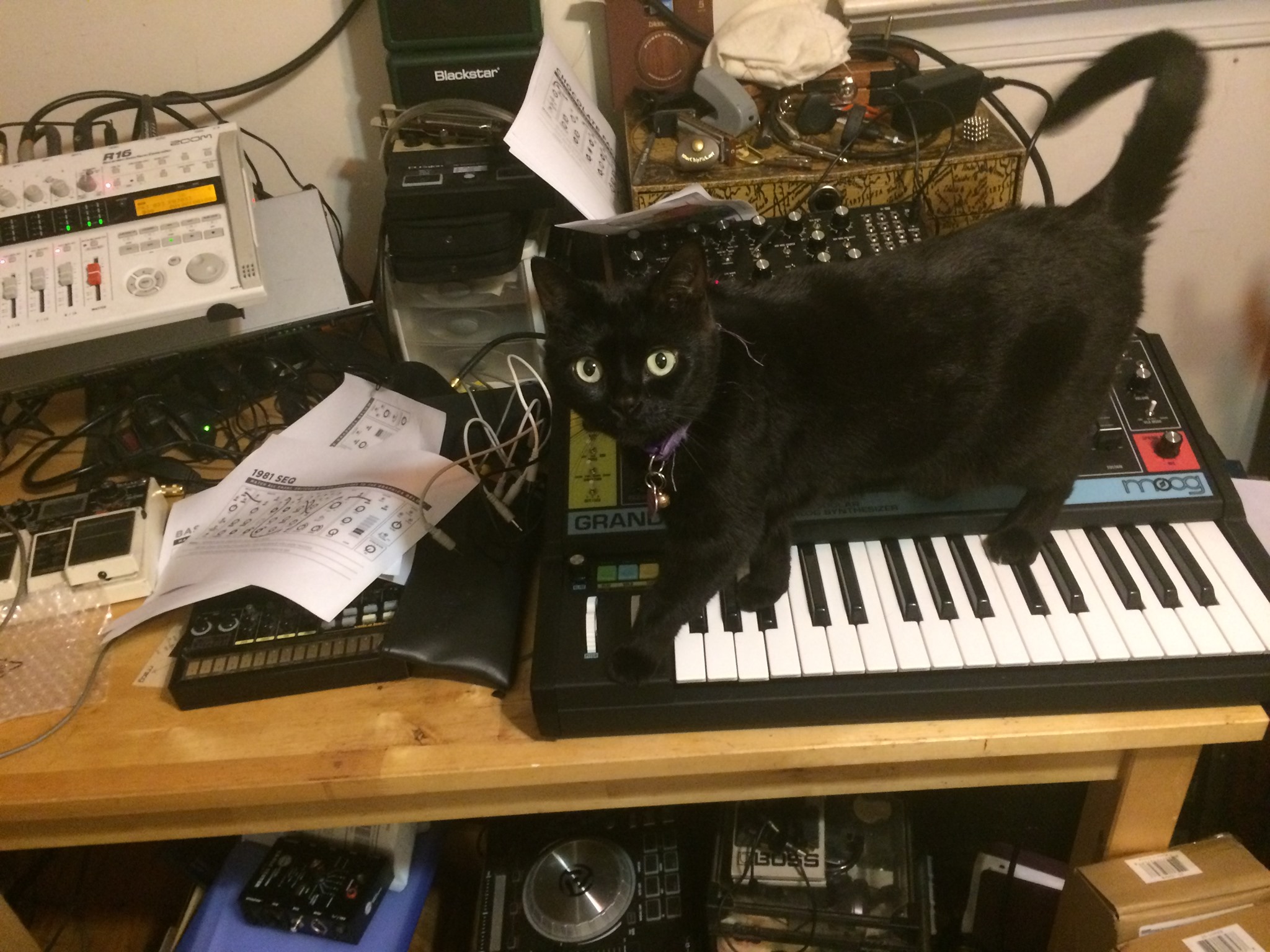
This cat is showing off a great find: a Moog MG-1, which was made for the Realistic (Radio Shack) brand in the early 1980s. From Paul Cunningham via Facebook.
Found this Moog at the pawn shop. Already had the cat. Look it’s got all it’s slider knobs!
The slider knobs (and other knobs) do fit the industrial design of the time. And the colorful section borders suggest a precursor to Moog’s current Matriarch series. It is, nonetheless, a fully equipped analog subtractive synthesizer:
Three-part envelope generator, with separately adjustable Attack and Decay or Release, and selectable Sustain on or off. The Envelope Generator can be triggered by either the keyboard, or the LFO.
Oscillator 2 can be tuned independently or hard-synced to Oscillator 1.
Polyphonic oscillator. This is a divide-down square wave generator. It is routed to the VCF and the VCA.
LFO that can modulate the oscillators and the filter using a Triangle, square or random Sample and Hold waveform
Voltage controlled amplifier with Keyed, Hold, and Envelope modes (accessed via 3-way switch, misleadingly only labelled “Tone Sources” but also affects Poly signal)
The subject line says it all. This little tabby is clearly owning the Kurzweil K2000S synthesizer. Submitted by Ron Gallagher via our Facebook page.
The K2000 was a big deal in the 1990s (though we at CatSynth never had one ourselves).
he K2000S uses V.A.S.T. (Variable Architecture Synthesis Technology) which allows you to take any multi-sample, noise or waveform and process it using just about any synthesis technique. The source of these multi-samples are from the 8MB of ROM which hold tons of authentic and superb quality samples. The internal processing is 32-bit with 18-bit DACs. The K2000 uses 31 sound-shaping algorithms to provide a variety of resonant filters, EQs, continuous panning, amplitude modulation, crossfade, distortion, digital wrap, waveshaper, pulse width modulation, high frequency enhancement, low frequency oscillators, hard sync oscillators and mixing oscillators, all with real-time MIDI control.
Handsome Leo poses next to a Moog Subsequent 37 synthesizer. Submitted by jenny Grover via our Facebook page.
This appears to be one of the limited-edition Moog Subsequent 37 CV versions which were introduced at Moogfest. I must admit, we at CatSynth are a bit envious of Leo and Jenny on this one 😸🎹
As our time in New York winds down (for now), it seems appropriate to share a Brooklyn cat. Elektra naps on a keyboard beneath a Korg MS-20 synthesizer. She seems really comfortable and content.
From Maeghan Donovan via Facebook. Please check out her music at http://maedon.net/
It’s one of those serendipitous moments that happen in New York. At the end of last week’s Ambient Chaos show, I received an invitation from Neb Ula the Velvet Queen to come to LadyJams is a monthly get-together where women get together and perform in randomly selected groups. I loved the idea, and especially the coincidence of this meeting; so on Friday I grabbed my trusty Arturia MicroFreak and headed out on the L train to Bushwick.
The festivities took place at Synesthesia, a gallery and art space in the apartment of Mio Nakai. Amidst objects and curios from the turn of the 20th century – and an old-fashioned bar to match – was an exhibition of sculptures that evoked both a delicate graceful quality and a confounding misplacement of human forms. It was in the midst of this milieu that Ladyjams unfolded.
Photo by Laura Feathers
I made some more new friends that evening, including Laura Feathers, Teena Mayzing, and Yana Davydova, who performed on electronics, voice, and guitar, respectively. I performed with them and others over the course of the evening in several miniature improvised sets. You can hear an example in this video.
This truly spur-of-the-moment music, as I had never performed with any of these artists before. The MicroFreak was definitely the right choice of instrument, given its versatility and immediacy (as well as being extremely light). I had some light melodic spacey touches, as well as deep bass pedal tones and various sound effects. I particularly enjoyed a call-and-response with Yana Davydova on guitar – we both were able to match one another’s melodic fragments and respond with variations that moved the performance forward. I also tried to choose sounds and notes to complement the words of Teena Mayzing and others during vocal sections.
Photo by Laura Feathers
Neb Ula and I also had a chance to perform together, as seen in the photo above and following video clip.
Although New York – and perhaps Brooklyn in particular – is an exceptionally fertile place for an event like this, I am left wondering why not try to do something similar in San Francisco? I certainly know enough women and non-binary performers to make it a possibility, so perhaps it will happen.
This rather handsome long-hair cat is posing with a Behringer Model D synthesizer, a keyboard, and two Korg Volcas, the first one of which is a Volca Keys. Submitted by Ricardo Branco via our Facebook page.
Today’s CatSynth pic takes us to the 2000s, with Rusty and his human James Maier in the studio. We see a Waldorf Microwave XT, a Nord Micro Modular, and more. From James Maier via Facebook.
TBT – Rusty Inspects Studio in 2000
Although it’s a small photo, it looks like Rusty has some of Big Merp’s color and markings.
It is that time of year when I invariably return home to New York for a visit. And this time it began in dramatic fashion with a return to the Ambient Chaos music series at Spectrum. Perhaps not quite a return, as Spectrum as since moved to a new location on the waterfront in Brooklyn. But it was still the same concept, hosted by Robert L. Pepper of Pas Musique, with a variety of local and visiting musicians performing adventurous electronic music.
The evening opened with a duo featuring Public Speaking (aka Jason Anthony Harris) and pianist Gabriel Zucker.
The unfolded in with sparse but structured piano set against electronic sounds evoking metal machinery. Both elements started out slow and quiet with lots of empty space but increasingly got more dense and urgent. After a brief interlude, a new phase of the music began with vocals set against fast piano runs. The vocals began very expressive and plaintive but soon morphed into a complex electronic sound under vocal control. Underneath this, an incessant thudding drum emerged.
Next up was The Tony Curtis Experience, a trio led by Damien Olsen on keyboard and electronics, Jeremy Slater on guitar and electronics, and Neb Ula the Velvet Queen on theremin – specifically, a Moog Theremini with which we at CatSynth are quite familiar.
Their performance mixed long tones on theremin, slide guitar + electronics, and synthesizer pads with loud percussive moments. The early portion of the set evoked some fantastic futuristic nightclub with crystalline hits and pedal tones. But Olsen’s keyboard brought it back to the present and near past with melodic and harmonic playing reminiscent of mid-20th century cabaret as well as synth-pop of the 1980s. The theremin, acting as both sound source and controller, provided antiphonal counter-subjects to these familiar sounds; and the guitar drones glued everything together. It was a fun set, especially with Olsen’s playful performance and his use of familiar idioms.
Then it was my turn to take the stage. And I compacted the setup for travel, with the Arturia MicroFreak, laptop, Novation LaunchPad Pro, tiny modular with Qu-bit Prism and Strymon Magneto, a new handmade touch synthesizer, and Crank Sturgeon Pocket Gamelan.
I planned a slimmed-down version of my solo set from the Compton’s Cafeteria Series show in August, including White Wine and an evolving improvisation over an 11/8 groove.
Overall, the set went well – a highly dynamic performance with a lot of melodic elements, jazz riffs, and noise solos layered over rhythms. A few items misfired, but all recoverable. I particularly enjoyed the sections of melody and jazz improvisation where I floated back to the sounds of the 1970s; it seemed the audience appreciated that, too. Finally, it was also just fun to be playing in New York again after an extended break. Watching the video of the set (which will be shared soon as an episode of CatSynth TV), I particularly thought this noisier and more “electronic” version of the 2019 set worked well in Spectrum and especially with the every-changing “spectrum” of light from yellow to violet and everything in between.
The final set of the evening featured 4 Airports, a duo of guitarist Craig Chin and synthesist Nathan Yeager. Chin performed with guitar and an array of pedals, while Yeager brought a large synthesizer setup complete with a modular system.
Perhaps more than the preceding sets, they lived up to the “ambient” in Ambient Chaos. Chin’s guitar gestures were subtle as he guided the sound into the electronic arena of the pedals, and Yeager’s synthesizer sounds were complex but still lending themselves to long ideas even when the tones and timbres moved between quick and slow. From the chaotic undertones and singular and dreamy landscape emerged, with occasional ebbs and flows and punctuations.
Overall, it was a wonderful night of music in this corner of the Brooklyn waterfront, with an intimate crowd in the cavernous but cozy space. I would also be remiss if I did not give a shout out to Sofy Yuditskaya for her video projections that reflected the music on stage. I certainly hope the gap until my next performance here is much shorter than the last.
[Photos by Banvir Chaudhary and Amanda Chaudhary]
[Full video coming soon. Please subscribe to CatSynth TV to be noticed when it is available.]