Occupy Wall Street (Zuccotti Park)

Being in New York in the third month of Occupy Wall Street, I of course had to visit Zuccotti Park, the symbolic and initial geographical center of the movement. And I did visit for a while on Saturday.

This is of course coming a little less than a week after the major raid on Zuccotti Park, so things were a bit sparse, indeed less active than some of the events I have attended in San Francisco. The ban on tents was in full force, with not a single tent in sight. I had also heard about a ban on musical instruments. So here I am playing the Smule Magic Piano on the iPhone in defiance.

Zuccotti park is in fact not much of a park at all. It’s a paved plaza with lights in between some of the stones. A few of the planted trees in the space were festooned with holiday lights. It’s the sort of modern public space one often sees near commercial buildings. If it wasn’t a protest site and rather cold, it would be a perfectly nice spot for lunch. I did of course get to see the “weird red thing”, aka Joie de Vivre by Mark di Suvero.

At the time I arrived, many of the leaflets and signs were in fact not about the core issues of the Occupy movement, such as income inequality and accountability of the financial institutions and their leaders, but rather a mix of 9-11 conspiracy theories (though I should not be surprised as we were just over a block from the World Trade Center site). I was disappointed to see that, as I place very little credence in such conspiracies and think of it as a detraction. But fortunately, a large march of people came back from the direction of the actual Wall Street and seemed to be more on message. I was even able to get from them a copy of the “Occupy Wall Street Journal”:

There was one tense moment when there were rumblings about police entering into the main area of the plaza. A quick look around confirmed this to be the case. As one speaker got up to address the crowd and remind everyone to be civil and not to repeat the mistakes of previous encounters, the police suddenly swooped in on one person, whom the arrested and carried out of the perimeter. It was all over quite quickly, and without any confrontations – there were additional calls to those assembled not to do anything provocative. But there was a lot of confusion, and no one seemed to know exactly why this one person was arrested. But it seemed to be connected to disrupting the putting up of holiday lights by the park’s owners.

Other than that, it was relatively calm and quiet visit to Occupy Wall Street…and a very cold one. The sparseness in comparison to recent west-coast events and the cold further suggests that the movement has to morph into something else beyond camps and marches.

CatSynth in New York

As I do ever year at around this time, I will be spending a week in New York.  This promises to be a rather busy trip, visiting with family and friends, seeing art exhibits, partaking in various New York rituals, and playing in two music performances.  For those in the NYC area (or who have friends in the NYC area), here is the information on the shows:

November 20, 2011. 8PM. AvantElectroExpectroExtravaganza

13 Thames St., 3rd Floor, Brooklyn, NY.
SK Orchestra, Doom Trumpet, Amar Chaudhary, Loop B, Badmitten (damien olsen)

November 26, 2011. PAS presents Experi-MENTAL Night at Theaterlab. 7PM.

Theaterlab: 137 West 14th Street, New York.
A night of Experi-MENTAL music featuring: PAS, Richard Lainhart and Lucio Menegon, Koning’s Blauw, Amar Chaudhary, ‘History of the Future’ live film score directed by Richard Lainhart with ‘The Orchestra of the Future’.

Many of these names should be familiar from past shows, including last year’s Omega Sound Fix, the now defunct Ivy Room Hootenanny here in the Bay Area, and others.

I will try and post sporadically while I am there, but I do expect to continue with live updates of NY adventures via Twitter @catsynth.

Fun with Highways: The Bay Bridge Turns 75

This past Saturday, November 12, marked the 75th anniversary of the opening of the San Francisco – Oakland Bay Bridge, known conventionally as “The Bay Bridge.” It is a regular part of life for many of us here, one of our main connections to the communities across the bay and a principal landmark during walks in my part of the city. It has been featured in many previous articles here on CatSynth.

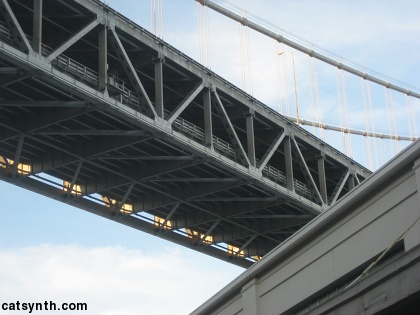
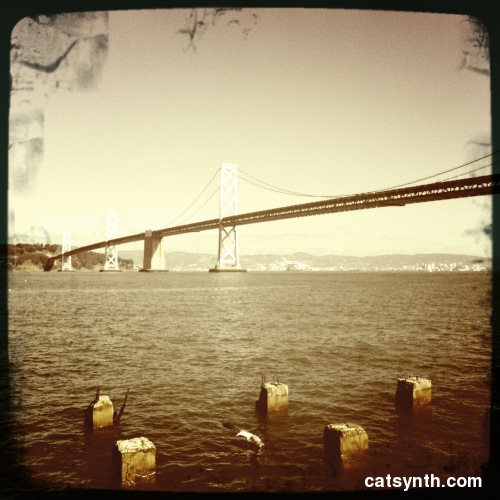
The Bay Bridge is a workhorse, spanning over 4 miles and carrying an estimated 270,000 vehicles a day, making it second busiest in the U.S. after the George Washington Bridge in New York. But the western double-span is quite a beautiful structure, both as seen from the hills of San Francisco and from up close.


[Click to enlarge]

[Click to enlarge.]

Don’t let that last photograph fool you. Even though it may look like it was taken 75 years ago, it was actually taken yesterday using the iPhone Hipstamatic app during an early afternoon walk by the bridge.

It was quite an engineering feat when it was built, the longest bridge of its time and built in challenging geography of the bay.

[Image from Wikimedia Commons.]

This video (as seen on the official Bay Bridge info site) captures both the era and the engineering:

Much like the Brooklyn bridge when it was first built, the Bay Bridge towered over the surrounding architecture of the cities it connected. It is anchored in the middle to Yerba Buena island with tunnels connecting the two spans of the bridges. On the the San Francisco side, it is anchored to Rincon Hill, once an upscale neighborhood in the late 1800s that fell into rapid decline and largely destroyed in the 1906 quake. The eastern bridge was built resting on mud rather than bedrock. It was the most expensive bridge built to date.

The idea of a bridge crossing the bay has been around since the 1800s. Indeed, such a bridge was proposed by Emperor Norton in the 1870s (I think this even made it into Gino Robair’s opera I Norton). But unlike his other proclamations, this one seemed like a good idea. After that, there were many proposals, such as this one that in some ways resembles the bridge that was actually built.

The bridge proposed in this drawing connected to Telegraph Hill rather than Rincon Hill, and has suspension bridges on both sides of Yerba Buena island.  The spires also make it look like some of the older suspension bridges on the East River in New York.

When bridge first opened, it carried US Highways 40 and 50 as well as the trains from the Key System in the East Bay. The upper deck had longer ramps leading to Harrison and Bryant Streets at 5th, roughly the same as the rather long ramps at those streets today. On the Oakland side, the bridge had viaducts from Cypress Street (Highway 17) as well as San Pablo Avenue and the Eastshore Highway (US 40). The bridge now carries Interstate 80 across the bay. The railway is long gone. Gone also are the connections to the old Transbay Terminal and Embarcadero Freeway, both of which have been demolished. The area under the bridge on the San Francisco side, once a gritty industrial waterfront, is now a picturesque boulevard that is great for walking. Through all of the changes, the bridge itself has not changed very much at all…

[Bay Bridge approach, 1940s]

[Bay Bridge and Embarcadero, 1970s and 1980s. Photos from Wikimedia Commons.]

[Present day, Bay Bridge and southern Embarcadero. Photo by CatSynth]

…until now. The eastern truss span, which was badly damaged in the 1989 earthquake, is now being replaced with a new more graceful cable-stayed span. The construction has progressed to the point where the tower is in place and the cables are being hung. It is indeed a bit distracting when traveling the bridge. But I am looking forward to seeing it completed, probably around the 77th anniversary in 2013.

Outsound GearExplore at Chamber Music Day

Back in mid-October, a few of us from the crew at Outsound Presents participated in Chamber Music Day at the De Young Museum in San Francisco.

There were over 140 musicians participating, with performances and demonstrations scattered around the museum. And “chamber music” was defined quite expansively to include a wide variety of instrumentation and genres, ranging from traditional classical music to experimental avant-garde ensembles and crossover groups. Our contribution was a demonstration of electronic-music gear – a mini version of “Touch the Gear Night” from the Outsound Music Summit. I primarily focused on software-based sound generation, with an iPad and a Monome connected to a MacBook running Open Sound World. Matt Davignon presented his setup featuring drum machines and effects pedals. CJ Borosque demonstrated her input-less effects change where the noise in the signal chain is the source for sound manipulation; and Rent Romus demonstrated live sound processing with a setup that included a Korg Monotron.

There was quite a large turnout overall for Chamber Music Day, and we had a lot of traffic at our demonstration table. Reactions ranged from mild curiosity to deep technical conversations. We were a particularly big hit with children, who are naturally attracted to hands-on demos and electronic gear.

[Amar Chaudhary and Matt Davignon demonstrating gear for young attendees at Chamber Music Day. Photo by Scott Chernis.]

This trio of young ladies spent a lot of time at the table exploring the various devices in great detail.

[Exploring the gear. Photo by Scott Chernis.]

They were particularly interested in the iPad. Here they are trying out the Korg iMS-20 app.

[Playing the iPad.  Photo by Scott Chernis.]

I would like to think that some of the kids (as well as a few of the adults) went off and downloaded some music-making apps for their devices and started playing. Or perhaps a casual guitarist found a new way to make sounds with his or her pedals.

Overall it was a great experience, and an opportunity for us to share what we do with musicians outside our small “new-music” community and with the general public. Thanks to the San Francisco Friends of Chamber Music (SFFCM) for inviting us to participate. To find out more about Chamber Music Day and their other events and programs, please visit their website.

[All photos in this article by Scott Chernis and provided courtesy of SFFCM.]

Weekend Cat Blogging and Photo Hunt: Two

For our combined Weekend Cat Blogging and Photo Hunt theme of two, we present a pair of Hipstamatic photos of Luna. A single pose, but two sets of lens and film effects:


It’s a sleepy morning for us, after I recover from two music performances over the past two days, and Luna basks in some sunshine after a wet and rainy Friday.


This weekend also marks the 400th Edition of the Carnival of Cats. That is quite a milestone, and we are happy to help celebrate! It is hosted by Mog, we has been the “Carnival Caretaker” over the past couple of years There is a history of the Carnival posted by last week’s hosts Nikita and Elvira of Meowsings of an Opinionated Pussycat.


Photo Hunt #291 is hosted by tnchick. The theme this week is two.

And the Friday Ark is at the modulator.

11:11 on 11/11/11

At 11:11 on this day 11/11/11, I snapped screenshots of both the iPad and iPhone featuring Luna.

Of course, the symmetry and homogeneity of the date and time is quite attractive, and unique (at least within a given century). The number 111111 is also interesting when you decompose it into primes:

111111 = 11 * 13 * 3 * 37 * 7

I find the prime factorization quite poetic.

We can also factor the date and time together (11:11:11 on 11/11/11):

111111111111 = 11 * 13 * 3 * 37 * 7 * 101 * 9901

Note quite as poetic as the previous example, but still interesting. In particular, 9901 is interesting as the greatest prime factor for any repeating series of 12 numbers. Other related properties can be seen at the site Prime Curios.