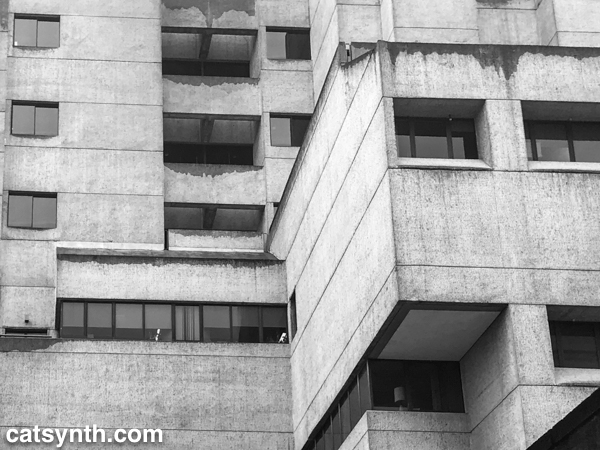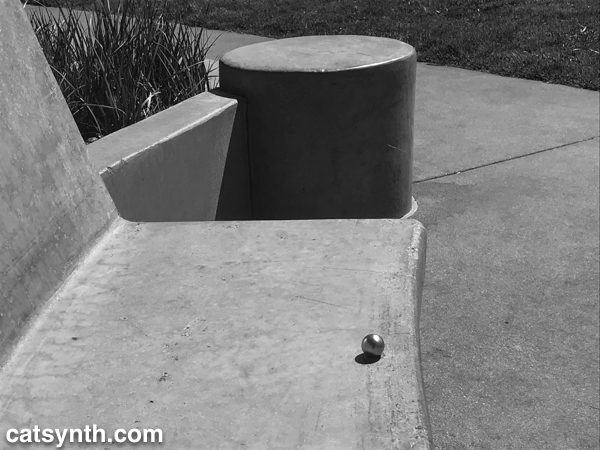
A study in geometry and texture at Lafayette Park in San Francisco.

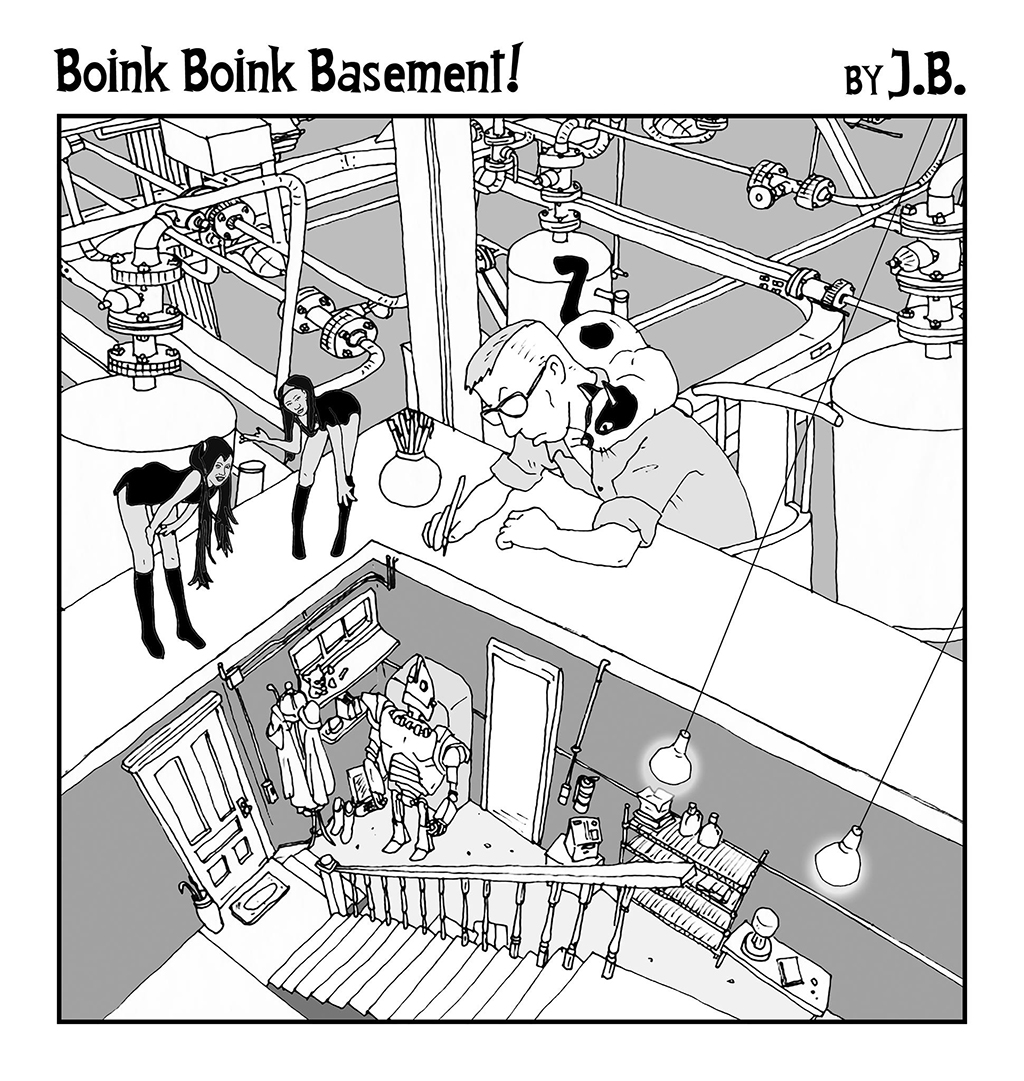
Sam Sam makes her cartoon debut in Boink Boink Basement!, our latest offering from artist J.B.
We think she fits right on with the myriad other fascinating elements in this surreal drawing. And snoopervising is one of the things she does best in creative settings, as can be seen in this previous post.
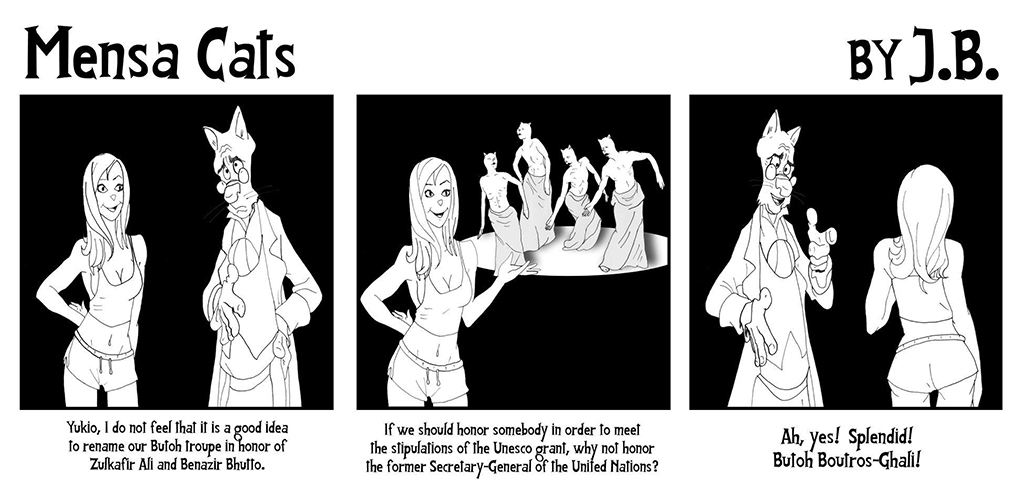
Marlon Brando is a controversial figure in contemporary circles, but we did some great movies a long time ago (followed by some not-so-great ones, then a couple more classics, and then some really awful ones). But his work has intertwined with many things at CatSynth over the past couple of years. Consider this cartoon by J.B. (Jason Berry), part of our extended Mensa Cat series.
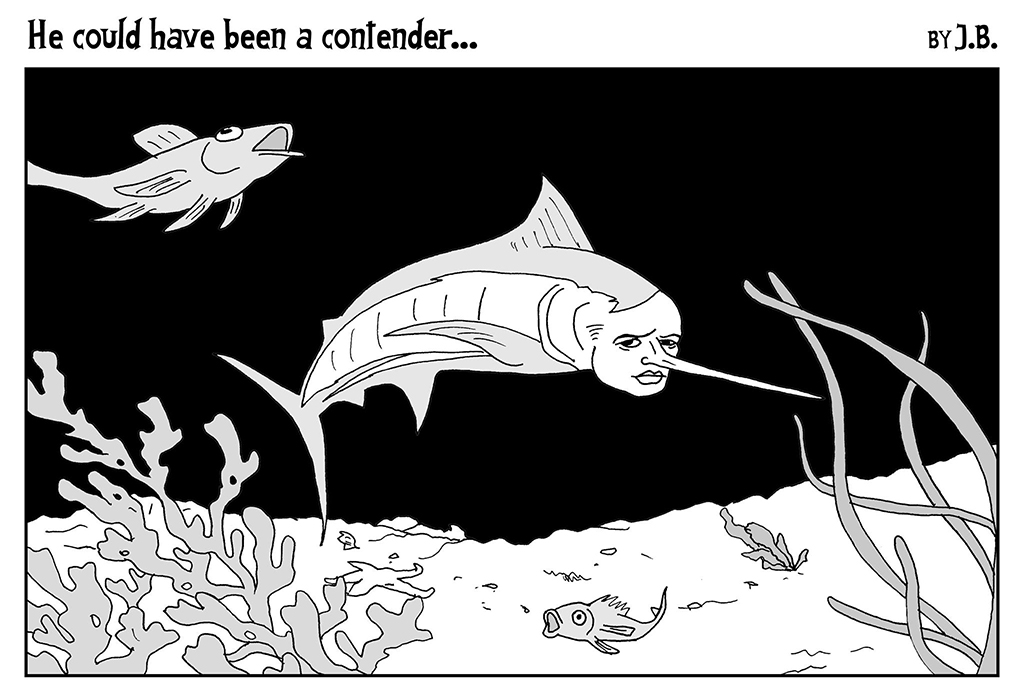
We leave the joke as an exercise to the reader. 😸
There is also the tune “Marlon Brando” initially composed by Jason Berry for Vacuum Tree Head, which I redid for my own band CDP. Here is a live performance of us playing it at the Make Out Room in San Francisco.
CDP Marlon Brando May 1 from CatSynth on Vimeo.
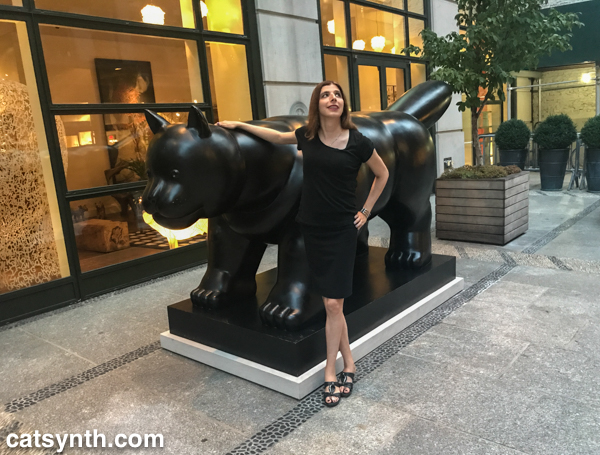
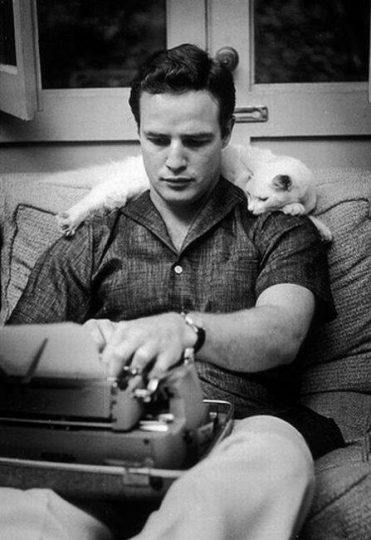
And finally, our friends at the Cat Museum of San Francisco shared this feline photo today.
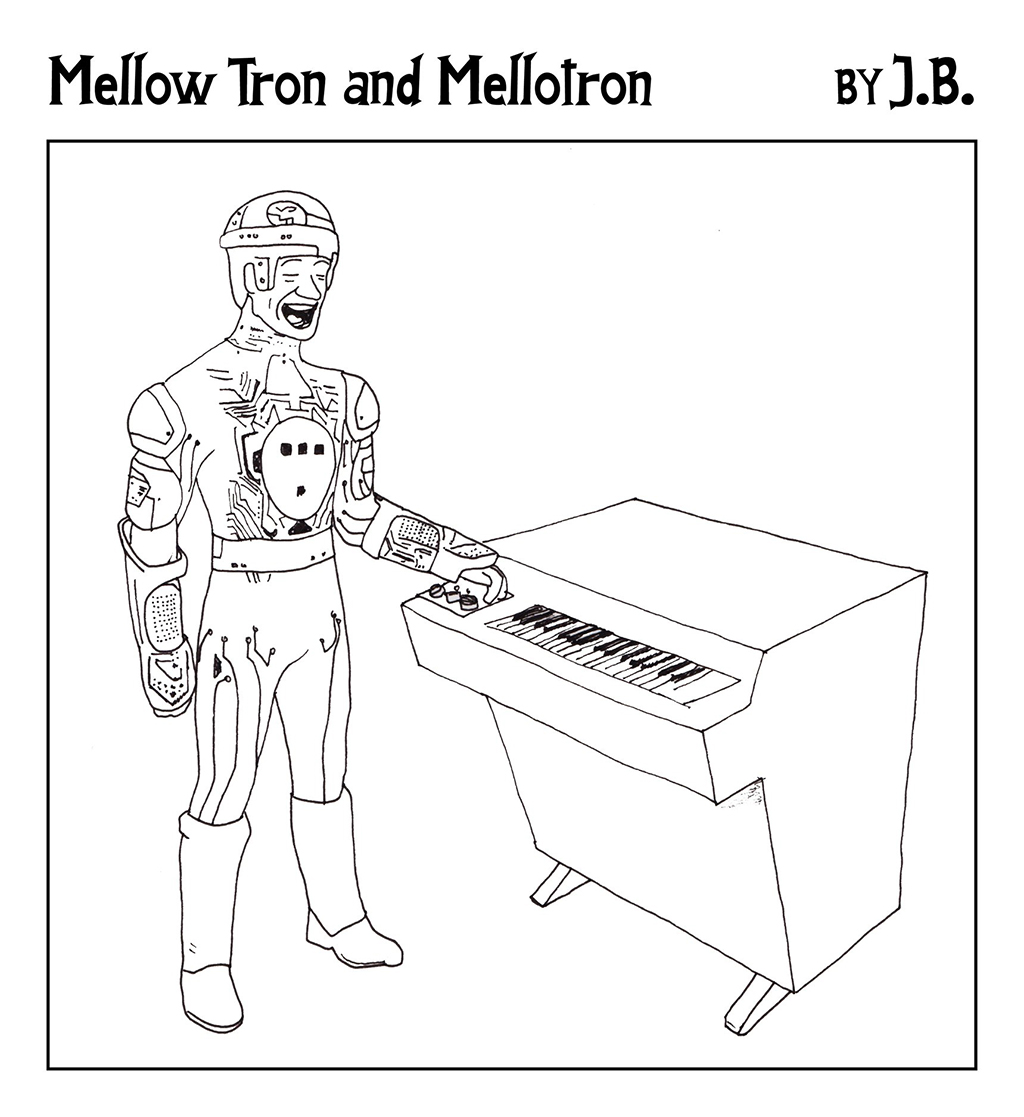
We bring you another from the latest series of cartoons by J.B., this featuring a classic Mellotron. In particular, it appears to be the iconic M400 model, or perhaps an Mk4.
You can read our recent review from the Mellotron booth at NAMM here. We also featured the instrument in a popular CatSynth TV episode.
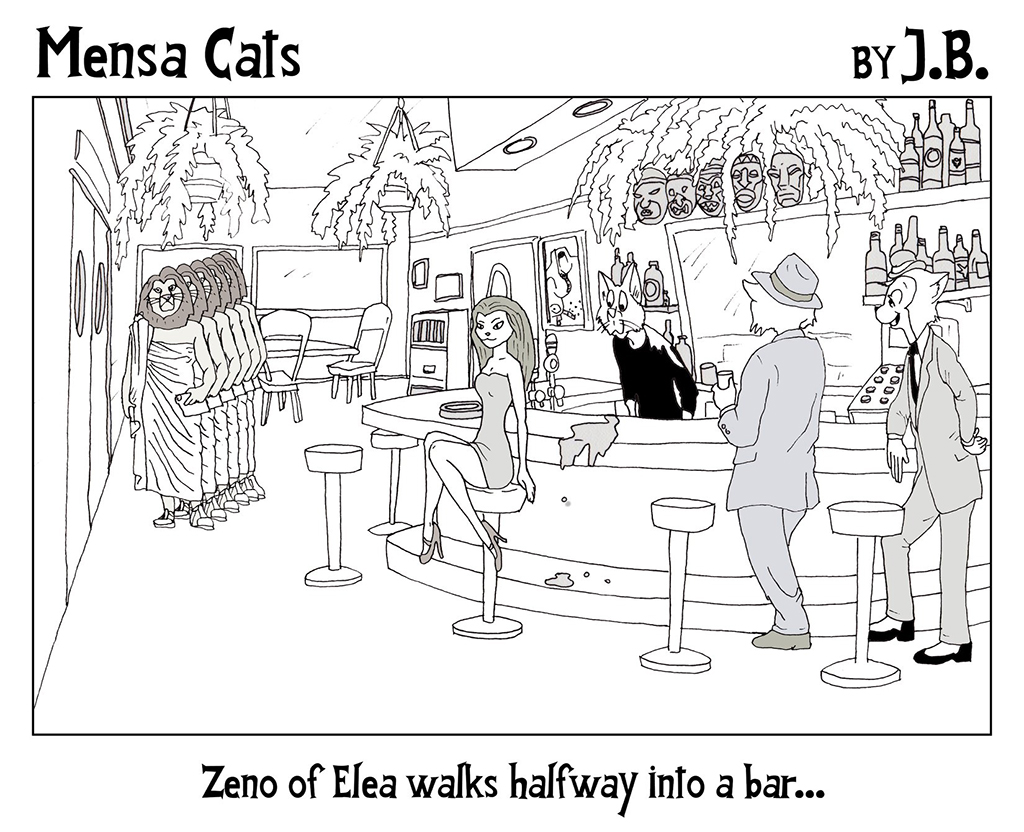
We bring you a brand new Mensa Cats cartoon by J.B. (that’s Jason Berry of Vacuum Tree Head). This one expresses not one but two of Zeno’s famous paradoxes in a single frame.
The first is the better-known Dichotomy Paradox, from which the punchline derives. In order to walk into the bar, Zeno (or any of the other patrons) must first walk halfway; and to travel from the halfway point, he must travel half of that distance, and then half of that distance, and so on. It seems that this process of walking halfway would continue forever and one would not arrive and one’s destination, yet we know in reality that we do.
The second paradox is the Arrow Paradox. Consider the frame frozen in time, as indicated by the liquid in mid spill behind the young lady cat, or the multiple instances of Zeno along his path. At any given moment, there is no motion. Zeno’s position does change between moment, but there is an infinite number of other frames, each with a fixed position. As copies/frames of Zeno get closer and closer together, the change in time between them gets infinitesimally small. Yet the process 0f adding up these infinite frames with zero motion in each results in Zeno walking halfway into the bar.
The two paradoxes (and the third, commonly referred to as “Achilles and the tortoise”) are closely related. The first deals with infinitesimal subdivisions of space, while the second deals with infinitesimal subdivisions of time. The key is that while any infinitesimal quantity is smaller than any quantity we can express, it is always still greater than zero. And adding up an infinite number of infinitesimal quantities can sometimes yield a finite number.
Take the halving process in the Dichotomy paradox. Zeno moves half this distance, then half of that, and so on. This can be expressed as an infinite sum.

As one gets closer to infinity, the sum gets closer and closer to one. More formally, we can say that as we approach infinity, the sum goes to 1. So an infinite number of subdivisions still reaches our goal of the full distance.
This process of applying operations to an infinite number of infinitesimal subdivisions is the principal behind calculus, and a marvelous thing to behold once one gets used to it. The mathematics does not necessarily answer the metaphysical questions raised by these ancient paradoxes, but it is what most interests us at CatSynth. It’s been a while since we last shared the joy and beauty of mathematics on these pages, but it is high time we resume the practice.
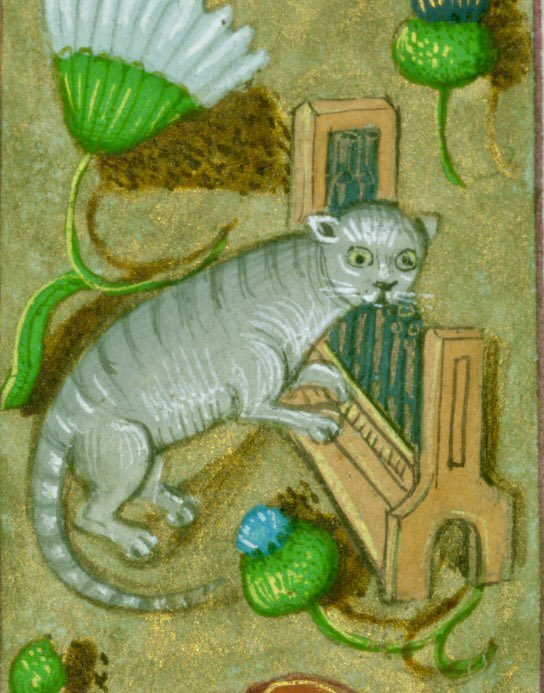
Cat playing the organ [Walters, W. 438, 15th c.]. Posted by Damien Kempf on Twitter and spotted by astute reader @endlessscribe.
The image comes from a 15th century prayer book in the collection of the Walters Museum based in Baltimore. From the museum’s digital library:
This late fifteenth-century Prayer Book was made for the Use of Rome and illuminated by followers of Willem Vrelant of Bruges. The manuscript was probably created for the couple depicted in two full-page miniatures (fols. 13v and 103r). The representation of the bride in the full-page miniatures, as well as references to her in suppliant prayers, indicates that the manuscript was commissioned primarily for the bride’s use. Further evidence of this is the prominence of women throughout the illuminations and drolleries, from one who was caught in adultery being brought before Christ, to Veronica extending her veil to Christ as he carries the cross. The decorative aspects of the manuscript stray from the typical border designs of this time period, focusing more on illusionistic Ghent-Bruges’ illumination (post-1475) and less on the Vrelant acanthus-floral borders. Among the number of full-page miniatures, fol. 229v stands out as an exceptional example of an imitation of a late fifteenth-century panel painting.
Interestingly, I did not see the cat among the includes samples.