
If you have your own cat-and-gear or cat-and-music pictures, you can submit them to us via our facebook page, tweet us @catsynth, or contact us.
via Gunfire Horibly on The MATRIXSYNTH Lounge. Also on the matrixsynth blog.


If you have your own cat-and-gear or cat-and-music pictures, you can submit them to us via our facebook page, tweet us @catsynth, or contact us.
via Gunfire Horibly on The MATRIXSYNTH Lounge. Also on the matrixsynth blog.

No, that’s not Luna. It’s a photo of another black cat by bootnavy via a thread on Muff’s Modules & More.
Originally posted at www.analogcraftsman.com.
Our combined Weekend Cat Blogging and Saturday Photo Hunt features the theme Heart. We have a few images that blend the theme with our interests in music, mathematics and of course, cats.

Here Luna poses with a heart-shaped kalimba (thumb piano).

Luna peers at the iPad, which displays a plot of a cardioid. We used a mathematical function that produces the heart-shaped figure when plotted with polar coordinates. The formula for the cardioid is: r = 1 – sin(θ), where r is the radius from the center of the plot and θ is the angle sweeping around the center. The best way to visualize polar coordinates is using one of those old circular radar screens where the plotter sweeps in a circular motion.
The photo also features one of Luna’s favorite toys, a heart-shaped plush toy with the word “kitty” inscribed on it. We have had it for years now (indeed, it was featured in a WCB/Photo Hunt back in 2008).
Weekend Cat Blogging #349 (Valentines Day edition) is hosted by Meowza.
The Saturday Photohunt theme is Heart.
The Carnival of the Cats will be up this Sunday at Meowzings of an Opinionated Pussycat.
And the Friday Ark is at the modulator.
This past Monday, I visited the studio of musical instrument inventor Tom Nunn to talk ahead of his upcoming retrospective performance at the Community Music Center in San Francisco on Friday February 17. The full interview appears below.

Tom Nunn with the Lukie Tube
TN: To me, they create a more interesting compositional format, or forum, I should say. They open up possibilities that traditional instruments can’t, because of tradition. Traditional instruments come with tradition, that’s why they call them that. That means that that’s a whole set of expectations that are historically and culturally determined before you even start saying anything. So, in experimental and improvised music, what I get from traditional instrumentalists is that they are trying to get beyond the traditional instrument. So they use different techniques and they use, you know, very imaginative ways of looking at the instrument as a sound-making device. Well, that’s what I am doing with found objects and then ultimately constructions out of found objects. So, we’re all on the same path. What we’re trying to do is, and what all artists and creators have tried to do is, extend and evolve tradition, not simply represent it. And it’s no disrespect to tradition because we wouldn’t be here without it. So I’m doing the same thing that Philip Greenlief or John Butcher or any of the rest of them are doing. It just happens to be with these things instead of those things. We have the same language, we have the same orientation to sound, and we bring to that an expression through phrasing and proportion that represent classical training and sensitivities.
AC: OK, so we can go from the “why” to the “how.” So if you were to begin a new instrument, or a new invented instrument, how do you begin that? Does it start with a particular set of materials or objects, or a process, or a particular musical or sonic idea?
TN: I think it starts with the material that you discover. You discover something about material or some combination of material or use of material that is sonically interesting, and then you see what you can do to shape that material to see if it’s musically interesting. And then you see what is involved in shaping that material and start focusing on that evolution from the sound of the material to the understanding of the material and its relationship to how you make it work, the techniques you use on it; and then finding the best designs for those techniques to accommodate those techniques.
Tom Nunn, Lukie Tube from CatSynth on Vimeo.
AC: Yes, so what was your first invented instrument that was used in a performance or a recording?
TN: Oh, that’s difficult to say, because I got into this when I was a graduate student at UCSD, and we were doing outside of the class outside of the university a pro-active socialism with music. And so we would go to a park and set up found objects and get the public involved in that. And I was interested in both the sociology of that and the composition of that. But the main thing was that it’s just an evolution of these materials and circumstances they exist in. So what I was getting at is I guess it was hard to say what the first was. Maybe the first was a gas bottle. Maybe the first was a certain way of using some material. The first constructed instrument that I called and have stuck with and keep to this day is the Crustacean. It was about 1977. And again, we had already discovered that rods work with plates and plates sit on balloons so it was a refinement already.
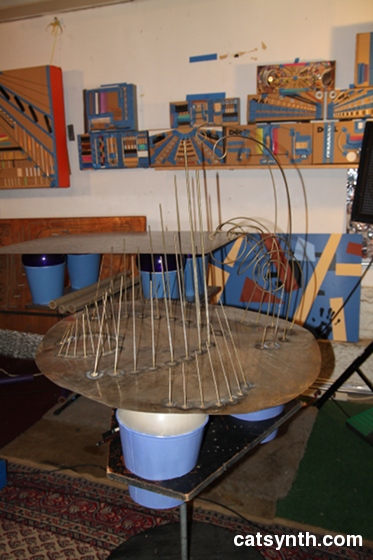
[The Crustacean. (Click image to enlarge.)]
AC: OK, and then presumably since that time there’s been more refinement learning from previous ones. So what sort of things have changed since this early instrument, or since those early performances? What sort of things have you learned that have been put to use in the latest instruments?
TN: Well, it was not so much a linear evolution in one direction. Those plates on balloons with rods, space plates I call them, that was one way, and actually didn’t go very far beyond that. What I got into were electro-acoustic percussion boards and that’s like the Bug and the Crab and these things on the wall here, Techphonic Plates, and ultimately the T-Rodimba. So it was basically hardware devices attached to plywood with a contact mic on the board. That was it. You play them with different things in different ways. But I used combs in that. And ultimately over the years, over many years, I got to the point of realizing that the combs were wearing in a certain way and how would I accentuate that because they seemed to be getting better. Therefore, because of the shape they were better. What if I started experimenting with shapes of combs or what if I started experimenting with things I put the combs on? So in a sense it was an evolution from electro-acoustic percussion boards and the technique of using combs into the creation of the Skatchbox, which was a new thing. 2008.

[Skatchboxes]
AC: OK, so actually I was going to ask about the Skatchbox. Visually, it seems a little bit different from the other ones and it’s more “reproducible.” And even though each one is unique and there are quite a few of them – there was the workshop we had at Outsound a couple of years ago. And even looking around the room there is almost like you would have with saxophones, like a soprano and a bass. So just a little bit more about the evolution of the Skatchbox and the different varieties and the different ways it can go?
TN: Yeah. Well, it started with the implement, oddly enough. It was almost like inventing a stringed instrument because you happened to have a bow. So that’s how that instrument evolved. It evolved out of the implement and to a certain extent technique because what I started with was a blank cardboard box. A big huge box that I found on the sidewalk that I put aside saying “I must be able to use this. It’s much too neat.” So I tried the combs over it because I had incidentally scraped a box that was full of National Geographic magazines, so it should have been really dead. But it wasn’t. It was very alive, resonant, as long as I was making the sound and when I stopped making the sound it stopped. And so I thought, “Hmmm. Wow.” So I started experimenting with how I pushed the comb across that cardboard box. Then I tried it on the big empty box on a keyboard stand. And then I started taping objects down to that to see what that does. And then like a silly goose I put a contact mic on the other side of the box and said “Well, that doesn’t work.” (And I said, “Well, maybe that’s a good thing”). But then I realized, no, put the contact mic on the inside of the top just like you would the plywood sheet and I did and it was like “Oh my god!”. It was like “God, this is five times more efficient than plywood.” Ten times. It was incredible. So I had a kind of “articulation instrument” that I had always wanted and never had. I always felt in recordings my instruments sounded like they were in the next room compared to everybody else, especially electronics. So this now has the presence and dynamics and articulation of electronics. I can take on any electronics with this. So that’s how I developed into these things and I just tried different layouts and designs of stuff and evolved different materials that I put on them and different techniques for putting them onto the box from tape to glue. And then it became more specific and more prototypical and more evolutionary…until I got these two which are perfect.
AC: OK, we’ll take a look at the perfect ones.
TN: Yes.

[“Perfect” Skatchboxes]
AC: Alright. That actually leads to one of the next questions that I had, which is that when I have been hearing the performances over the last few years, I am often struck by how the timbres remind of electronically generated sounds. I know there are the contact mics and the electro-acoustic aspect through that, but it is still coupled with acoustic sources. And in designing or evaluating the sound, is the relationship between electronics or the mathematics of sound?
TN: Not really, not really the mathematics at all. The closest thing I have to anything like that would be – well it’s not even mathematics, it’s scale-wise. The only scalar instrument is the Octatonic T-Rodimba. It has octatonic scales on G, G sharp and A, overlapping, and it’s definitely a pitch instrument. It’s sounds something like a marimba. So other than that, what I have done is, really, and on purpose, create elements, or use elements, which are somewhat random and themselves improvised as the building of the instrument happens. So that when I have the instrument, it’s not so much an instrument that represents a system, it’s an instrument that represents a kind of territory to explore. So for me I like the idea that an instrument has a character, a life of its own, and it speaks to us as we play it. We have an interaction between one another as we’re playing together. And I think that happens naturally with all instruments and players anyway, ultimately, when they’re improvising at least. But I’m sure otherwise, too. So, it’s again the same thing that all musicians feel and sense and experience in relationship to their instrument.
[Tom Nunn demonstrating the Octatonic T-Rodimba.]
AC: Yeah, especially looking around [the studio], thinking of the visual aspects of the instrument. So how do the visual aesthetics play in. So how much of the design of a particular instrument is visuals versus sound quality versus playability? Sort of, the physical aspects?
TN: Well, if I were to order them in priority, I would say first is sound. And that then mandates technique, and technique mandates design. And once you get the design, you can decorate it however you want. But you need to get that essential design that works to get that essential sound that works, because of that essential action that makes the object sound like that. So beyond that, since you’re building something, you might as well make something attractive, interesting, fun, curious. So if you are going to have rods why not bend them and make antennae? And as you’re doing that visual thing, you’re also gaining some kind of acoustic thing because you’re changing the harmonics of the rod. It’s different than a rod that was straight. So like for the Crab, I have three bends in the rod, or two bends in the rod, and they look like little crab feet. But they also create a very distinct acoustic sound because of that. They have a high sound and a very low sound. When I got the Lukie Tubes that was because I had these plates that had been sanded for looks only. But had they not been sanded, the tubes wouldn’t have worked. So sometimes the decoration leads to actual new designs for acoustic reasons.

[The Crab]
AC: So in terms of being able to play the instruments, how does one “master” one of these instruments? Is there a discipline for learning how to play them and for practicing?
TN: Well, it’s a lot of hours of practicing. But as you’re practicing, you’re doing two things. You’re getting familiar with the instrument, but you’re also practicing improvisation, you’re also practicing composition. And you’re practicing composition and improvisation in the context of that instrument with that format and those techniques. So you’re working always on two things – that’s the way I work. Maybe somebody could more objectify it but it’s hard for me to separate the work on the instrument alone from the work on the instrument as a compositional device.
AC: So is that process a little bit different when it’s having somebody else play one of the instruments?
TN: Well, when somebody else plays one, I see different things happening, I hear different things happening. I see different orientations, different approaches. Sure. I’m just an individual. I’m not a prototype, or a metatype, or whatever. Every time I’ve seen people play my instruments they come up with ideas I hadn’t thought of, or approaches or sounds or styles or all kinds of stuff they come up with on their own. Including what kids do.
AC: So, thinking about the performance coming up where there are also a lot of guests that are also using traditional instruments, what is the process for working with performers who are using standard instruments? Is it more about working with the individual performers who were invited, or is it about trying to pair instruments?
TN: It’s more the relationship with the performers who happen to have those instruments but also happen to have a history of playing with me. And so I’ve played innumerable hours with everybody that is going to be on this program. So we all know each other very well. And that’s a really nice thing if you’re doing free improvisation, which most of it will be. But these are master players, master improvisers, and I’m just damn lucky to have a situation where I can call on people like that. So many of them, and such a diversity! And that’s what we discovered with the TD Skatchit project. And that was David’s idea and it just was spot-on in terms of connecting with his culture and bringing the boxes into that. In this particular performance, it’s going to be people I’ve always played with, but I’ve always played with people who play traditional instruments. It’s actually easier for me to play with people who play traditional instruments than people who play experimental instruments. Actually much easier.
AC: So you were mentioning that there is going to be a lot of free improvisation. Has there been a lot of work with formal composition with your instruments?
TN: Yes, the second piece on the program, Plasticity, is written by Allan Crossman, a good friend of mine, who is a retired teacher from Concordia in Montreal. And he is an active composer. He wrote this piece for the Soniglyph and orchestra, and we got it performed by the San Francisco Composers Chamber Orchestra. And we had about four or five rehearsals of that and then did it live and I have a recording of that. But we are going to be doing a piano and Soniglyph version of that piece. That’s the most formal piece, the most absolutely composed piece. But still within that, the composition is about what parts of the instrument I’m playing and what techniques I might be using but not exactly what I’m playing. Whereas what he has, some places are very specific and some are quasi-improvised.
AC: Following up on that, any thoughts on how one would notate for your instruments?
TN: [Laughter] One of the big reasons I got into improvisation with these things! I mean, they [composition and improvisation] happened at the same time, but, my god, what a nightmare trying to notate for this.
AC: I figure it would be an interesting challenge, actually…
TN: Especially the boxes. Good damn luck with that. It’s like notating electronic music. For one thing, what’s the point? As if somebody is going to one: learn how to read it; two: learn how to play it with that notation, with those techniques; and three: get even remotely close to what you were thinking. So no, you know the thing about experimental instrument and stuff is trying to push the envelope of what music is. Part of that is getting away from the idea that everything is compositionally controlled. But it isn’t, like, burning your bridges. We still have relationships to composers and compositions. It’s just that we sit around the same table now and they take into account what we thrive on and vice versa. It’s great.
AC: So in the context of that newer relationship between composers and performers, would you like to see more compositions?
TN: If they’re good.
AC: And then, anything thoughts on how your instruments have affected people in this community or beyond who think about music, whether they’re performers or listeners?
TN: It would be difficult to say what effect I have on anything. That part is kind of a hope and a prayer that maybe there would be some influence that is positive in somebody’s life and just let it go at that. I’ve given away a lot of instruments. I’ve given away a lot of CDs. It’s my inclination to give things away rather than sell them when it comes to music anyway. To me it’s like this is food for the soul and so how can we put a price on that. So yeah, I end up giving away a lot of instruments. And that is, I think, an appropriate way to dispense with this stuff. If somebody says, “well I can do that”, then go home and do it. Rent [Romus of Outsound Presents] went home, and he and CJ each made a box, after [the workshop at the 2010 Outsound Music Summit]. Great! It’s kind of like that. If teachers saw what the potential of the Skatchbox was for elementary school kids or junior-high school kids, kids that hadn’t gotten the big dose of cynicism that’s going to come down the line yet. So that they don’t see it as silly or stupid or not cool or whatever. But that they see it as just interesting. Which is the virtue of kids.
Drone Church for Cats from Keith Fullerton Whitman on Vimeo.
The drone sounds from the modular system are quite nice, and about halfway through the video it pivots to the cats. It made me smile this morning. The cats, on the other hand, seem completely disinterested in the music.
Also on matrixsynth.
One exhibition I have come back to a few times over the past month is Todd Hido’s solo photography show, Excerpts from Silver Meadows at Stephen Wirtz Gallery.

[Todd Hido, Untitled #10121-A,2011. Courtesy of Stephen Wirtz Gallery]
The show features large images that were taken near Kent, Ohio, where Hido grew up. We see wintry scenes of modest houses and fields in a flat landscape with a few trees. The effects of snow, wind and the windshield of a car give the images a somewhat blurry quality. Interspersed among these pieces are a contrasting set of clear, high-contrast images featuring female models in vintage dress or poses. All the pieces bear very dry titles that are presumably based on serial numbers of some sort, a detail which I find interesting for what are emotionally strong images.

[Todd Hido, Untitled #10106,2011. Courtesy of Stephen Wirtz Gallery]

[Todd Hido, Untitled #10473-B,2011. Courtesy of Stephen Wirtz Gallery]
At first glance it may seem to like two shows mashed together into one, a stark wintry landscape in a small community, and stylized portraits of female subjects. The often blurry effects of weather and glass in the exterior images also contrast with the hyper-clarity of the indoor portraits. But taken together they do form a narrative whole that is very film-like. Indeed, I had the impression of stepping into a David Lynch film. The wintry exterior is a small town somewhere in the Midwest that seems perfectly normal. It’s a not a picture postcard of a the archetypical “small town” adorned with a layer of snow, but rather a place that is maybe a little more bleak, a little more tired, a little more isolated. But afterd entering a few of the snow covered houses, a more eerie and eccentric reality emerges within, populated with unnerving but seductive characters. The effect is accentuated by the fact that several of the portraits feature the same model in very different roles and appearances (something I would not have recognized if it were not pointed out to me), but by the dreamlike effect of the inclement weather and dark skies in the outdoor photographs.

[Todd Hido, Untitled #9221,2010. Courtesy of Stephen Wirtz Gallery]
My impressions seem in line with Hido’s mission in this collection, “the artist’s metaphorical reckoning with his own past, while providing a majestic summation of the suburban childhood experience in general…homes built similarly to convey stability actually conceal lives seething with sexual and psychological instability.” I also like how he uses road trips as his part of his execution of this vision (indeed, the feeling of looking out a car window in stormy weather permeates much of Hido’s outdoor imagery). It suggests a dark corner of one of my “Fun with Highways” posts.


[Todd Hido, Untitled #1843,1996. Courtesy of Stephen Wirtz Gallery]
[Todd Hido, Untitled #10502-42,2011. Courtesy of Stephen Wirtz Gallery]
The cat portrait is a bit random, but it is quite humorous and does fit into the overall structure. I thought it worked especially well paired with the classic head portrait reminiscent of the late 1950s or early 1960s.
The show will continue at Stephen Wirtz Gallery in San Francisco through February 25.
From Sawa Masaki on flickr, another photo featuring Taro:

I am pretty sure Taro is posing with the DSI Mopho, though it is a bit tricky to tell with the white-on-white effect 🙂
Also appears on matrixsynth.
For non-cat, non-synth fun, please check out my Fun with Highways: Colorado article from yesterday.
Our “Primary Highways” series continues with a visit to Colorado. This edition is a bit different, in that I trace a family trip from a great many years ago, but insert more contemporary interests along the way.
 We initially entered from the northeast on I-76. The road was relatively straight here amidst softly rolling hills of the High Plains. The landscape is dotted with farms amidst open grassland. The Rocky Mountains appear to rise from the plains quite suddenly, as does the city of Denver.

[By Hogs555 (Own work) [CC-BY-SA-3.0], via Wikimedia Commons]

 On that original family trip, we did not actually stop in Denver, but here we will do so. We turn south on I-25 along the edge of downtown Denver, passing through the interchange with I-70 known as “The Mousetrap.” We exit with US 6 which is surprisingly enough Sixth Avenue in Denver. Actually, it’s a freeway, the “Sixth Avenue Freeway.” Heading east in the freeway, it empties out onto city streets near the Santa Fe Arts District. A quick look at the websites for the galleries along the corridor suggests a relatively conservative selection, though I did see some interesting things from Sparks. Further north we find the Denver Art Museum.

[By Archipreneur (Own work) [CC-BY-SA-3.0 or GFDL], via Wikimedia Commons]
This building, which is just part of the museum, is designed by Daniel Libeskind, who also designed the Contemporary Jewish Museum in San Francisco and the plan for the new World Trade Center complex in New York. The shape of the building is intended to reflect the peaks of the Rocky Mountains, although such angles appear quite often in Libeskind’s architecture. In front of the museum, we also find once again another sculpture by Mark di Suvero, who we have encountered before in this series. This one is called Lao Tzu. The museum currently has an exhibit of Garry Winograd photography that I wouldn’t mind seeing.
 We leave Denver on I-70 and head into the mountains, on one of the most spectacular stretches of interstate highway in the country. At the Continental Divide, there are two options. One can stay on I-70 through the Eisenhower Tunnel, or take a detour on US 6 up through Loveland Pass. We opted for the latter on that original trip, with spectacular views of mountains in all directions, and a chance to walk on a patch of hardened snow and ice…in August. Not surprisingly, it was quite cold. I don’t have any pictures from that trip, but here is what the pass looks like today:

Further west, I-70 meets the mighty Colorado River and winds its way through Glenwood Canyon, which was my introduction to the southwest with its distinctive colors and rock formations. The difference from the eastern side of the Rocky Mountains and the peaks is dramatic. And while I loved the forested mountains, there is something personally compelling about the sheer red rocks. The highway itself is also quite a marvel, both in terms engineering and aesthetics as it attempts to be both functional and blend with the landscape.

[By Patrick Pelster [CC-BY-SA-3.0-de], via Wikimedia Commons]
Along I-70 in Glenwood Canyon, one passes a turn off for a place called No Name. The community of No Name supposedly did not receive its name (or lack thereof) until the coming of I-70, when it was assigned to the exit because the area lacked a formal name. There is also No Name Creek and No Name Canyon, and a No Name Tunnel on the highway.

 I-70 and US 6 descend from the Rocky Mountains into the town of Grand Junction, where they meet US 50. One can exit the interstate here and travel on State Highway 340 through Grand Junction and Fruita to Colorado National Monument.

[I, Daniel Schwen [GFDL or CC-BY-SA-3.0], via Wikimedia Commons]
The formations in the monument have this distinctive bottle shape – not unique to this location, but I noticed more of them there. Another thing I noticed there was an upper layer of rock, more gray than red, then seemed to have been gone from the more well-known canyons and formations in Utah and Arizona. It was also my first chance to see the rocks up close and personal, touch them and observe the details.


 From there, we took I-70/US 6/US 50 west into Utah. But, we later reentered Colorado from the Four Corners along US 160. The quiet and stark southwestern landscape particularly appealed to me then and still does now. We then headed north on what was then US 666 (the “Devil’s Highway”), but has since been renumbered as US 491. Honestly, I wish they kept the 666 designation. But it is what it is. The two highways separate in the town of Cortez, and one can continue on 160 east to Mesa Verde National Park.

[Andreas F. Borchert [GFDL or CC-BY-SA-3.0-2.5-2.0-1.0], via Wikimedia Commons]
The Cliff Palace was is largest of the cliff dwellings in the park. The geometric shapes and layout still present in the dwelling are quite interesting. There are distinctive towers, one square tower reaching almost to the ceiling of the cave, and the round tower; and also the sunken round spaces known as kivas. One can see the parallels in these ancient structures to contemporary southwest architecture as well.
I have not had much time to re-explore the southwest in recent years, except for a bit of Arizona, so I would very much like to return to Colorado sometime soon.

Via matrixsynth, where you can see more images of the instrument. I did not know about the Korg MaxiKorg until now.

If you want to submit your own cat-and-gear (or cat-and-music) pictures, you can do so via our Facebook page, via Twitter @catsynth, or by contacting us.


