From Taki76 on YouTube:
“Meow”
I need to find this cat toy keyboard! It would be great for circuit bending and future performances.
From Taki76 on YouTube:
“Meow”
I need to find this cat toy keyboard! It would be great for circuit bending and future performances.

From Michael Van Dijck via our Facebook page.
Here is an example of the Hohner piano in action:
In this video, Chick Corea plays a Hohner Electra piano with Miles Davis. (Keith Jarrett is playing a different electric piano.)
Electric pianos are of course not strictly synths, as they are electro-mechanical rather than electronic. But these instruments are favorites of ours here at CatSynth.
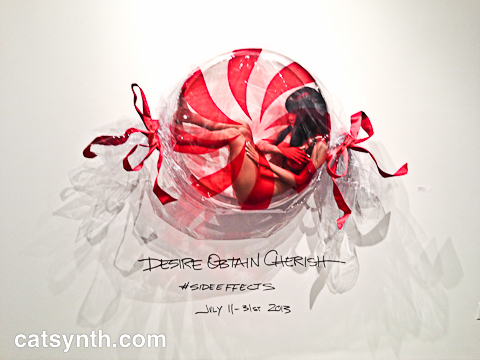
For us at CatSynth, the summer is usually a time of intense musical focus, and this one more so than most. While I keep up with the visual arts as best I can during these periods, it often takes something strong and unusual to get my attention for these pages. #sideffects, the solo exhibition by Desire Obtain Cherish (DOC) at The McLoughlin Gallery, is one such show.

The cover piece of the exhibition, shown above, along with the title itself, gives the viewer an immediate sense of what the show is about. The piece combines several banal and commercial elements, a store mannequin stuffed inside a replica of a familiar peppermint candy. These materials fit perfectly with DOC’s use of commonplace materials and tropes, but they are also provocative, pointing out the association of the female figure (particularly Asian female figures) with a commoditized “sweetness” and sense of possession. Clearly, we should expect to have our sensibilities tweaked a little bit as we progress through the exhibition. At the same time, the title with its hashtag and the written style tell us that along with the art, we will be subject to a bit of the artist’s written opinion, whether we want to or not. Indeed, the gallery layout for the show juxtaposes groups of similar art pieces with written thoughts from the artist, titled with a hashtag, an organization I found fun and creative.
The entrance to the exhibition is dominated by a piece featuring a “red carpet”, which was particularly amusing for the opening.

[Image courtesy of The McLoughlin Gallery.]
The cartoon hands at the end of the carpet are sweeping something in some direction, but it’s not clear if it’s the carpet or the gold bricks that lie beyond it. The gold bricks, which were simultaneously part of the larger installation and individual works in their own right, bore DOC’s official designer monogram, if one imagined such a thing existed outside the confines of an art gallery.

The resemblance to certain well-known designers’ monograms is clearly not a coincidence. Indeed, the monograms of actual well-known designers featured prominently in the series Designer Drugs:

[Image courtesy of The McLoughlin Gallery.]
A sardonic and somewhat dark sense of humor permeates much of the work, with an emphasis on twisting commercial or pop-culture references. There was a series of crucifixes made from flavored chocolate bars emblazoned with the brand-name “Heresy”. (Unfortunately for me, but fortunately for the artworks, they were not made of real chocolate). The theme was most strongly present in the series of “pill portraits” featuring iconic images of celebrities who died from drug overdoses, assembled meticulously from thousands of individually wrapped pills. The subjects range from movie legends like Judy Garland as Dorothy to artists like Jean-Michel Basquiat.

[Image courtesy of The McLoughlin Gallery.]
Despite his open ridicule of commercial and celebrity culture, Desire Obtain Cherish – whose real name is Jonathan Paul and was refreshingly down-to-earth when talking with visitors to the opening – is not without humility about his own role as an artistic provocateur and his history in Los Angeles street art. Indeed, one of the most fun parts of the opening was an installation in which visitors were invited to grab hold of a paintball gun and shoot a hanging figure directly mocking street art heroes including Banksy.

I did of course try my hand at the gun, which is quite an experience for those of us not immersed in so-called “gun culture.” It did splatter not only on the figure and the surroundings, but some bits rebounded back out into the main gallery dangerously close to myself as well as innocent bystanders.
It should also be noted that Desire Obtain Cherish, who was trained at the Parson’s School of Design, still retains his knowledge of art history and practice even as he openly rebells against it. This was particularly noticeable in his riff on Dali’s famous “melting clock” piece. In a contemporary play on the original piece’s title, DOC’s is called “Short Term Memory.”

Overall, this was a strong show, and a coup for a gallery that I have been following since its inception about two and a half years ago.
Desire Obtain Cherish, #sideeffects, will be on display at The McLoughlin Gallery through August 31. If you are in San Francisco this week, I strongly recommend checking it out.

It’s not unusual for Luna to spend most of her day napping in sun puddles, but it’s a rare occasion when I get do so as well. This month has been rewarding but also exhausting, with work, the Portland trip, multiple shows and sundry other events and obligations. Fortunately, this weekend is largely free and thus a good time to rest as well as attend to health and home. And of course to spend time with Luna.
The Carnival of the Cats will be up this Sunday at Mind of Mog.
And the Friday Ark is at the modulator.
It’s been a little over a week since the Battery Powered Orchestra Workshop (BPOW!!!) occurred in Portland. Today we look back at the workshops, which were in many ways the central components of weekend.
During the Saturday morning session, I attended a workshop on electronic textiles hosted by Cat Poole of Cacophonous Creations. The skill was to learn how to use conductive thread to embed both light and controls into clothing for future performances. But for the workshop, the task was to simply sew an LED and its associated circuit onto a dinosaur patch:

Of course, we at CatSynth approve of Cacophonous Creations’ chat noir logo! As for the task itself, the biggest challenges related to general sewing and laying out elements to properly fit (at least for someone with little sewing experience beyond repairing buttons). But I got through the threading of the circuit. It would be great to incorporate something like this into costuming for future performances.
In the afternoon, I attended a session presented by Steve Harmon of Synthrotek. It centered around DIY electronics and the ubiquitous 555 integrated circuit. But that then merely building an Atari Punk Console with a 555, we stepped it up with Synthrotek’s 4093 NAND Synthesizer.

The 4093 includes three square waves, based on a dual 556 integrated circuit. I was quite intent to complete it and be able to use it for my performance that evening. The soldering of the components went quite smoothly – it helps to both see other people soldering and to have access to a good iron. It was a quite a rewarding moment when the synth was complete and making sound.

My only disappointment was the pots not quite fitting and ending up a bit lopsided. But it worked great in the performance and will certainly be used again in the future. The additional confidence on soldering will also be valuable for future projects.
Additional workshops in the afternoon included an introduction and demonstration of modular synthesizers by Jeph Nor. He demystified modular for a general audience by presenting the fundaments (oscillators, filters, amplifiers) and adding additional elements.

[Image from the BPOW Facebook page.]
Attending all the workshops on Saturday would have been impossible, especially if one wanted to complete the associated tasks. In particular, I was also interested in the Raspberry Pi which was presented by Edward Sharp.
Sunday’s workshop sessions opened with a demonstration of “squishy circuits”. It turns out that homemade play-doh is quite a good conductor of electricity, and can be used to quickly prototype circuit ideas. It also serves as a very accessible medium for introducing principles of electronics to children.

We also got to see other non-traditional conductive media including ink and paint that can be used to integrate electronics into artwork without the use of wires.

Then everyone scattered for an electronics scavenger hunt to find electronic toys and various media to use in projects during the afternoon. The participants reconvened later in the day and got to work.

Our host Travis Feldman of Molecule Synth hacked the interior of an Atari console with both audio and video modifications, attaching it to a Moog pedal.

Other creations included a circuit-bent toy keytar and a tactile surface used to control audio and video on a laptop.
Overall, the workshops at BPOW were a rewarding experience. In addition to new inspiration and a few new skills, I liked seeing the wide variety of interests and disciplines that others brought to creative DIY electronics for music, video and performance art. If the event does recur next year, it will be interesting to see how technologies and the skills of participants have further evolved.
In addition to the workshops, BPOW also featured performances in the evening. We will look at those in a subsequent article.
Today, August 17 is officially Black Cat Appreciation Day. Of course, that could apply to any day here at CatSynth.

My black cat Luna, who was originally adopted from a shelter, certainly gets a lot of appreciation and love.

Black cats are sleek and gorgeous. And I have often found them to be among the most sweet and affectionate of cats. Luna is no exception on either front.

Sadly, black cats are still among the last to be adopted from shelters in the United States. Whether it’s lingering superstition or plain bias is hard to say. I see way too many heartbreaking stories of abandoned black cats in kill shelters reaching the end of their time. Black Cat Appreciation Day is an effort to highlight the plight of black shelter cats but also to celebrate them as wondrous companions. This video, from the Meadow Lake Humane Society of Saskatchewan, Canada, always gets to me:
There are numerous local groups on Facebook and elsewhere dedicated to helping black cats, and I encourage interested readers to check them out.


