Another listless Sunday evening, another highway interchange.
This is the bizarrely complex interchange of highways 401 and 427 near Toronto and Mississauga, not far from Toronto Pearson International Airport. They are known colloquially as “the 401” and “the 427”, similar to way highways are referenced in southern California.
It looks like there might have been a plan to build another freeway extending due east from interchange, which could explain it’s strange configuration. It could also just be due to the fact that 401 is a huge highway. South of the interchange towards Mississauga it widens into 18 lanes divided into four sections (one collector and one express) in each direction. To the north it thins out but becomes as 16 lane collector/express system again as it approaches Toronto. This would make it one of the largest in the world, certainly larger than the New Jersey Turnpike at its widest, or I-5 south of Los Angeles. It is also one of the “busiest highways in North America” (see this reference.)
Here is a view of the interchange looking east along the 401:
The 401 extends all the way to the western end of province to Windsor, just across the U.S.-Canadian border from Detroit. I have thought about a musical “401 tour” a few times, that would start in Detroit (and leave time for photography) and extend to Toronto. As such, leads on experimental musicians and performance venues along this route would be welcome.
We at CatSynth are planning a quiet August, and what better way to begin than with hosting both Weekend Cat Blogging and Carnival of the Cats on the same weekend!
Call it efficiency, or poor planning, but here we are and we’re ready to host both events together in a combined round-up. So feel free to leave a comment below to submit your WCB post, or if you prefer use the handy COTC submission page. Either way, it ends up here.
Next up, Animal Shelter Volunteer presents Loreen and Krystal, two sisters available for adoption. They are a beautiful pair, and need to adopted together. Today, they are taking it easy while they wait for a forever home.
At Lost in the Cheese Aisle, Elisson introduces as to Bean, the littlest Barn Cat-in-Training. Very cute, indeed! Bean lives with Elisson’s “Elder daughter”, who has left urban (and urbane) life for a more bucolic existence, at least for the moment.
At Judi’s Mind of Matter, Jules poses very handsomely for Luna. Black cats rule! We always know we can count on Jules to provide a great shot for WCB. Meanwhile, Vincent looks horrified at what happened to his friend Smudge from Pam’s Sidewalk Shoes. What could it be?
It turns out Smudge had a trip to the vet for grooming and some serious dental care. That does sound painful! But in truth, he feels much better afterwards.
The cats at Friends Furever are celebrating Bora Bora day. We’re not entirely sure what it’s about, though it looks like a lot of fun (Bora Bora is an island in French Polynesia). And it involves a big fish. We are also sending healing thoughts for Ellie, who is not feeling well this weekend. Get well, soon!
We are also sending healing vibes for Samantha at Life at Cat’s Perspective, who could use some healthy thoughts after her last vet appointment. But amidst the seriousness, the whole gang is also heading to Bora Bora.
It’s a low-energy day at Chez Ranger, so they are reposting some old pictures. But hey, they are new to us, and the first picture is quite nicely composed. They report that Maddie is in good health, after her recent vet trips and health concerns.
But we do have some great close-ups from Team Tabby. All five cats are in a happy mood, and we are happy to have them join WCB this week. We show a side-by-side comparison of Mindy’s photographic portrait and a more stylized rendering.
We conclude with a bit of WCB apocrypha.
We meet Cheops of Donna’s Designs, who is joining WCB for the first time. Welcome!
Thanks to everyone who commented or participated this week. We will continue to post both WCB and COTC entries through the end of Sunday (US Pacific time), so do join us if you are interested in participating. Also, please let us know if we missed your entry in the complexity of handling both at the same time and we’ll add you right away.
The final concert of this year’s Outsound Music Summit brought together various inventors of new musical instruments under the banner “Sonic Foundry Too!” Rather than each inventor simply presenting his or her work, they performed as pairs. The pairings were selected for musical congruity and brought together people who may have never performed together before. As such, this was truly “experimental music”, with the outcomes uncertain until they unfolded on stage.
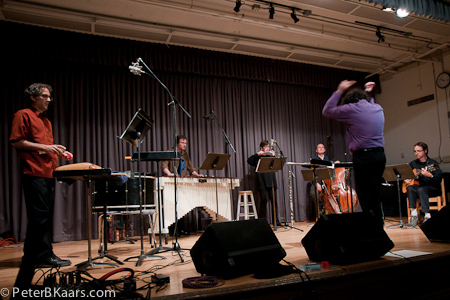
As one would expect, the stage setup was quite impressive, with musical contraptions large and small.
This large “bucky ball” was one of the more intriguing from a visual and sculptural perspective. With the holes and vaccuum-cleaner hoses inside, it was not immediately clear what this was supposed to do as a musical instrument.
It turns out to be Terry Berlier’s Percussion Ball, and is played like a hand percussion instrument. The performer taps or slaps the various faces and the hoses provide resonance.
The first pairing featured inventions by Terry Berlier and Bart Hopkin. Berlier was not in attendance, so David Michalak was called upon to learn and perform his instruments, including the aforementioned Percussion Ball. The performance was among the musically strongest of the evening. Michalak appeared from the wings adorned with LEDs and proceeded to the percussion ball, which turns out to be a tuned drum. He began with a an expressive free rhythm exploring the different faces, which became more structured as Hopkin joined in with his own percussion.
What ensued was a tight rhythmic drum duet, which reminded me a bit of Japanese drumming. Gradually, Hopkin’s drum sounds grew more electronic, but the strong rhythm persisted. Michalak then tossed a couple of the LEDs into the audience and transitioned to playing a gamelan-like instrument made of metal plates and which produced a bell-like sound. The strong rhythm faded into an ethereal mix of bell and chime sounds. There were several other interesting instruments and musical moments in the remainder of set. A keyboard instrument that looked a bit like a toy piano produced high bell and wind-chime sounds. Hopkin also had an impressive clarinet-like instrument with a ribbon for continuous pitch change.
The next set featured Bob Marsh performing with his new Sonic Suit #1 and Brenda Hutchinson with long tube and gestural controls. We had seen Marsh’s suit in action at the Touch the Gear Expo – it is covered in plastic water bottles, some of which contain sound-generating materials beyond the crunch of the bottles themselves. We have also seen Hutchinson perform with you long tubes before, including at the Outsound benefit dinner – in this case, it was actually a shorter version, about one-third the standard size.
Hutchinson began with slurping sounds through the tube, accompanied by small rustling and crackling sounds as Marsh began to move slowly. With the addition of electronics, one could hear strong resonances from the tube. The effect was like pouring water, and it seems that the timbre from the bottles on the suit were matching it at times. Marsh increased his motion in the suit, set against a variety of environmental sounds from Hutchinson such as water, fire, air and animal sounds. Eventually he got up and started to dance, moving the arms of the suit in fan patterns, with noisier sounds from both performers.
The following set featured Tom Nunn and Stephen Baker, with David Michalak returning to make a trio. The music started with the sounds of scrapes and bells from multiple sources. some of which emanated from Nunn’s instrument in which the performer ran large cardboard tubes over a metal sheet suspended on top of purple balloons. (Did I mention that almost every night of the summit featured balloons?) Baker’s instrument with metal pegs on a tube was particularly melodious against the brass-like sounds from Nunn’s sheet-metal instrument. The various metal sound sources played off one another for interesting beating effects.
[Tom Numm, Stephen Baker and David Michalak. Photo by Michael Zelner.]
Baker had several other instruments in this theme, including a series of bowls and a long metal arc, both of which contributed to the overall tuned metal sound. By contrast, Michalak’s use of skatch box provided noisier and more percussive sounds that filled in the space in between the long tones. Listening to the longer tones with soft details like beating was quite meditative at moments, enhanced by the low lighting during the set.
Walter Funk and Sasha Leitman immediately distinguished themselves from the previous sets in their use of electronics as a central element. They set themselves up quite minimally on either end of the stage, with a lot of empty space in between. The space was the perfect visual for the beginning of the music, where a repeating metal sound soon revealed itself to be the sound of train. The train gradually morphed into the sound of a human voice. Set against this were subtle low-frequency tones, scraping metal and a steady low rumble. During the set, Walter Funk produced a lasagna pan (which he had mentioned during the pre-concert talk) – this is the first time I had seen a lasagna pan used as a musical instrument in a formal setting. It was used to produce rhythmic scrapes, rumbles and rolling sounds that reminded me of a standard snare drum. What at first sounded like a motor being used to excite the pan was later revealed to be water. Against this were more electronic sounds, something that suggested a granular synthesizer and another that sounded like a distortion pedal for a guitar. At one point, the music shifted to a series of power chords, and a rhythm with delays (i.e., where the echoes of the delay become part of the overall rhythm). The set concluded a series of loud machine noises.
The final set paired Sung Kim on a bowed cello-like instrument with Dan Ake playing a giant towering contraption of poles, wires and metal objects.
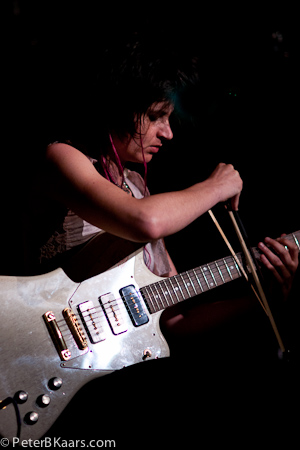
I had heard Kim perform on his well-crafted string instruments before – in some ways, they were the most “traditional” of the musical inventions in use during the evening in that they were not only shaped and constructed similar to standard string instruments, but were played using traditional techniques of the string family like bowing and plucking. I have also seen Ake’s large architecturally-inspired sound-generating devices as previous Touch The Gear nights. Both began the set with bowing. Ake was slower and more deliberate in bringing out the timbres of the large metal elements. Kim, by contrast, was fast and vigorous, evoking a dramatic cello solo. Ake also had metal claws that he used to tap parts of the tower and pluck wires, as will as a large wire wisk for additional effects. Kim also played his instrument more percussively at times. The timbres of the two instruments matched well and blended at times. The structure and narrative of the performance did not blend quite as strongly as some of the others, though there were great moments where the music grew to a crescendo, a section of a steady plondering rhythm with eighth-note bowing and strumming of odd-harmony chords, and a noisy section of screeching tones that resolved a major harmony.
This set concluded the evening, and the Summit as a whole. In a sense, it was a quiet way to end, without the dramatic musical finishes of previous evenings. But in the sense of each set being an experiment and the opportunity to see and hear something new, it was quite a successful conclusion.
We happy to have a new picture of Mimi from our friend Eric Pochesci of polynominal.com, this time with a Roland Alpha Juno:
And we also introduce “her little brother called “Monsieur Gris” (Mister Grey) playing with Future Retro Revolution! he’s a bit shy :)”
I have to admit, the Future Retro Revolution has interested me for a while because if its visual appeal. I tried it a few times at NAMM, but it never made to the top of the priority list to acquire. Does anyone have any thoughts on it as an instrument?
I recently downloaded an iPad game for cats by Hiccup for Luna to try out. For a cat that spends a lot of time surrounded by technology, including the iPad, she is quite reluctant to touch it, so I wasn’t quite sure how she would react.
The game features a little mouse that resembles a cat toy scurrying around the screen. When the cat (or human) hits the mouse, it emits a little squeak and the player receives points; and the process repeats. That’s it – very simple. I started it up for Luna, and she immediately went to tracking the mouse intently, her little head shifting back and forth in deliberate motions. Tentatively, after a while, she started to paw at it, and eventually managed to pounce on the mouse. She seemed to be quite enjoying it, though she was still a little nervous and often backed away from the device after a pounce.
Here a brief excerpt of her first day of playing:
This is really just a little diversion for both of us to enjoy together, Luna playing with a virtual toy that draws her attention, and my taking delight in watching her do so. But this is clearly a demonstration of user engagement in the app space, for both cats and humans. Sometimes simplicity wins out.
I set up the game again in the office/studio while writing this article, and managed to get a brief iPhone video of Luna’s play. As one can see, she has gotten a bit more confident, even aggressive with it.
This does not seem to be a good game to play a small cluttered space.
Weekend Cat Blogging will be hosted here at CatSynth next weekend, so do check then and submit your cat-related blog posts. New participants are always welcome.
The Outsound Music Summit continued last Friday with “The Art of Composition”, performances of new works by Krystyna Bobrowski, Gino Robair, Andrew Raffo Dewar and Kanoko Nishi. I had heard these four composers discuss their work at the panel session a few days earlier. Now it was time to hear their music.
There was an impressive array of equipment on the stage. Much of it was for Krys Bobrowski’s two pieces.
Balloons have definitely been a big theme of this year’s summit. (Tom Djll featured a balloon in the previous night’s concert, and Tom Nunn featured them in his instrument the following night) In this case, the balloon was used as a resonator in Bobrowski’s Lift, Loft and Lull. Gino Robair struck the “gong”, the large metal rectangle, and brought the balloon close to it. The combination of the balloon’s acoustics and the connected microphone produced a unique resonance effect (and a clever use of acoustic and electronic effects). Against this, Bobrowski played a wildly curved orange horn-like instrument made from kelp that brought to mind a shofar.
The second movement brought the duo together on a single instrument, a large metallic xylophone-like instrument where long tubes were resting on…balloons(!). At first, they played the instrument in a standard way, producing percussive melodies with mallets. But over time, they began to explore different sounds of the instrument, such as rubbing the tubes, and also producing a sound that suggested a motorized device. They also placed different preparations on the instrument to invoke different effects and articulations.
You can see an excerpt of the performance in this video:
Bobrowski and Robair also performed a piece featuring the composer’s glass glass instrument in a duet with wine glasses. I had last heard Bobrowski play gliss glass at the benefit dinner. It was interesting to hear the instrument contrasted with the wine glasses.
Robair played them traditionally, rubbing the rims to produce strong resonances, but also used tapping and splashing in the water as percussion. The gliss glass vessels, by contrast, can be drained and filled while they are played, resulting in pitch-bend effects that were put to strong use in the piece. There was lots of complex phrasing as well as eerie harmonies and unexpected sound effects. At times, the harmonies were more anxious and expectant, while at other moments they approached romantic tonality.
Andrew Raffo Dewar’s Interactions Quartet presented Dewar’s new piece Strata, which was inspired by a series of paintings by Argentine artist Eduardo Serón. You can see examples of Serón’s work in this video. His abstract paintings – which I, too, found musically inspiring – feature simple shapes and colors in tight compositions. These simple but powerful visual elements were reflected the clean acoustic notes and sounds of the music. It started out very sparsely, with individual disconnected notes on each instrument. Individual notes became short phrases, and eventually slightly longer lines that intertwined in an undulating counterpoint. The music was quite meditative, with the modal quality and contrapuntal texture, but also had a strong emotional undercurrent. One interesting moment featured the saxophone (Dewar), oboe (Kyle Bruckman) and marimba (Gino Robair) converging into a single pitch range and timbre. Eventually, the complex rhythms coalesced into a single triple meter with a strong driving rhythm anchored by John Shiurba’s percussive guitar and metric beating of ankle bells by Robair. Above the metric foundation one could hear playful descending lines. After staying together rhythmically for a while, the different lines and instruments went their own ways, with various shakers, harmonics on guitar and english horn, and an impressive passage of multiphonics by Dewar on soprano sax – all still remaining within a strong sense of counterpoint.
Kanoko Nishi presented her original graphic scores as interpreted Tony Dryer on contrabass and Italian guitarist and visual artist IOIOI. It would have been interesting to see Nishi’s graphical scores, but the darkened room and minimal setting left ample opportunity for imagination. We did get a taste of what we were in for as Tony Dryer was setting up and soundchecking his equipment, and we were treated to several ear splitting bursts of loud feedback. The performance itself, however, began quite subtly with Dryer bowing very quietly on the bass. Every so often, there would be a louder scraping sound on the bass before returning to minimal levels. Then, all at once, there was a loud hit followed by a long LOUD sustain and feedback. These deliberate and had a great tone, but it was still very loud. When it finally cut out, it was like shutting off a very loud engine – there was even the rumbling slowing to a series of clicks. This was followed by a loop of low-frequency bass notes at a modest volume, which settled into a bit of a groove with noisier sounds layered on top. Eventually, higher electrical noises and squeaks overtook the sounds of the bass. Dryer concluded by playing the stand of the bass (now resting horizontally) with what appeared to be an instrument string.
The performance then transitioned seemlessly to IOIOI, who was also set up in front of the stage with minimal lighting. She began with long sustained notes in a tonality that sounded Middle Eastern, both in terms of the scale and the use of microtones and pitch bends. Things quickly grew louder, with high screeching tones and loud sustained tones that obscured the otherwise beautiful detailed guitar technique. As things quieted down a bit, I was able to focus more on the fine details, such as bends metallic resonances. IOIOI employed preparations in her guitar at times, such as chopsticks, that gave the instrument a more raspy, percussive sound. She also used bowing that yielded a vigorous passage of scratching tones. Overall, a virtuosic display.
Gino Robair returned for his third appearance of the evening, this time to present his Ensemble Aguacalientes, featuring Polly Moller on flutes and ocarinas, John Shiurba on guitar, Loren Mach on marimba, Jim Kassis on percussion and Scott Walton on bass. Aguacalientes is “a musical suite based on scenes captured by Jose Guadalupe Posada in his politically charged engravings of late19th -and early 20th-century life in Mexico”, many of which feature skulls and skeletons, or calaveras. In keeping with this source, the instrumentation of the ensemble reflects Mexican folk and popular music, including the ocarinas and percussion. The piece began with a very sparse texture, where short melodic lines on the flute headjoint were punctuated by percussion hits. Soon an array of other percussion, including a guiro, and the guitar and bass joined in, with numerous rhythmic lines set oddly against one another. The ocarina lines were longer and more traditionally melodic, but with the instrument’s distinctive sound. There were interesting timbral moments, such as a sinister interplay between harmonics on the bass and guitar, and a more gentle combination of string-bass and bass-flute harmonics. I did find myself listening to the polyrhythms that emerged at various points during the piece, and for the more idiomatic moments that channeled the Mexican subject matter.
Overall, it was a strong concert, and seemed well received by the large audience. I was also left thinking about the often boisterous debate in the Bay Area new-music community between composition and improvisation. Having heard the improvisation-centric and composition-centric nights of the summit back-to-back, I am struck by how much similarity there was – one could have interleaved pieces from both nights into a single concert and ended up with a result that was musically consistent.



 This is the bizarrely complex interchange of highways 401 and 427 near Toronto and Mississauga, not far from Toronto Pearson International Airport. They are known colloquially as “the 401” and “the 427”, similar to way highways are referenced in southern California.