
More pictures from Ron De Rooij via facebook.
While the other cats in the household run the synths, Timber mans the meters.

More pictures from Ron De Rooij via facebook.
While the other cats in the household run the synths, Timber mans the meters.
The Outsound Music Summit continued on Thursday night with a concert titled “The Freedom of Sound”. It is a rather lofty title that can mean many things – in this case it describes ensembles that have explored and perfected musical improvisation through many years of playing together. The emphasis on experience and discipline is a reminder that “freedom” is a double-edge sword, in music, in politics or any area of life. During the artist Q&A before the concert, Tom Djll of Grosse Abfahrt lamented that bad improvised music can just be “mush” – and any of us who have been immersed in improvisation for an extended period have experienced the mush. But the examples of free musical expression on display this night were very articulate, structured, with musicality and narrative.
Tri-Cornered Tent Show opened the evening with an “operatic improvisational song cycle.” In the Q&A, composer Philip Everett talked about the influence of the Vietnam War and legacy leading up to the seeming perpetual war of today in his piece. The subject was hard to miss as guest vocalist Dina Emerson sang the lines “After war came the barking of dogs” and “After the war came another” among others, allusions to the unending series of wars we have found ourselves in over the past few decades. Behind Emerson’s singing, regular group members Philip Everett, Ray Schaeffer and Anthony Flores provided a foundation of static noise, explosive synthesizer and drum phases and free improvisation that moved between disparate rhythms and lines to a single unified tone. In listening to performance, I was reminded of the traditional oratorio, with the theatrical operatic vocal performance with the dramatics and emotion but without the staging and costumes.

[Tri-Cornered Tent Show, with Dina Emerson. Photo: PeterBKaars.com.]
There were particular moments that I liked, such as the emergence of a funky bass-driven riff with percussion and harmonic support that went on for some time, while some of the electronics remained asynchronous. And then there was the movement of the piece where Emerson’s voice was front and center channeling the sound of a Southern blues or spiritual singer with minimal instrumental sounds, mostly strings and delay effects, and later metallic resonances.
Next up was Positive Knowledge, the duo of Oluyemi Thomas and Ijeoma Thomas. opened with free improvisation with bass clarinet and voice. They were able to make their disparate instruments sound quite a like a times, and if I wasn’t watching the performance I could have mistaken them for a saxophone duo. The unity diverged a bit as Ijeoma Thomas moved from free vocals to poetry. In the gaps between lines of the text, the clarinet provided squeaks, growls and other noisy sounds.

[Positive Knowledge. Photo: PeterBKaars.com. ]
The instrumentation shifted throughout the performance, with recorder and whistle, expressive pentatonic humming, a walking gong, and poetry set against metallic percussion. The shifts in timbre and texture and movement between words and abstract sounds gave the sense of a story unfolding.
The final performance of the evening, featured Grosse Abfahrt. Regular ensemble members were joined by guest artist Kyle Bruckman. It began with a large balloon, which Tom Djll inflated and then placed over the mouthpiece of a trumpet. The resulting squeaky but steady sound served as a basis for the first part of the performance, and given the size of the balloon continued for quite a while. Kyle Bruckman on oboe matched the pitch of the balloon and trumpet quite closely, but with enough imprecision to leave interesting beating and timbral effects. The other performers entered into the mix, complementing the tone of the balloon and filling in the void when it finally expired. Tom Djll provided a number of creative noisy tones on the trumpet as well as other custom one instruments: a purple hose that could be played like a brass instrument but also spun around like a whirly. He also had a pair of long orange pipes that looked like didgeridoos and were played both trumpet-like and with air canister that is usually used for cleaning keyboards. Gino Robair continued percussion sounds such his signature oddly-shaped bowed cymbal and chaotic electronic sounds from the blippo box. Tim Perkis’ electronic sounds had a delightful liquidy quality that added a lot of fullness to the ensemble. John Shiurba’s guitar and effects pedals rounded things out with a harder sound closer to Djll’s trumpet than to the other electronics.

[Grosse Abfahrt, with giant yellow balloon. Photo: PeterBKaars.com.]
After all the performers joined in, the music gradually built into a thick noisy metallic texture – mostly a drone but with different shorter sounds in front. Then things shifted to softer, staccato sounds. I liked the empty space in which I could hear details like the distinctive timbre of the blippo box. There were other moments of soft, uniform tones among all the performers, register movement between high and low, wind noises and scratches, tiny sounds and loud drones. It was a powerful, energetic performance that went by rather quickly.
In total, it was a strong show, with three very different ensembles and styles that nonetheless fit together musically beyond simply the theme of free improvisation.

One of several submitted by Ron de Rooij on Facebook.
“bimbo . jemoet wel veel omje kitty geven astie de plaats van je tb,…. inpikt in de studio. tb acid monstertje”
attention / tickle me or;…….. i wil destroy ya setup;-[[
The theme for this week’s combined Weekend Cat Blogging and Photo Hunt is Patch. We at CatSynth have an alternative take on the theme, as Luna poses with a Korg MS-20 patch on the iPad:

As a bonus, the app’s simulated interface features patch cords. They’re a little challenging to manipulate on the screen, but the make for nice visuals.
Appropriately for an iPad-centric post, Weekend Cat Blogging #320 is hosted by Meowza at his blog iMeowza.
Photo Hunt 275 is hosted by tnchick. This week’s theme is Patch.
The Carnival of the Cats will be hosted this Sunday by Nikita and Elvira at Meowsings of an Opinionated Pussycat.
And the Friday Ark is at the modulator.
The concert portion of the Outsound Music Summit began on Wednesday with an evening entitled “Face Music.” The four solo performances all centered around voice, but more on unusual uses of the voice and the face for making musical sounds than on traditional singing. Within this context, each of the performances was quite different.

[Theresa Wong. Photo: PeterBKaars.com. (Click image to enlarge.)]
Theresa Wong opened the concert by stepping out in front of the stage with only a microphone. At first it seemed like she was just standing still, but gradually one could hear the very subtle vocal sounds she was making. These soon grew into loud clicks, slurps and other percussive voice sounds, which she played around with for some time. There was a section where she used a mixture of noises and slowly descending squeaks reminded me Xenkis’ 1950s electronic compositions. Her second piece, which featured voice and cello, was more lyrical, with rich high voiced sounds (closer to singing) against more inharmonic cello overtones.
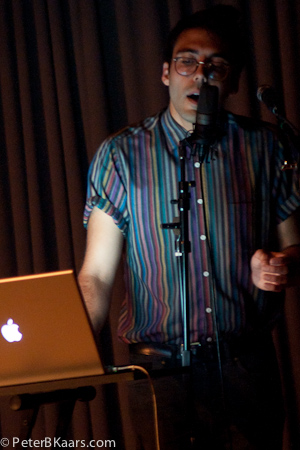
[Joseph Rosenzweig. Photo: PeterBKaars.com. (Click image to enlarge.)]
Joseph Rosenzweig used his voice to drive various electronic processes. For the first part of the set, he mostly used breath sounds, which were processed with distortion and other effects that became quite loud and intense. There were also moments that were more subtle, with softer metallic sounds behind the voice. As his vocalizations grew more complex, some parts began to take on the sound of speech, and there were moments while watching him that it seemed he was actually “speaking” the amplified electronic sounds. Over time, the arrangement grew to include multiple layers with percussive effects on more traditionally voiced sounds that feed into buzzing short loops and long drones of FM-like bell sounds – at this point, the electronic parts began to separate from the vocal source and take on a life of their own, with subtle high sounds, and then a low rumble against high vocalizations.
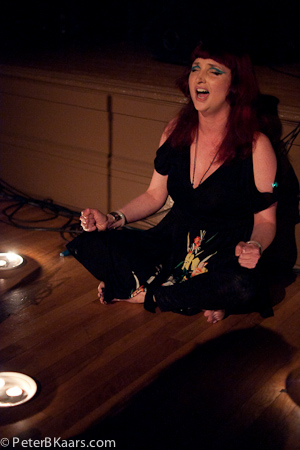
[Aurora Josephson. Photo: PeterBKaars.com. (Click image to enlarge.)]
Aurora Josephson opened the second half the concert with candles, incantations when led into a performance of John Cage’s Experiences no. 2. The quiet, subdued performance focused more on traditional pitched singing. Experiences no. 2 is in a pentatonic scale and very lyrical, with a folk-song or spiritual quality. It was an oasis of calm, and a great contrast to the performances that preceded and followed.

[Bran…(pos). Photo by CatSynth.]
Bran…(pos) concluded the concert with an intense and theatrical set that probably most fit the term “face music”. He disappeared behind a screen onto which a colorful image of a butterfly was projected. From behind the screen, one could hear disembodied sounds of chewing, crunching, churning, squeaks, pops and other percussion that one can make with the face and mouth – at once they were everyday sounds, but also heightened through amplification and rhythmic placement. After a period of time, the otherwise still video started to glitch, with grainy video images briefly appearing on the screen. After a moment, I realized that this was in fact the face of the artist from behind the screen. Soon, the live video replaced the still images entirely. (From my vantage point, I could actually glimpse the “man behind the curtain” while watching the live video.) The sounds and visuals together gave the impression that he was “eating” the microphone. After a while, soft resonant bell-like sounds emerged in the background behind the face sounds, and gradually loops and rhythms began to emerge as well as the facial gestures in the video grew more frantic. There was a moment when the “face music” seemed to stop leaving only a drone of pure synthesizer sounds, after which Bran…(pos) returned with a more traditional voice sound. The background elements grew more industrial, with strong resonances the morphed into large bells. The set ended in a visual of melting red.
You can see a video of Bran…(pos) below:
The overall trajectory of the concert was good, as was the contrast, ranging from Theresa Wong’s nearly silent and unaccompanied opening to Bran…(pos)’s frenetic and gear-intensive end.
The Outsound Music Summit continues through Saturday evening with additional concerts. Look for more reviews here, or follow @catsynth for live tweets.
Sad news about a feline composer, from the New York Times:
Ketzel, who won a prize for piano composition in 1997 and went on to be featured in a book, “The World of Women in Classical Music,” died Wednesday in Manhattan. She was 19 and lived on the Upper West Side.
Ketzel was a black-and-white cat.
In the article you can see a picture of Ketzel (whose name means “cat” in Yiddish), and a recording of her one composition, Piece for Piano, Four Paws. It is descending pitch-wise, but has a good sense of timing with a “beginning, middle and end.” The work was transcribed by one of Ketzel’s humans, Morris Moshe Cotel, who retired as chairman of the composition department at the Peabody Conservatory in 2000 and became a rabbi. It would be interesting to see, and even perform the score of Ketzel’s piece at some point.
Her piece one an award in the Paris New Music Review’s One-Minute Competition, and led to exchange between Professor Cotel and Allan Forte, with this observation:
long the way, Professor Cotel said he realized that Ketzel’s “exquisite atonal miniature” used only 10 pitches of the chromatic scale. “The two missing pitches are G natural and B-flat” — the opening notes of Domenico Scarlatti’s famous Fugue in G minor, known as the “Cat’s Fugue.”
Our thoughts go out to Ketzel’s surving human, Aliya Cheskis-Cotel.
A photo and video submitted by vlern via facebook:

“Clyde guards the modular.”
Clyde also stars in the next installment of the “My Cat is a Synthesizer” video series.


