Zimoun and Jim Haynes at Swissnex

In mid-January, I had the opportunity to see a performance by Swiss artist and instrument-maker Zimoun and local artist Jim Haynes at Swissnex here in San Francisco.

Swissnex is tucked away on quiet block in a “neutral zone” between the FInancial District, Chinatown and North Beach (an area I enjoy passing through on some of my long walks). The space is very minimal and stark white, with bits of the structural architecture and industrial quality of the building present. Within this space, a large array of music-making machinery was set up. One one side was Zimoun’s very minimal instrumentation, and on the other the chaotic array of gear and elements that would make up Haynes’ performance.

Zimoun’s instrument was incredibly simple, a series of cardboard boxes on top of which were mounted ping-pong balls on motorized arms. The boxes served as resonant chambers for the excitation of the ping-ping balls.
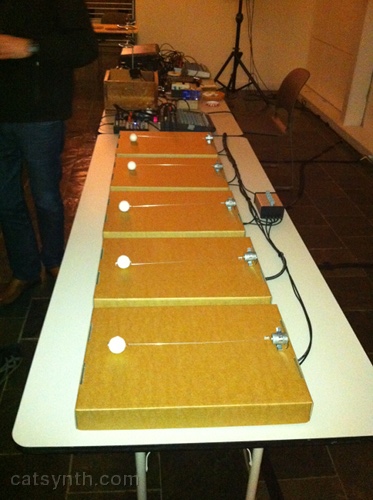

[Click to enlarge.]

The performance unfolded as simply as the instrument itself. First, one of the five units began to vibrate, producing a low rumbling sound. Gradually the other ball+motor+box elements entered the mix, producing an odd harmony of machine noises. Out of this combination, I heard a higher-pitched metallic sound. I am not sure if this came directly from the machinery of the instrument, or was an acoustic artifact from the interaction of the different sounds. That is one of the interesting things about having such a minimal concept behind a piece, it allows one to focus on the output and explore minute details that would often be lost in a more complex performance. The piece continued as continuous sound, without much in the way of change or development, for about twenty minutes. The combination of the sound and visual environment allowed for a few minutes of peaceful detachment and I was able to experience it purely as signal and image processing without social context.

Jim Haynes’ performance was a sharp contrast to Zimoun, both aurally and visually. His table was covered with a diverse array of audio devices and lab equipment.

[Click to enlarge.]

At first, I took the metal column and rings to be a custom-made theremin of sorts before realizing that it was the rings and tower familiar from countless science classes.

After an initial burst of loud noise and feedback (which reassuringly let us all know that “yes, this thing is on”), the sound unfolded as an exploration of traditional elements, notably fire, air and earth. He opened with fire, specifically from the flame of a lit candle. He latter added sand, which poured from a bottle he placed on the metallic rings so that the sand could gradually fall out onto a contact microphone. While Zimoun’s performance invited detachment, Haynes’ required close attention. Many of the sounds that emerged seem closely related to the elemental sources: from the fire a series of crackling sounds and wind sounds from the excited air, and from the sand a sea of granular noises that could at times seem like liquid. But there were other sounds as well, the sound of ambient radio static, something akin to vinyl noise, a high-pitched shaking sound, and metallic rattling. Whether these were directly from the fire and sand or from the BOSS Dr. Sample and associated effects boxes is unclear.

This performance was in many ways a preview for Zimoun’s exhibition at the Gray Area Foundation for the Arts (GAFFTA) which opened a few days later. That exhibition is still ongoing and will close on on February 22nd. Follow the link for more details.

CatSynth pic: Diego and Befaco Slicer Prototype

From comun y corriente, via matrixsynth:

Googlish translation from matrixsynth:

The other Diego had domestic problems that will prevent you bring your Spanish guitar, so you will be forced to play with this wild animal.

And another picture from amstrad on flickr, featuring Kiska:

Finally, an update from c+c via the comments on matrixsynth:

ust a brief explanation of what was going on here… This was published a couple of days before our first Corrientazo, a concert featuring many musicians using compact synthesizers and DIY stuff. So we were announcing that Diego, from Befaco, was going to play with a prototype of their new Slicer / 8 step sequencer, to be released later this month (more info soon!).

Then I heard news from Amstrad that he was no longer going to play spanish guitar + MFB 522 in the concert, because the cat ate the guitar! So he brought his DIY modular, from the Befaco workshops, instead; and played it via MIDI from his iPhone!”

I would be curious to hear the iPhone + Befaco performance…

Weekend Cat Blogging #297: Construction again

The on-again off-again construction at CatSynth HQ is finally on again for real. That meant Luna had to go back to boarding for a couple of days, but I brought her back home the weekend. Here we see her inspecting the state of the work:

>

Hopefully it will be done early next week. The whole process has been a bit stressful for both of us. I hope letting Luna enjoy some time at home over the weekend is indeed better for her, and I’m not adding to her stress or exposing her to much fallout from the construction work. It’s certainly far less than what we went through in late 2008, so hopefully it’s OK.


Weekend Cat Blogging #297 is being hosted by Oliver and Noli at The Accidental English Teacher. This is their first time hosting!

The Carnival of the Cats will be hosted by Nikita at Meowsing of an Opinionated Pussycat. This is definitely not his first time hosting.

And the Friday Ark is at the modulator, back from hiatus.

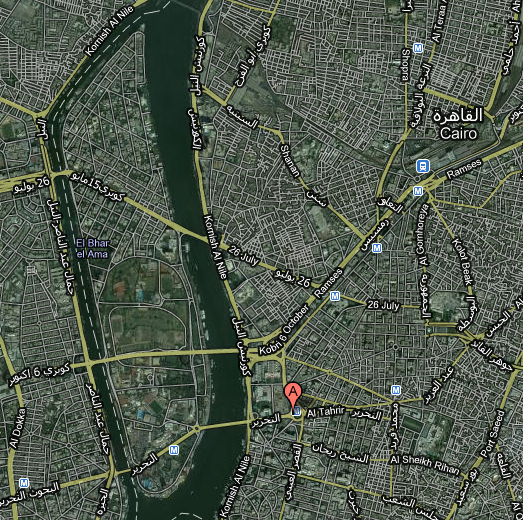
Fun with Highways: Cairo Edition

[Click to enlarge.]

“moving traffic and free exit ramps in cairo” on Thursday 10 February, by sierragoddess on flickr. (Creative Commons).  From what I can tell, it looks like this highway is the Ring Road / Mehwar Al Moneeb, south of the area on the map.

“Over the lion of Kasr Al Nil bridge”, by Kodak Afga on flickr (Creative Commons).  She has several other pictures of protests, some with infrastructure and landmarks.  This bridge is on the map and the road it carries feeds into Tahrir Square.

And finally…

Paul Cowan, Cameron Soren, Amy Yao, Jancar Jones Gallery

A couple of weeks ago I stopped by Jancar Jones Gallery to see the current exhibition featuring works by Paul Cowan, Cameron Soren and Amy Yao. One the things I like about visiting is the gallery itself, a small but inviting room tucked away on a rather idiosyncratic block of Mission Street in SOMA. Despite being such a small space, the exhibitions are always sparse and calming. (You can see previous reviews of exhibits at Jancar Jones via this link.)

[Installation View: Paul Cowan, Cameron Soren, Amy Yao. Image courtesy of Jancar Jones Gallery.]

Perhaps the pieces that most caught my interest were Paul Cowan’s two paintings featuring musical notes, both with the label Untitled, 2010. Each features a single quarter note on five-line staff without a clef. Assuming an implicit treble clef (which is admittedly a big assumption), the notes would be A and G, respectively. The “A” is on a very sparse canvas with red lines, similar to something I might have had to draw out myself during early years of studying music. The “G”, by contrast is filled in with vibrant color fields, though once again red is the most prominent color.

[Paul Cowan: Untitled, 2010, oil on canvas, 20 x 16 inches; and Untitled, 2010, oil on canvas, 18×14 inches.  Images courtesy of Jancar Jones Gallery.]

The other piece that caught my attention was Amy Yao’s Dealing Don’t Cry, which featured three small bits of newspaper fastened to a horizontal wooden dowel. The bits of text on two of the paper bits feature the text “Dealing” and “Don’t Cry” – I am always interested in the use of text, especially when the context is missing. My understanding in this work is the title is derived from the material, rather than text being found to fit the title.

[Amy Yao, Dealing Don’t Cry, 2010, wood dowel, newspaper.  Image courtesy of Jancar Jones Gallery.]

Rounding out the exhibition was Cameron Soren’s untitled video installation depicting the gallery on the opening on January 7, 6-9PM.

This is the final weekend for the exhibition – it closes on February 12 – so stop by if you happen to be nearby.

Preparing for Regents’ Lecturer presentation, Part 1

I have been busily preparing this weekend for the first of my UC Berkeley Regents’ Lecturer presentations:

Open Sound World (OSW) is a scalable, extensible programming environment that allows musicians, sound designers and researchers to process sound in response to expressive real-time control. This talk will provide an overview of OSW, past development and future directions, and then focus on the parallel processing architecture. Early in the development of OSW in late 1999 and early 2000, we made a conscious decision to support parallel processing as affordable multiprocessor systems were coming on the market. We implemented a simple scalable dynamic system in which workers take on tasks called “activation expressions” on a first-come first serve basis, which facilities for ordering and prioritization to deal with real-time constraints and synchronicity of audio streams. In this presentation, we will review a simple musical example and demonstrate performance benefits and limitations of scaling to small multi-core systems. The talk will conclude with a discussion of how current research directions in parallel computing can be applied to this system to solve past challenges and scale to much larger systems.

You can find out more details, including location for those in the Bay Area who may be interested in attending, at the official announcement site.


Much of the time for a presentation is spent making PowerPoint slides:

With slides out of the way, I can now turn to the more fun part, the short demos. This gives me an opportunity to work with TouchOSC for the iPad as a method for controlling OSW patches. We will see how that turns out later.