
Category: Modernism
-
Weekend Cat Blogging: Modernist Sunshine

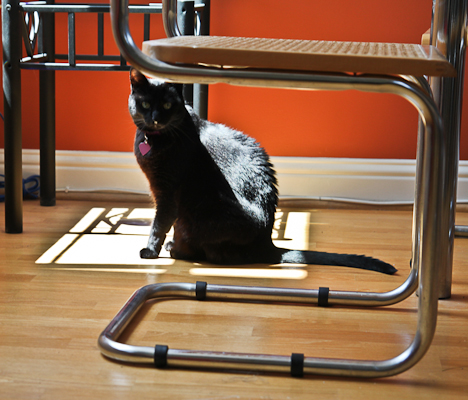
Luna always loves the patches of sunshine that pour into CatSynth HQ in the morning. On this particular morning we see her posing regally in an Art-Deco-patterned sunshine spot. The shadow is cast by the table just behind her, a piece that dates back to my graduate-student days in Berkeley but still fits the overall style of our current pad in the city.
On a sad note, we learned that our friend and fellow cat-blogger has passed away. We send her family our thoughts.
Weekend Cat Blogging is hosted by Bengal Business.
The Carnival of the Cats will be up tomorrow at Mind of Mog
And the Friday Ark is at the modulator.
-

Weekend Cat Blogging and Photo Hunt: Sturdy
We return to a combined Weekend Cat Blogging and Photo Hunt this Saturday on the theme Sturdy. Here we see Luna passing by some of the sturdy support columns that hold up CatSynth HQ.

The wooden beams are quite thick, and fastened with multiple bolts and metal junctions both on the top and bottom.

The diagonal beam adds addition sturdiness, especially in the event of a seismic event. But the strength also has a modernist aesthetic quality that fits the overall style of our space.
Weekend Cat Blogging #356 will be hosted by Kashim, Othello and Salome at PaulChens FoodBlog?!.
The Saturday Photohunt theme is Sturdy.
The Carnival of the Cats will be up this Sunday at When Cats Attack!
And the Friday Ark is at the modulator.
-
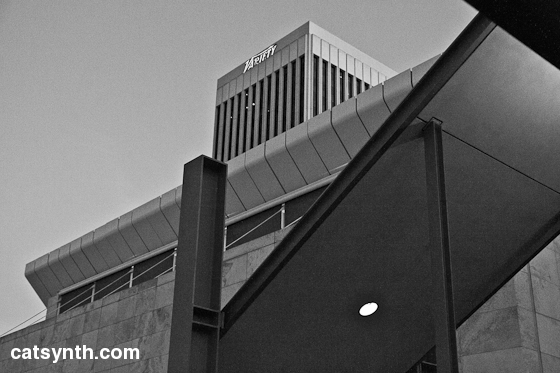
Wordless Wednesday: Variety (LACMA)

As always, check the comments for some info on the picture. But please also check out the associated review of my LACMA visit.
-
Fun with Highways: New Hampshire
We continue our series this season with a visit to the Granite State. New Hampshire typifies what we think of as “northern New England.”, with a mixture of old factory towns and mills, forested mountainous wilderness and rocky coastline.

[Photo from dougtone on flickr.]We begin on this rather oddly named bit of highway south of Nashua called the “Circumferential Highway.” It’s not really circumferential of anything, except maybe an argument. But it does connect us to a major highway, the Everett Turnpike, as we head north through the state. I actually have visited Nashua. It was (gasp!) 20 years ago when a college friend invited me to tag along with him to go up to New Hampshire and volunteer for a presidential candidate I had barely heard of named Bill Clinton. The main thing I remember about walking around the town was that it was very cold. And it also looked a bit more gritty and rundown than the some of the more recent images I have seen.

 Traveling north on the Everett Turnpike we come to the state’s largest city, Manchester. The turnpike merges with I-293 and heads north along the river, passing by downtown and the old mill buildings of the Amoskeag Manufacturing Company. This was a huge enterprise in its day, and apparently had the largest cotton textile plant in the world in the late 19th century. The company went under in the 1930s, but the buildings remain. You can see the rather narrow I-293/Everett Turnpike along the river just in front of the red brick mill buildings. Many have found new uses for contemporary industries as well as residential and commercial development.
[Image from Wikimedia Commons.]Manchester is also home to the Currier Museum of Art. It’s plaza includes the sculpture Origins by Mark di Suvero.

[Photo by madame urushiol on flickr.]It seems like variations on his “weird red thing” (aka Joie de Vivre) from Zuccotti Park are everywhere. After our Iowa article last week, a reader on DailyKos recommended a sculpture garden in Des Moines that also contains a di Suvero piece. I wonder how many more we might encounter as this series continues. The Currier also manages the Zimmerman House, a Frank Lloyd Wright masterpiece in the northern part of the city.

[Photo by mmwm on flickr.]New England was apparently quite a hotbed of modern architecture in the middle of the 20th century, and many of the designs make Frank Lloyd Wright’s look conservative by comparison.
An avid highway enthusiast who goes by the name “FreewayJim” on YouTube has a fun time-lapsed and annotated view of the drive north on the Everett Turnpike and I-293 through Manchester as I-293 merges back into I-93 towards Concord. It turns out this is his hometown, so he brings a bit of knowledge about what has changed, and especially what has not changed on these roads.

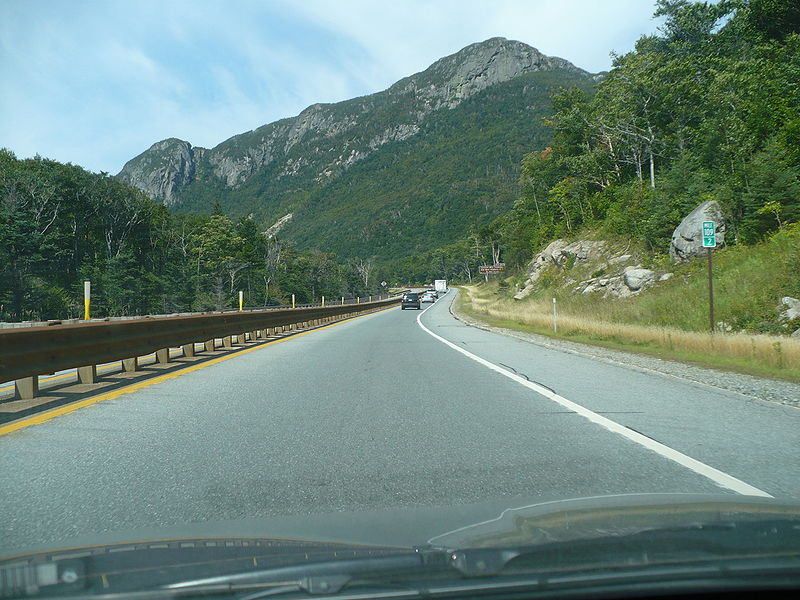
 I-93 continues north from Concord and winds its way gracefully into the White Mountains region. Here we see the rugged northern New England wilderness, another defining feature of the state. Cosigned with US 3, I-93 continues north into Franconia Notch State Park, where it narrows to just one lane in each direction, a rarity for an interstate highway.
The park includes among other things the former site of the Old Man in the Mountain. This natural feature on Cannon Mountain symbolized the state. It is part of the state highway shields. It is on the state’s commemorative quarter. It is on the state’s license plates. And it came crashing down off the cliffs one night in 2003. It sounds like there was a great sense of loss for the state when this happened. A memorial is currently being built at the base of the mountain, which will feature large granite elements representing both the formation itself and the state’s identity.
 One can leave I-93 here and head eastwards on NH 112, the Kancamagus Highway through the White Mountains. In addition to having a great name, the roadway provides scenic vistas of the mountains and forests (especially dramatic in the autumn) as well as rocky rivers and covered bridges.

[Click images to enlarge.]It seems like New Hampshire has quite a few covered bridges. I was actually in this area once as a kid (even more than 20 years ago). It was quite beautiful, but even in summer the water in the river was cold.
Highway 112 ends at the town of Conway, which I knew sounded familiar for some reason. It is in fact because of the Animal Rescue League of New Hampshire’s shelter in the town. I think I crossed paths with them once via Weekend Cat Blogging. In any case, they have some nice cats available for adoption if you are in northern New England.

UPDATE: Speaking of cats, we would be remiss if we did not head north from Conway on Highway 16 to Mount Washington. This summit has famously high winds and all around terrible weather, but it is quite an experience to visit (on that same childhood trip I was picked up off the ground by a gust of wind). Plus, they have an official observatory cat, Marty. He is one in a long line of Mount Washington cats, about whom you read more here. Marty’s predecessor, Nin, was there for quite a while and posted this article in 2007 when Nin retired.
Returning to Manchester, one can head westward or eastward on NH 101. To the west, the highway is a local road that winds its way to the town of Keene. I only learned about Keene through these great photo an abandoned factory. It seems to not fared as well as its larger counterparts in Manchester and Nashua, but the ruins are quite beautiful as a photographic subject, especially with the snow.

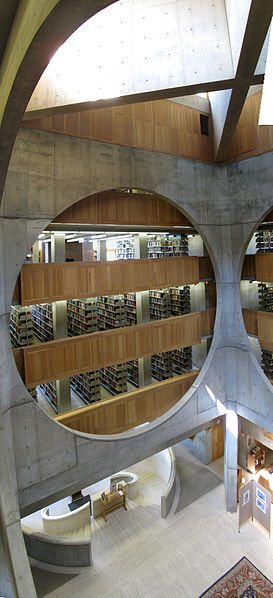
[Photo by Lorianne DiSabato on flickr.]East of Manchester, 101 is a large highway heading towards the coast. It passes by Exeter, a town with a prep school that many of my college acquaintances attended. But more interestingly, the academy includes this modernist library designed by Louis I. Kahn:

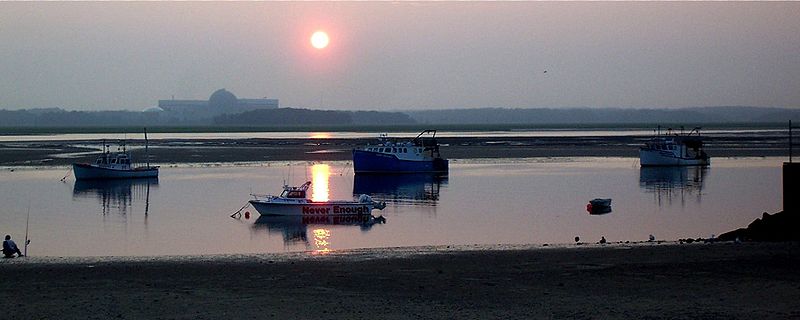
[Photo by Pablo Sanchez via Wikimedia Commons. (Click to enlarge.)] 101 eventually hits the coast at highway 1A, just north of Seabrook. Although the beaches along this shore are quite scenic, I know them mostly from the history surrounding the Seabrook Nuclear Power Station. In 1977, the Clamshell Alliance staged what we would now refer to as an “occupy protest” on the construction site of the plant. Nonetheless, at least one reactor of the plant was built. If I didn’t know what it was or the dangers surrounding nuclear energy, I would actually think of it visually as a positive contribution to the landscape, contrasting with the low horizon, dunes, wetlands and ocean, as in this photo from along 1A:
And I think this sunset is a perfect way to conclude this short trip to New Hampshire.
-
The Bronx Museum
I always like to discover new places when I visit New York, and one of those on my most recent trip was the Bronx Museum.
From the D train, one alights at the 167th Street station along the Grand Concourse. Two blocks south is the museum’s impressive new building. The structure is a start metal facade with odd angles and geometric details that one often sees in contemporary buildings. But the repeating patterns also evoke the old narrow apartment buildings that used to cover this an many other sections of the Bronx. Inside the lobby, a large installation by Bronx-born conceptual artist Vito Acconci fills the space with airy undulating shapes that complement the exterior architecture.

It turns out this piece is made from Corian, which the artist uses to make solid but seemingly pliable forms. The numerous holes allow air and light to become part of the piece. I think the protrusions that look like seating are in fact seating for visitors, but I did not ask. (As an interesting side note, it turns out that Acconci has already been mentioned on this blog in this review closer to home.)
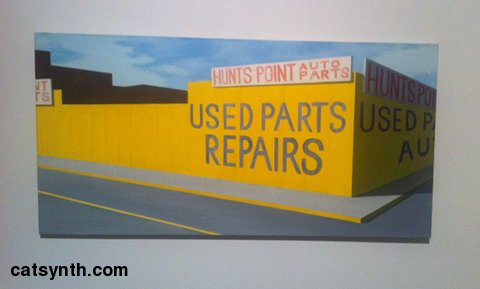
One gallery featured paintings and works on paper by the Cuban-American artist Emilio Sanchez, all depicting commercial buildings from the Hunts Point neighborhood. Hunts Point is at the southern edge of the Bronx, known for its huge produce market and concentration of auto-repair shops.

These colorful canvases strip the buildings and street down to essential elements, the rectilinear forms of the structures and lettering of the signs.
The sources for these paintings were images from the 1980s, a time when the Bronx had gone through a precipitous multi-decade decline that give the borough its reputation. None of the urban decay that was undoubtedly present on the streets at the time is present in these pieces. Indeed, the colorful palette and idealized shapes celebrate the neighborhood.
Also on display was a large exhibition entitled Muntadas: Information >> Space >> Control by the artist Antoni Muntadas. Through video, photographs and other media, the artist explores “the relationship between public and private space, the media, how information is conveyed, interpreted, and manipulated, and the way that public opinion is shaped.” One wall featured five photographs of scenes from the Bronx, with the opportunity for visitors to write the own responses. Among the photographs were the infamous Charlotte Street building facade from the late 1970s, and a more recent image of a girl interacting with a gorilla at the Bronx Zoo.

Both of these are familiar aspects of frequent visits to the Bronx as both a child and an adult, the bleak landscape of the 1970s and 1980s and the natural oasis and curiosity of the zoo. As such, this was the most personal aspect of the exhibition. The other pieces, which included videos, images and printed words taken out of their original context, was interesting, but not quite as resonant. Though I did enjoy seeing a clip from Goddard’s Alphaville among the images.

Although my visit was during the museum’s free Friday evening, it was almost empty. This gave the space a bit of a lonely feeling, but also complete freedom and peace to enjoy the galleries. Granted, it was the Friday after Thanksgiving, the busiest shopping day of the year, and an exceptionally warm evening for late November in New York, so I hope the emptiness I saw was an exception. Nonetheless, I am glad I had the chance to finally visit, and it was great to see the positive changes that are happening in the area. I strongly recommend a trip north on the D line to check out the museum and its surroundings.
-
Visiting the 9/11 Memorial in New York
My trip to New York included a visit to the to 9/11 Memorial. As stated on the website, the memorial is “A national tribute of remembrance and honor to the men, women and children killed in the terror attacks of September 11, 2001 and February 26, 1993.” At its most essential level, it is a space rooted in tragedy and loss and remembrance. But it also is a positive space, in harmony with the modern urban landscape, the changes happening as the area is rebuilt, and a prototype for ways to think about public urban spaces for the future.
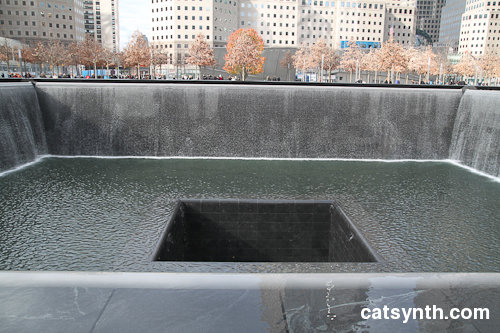
The memorial is located on the World Trade Center complex, and occupies a large portion of the original site. It is anchored by two large square waterfalls and reflecting pools, each approximately the size and location of the footprints of the original twin towers.

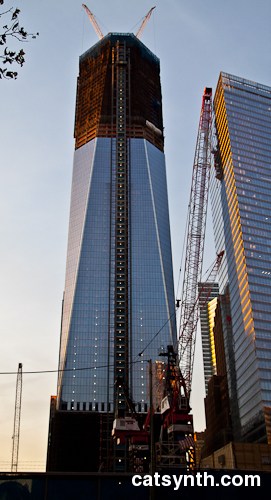
In this photo, one can see how the pools are situated with respect to the other architectural features of the landscape. Behind this pool on the footprint of the original south tower are (from left to right), the existing buildings from the World Financial Center in Battery Park City, the new One World Trade Center building still under construction, and the September 11 Museum (also still under construction).
At the center of each reflecting pool is a dark square hole whose bottom cannot be seen from the sides and into which water from the pool falls.

The trees visible in the above photo are swamp oaks, and form an important part of the memorial. Although orange and rather spare in late November, they form a green canopy that will shade much of the space during the spring and summer and add a sense of life to the space. They are also an integral part of the green design, with the shade helping to reduce stress and energy on the underground parts of the complex (including the major transit hub at the site). Conversely, the paved walkways are designed in such a way as to support the trees and not put undue stress on them or their roots (visit the website for more detail on how that works).
The sides of pools are lined with bronze onto which are inscribed the names of all the people who died in the attacks on September 11, 2001, as well as the six people who died in an earlier attack on the World Trade Center in 1993.

It is somewhat reminiscent of the names on the Vietnam Memorial in Washington, DC, and indeed I did see some people making rubbings of particular names.
The architecture of the pools, with the concentric squares and footprints, grounds the memorial in the architecture of the original site. The museum facade also takes on elements from the long lines of glass and steel structure of the original towers. Even the cascading water into the pools seems to have been designed to reflect the original architecture. The pattern of the water as it cascades over the edge strongly reminds me of the two-story lobbies of the original towers.

Visits to the memorial is still very controlled, and one has to book passes for a particular date and time well in advance. But we were able to get a good time during what is presumably a busy week. I am glad I had a chance to visit at this time, with the overall site still in progress. I would like to see it again in the future as the buildings and the museum move forward.
-
New Topographics, SFMOMA
If one were to construct a photography exhibition for me to attend, it might look something like New Topographics at SFMOMA. Indeed, “construction” is an apt term, as most of the photos explore the human alterations to the natural landscape, particularly in the western United States but in other locations as well. Yet, the natural landscape does continue to play a central role in the environments and in the images. It shapes how the human-made structures are constructed and arranged, and how they decay. The exhibition was originally presented in at the Eastman House in Rochester, New York in 1975.
“A turning point in the history of photography, the 1975 exhibition New Topographics signaled a radical shift away from traditional depictions of landscape. Pictures of transcendent natural vistas gave way to unromanticized views of stark industrial landscapes, suburban sprawl, and everyday scenes not usually given a second glance. This restaging of the exhibition includes the work of all 10 photographers from the original show: Robert Adams, Lewis Baltz, Bernd and Hilla Becher, Joe Deal, Frank Gohlke, Nicholas Nixon, John Schott, Stephen Shore, and Henry Wessel.”
It is hard to imagine that such a portrayal of landscape was new to art photography at the time. The ideas and subjects in much of the contemporary photography that commands my attention, as well as my own photographs that often appear on this site for Wordless Wednesday. But it was certainly a sharp contrast to the traditional views of landscape in photographs, especially view of the American West, which tended to be not just natural but a romanticized form of nature. One only need step beyond the exhibition to SFMOMA’s main photography collection to see the changing views of landscape and romantic imagery.
The desert tends to be my favorite natural landscape (along with the coast), and is prominently featured in many of photographs. It has a stark beauty, but it also acts as a vessel for human artifacts. Set in the desert landscape, one can linger on the contrasts and similarities between artificial and natural. The straight lines and simple textures don’t get lost in the landscape, and are in fact amplified by it. In Joe Deal’s Untitled View (Boulder City), the roads, buildings and the trailer are partially obscured by natural elements. In a sense, they are distilled down to the lines , which are emphasized by the wires and shadows that traverse the image. At the same time, the natural landscape also seems to follow the straight lines, and in turn the soft undulations of the terrain and reflected in shallow peaks of the partially hidden houses.

[Joe Deal (American, b. 1947), Untitled View (Boulder City), 1974, George Eastman House collections. © Joe Deal.]
The lines (no pun intended) between the natural and artificial aspects of the landscape are further blurred in Frank Gohlke’s Irrigation Canal, Abuquerque, New Mexico. Here we see a completely artificial environment, the concrete-sided canal with vegetation establishing itself at the edges of the water.

[Frank Gohlke (American, b. 1942), Irrigation Canal, Albuquerque, New Mexico, 1974, George Eastman House collections. © Frank Gohlke.]
At first glance, the mud and vegetation seem to mar the otherwise smooth and clean surface of the canal. But in reality, they are part of the environment, and thus part of the image as well. One could say the same thing about the reverse situation in Deal’s photograph, where the human-made elements have become part of the natural landscape.
Lewis Baltz takes the theme of straight lines to its aesthetic extreme in both the artificial and natural aspects of the environment. His images feature perfectly rectangular buildings set against the flat landscape in Orange County, California.

[Lewis Baltz (American, b. 1945), Jamboree Road Between Beckman and Richter Avenues, Looking Northwest, George Eastman House collections. © Lewis Baltz.]
Some of Baltz’s other photographs feature facades of rectangular commercial buildings either straight on or at angles. Close-up and with less context from the landscape, they begin to feel more abstract. This is particularly true of East Wall, McGraw Laboratories with its extremely high contrast black and white rectangles. In South Wall, Mazda Motors, 2121 East Main Street, Irvine, the landscape is seen only in the reflection of a window, once again a rectangle inside another.
The sharp contrast and combination of architecture, landscape and abstraction made Baltz’s pieces among my favorite in the exhibition. Similarly, my attention was also drawn to the work of Bernd and Hilla Becher. Their photographs featured industrial and mining buildings in Pennsylvania. Some of the buildings were in states of disrepair, such as Loomis coal Breaker/Wiles Barre, Pennsylvania (1974), or even seemed on the verge of collapse as in the image below:
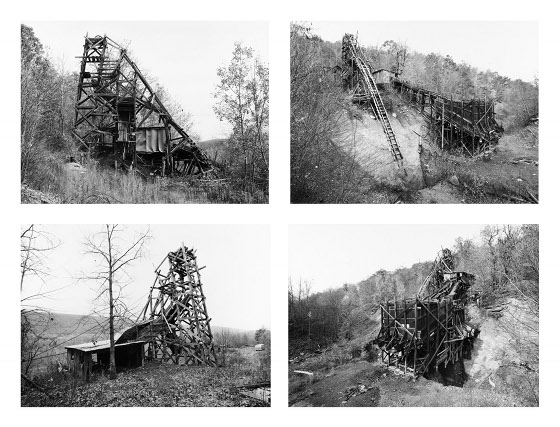
[Bernd and Hilla Becher (German, 1931-2007 and b. 1934), Pit Head, Bear Valley, Pennsylvania, 1974
© Hilla Becher, 2009.]The structure seems to melt back into the natural environment, and at the same time provides a series of straight (albeit somewhat distorted) lines and geometric shapes. Once again, the high contrast of the image allows one to focus on the abstract elements without completely losing the context that it is a building on a hillside. It would be easy to dismiss these photographs (and indeed many in the exhibition) as social commentary or socially-inspired art, but they have detached quality and the emphasis is on the visuals details – in particular those details that I look for in when viewing and evaluating modern art. The Bechers’ images in particular have a sculptural quality, something that comes out even more directly in their book Anonyme Sculpturen.

Nicholas Nixon (American, b. 1947), Buildings on Tremont Street, Boston, 1975; George Eastman House collections; © Nicholas Nixon Nicholas Nixon’s work stands apart from the others in the exhibition in that depicts urban landscapes from Boston and Cambridge. His Buildings on Tremont Street, Boston depicts a classic 20th century vertical city image of tall and densely packed but quite detailed buildings. Nixon’s image Boston City Hall, Covernment Center Square and Faneuil Hall provides another type of contrast in the landscape that is particular to cities, a tension between modern and traditional architecture. Set against a backdrop of larger buildings, one see a popular older landmark contrasted with the modernist and rather controversial Boston City Hall. It’s a building I actually quite like visually, and it brings us back the rectangular shapes in Baltz’s southern California images.
I conclude with this quote from the exhibition catalog – a rather extensive volume that includes not only the images but a detailed discussion as well as a reproduction of the original catalog – that I find illuminating in thinking about the work of these artists as well as my own photographic interests:
Photography based on attraction to, even love of, the subject while neither revealing that motivation nor imposing it on viewers – it may confuse viewers accustomed to being seduced or sermonized. Adding another degree of complexity is the likelihood that the attraction and love were likely not pure, but instead joined to anxiety and repulsion. Reconciling these opposing forces was an exercise undertaken by each of the New Topographics photographers in different ways.
[New Topographics, copublished by Steidl Publishers and Center for Creative Photography in cooperation with George Eastman House, page 18.]
The exhibition will be on display at SFMOMA through October 3.
[All images used in this article were provided courtesy of San Francisco Museum of Modern Art. Individual copyrights displayed in captions.]