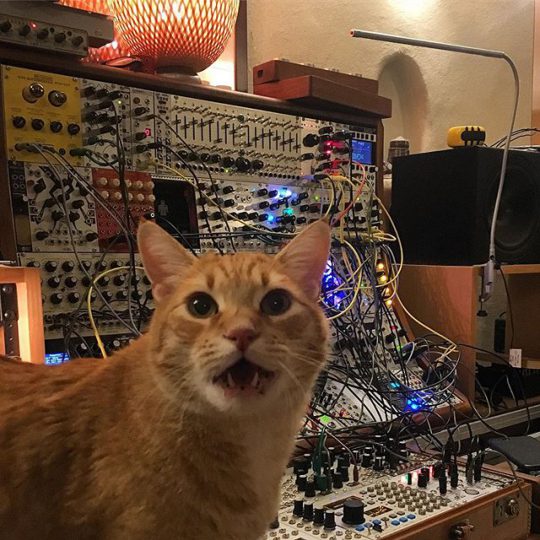
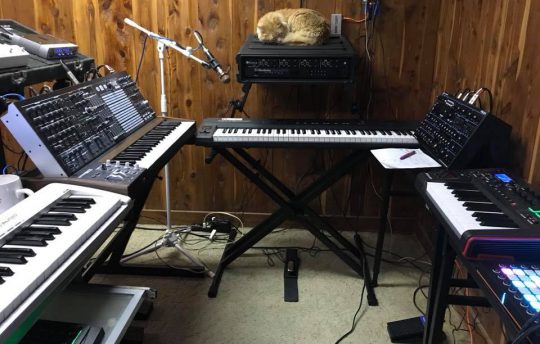
Our ginger feline friend Rufus returns, courtesy of iamshadowdancer on Instagram. He looks ready to serenade us with a new song.
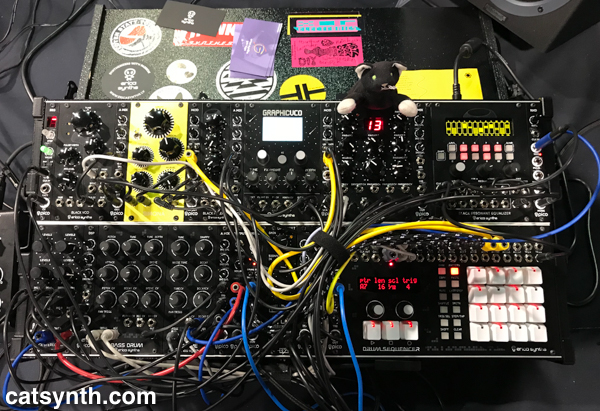
He has a rather impressive modular setup! The upper case is by Goike. It contains a wide variety of modules – we see a classic Metasonix yellow, a Mordax DATA on the right, a Make Noise Maths, and many others that whose identification we leave as an exercise to the reader.
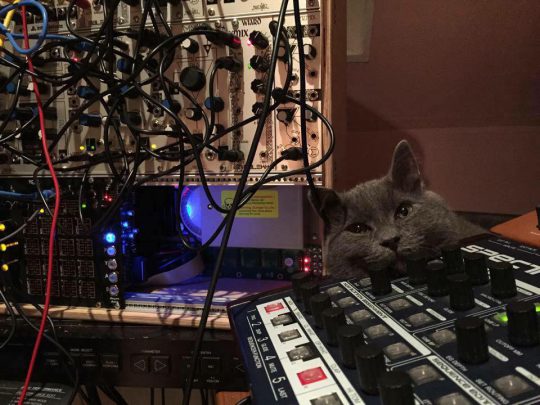
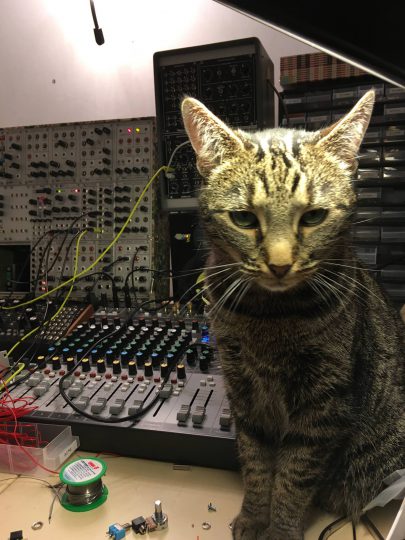
Handsome cat sneaking up on a Radikal Technologies Spectralis synthesizer (1st gen). There are some Eurorack modules including the familiar old-style Wiard modules from Malekko Heavy Industry.
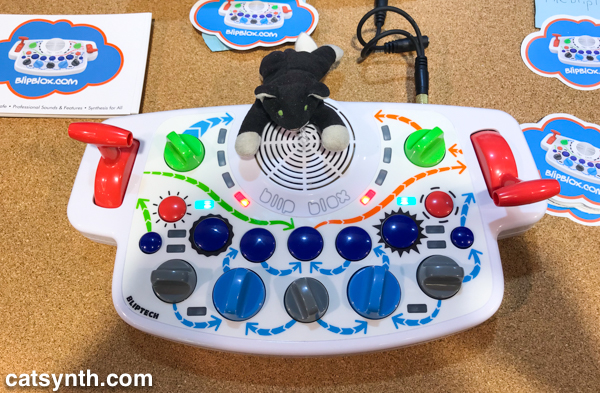
Among the more unique instruments that we saw at NAMM this year was the Blipblox, a fully functional synthesizer in a plastic shell reminiscent of children’s toys.
Don’t be deceived by its appearance. The Blipblox is a full-featured monophonic synthesizer with selectable signal topologies and oscillators; a low-pass filter; a sequencer; and even a drum machine. There is also a modulation matrix to complete the feature set. In some ways, it seems similar to overall style and concept of the Moog Mother-32, though it is of course a very different instrument.
You can hear a bit of our attempt to play the Blipblox in this video.
It certainly seems like an interesting way to introduce kids to synthesizers and both the science and art of sound. But it also seems quite usable for live performance – if it’s rugged enough for kids, it’s probably rugged enough for the stage. We look at it an immediately think of the repurposing of musical toys for experimental electronic performance via circuit bending. Whether a Blipblox is bendable or not is beyond the scope of this initial look, but it would certainly fit in with a setup that includes such modified instruments.
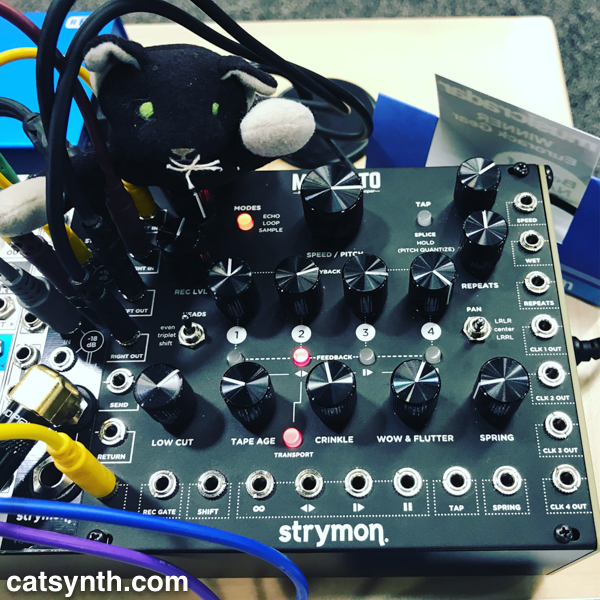
At NAMM, one tries out a lot of instruments and walks away wanting to have a good number of them. The novelty fades quickly, but some you find that you continue to really want. The Magneto module from Strymon is in the latter category.
The Magneto is a four-head tape delay simulator. Its controls are very intuitive and playable, with enough flexibility to be used to generate spring-reverb-like sounds as well as function as a looping device via a mode switch. You can see our first attempts with the Magneto in this video.
Strymon put a lot of attention to detail both in terms of sound design and usability into this device. And as one would expect from a Eurorack module, just about every function can receive external CV input, making it more of a musical instrument in its own right than it would be in a studio rack or even a guitar pedalboard. We were able to observe the delay and looping functions in great detail, but it was more challenging to discern the tape-effect functions, such as “wow-flutter” and “crinkle”. Part of that is just the chaotic environment of NAMM (even in the more calm depth of Hall E). Hopefully, we will get a chance to try those out in more detail in the near future.
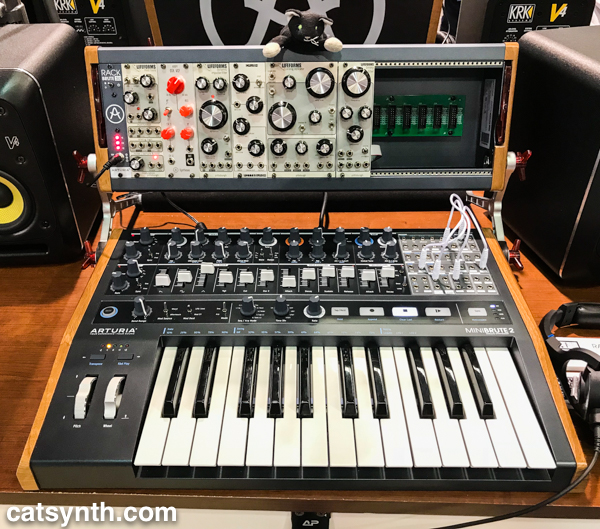
We continue to work our way through our experiences from NAMM 2018 with the Arturia MiniBrute 2.
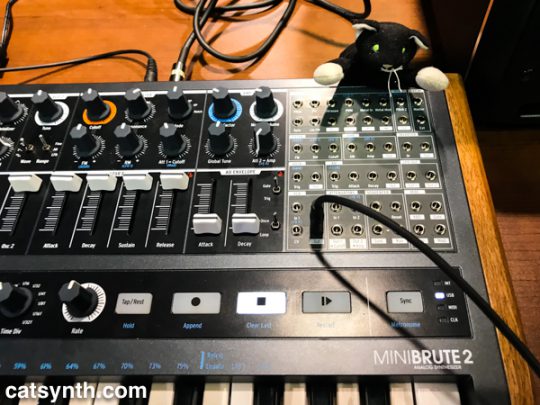
The original MiniBrute made quite a splash a few years ago with its all-analog signal path, usability, and low price. It also had a sound that was distinct from other low-cost analog synths, in part because of the “Brute Factor” knob. That knob is back in the MiniBrute 2 along with a Steiner-Parker filter that together with the Brute oscillator gives the instrument its sound. But there is now a second oscillator, and, perhaps more significantly, a modulation matrix and patch bay.
The built-in synthesizer topology includes a lot more modulation than the original, and the patch bay allows for reconfiguration and expansion with the RackBrute Eurorack cases that integrate 3U or 6U or modules with the MiniBrute in a single case. This does seem to be a trend we are seeing with built-in patch bays to full analog mono synths (the Moog Mother-32 being the prime example). One can also interpret the MiniBrute 2 as incorporating ideas from the flagship MatrixBrute writ small. The ecosystem also includes an alternate form-factor, the 2S, which has drum pads reminiscent of the BeatStep Pro instead of the keyboard.
We were only able to scratch the surface at NAMM, and also had a bit of difficulty with our video. So we are hoping to provide a more in-depth look at this instrument both here and on CatSynth TV in the not too distant future.
We continue to work our way slowly through the embarrassment of riches from NAMM 2018 with a look at new modules from Erica Synths.
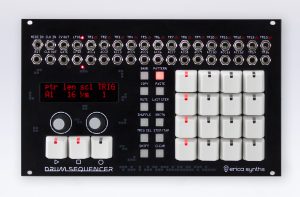
The biggest of the new modules, both physically and in terms of garnered attention, was the Drum Sequencer module. It has an attractive retro look and feel with a raised keypad and red LED display, reminiscent of instruments and studio gear from the 1980s. It also features 12 independent trigger outputs and 12 separate accent outputs – of course in the context of a modular synth one need not use the accent outputs for “accents”.
The sequencer itself is full-featured with separate meter and length per track as well as independent shuffle and probability per step. The probabilistic step function is intriguing, and one I did not have a proper opportunity to explore at NAMM, so hopefully I will get a chance to do so in the not too distant future.
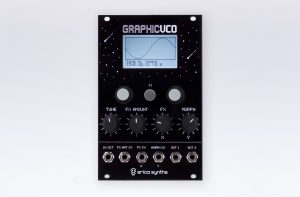
The Graphic VCO returns to a more contemporary design found in many digital Eurorack modules.
This module allows the user to draw his or her own waveforms Etch-a-sketch style to use in two simultaneous wavetable oscillators. In addition to mixing, they can be arranged in different topologies for FM, ring modulation, waveshaping and more. The waveform selections and configurations can be sequenced for continuously morphing sounds. It would be interesting to use with the Drum Sequencer.
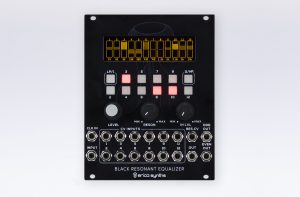
The final module we looked at was the Resonant Equalizer. It is basically a 12-band bandpass filter with each band independently controllable via CV. One can also control all the bands with a single CV input for sequencer-based changes. Again, this feels like a module that would work well in tandem with the Drum Sequencer. It also has an attractive visual look for live performance use.
You can see all these modules in action in our recent video, which also features a “virtual appearance” by Tuna, the official Erica Synths cat 😺
We congratulate Tuna and rest of the team from Erica Synths on their offerings for this year’s show, and hope to someday visit them in Latvia.