A photo and video submitted by vlern via facebook:

“Clyde guards the modular.”
Clyde also stars in the next installment of the “My Cat is a Synthesizer” video series.
A photo and video submitted by vlern via facebook:
“Clyde guards the modular.”
Clyde also stars in the next installment of the “My Cat is a Synthesizer” video series.
The Outsound Music Summit began this Sunday with the annual Touch the Gear Expo. Visitors have a chance to see and try out the equipment used by musicians and sound artists. We had a a diverse group of participants this year, and this short video gives a good overview of some of the sound and visuals that one would have encountered:
We had a decently sized turnout for the event, and the evening went by quickly. While not at my own station, I did my best to see others work, but did not get to everyone. For those who followed my live tweets from the event, the remainder of article might seem redundant, but I do provide more detail.
I brought a small rig that reflects my recent solo work, with an iPad as both a synthesizer and controller for software on the laptop, a monome, the Wicks Looper and a Korg Mini-Kaoss Pad.
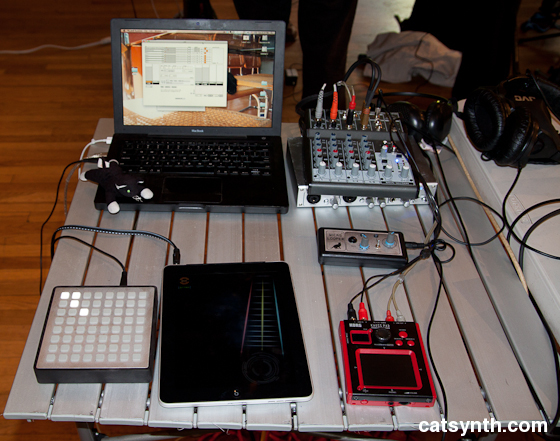
The iPad was primarily running TouchOSC, controlling a version of my piece Charmer:Firmament running in Open Sound World on the laptop, as well as a few popular instruments like the Smule Magic Fiddle and Bebot. The monome was controlling sample loops, and the Wicks Looper was feeding into the Kaoss Pad.
Next me, Matt Davignon presented a turntable and effects pedals that was quite popular with visitors. There is still something compelling about a tactile and intuitive interface such as a turntable that compels people to want to play it. In contrast, the monome in particularly seemed to intimidate people.
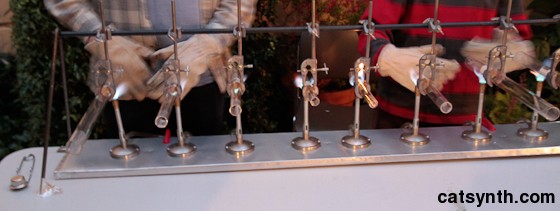
There were many non-electronic offerings as well, including the quartz cantabile by Todd Larew. Who needs electronics when you have fire as your primarily technology!
Bob Marsh wandered the hall in a suit covered in plastic water bottles, some containing mechanical sound generating elements, and was quite a presence throughout the evening.
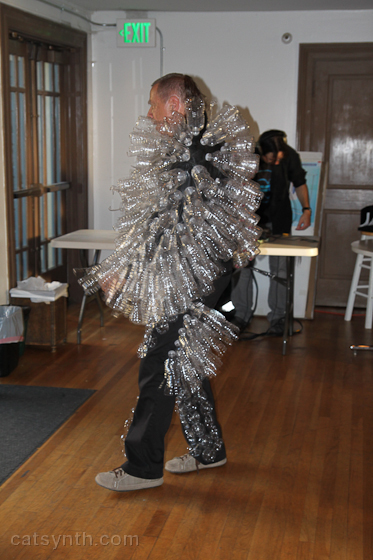
He also brought several other articles of sonic clothing for people to try on and play.
Tim Thompson brought his space palette, a large wall-sized controller in which one controls sound and visuals by moving in the various spaces in the panel.

I had seen him perform with the space palette before, but this my first opportunity to try it out myself.
Another original instrument, the Ernestophone, featured one main string and several sympathetic strings, and a very rich sonic palette of overtones.
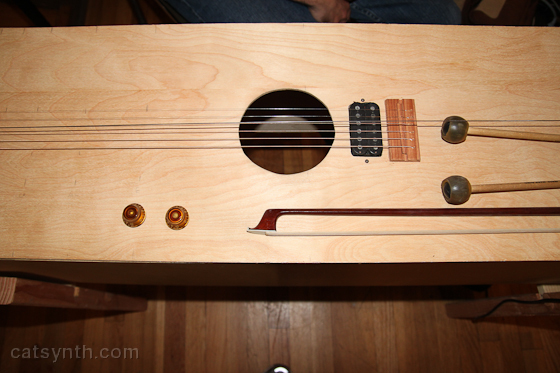
Phogmasheen presented an instrument made from pick heads and cake pans.
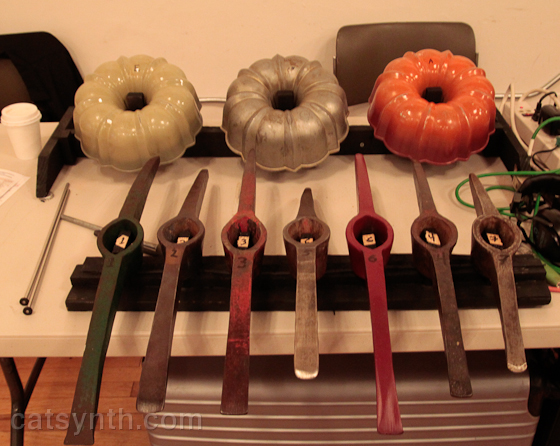
One strikes the metal elements with mallets or sticks, and then pickups process the output electronically.
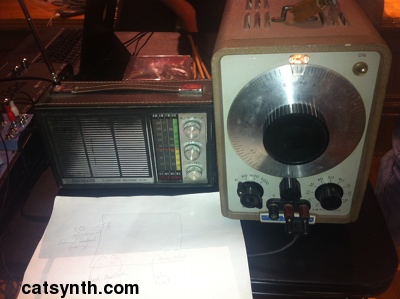
This is not the first time I have seen a classic 1950’s HP oscillator at Touch the Gear, but it’s the first time I have seen one paired with a Peerless transistor radio, for a very retro noise experience.
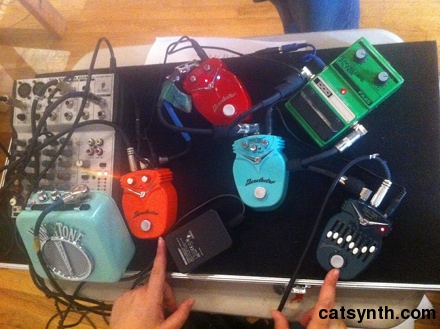
Noise rigs are a common theme, particularly chains of effects pedals and mixers that operate solely on the noise inherent in electronic circuits but then amplify and shape it through non-linear processes of the effects change into rich and chaotic sound palettes. One example is this colorful rig from CJ Borosque. I was able to get subtle an expressive control of the sound by focusing on only a couple of knobs.
Other participants included Tom Nunn presenting one of his sonic inventions, Rick Walker demonstrating high virtuosic use of live-looping hardware and Laurie Amat getting rather humorous results from the sound of the crowd in the hall processed through a classic green Line6 delay pedal.
The panel discussion on Monday night, entitled “Elements of non-idiomatic compositional strategies” was quite a contrast to Touch the Gear Night. Four composers, Kanoko Nishi, Andrew Raffo Dewar, Krystyna Bobrowski, and Gino Robair engaged in a discussion moderated by Polly Moller about their music, influences and views on composition in front of an intimate audience with plentiful wine, cheese and dark chocolate.

One of the interesting questions was whether each of the composers began their ideas with sound, or a focus on sound. Not surprisingly, the answer was no – although sound was the medium of creativity, the source ideas can come from anywhere. In speaking about his piece for the Friday concert at the summit, he described how the work was influenced very directly by paintings by the Argentine artist Eduardo Serón. Gino Robair similar painted a very visual and conceptual influence for his suite based on the engravings of Jose Guadalupe Posada of late19th -and early 20th-century life in Mexico, and the skeletons and skulls in particular. Kanoko Nishi referred “music completely devoid of symbols”; and Krystyna Bobrowski described her work with her created instruments as a “sonic bloom of resonance”, perhaps my favorite phrase of the evening.
Other topics discussed included composing for instruments or sounds versus composing for particular musicians, i.e., “instead of preparing the piano, prepare the pianist” (as I pianist, I am not sure how I feel about being prepared), and questions about the rewards of composing experimental music – because it was accepted by panelists and audience alike that their are neither financial nor sexual riches to be gained by this pursuit. Perhaps the response that rang most true to me was that composing music is an obsessive-compulsive activity that some of us just have to do whether we like it or not.
For those who not familiar with the terms, think of idiomatic music as music that falls into recognizable patterns and genres that one can readily identify, so non-idiomatic music is music that attempts to defy such categorization. However, I often find the dichotomy not particularly useful. I sympathize with the composers’ desire to two work that transcends past categorization, and I often strive to do the same thing – but we can’t help but be influenced by the music and sounds around us, and shouldn’t necessarily fear the appearance of these influences in music that we call “new”. It was also interesting how much all four panelists distanced themselves from mathematics, even while acknowledging the deep and longstanding interconnection with music.
All for composers will have work on the Friday night concert at the Outsound Music Summit. Click here for more details.
Today we mark the 5th Anniversary of CatSynth!

I started this site on July 19, 2006 as a novelty when a friend and former colleague at E-MU systems suggested that I “should make a website about cats and synths.”
Every anniversary we feature the photo of Luna from the inaugural post.

I still have that Novation keyboard, though it does not get used as often of late. Luna of course still is very territorial about that beanbag chair. Times have changed a bit, here is an iconic photo of Luna from this past year, this time with an iPad app (in this case, the Smule Magic Piano):

Another quirky way we like to celebrate is with statistics. First the basics:
1559 posts.
0.85 posts per day.
8784 comments.
5.63 comments per post.
476 posts featuring cats and synthesizers.
195 reviews (and gig reports).
381,735 visitors.
Even after five years, people from around the world continue to send us pictures of cats and music gear. These days most of those come via our Facebook, which together with twitter has become a major way people engage with this site.
From Google Analytics (which we finally got working properly over the past year), here is an overview of where our visitors come from around the world.

By far and away most of our visitors are from the United States, followed by the United Kingdom, Canada, India, Australia, France and Germany. I’m gratified to see so many visitors from India, though I’m curious why we never receive any comments from there…
It’s also interesting to look at cities.

Not surprisingly, the top cities are San Francisco and New York. In Google, it’s SF followed by NYC, while in Facebook, New York is the top city.
Our most popular posts judged by number of visitors are the annual endangered wild cats on earth day. Over the past year, our most commented posts were:
Our top commenters the past year:
| Kitty | 199 |
| Mickey, Georgia and Tillie | 146 |
| Gattina | 94 |
| CatSynth | 90 |
| The Chair Speaks | 66 |
| meowmeowmans | 65 |
| Snowcatcher | 56 |
| AVCr8teur | 51 |
| Daisy the Curly Cat | 48 |
| Cats of Wildcat Woods | 41 |
| Beth @ 990 Square | 40 |
Thanks to all our friends (in time zones earlier than U.S. Pacific Daylight Time) who already sent in comments for the anniversary, and to the Cat Blogosphere for their anniversary shout-out!
And while we will continue to keep doing what we do, it has been more of a challenge over this past year to keep up with posts, especially the longer-form reviews. There is a trade between doing music and art, and writing about people doing music and art. But I still love doing everything here, and will find a way…

Via The MATRIXSYNTH Lounge (and the matrixsynth blog).
“New member of the band. Pretty good on the modular.”

The 2011 Outsound Music Summit begins this Sunday at the Community Music Center, 544 Capp Street in San Francisco. I am planning to be the every night, and will be live tweeting @catsynth with hashtag #outsound for those who wish to follow vicariously and to dialog with friends and supporters. Of course, the best experience of any musical performance is to attend in person. Visit our Summit website for more information about the schedule and tickets.
The festivities kick off on Sunday with the annual Touch the Gear Expo. I will be participating again this year with gear that reflects the music that I have been doing over the past year, i.e., so think small devices. There will also be interesting DIY electronic and acoustic gear, musical art and novel repurposing of mainstream gear for experimental music.
From ipadjunkie on YouTube.
The cat is clearly not amused by the the human’s antics with the Cat Piano app.
You can see more fun with cats and the Cat Piano on this previous post.
From widtara on YouTube:
“Adjusted to lower pitch than the first one.”
There are three cats in the video, but readers are forewarned that the sound can be a little challenging to take for the full length of time.
The “first one” actually appeared here back in 2009.
Here is another classic cat-playing-theremin video. Indeed, a reader on twitter reminded me about this video and thus led to the theme of today’s post.
From Appliancide (via matrixsynth).

More info via this link.
“Like most modular synthesizer users and builders, I suffer from Serge envy. Thankfully for all of us, Ken Stone licensed some of Serge’s designs to sell as CGS PCBs.
Here is my first module using these Serge designs”

The cat in the first photo is the “project supervisor.”
As another feline reference, “CGS” is “Cat Girl Synth”.


