Oakland Underground Film Festival Summer Salon

Last Friday, I participated in the Expanded Strangelet Minus One ensemble at the Oakland Underground Film Festival’s Summer Salon.

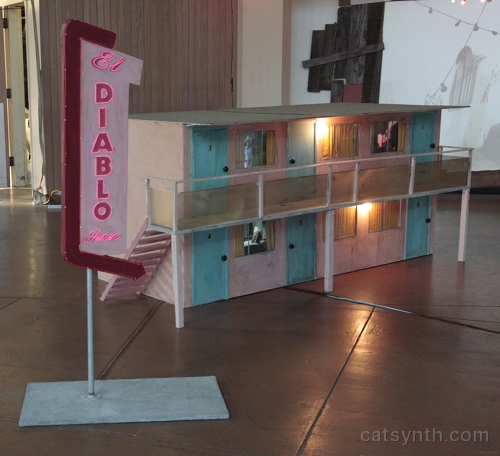
The event took place in the cavernous space that used to be a Barnes and Noble in Jack London Square in Oakland. There was a large screening area as well as several installations arranged around the space. The most captivating installation was Tracey Snelling’s Bordertown. She created a series of models at different scales that one might see in a small town in rural California. The scales range from life size in the “Maria” ice cream cart to a miniature commercial strip with detailed buildings. The entire model fits on a large table, but when photographed up close, one loses the sense of scale and the town seems like it could be a life-size model. One could spend quite a bit of time examining all the details, the buildings, the objects inside of them, and signs on the sides.
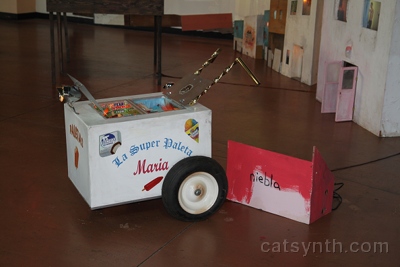
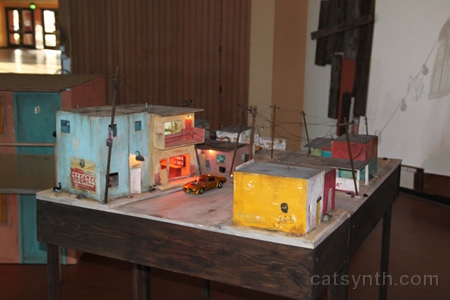
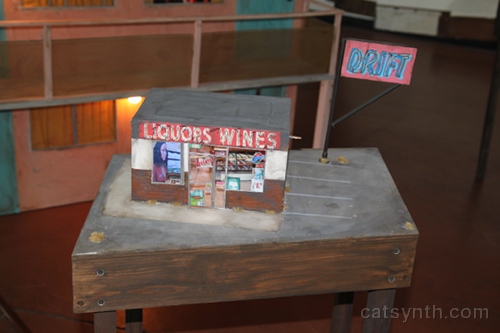
[Tracey Snelling, installation views. Photos by CatSynth (click to enlarge)]
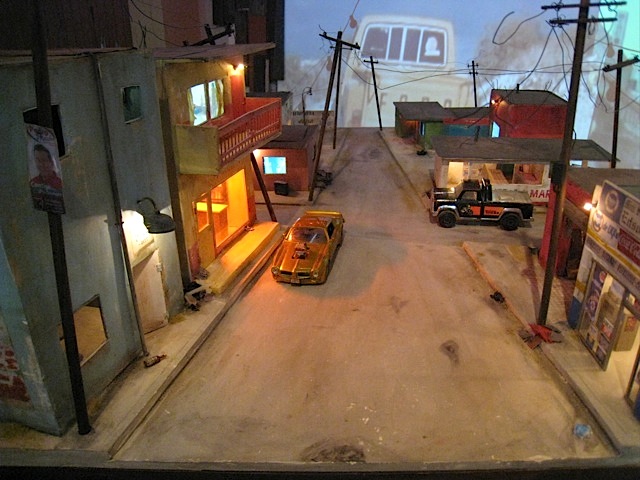
[Tracey Snelling, installation view.  Photo by Michael Zelner (click to enlarge).]

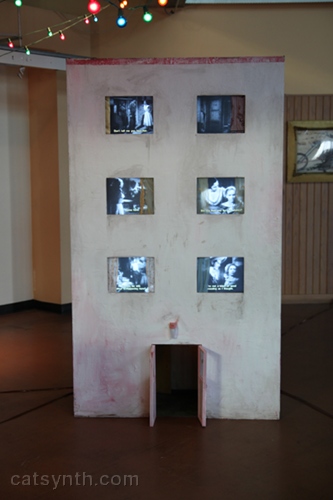
Several of the pieces incorporate video, such as the “El Diablo Inn” with videos playing in each of the rooms. The larger apartment building had movies playing in each of the windows, and videos of scenes from U.S.-Mexican border were projected onto a full-size screen behind the installation.
Although Snelling’s installation captures a small border town rather than a large urban area, some of the elements that she focuses on, such as industrial buildings and somewhat seedy spaces are similar to those that drive my current interests in urban photography. Urban photography was, however, the central focus of Idan Levin’s photography, which included scenes of colorful city buildings in Japan, industral lots and highway overpasses. As he states, “I prowl the streets at night, seeking a unique vantage point from which I can capture an alternate view of the world…”. He describes this view “prying, mysterious, lonely, and sometimes resembling a sci-fi post-apocalyptic cinematic scene.”
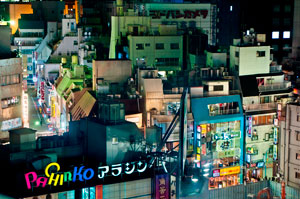
[Idan Levin, Tokyo Scape #1]

Only a few of his images were on display, but I encourage readers to visit his online portfolio.

Michelle Lewis-King’s installation featured projected video onto two cut-outs of female figures.
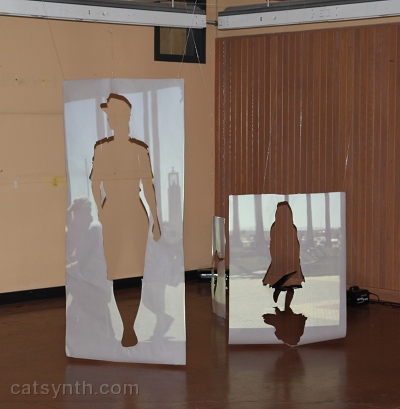

[Michelle Lewis-King, installation view. Photo by CatSynth (click to enlarge).]

The combination of the video and the empty space of each figure made it seem like both the adult woman on the left and the young girl on the right were present in the environment of the video.

The Expanded Strangelet is an electronic improvisation group founded by Lucio Menagon. He was not with us for this performance, hence the “minus one.” But we did have myself, Matt Davignon, Wayne Grimm, John Hanes, Suki O’Kane, Jonathan Segel, and Michael Zelner. I have played with them before at last year’s Oakland Underground Film Festival, and once again I had my minimal setup if iPhone and Korg Kaoss Pad.
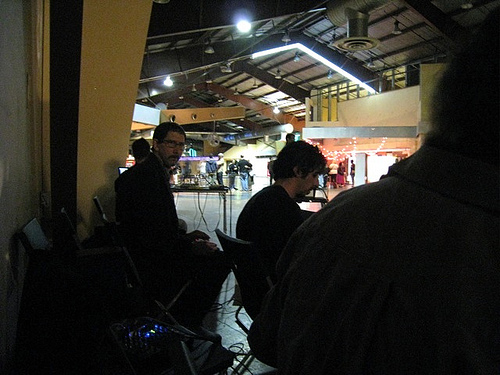
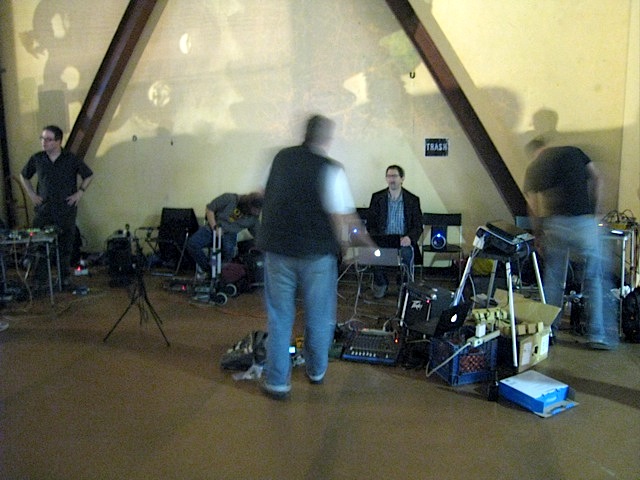
[Expanded Strangelet Minus One.  Photos by Michael Zelner (click to enlarge).]

With Suko O’Kane conducting, we performed an improvised set of exactly 45 minutes, with various duos and solos, and sections with low drones and high staccato elements to provide some texture and an arc.

During the performance, we also projected videos onto the wall, and floor, and even onto people who walked by. We projected my video of Luna from the Quickening Moon Concert onto the floor, and at times it was appeared on the clothes of people nearby:
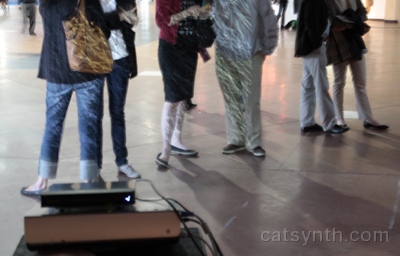
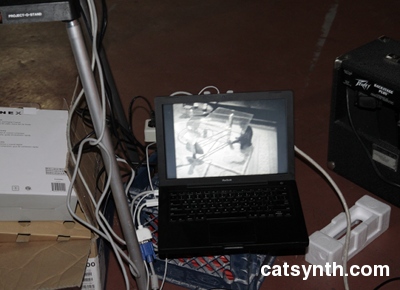

[Click images to enlarge.]

Our performance was preceded by a pair of bands from Bay Area Girls Rock Camp, including the band Poison Apple Pie. The local nonprofit program “aims to empower girls through music education, promoting an environment that fosters self-confidence, creativity and teamwork.”

There were numerous short firms and videos shown as well, including work by the Cinepimps and others.
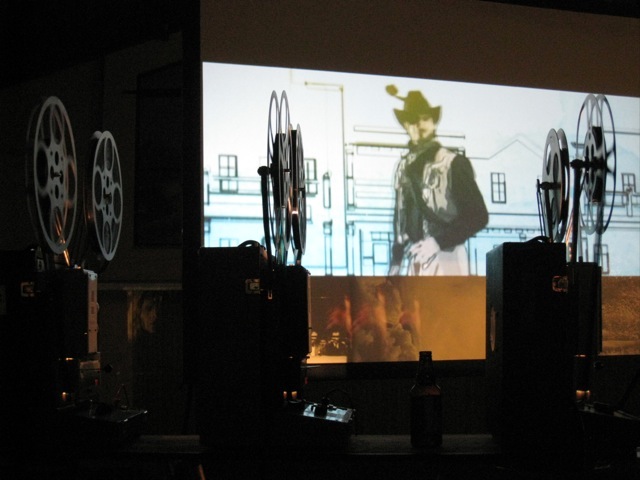
[Cinepimps.  Photo by Michael Zelner (click to enlarge).]

Please visit the event site for a full rundown.

Weekend Cat Blogging #265: Health and Creativity

The themes of this month here at CatSynth are health and creativity, and we reflect on those themes for Weekend Cat Blogging.

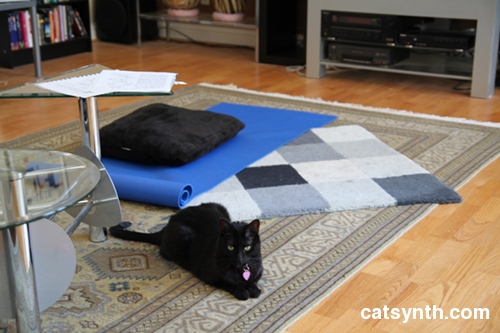
We have started a recent phase in our beginning yoga practice centered on opening up creativity, prosperity and opportunity.  It is of course also good exercise and helpful for health and well being.  Luna enjoys joining in, too:

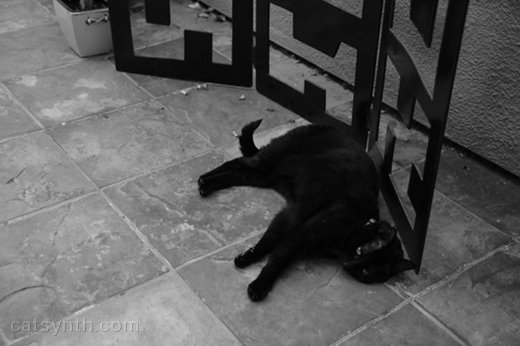
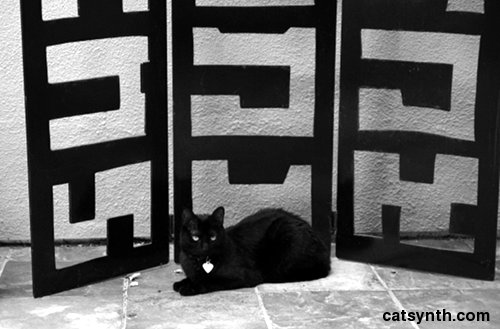
Photography continues to be a central form of creative expression, even as I need to balance it with music, especially with several more shows coming up this month.  Luna obliged me earlier this week by posing in front of one of the patio sculptures on a warm afternoon:

I got several great photos from this session, one of them appeared earlier this week during Wordless Wednesday.  Here is a small version, but readers are encouraged to check out the larger version in the WW post.


Weekend Cat Blogging #265 will be hosted by Jules and Vincent. Because of the Independence Day holiday here in the U.S., the roundup will be up on July 5.

The Carnival of the Cats, will be up tomorrow, July 4, at Mind of Mog.

Nikita Cat will be hosting the monthly Bad Kitty Cats Festival of Chaos on July 4 as well.

And the Friday Ark is at the modulator.

Zecca and Frazier, Gallery 16 – and Views of the City at Artist Xchange

A few weeks ago I went out to a couple of openings on a night when I thought I wouldn’t. But after a little bit of rest I was ready to venture out into the still bright and unusually warm evening.

First up was Gallery 16 for the opening of an exhibition featuring the work of Alex Zecca and Suzanne Frazier.

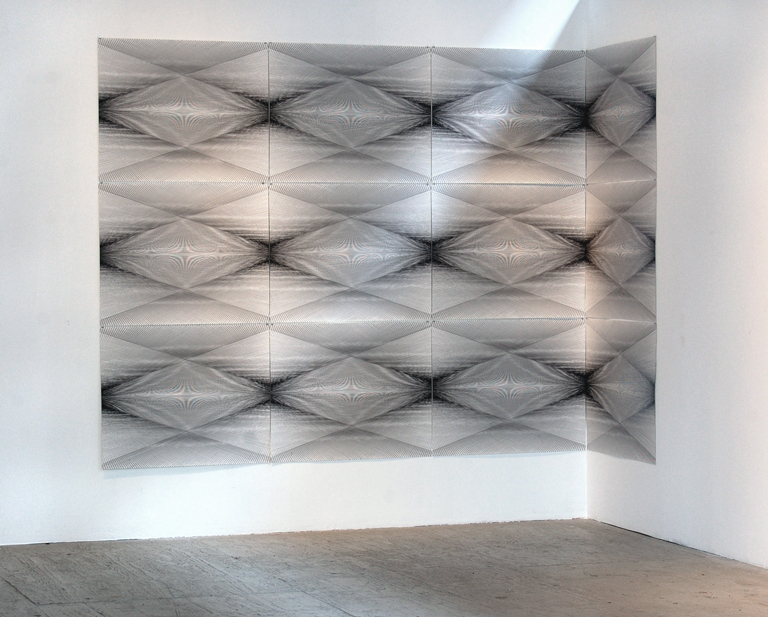
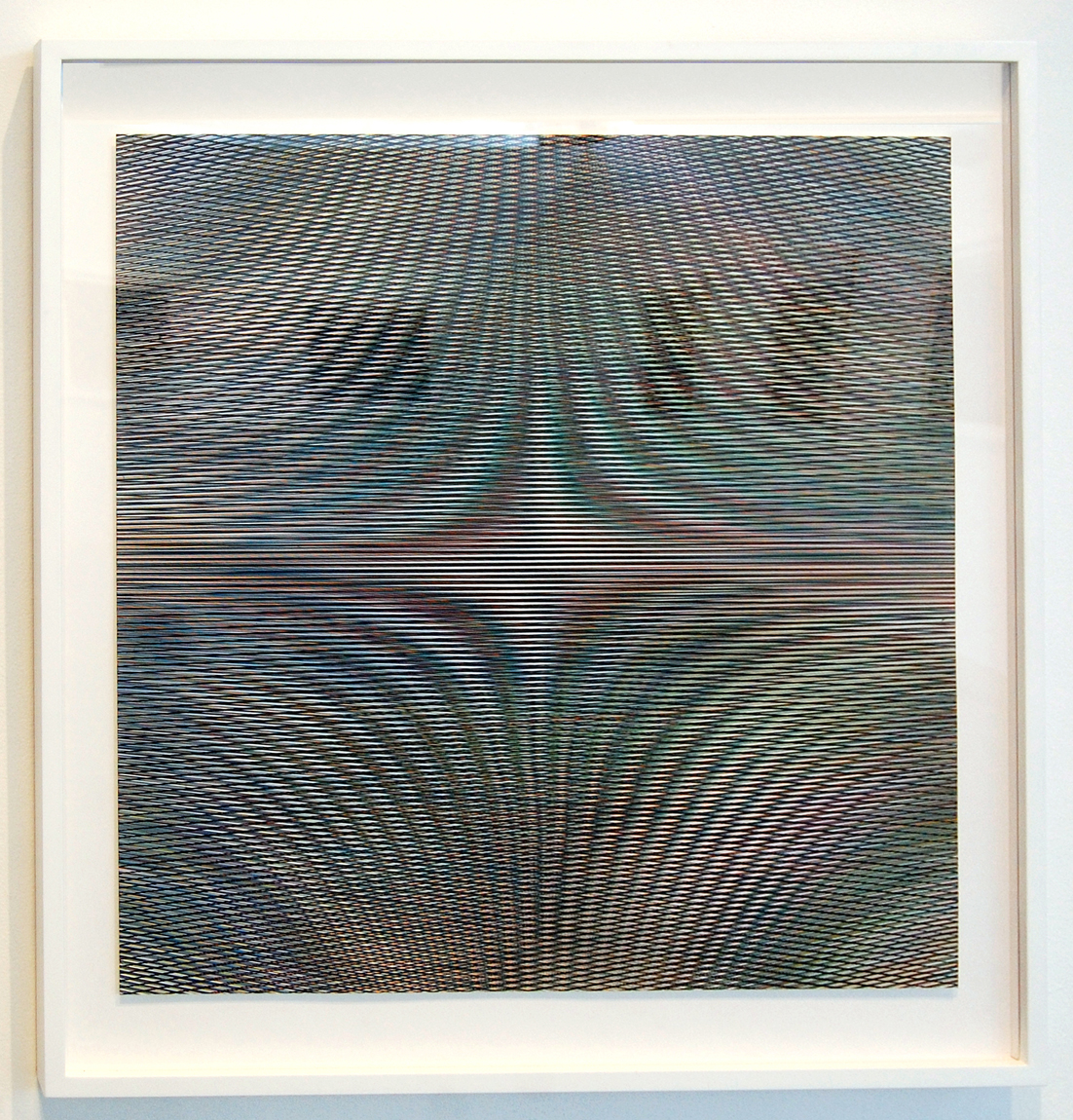
Alex Zecca’s large scale works are composed of thousands of straight lines meticulously drawn in ink. The pieces emerge from the interactions among all the lines. As the artist states, “Color, mixing, reaction and saturation, as well as sequence and systems are the visual dialogue central to my work.” It is hard to imagine the amount of work (physical and metal) that goes into creating something like this.

Some of the works were single color, in which complex images emerge from the density of intersecting lines as well as the angles at which they cross. My favorite pieces in the exhibition were the monochromatic series JANUARY 26, 2010.


[Alex Zecca. JANUARY 26, 2010. Courtesy of Gallery 16, San Francisco CA. (Click to enlarge image)]

Each of the twelve sections contains 1260 lines out of which the overall geometric texture of diagonal lines and curves emerges, as well as a texture that resembles interference patterns in optics. Color adds an additional dimension to some pieces, such as FEBRUARY 5, 2010. In the piece, the interference patterns are the central element created by the lines, with complex and subtle color transitions at odd locations within the overall image.


[Alex Zecca. FEBRUARY 5, 2010. Courtesy of Gallery 16, San Francisco CA. (Click to enlarge image)]

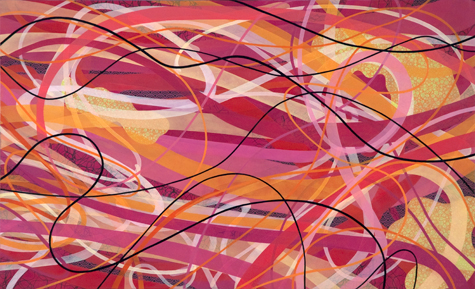
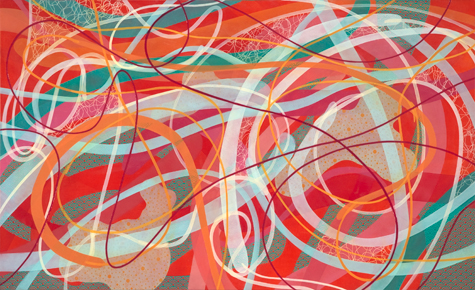
The paintings in Suzanne Frazier’s Tidelog series with their thick curving shapes and bright colors seem very different at first, but they also follow a very meticulous (and time-consuming) process. Frazier was inspired by the entanglements found along the northern California coastline. She made photographs of masses and strands of kelp, projected the images onto the wall of her studio, and then traced the shapes onto acetate, which she then cut out and used as an “alphabet” from which to create the paintings. The results are paintings whose colors and overall composition are abstract, but whose components are shapes from nature.


[Suzanne Frazier. Tidelog #9. Courtesy of Gallery 16, San Francisco CA. (Click image to enlarge)]

While creating the paintings, she also found that the spaces between curves were themselves interesting, and filled these very various textures of dots, crossing lines, etc. Thus, just as with Zecca’s ink drawings, one is compelled to look closely at these paintings to see the detail. Indeed, it was the detail that particular drew me to certain works in the series, such as Tidelog 7 and Tidelog 9.


[Suzanne Frazier. Tidelog #7. Courtesy of Gallery 16, San Francisco CA. (Click image to enlarge)]

The exhibition at Gallery 16 will remain up through July 16.


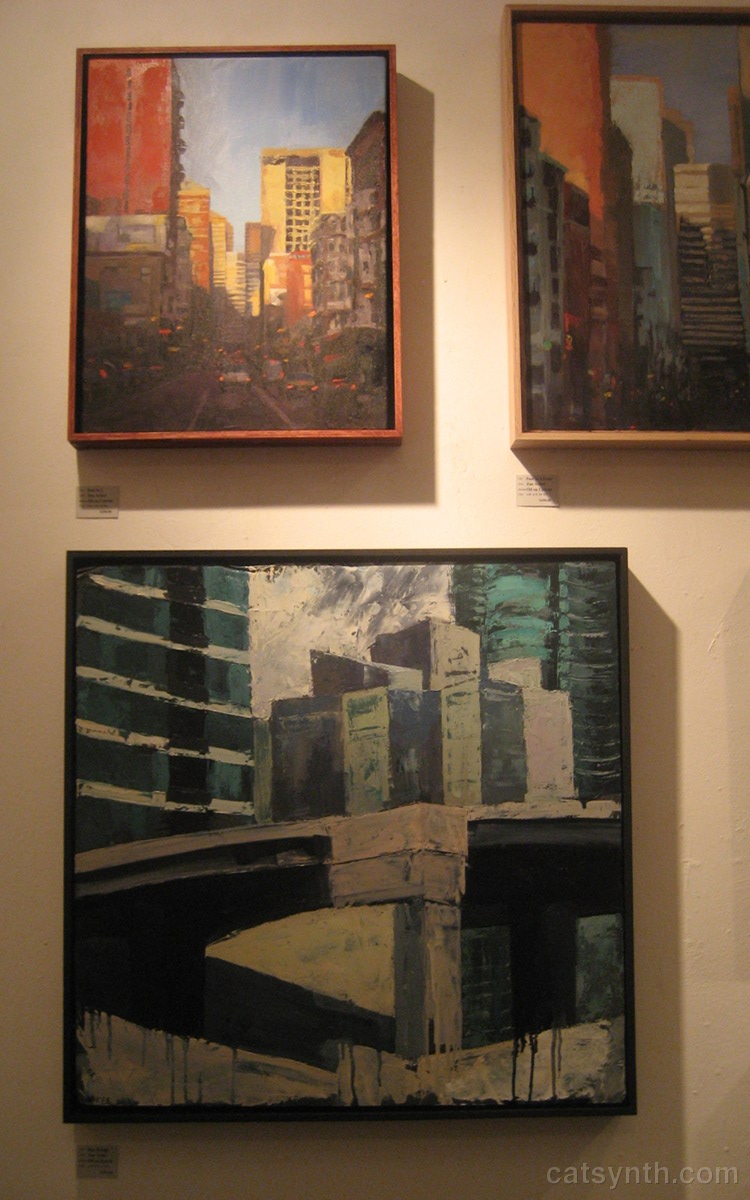
Next, it was off to Artist Xchange for the “Views of the City” show. Regular readers know that views of the city (or of cities in general) are central to my own artistic output as well as what I look for in others. I do tend to look for more unique views of the city, less traveled neighborhoods, unusual perspectives, or spaces and details that are otherwise overlooked. It is too easy in a city like San Francisco to fall into the trap of producing postcard images or trite pieces that would look at home in a souvenir shop, and several artists in this exhibition did just that. But several artists did express unique views of the city that caught my attention.

Sonja Navin was back with her views of familiar highways such as I-280 and side streets around the city. We have reviewed her work before, including her exhibition back in March. Complementing Navin’s work was Zue Acker, who presented her own highway painting as well as images of downtown city blocks were familiar to me as a resident. Indeed, her painting empty downtown – long shadows is exactly the same location as one of my Wordless Wednesday photos!


[Zue Acker. Installation view at Artist Xchange. (Click image to enlarge)]

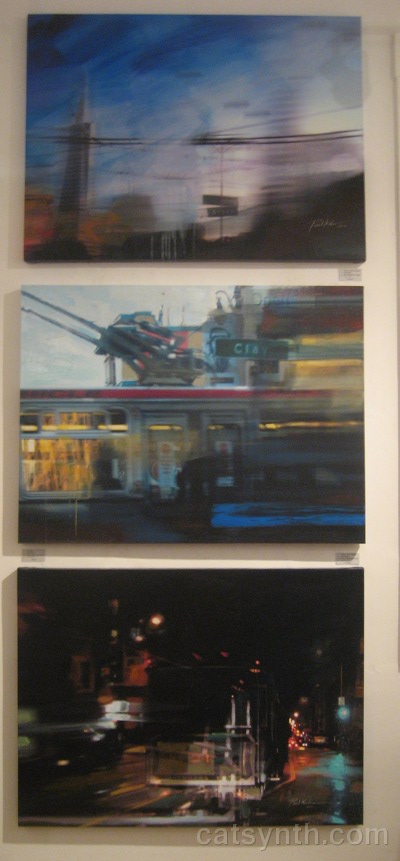
Paul Kirley captures the city in mid motion, such as his painting Clay Bus showing a Muni bus moving along Clay Street. He refers to these works as “Mixed Photo / Paint Dreamscapes”, blending expressive paint and photographic compositions together on a single canvas. Rather than paintings of blurred or modified photographs, the painting itself becomes the process that causes the photographic images to blur and disintegrate in places.

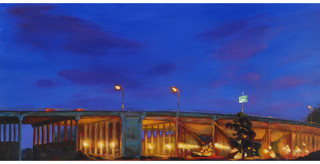
Elizabeth Geisler’s cityscape images included locations or views in the Bay Area that I did not know well, such as the Richardson Bay Bridge near Sausalito.

[Elizabeth Geisler. Twilight (Richardson Bay Bridge)]

Finally, Joaquin Sorro’s Dolores was a fun piece with buildings and trees at add angles, and seemingly in mid-motion as one might find in a comic book. In fact, his image reminded me of some of the experimental comic art I have been reading about recently, but which will remain a topic for another day.

Emergency (X)tet, Meridian Gallery (and The Candy Store)

Last Saturday I attended a performance of the Emergency (X)tet at the Meridian Gallery. Unlike a normal string quartet or quintet, the number of performers in the (X)tet is variable. And on this particular evening X was equal to 7, with Adria Otte, Angela Hsu, and Jonathan Segel on violin, Bob Marsh and Doug Carroll on cello, Kanoko Nishi on bass koto, and Tony Dryer on contrabass.

All Emergency (X)tet performances involve free improvisation. But like all good free improvisation, a structure emerges within each piece. Some sections focused on short tone bursts, others on long harmonics, and others on extended techniques such as striking the body of the instrument. I particularly noticed the use of “prepared violin”, in which objects were inserted between the strings of the violin to change the timbre and performance characteristics (similar to a prepared piano). At various points the violins as well as the contrabass were all performing with various rods inserted in between the strings.

In the second half of the performance, the string (X)tet was joined by Kinji Hayashi performing butoh dance. Butoh dance emerged in post-World War II Japan. Most performances of butoh that I have seen involve very slow and deliberate motion, usually in white make-up and has an overall dark or absurdist theme. As with the purely instrumental pieces, the dance movements were improvised in response to the music, but it had an overall structure. Hayashi first emerged from the hall covered in newspaper, forming a sort of a sort of “newspaper monster” or large mass moving slowly. Every so often, one could glimpse his hands or face underneath.


[Click to enlarge image.]

The slow movements were punctuated by dramatic or even comical fast motions (at one point, an audience member’s purse was pulled underneath the newspaper). As the piece unfolded, more and more of the newspaper was cast away to reveal the dancer in full traditional costume, with dramatic movements along the full length of Meridian’s performance space. As with many improvised pieces, the ending came at an unexpected moment.


On display at the Meridian Gallery during the performance was the exhibition The Candy Store featuring the work of John deFazio and Leigha Mason. DeFazio’s 100 Xerox collages based on cantos from Dante’s Divine Comedy was on display in the music room, and was probably the closest aligned to my artistic interests, featuring graphic and text images in black and white. Some were abstract, some featured cultural or historical references, others included disturbing imagery. He also designed several large funerary urns with very whimsical designs dedicated to mythical figures as well as popular culture. The title piece for the exhibition was Mason’s life-size candy shop installtion. The resin and sugar objects are bright and translucent, and seem very inviting, until one gets closer and sees the hair and fingernails embedded within. Mason seems to play upon this mixture of invitation and revulsion, which also was apparent in her accompanying drawings that featured children with grotesque faces expressing joy, perhaps that of “kids in a candy store”.

Garden of Memory 2010

This past Monday on the Summer Solstice I once again attended the annual Garden of Memory at the Chapel of the Chimes in Oakland. This year, I was going not just as an audience member and reviewer, but also to participate with the Cornelius Cardew Choir, and also ended up playing in an impromptu electronic improvisation.

Being practical, I first crossed the building to where the choir was located to check in and drop off a few things. On the way I encountered Randy Porter’s “one man orchestra” featuring prepared guitar, brass instruments and tubing. This was a fun performance to watch, and it did not escape me that there were a lot of kids watching him, too.

After dropping off my stuff, I wandered around the corner following some strong bass tones that echoed around the hallway. In one of the side chambers, Beth Custer was performing clarinet. She produced a variety of standard and extended-technique tones. I was wondering if she also was going to perform using the array of other wind instruments behind her. I continued to follow the resonant bass sounds and in a side room found Thomas Dimuzio performing dronelike sounds with guitar and effects. This section of his performance had long tones with heavy distortion and bass undertones that were the source of resonances in the main hallway. I sat to listen for a few minutes as his tone gradually moved away from distortion towards something more pure sounding. Nearby was an outdoor patio, where Orchestra Nostalgico was playing minor-key jazzy music that reminded me a bit of klezmer.


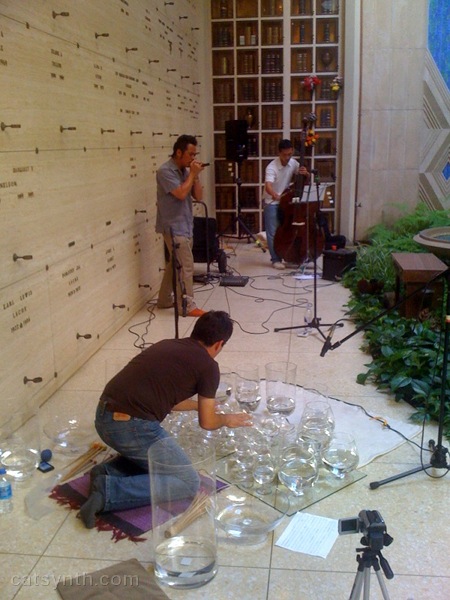
[Schocker, Ueno and Fong. (Click to enlarge)]

One of my favorite new performances this year was the trio of Ken Ueno, Adam Fong and Edward Schocker. Ueno’s expressive and virtuosic vocals, which focus on a variety of extended techniques, blended well with Schocker’s performance on glasses and Fong’s bass. For example, Ueno’s vocals used techniques like throat singing with strong resonances, which complement harmonics on the bass. The sounds were more delicate at times, but the performance an aggressive, harder sound overall which I found welcome. It is interesting to note that they were situated in the Chapel of Tenderness.

Maggie Payne had an installation in the same room as last year, once again making use of the fountain and other elements of the room. Next door was the Crank Ensemble, who were getting started with a new piece as I arrived. The instruments cover a wide range of sound-generation techniques and timbres, but they are all hand cranked. As such, they tend to produce regular rhythms of repeating notes and different rates. The piece began with some slow patterns of metallic and plucked sounds, but as more performers came in it got increasingly complex, with faster rhythms and more variety. One thing that is always readily apparent is how much physical effort it must take to operate some of those instruments, especially given the repetitive nature.

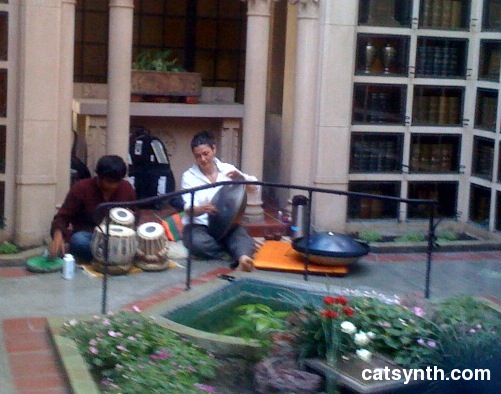
An equally rhythmic but very different performance was unfolding in the Chapel of Eternal Wisdom. Laura Inserra performed on an instrument called a hang, a large tuned metal pod set against a percussionist with three tablas (as opposed to the standard two). The duo quickly built up complex but meditative rhythms. Interestingly, there was another hang performance nearby (I am not sure which group this was, however).


[Laura Inserra. Hang and tabla performance. (Click to enlarge)]

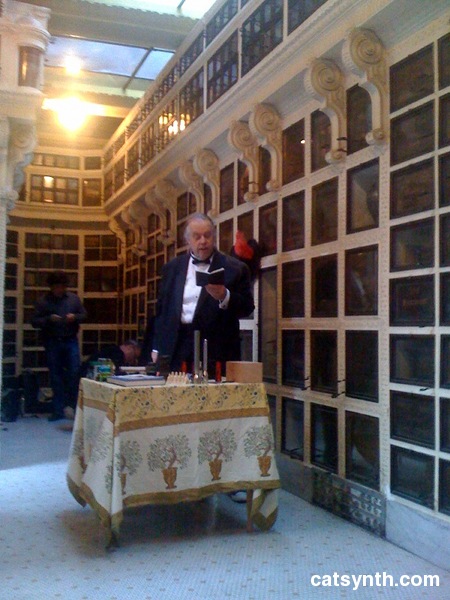
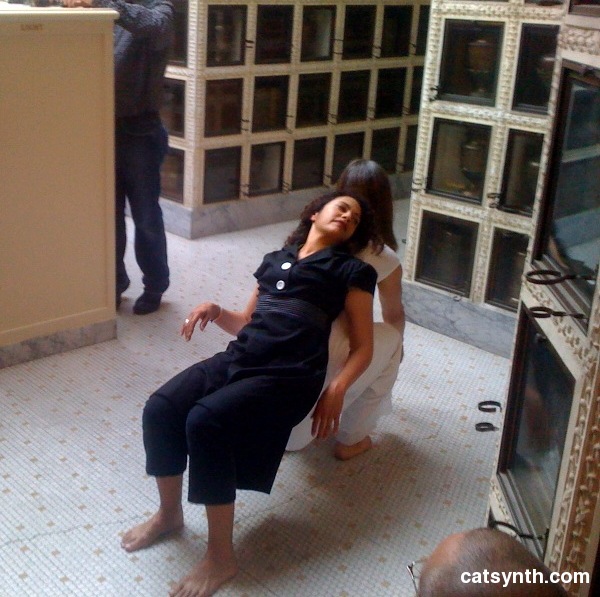
In the columbarium, a heard a performance of Gino Robair’s opera I Norton. I had seen a large production of the piece at least year’s San Francisco Electronic Music Festival. This performance once again featured Tom Duff in the role of Norton I, “Emperor of the United States and Protector of Mexico.” Robair performed with a small custom electronic instrument alongside a Bleep Labs Thingamagoop (I do want to get one of these at some point), with small portable speakers and taking advantage of the acoustics of the stone room. This performance also featured dance elements, and the two dancers also provided theatrical supporting vocals.


[Scenes from Gino Robair’s I Norton. (Click images to enlarge.)]

Wandering back I heard Theresa Wong performing cello while singing a blues song. I have heard her perform cello both solo and in ensembles on many occasions, but had not heard her sing blues before. I then walked by another performance featuring cello. Albert Behar and the Movement combined cello with electronics to produce ambient music that sounded like a score for a film.

I passed by a trio with our friends Tom Djll, Karen Stackpole and Ron Heglin. The combination of brass (Djll and Heglin) with Stackpole’s trademark gongs seemed like it would be quite a contrast, but at this particular moment, the short tones on the gongs and the bursts from the trumpet and trombone seemed to match in overall contour if not in timbre.


[Cornelius Cardew Choir. (Click image to enlarge)]

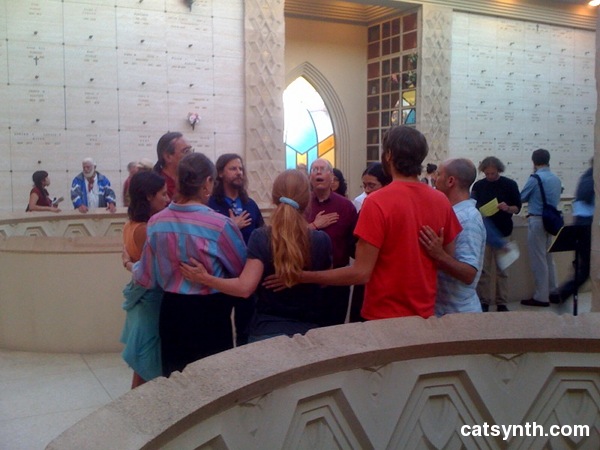
It was then time for my first shift with the Cornelius Cardew Choir. We were performing a four-hour version of Pauline Oliveros’ The Heart Chant, in which performers enter and exit a circle, and while joined with others sing long tones on a steady pitch in between breaths. This turns out to require a lot of energy, singing a series of long tones for about ten minutes, especially for someone who does not do a lot of singing. I did my best, and also simultaneously listened to the sounds of the other voices and the overall harmonies. My favorite moment was when the harmony evolved organically into a steady perfect fifth. The overall quality, while very focused on the body and breadth, was meditative and calming. The piece is supposed to be one of healing, and I used the opportunity of this performance to send healing vibes to someone who needs them.

At sundown, around 8:30PM, we led the annual ringing of bells, as part of Brenda Hutchinson’s Daily Bell project, which started in 2008 but continues every year. At 8:32PM bells started ringing throughout the main hall, gradually getting louder as more people joined in; and then a minute later, it came to an end.

After sunset, I wandered down to the Sanctuary, a small dark room, where Sylvia Matheus and Thomas Miley were performing a large and richly textured electronic improvisation with a mixture of synthesized sounds and vocal samples. Gino Robair had joined in with the instrument he had used in I Norton, and at Matheus’ invitation I joined in as well, using several iPhone instruments such as the Bebot and Smule Ocarina. This spontaneous performance was a welcome coda to this long evening of music.

Weekend Cat Blogging 264: Cats in Santa Cruz

Last weekend I made a brief visit to Santa Cruz (where as many readers know I lived for several years). While walking around with a friend, I was reminded of how many cats are around, in front yards and on sidewalks. Here are a few of them:

This cat appears to be enjoying the plants in this garden, or perhaps something hidden amongst the plants:

Cats are a rarity on my walks around downtown San Francisco, though I occasionally encounter them in the Mission district and in industrial areas.


Weekend Cat Blogging #264 is being hosted by Nikita Cat at Meowings of an Opinionated Pussycat. His dad often takes photos of cats he sees on walks.

The Carnival of the Cats will be up this Sunday at One Cats Nip.

And the Friday Ark is at the modulator.