In this installment of our “primary highways” series, we look at the states of Mississippi and Alabama. In some ways, this is a particularly challenging edition, as I have never personally visited either of the states – in fact they are among only five remaining states I have yet to visit (Kansas, which held its causes on Saturday, is another of the five). So we will do the best we can.
 I did come close to visiting Mississippi in 2006. For one day while I was in New Orleans, I had rented a car to reach places outside the public transportation grid that was still limited after Hurricane Katrina, including the Lower Ninth Ward. I was tempted to get back on I-10 and head east to Mississippi, just to be able to say I was there. But in the end I decided against it. Had I continued, I would have crossed into Mississippi in a sparsely populated area along the Pearl River. To the north of I-10 is the John C Stennis Space Center, where NASA has tested engines for many of our legendary space vehicles including the Apollo Saturn V and the Space Shuttle.

G iven that it is an engine test facility, it’s not surprising there isn’t much of a permanent population in the area. Several communities were removed when it was built, and supposedly a few remnants of the communities, particularly Gaineville, still exist. Indeed, off of Highway 607, the “Shuttle Parkway”, is Lower Gainesville Road, which heads past various space-center complexes towards the Pearl River and ends at what could be the remains of the town.
 Heading southward on 607 from I-10, we eventually reach US 90, which continues along the Mississippi coast through the towns of Waveland and Bay St Louis, which were devastated by Hurricane Katrina. Perhaps the most dramatic example was the bridge carrying US 90 over St. Louis Bay, which was completely destroyed.

It has since been replaced by a new bridge, a graceful flowing structure that has won the American Transportation Award and became a symbol for the region.

[By Frank Kovalchek from Anchorage, Alaska, USA [CC-BY-2.0], via Wikimedia Commons]
US 90 continues along the coast as Beach Boulevard towards the cities of Gulfport and Biloxi. Biloxi is a big resort and casino town on the coast, but it, too, was devastated by Hurricane Katrina. Although it sounds like there is still much rebuilding to be done, many of the city’s casinos have since reopened and landmarks restored including the iconic Biloxi Lighthouse and the Ohr-O’Keefe Museum Of Art that was designed by Frank Gehry. The Ohr-O’Keefe was under construction when Katrina hit and was severely damaged. It ultimately opened in 2010.

[By Woodlot (Own work) [CC-BY-SA-3.0 or GFDL], via Wikimedia Commons[]
South of nearby Gulfport is Cat Island. I thought maybe it had something in common with the famous Cat Island off the coast of Japan, but no such luck. As far as I can tell, there are no cats there, and the name itself was a mistake.

 From the southeast corner of the state, we jump to the northwest corner. Specifically, we are going to a junction outside of Clarksdale where US 61 and US 49 meet. This crossroads is considered by many “the crossroads”, where according to legend blues musician Robert Johnson sold his soul to the Devil in exchange for his musical gifts.

[By Joe Mazzola [CC-BY-SA-2.0], via Wikimedia Commons[]
Legend or not, Clarksdale has a particular association with the blues, and is home to the Delta Blues Museum.
US 49 has long been a major highway traversing the state diagonally. From Clarksdale, it winds its way through the Mississippi Delta, even splitting into separate east and west parts, before leaving the delta and approaching the capital and largest city, Jackson. On the northwest approach to the capital, US 49 carries the name Medgar Evers Boulevard in honor of the civil rights leader who was assassinated in Jackson in 1963. The highway then bypasses the downtown with I-220 and I-20 before continuing to Hattiesburg, home of Southern Mississippi University.
 In Hattiesburg we meet I-59. The drive along I-59 and US 11 to the town of Laurel was recommended to me (actually, the drive south from Laurel to Mississippi State University). In Laurel, I-59 had an unusual S-curve that rivaled Dead Man’s curve in Cleveland due to railroad overpasses, but it has supposedly been reconstructed. I-59 continues north to Meridian, where it joins with I-20.
 Briefly leaving the freeway in Meridian, one can take Highway 19 north to the town of Philadelphia, made infamous for the death of three civil rights workers James Chaney, Andrew Goodman and Michael Schwerner. The murders took place off of Highway 19, and it was presumably the route they took to Neshoba County.

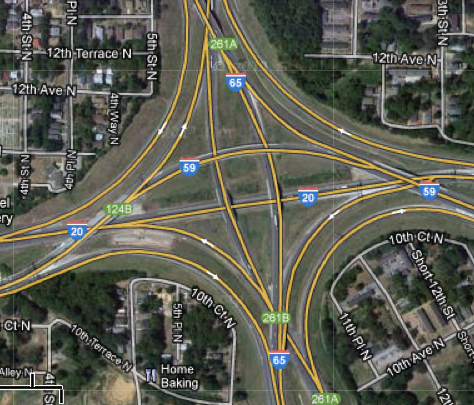
 I-59 and I-20 continue as a single route into Alabama, all the way to Birmingham. It is largest city in either of the states in this article, and is crisscrossed by several major highways. A large interchange between I-59/I-20 and I-65 just west of downtown is known as Malfunction Junction because of the frequent (and unfortunately, sometimes deadly) accidents that happen there.
[Click to enlarge.]
Interestingly, it does not look that complex from a map view, especially when compared to a nearby junction of I-59/I-20 and US 31/US 280. While it does look more complex, it does afford a good view of the city skyline when approaching from the south.
Birmingham has a strong industrial past, especially in iron and steel. Indeed, the Sloss Furnace in the city is one of the few industrial sites preserved as a National Historic Landmark.

[Timjarrett at the English language Wikipedia [GFDL], from Wikimedia Commons]
Visitors can wander and enjoy the site, which features defunct but preserved industrial buildings and machinery. This would be a fantastic place to photograph! I could also see it as a musically inspiring location, for pieces based on metallic resonances. The center does hold concerts, and has a highly regarded program in metal arts. (I wonder if they have arts residencies?)
As has happened with many other industrial cities that experienced long declines, downtown Birmingham appears to rebounding as a residential and cultural center, with lofts and galleries. There is also the restored Alabama Theatre which functions as a performing arts center while retaining many of its movie-palace features, most notably its original Wurlitzer Organ. (It should be noted this is the second Wurlitzer to be featured in this year’s “primary highways” series.)

 South of Birmingham is the town of Selma, which has a storied place in the Civil Rights Movement. A voting rights movement in the town ultimately grew into the Selma to Montgomery Marches in 1965. The marches took place on US Highway 80 heading east from Selma and crossing the Edmund Pettus Bridge.
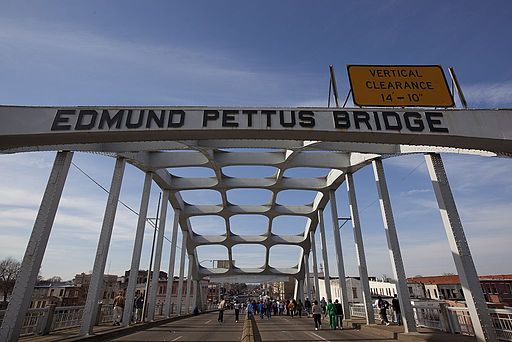
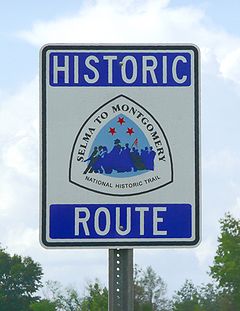
The first march was met by state troopers and the marchers were brutally assaulted. Images “Bloody Sunday” were broadcast nationwide, shocking many and galvanizing support among some for the civil rights movement. Two more marches along the same route were organized. The third march passed the bridge and continued all the way east on Highway 80 to Montgomery. The march then veered north onto the Mobile Highway, parallel to present day I-65, and then along city streets to the state capitol. The entire route is now marked as the Selma to Montgomery National Historic Route.
 From the state capital, one can travel south on I-65 to Mobile and back to the Gulf Coast, where we began. We switch on to I-165 which enters the downtown and becomes Water Street. Heading further south, we come back to I-10, which crosses Mobile Bay on a long causeway. From the causeway, we can look back at the city at sunset.

[Photo by faungg on flickr. (CC BY-ND 2.0)]




 We begin near Cleveland, the state’s largest metropolitan area. I-90 comes in from the east along the shore of Lake Erie. At “Dead Man’s Curve”, the highway makes an abrupt and rather angular turn to the south to become the Innerbelt Freeway along the edge of downtown.


 The most iconic of the many crossings is the Detroit-Superior Bridge carrying US 6 and US 20 across the river into downtown. The name seems a little odd, as we’re not in Detroit and Cleveland is on Lake Erie rather than Lake Superior. But it connects Detroit Avenue with West Superior Avenue and thus the name is quite appropriate. It rises high above the river and is quite picturesque against the downtown skyline.
 Looking towards the lake from this bridge, one sees how closely packed the crossings are, and the diversity of shape, height, function, and level of disuse. In the picture below, we see the blue bridge carrying a major freeway, State Highway 2, beyond that a rail bridge, and in the front the ruins of the older Detroit Avenue viaduct.


 We depart Cleveland continuing on I-90, and then switch onto I-71 to journey diagonally across the length and breadth of the state. It winds through the suburbs, crossing many other highways before intersecting our friend I-80, which runs across the state as the Ohio Turnpike. The Ohio Turnpike is familiar from numerous cross-country trips, with the rolling hills and suburbs giving way to a much straighter road over flat terrain and farmland as one heads west. But in this instance, we continue south on I-71 towards Columbus, the state’s capital and largest city.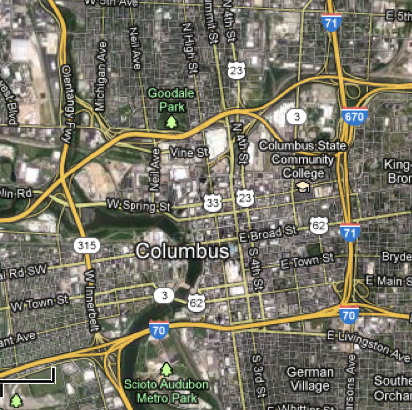


 Columbus is in the middle of the state, and without much to get in the way it has developed the “standard” set of ring roads we see in many cities around the world: an outer beltway (in this case, I-270) and an inner belt around the downtown (a combination of I-70, I-71, I-670 and State Highway 315).


 We begin in the Northeast Kingdom of Vermont along State Highway 114. It winds its way from the most remote northeastern corner of the state and The Kingdom State Forest eventually into the towns and lakes of the region.
 We can follow VT 16 back to Interstate 91, the main highway in and out of the “The Kingdom”. Heading south on I-91, the terrain looks a lot like eastern New York, hilly and forested. We turn off the highway onto US 2 and head west to Montpelier, the state capital. It has the distinction of being the smallest state capital in the U.S.
 It is in Montpelier that we turn onto Interstate 89, which crosses the state diagonally from New Hampshire in the southeast to the Canadian border in the northwest. Along the way it connects the capital to the largest city, Burlington. Although I-89 never enters the city, it is easy to connect to the downtown via US 2.

 Lake Champlain contains several large islands, particularly in its northern half. US 2 traverses most of these, including Grand Isle via a network of bridges and causeways before heading west at the north end of the lake, where Vermont, New York and Quebec all meet.
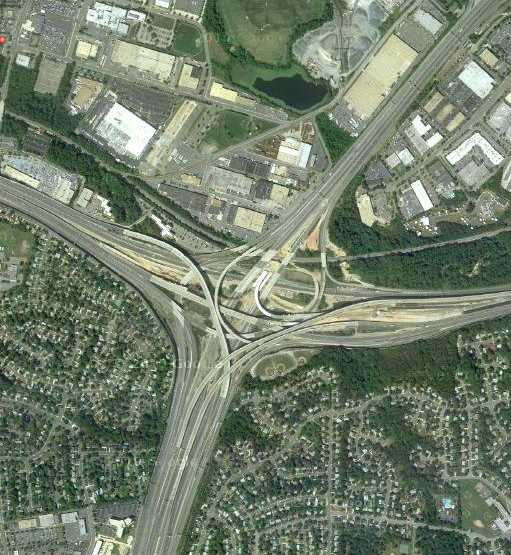


 The Mixing Bowl, also known as the Springfield Interchange, connects I-95, I-495 (the Capital Beltway) and I-395. The latter heads north into the center of Washington DC, while I-495 casts a wide circle through the suburbs. The interchange is complex-looking enough and well-known enough to have even gotten
  We can stay in Virginia on I-495 heading “west” (though what is west on a circular highway?) and turn west on I-66. The highway is quite crowded in the growing suburbs of northern Virginia, but starts to quiet as one moves westward. Along the way, one passes Bull Run and Manassas of Civil-War battle fame. There was not one but two major battles here. I am pretty sure there are more Civil War sites in Virginia than any other state, and many in the northern part of the state like Manassas are likely getting absorbed into the expanding suburbs. I-66 continues west towards the Appalachian Mountains, specifically the Blue Ridge Mountains that form the eastern edge of the range. Before its end, we can turn southward to Shenandoah National Park and tour the Skyline Drive.

 Back on I-64, we can head west onto Interstate 81 which runs along much of the Appalachian Mountains. It passes through hills, valleys and towns along the way, and is indeed a major corridor for the interior eastern US, connecting the northeast with the south. As such, it connects to our next state.
 We continue on I-81 into Tennessee, where it ends at I-40. Here we leave the interstate and head south first on TN 66 and then US 441 to the Great Smoky Mountain National Park. It has the distinction of being the most visited national park in the U.S. It offers great views of the southern Appalachian mountains, both scenic vistas of the mountains and details such as streams and waterfalls.


 Continuing westward on I-40 through the state, our focus shifts to music. Nashville is of course a major music-industry center, both in terms of records and musical instruments, and is synonymous with country music (though in fairness the city is home to other types of music as well such as alternative rock). But I think I would identify more with its neighbor to the west, Memphis. Memphis is home to important early blues, but I think it is the later Electric Blues, early Rock-and-Roll and Memphis Soul (as epitomized by Stax Records) that most interest me – even as a mostly “experimental” composer, the sounds of these genres are a strong influence. I can’t personally speak to an I-40 musical rivalry between Nashville and Memphis, but perhaps some readers may be able to contribute here.
 Indeed, I-40 is named the “Isaac Hays Memorial Highway” on its eastern approach to Memphis. Long before he was Chef on South Park, Isaac Hays was a leading figure in Memphis Soul on Stax. I-40 and I-240 together form a beltway around this city’s outer neighborhoods, but its downtown and many of its most famous landmarks lie further west, between I-240/I-69 and the Mississippi River. Just off this highway south of downtown is the Stax Museum on McLemore Avenue. Further north on off I-240/I-69 is large exit for Union Ave, which carries several number designations all at once (US 51/64/70/79). Union Avenue was once home to Sun Records which produced many of the earlier Rock-and-Roll artists of the 1950s. Union Avenue also provides access to Beale Street.