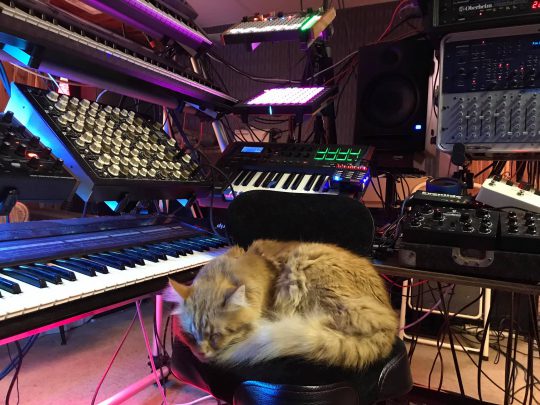
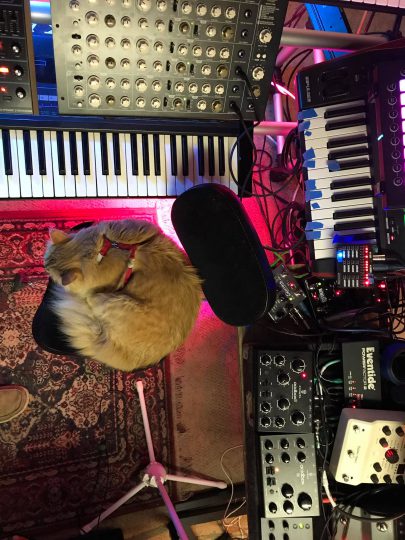
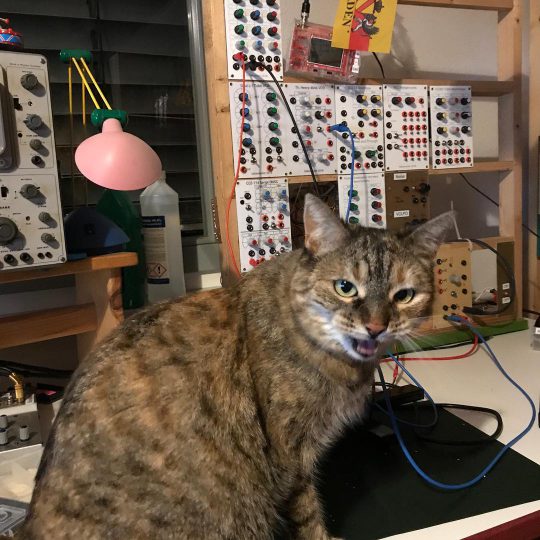
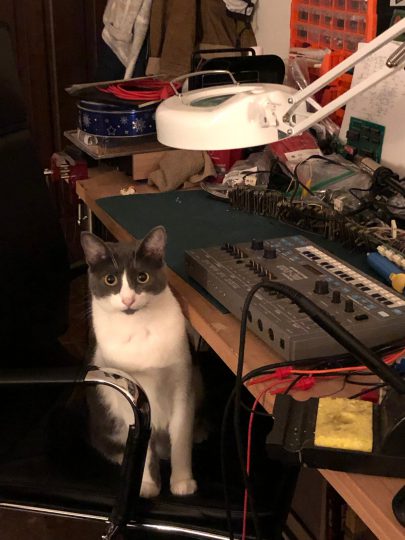
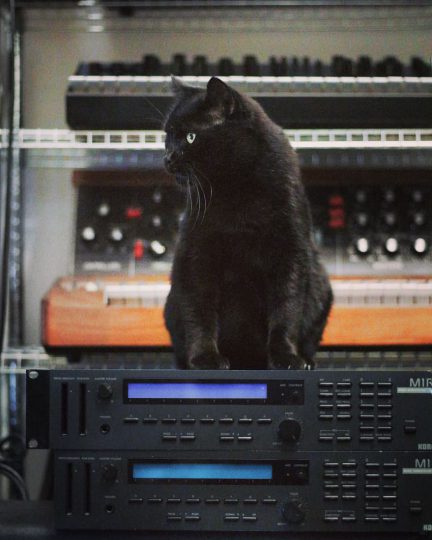
Mr. Maximillion is napping peacefully in the middle of the studio. Identification of the synths left as an exercise to the reader.
From our friend Charles Whiley via Facebook.
I can leave him down here. In fact he finds peace in this room. The others…not so much.
Sam Sam can be found napping in our studio as well. It is, of course, part of her territory, but she sees it as a safe space. If she is particularly anxious, she sometimes hides behind the mixer and equipment rack.
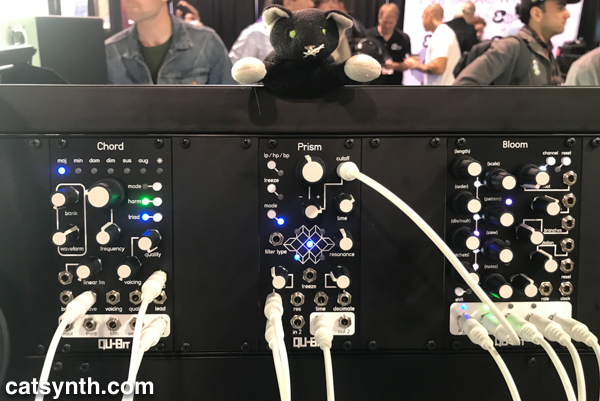
One of our first stops at NAMM 2019 was to visit our friends at Qu-Bit Electronix. This year they had three new modules to share.
The first of the three was the Prism (center in the picture above). It combines three audio processors that are mapped to a three-dimension “prism” control space. One axis controls a comb filter, another a bit crusher, and the third is time/speed control. The audio processors operate on a buffer, which can either be continuously updated from audio input or “frozen” in time and looped. Finally, there is a multi-state filter that can either operate at the beginning or end of the signal chain. Of the three, this one perhaps intrigued me the most with the possibilities of mapping these different functions to CV input (e.g., from a Maths or a sequencer) in ways that push traditional music. You can hear a bit of it, along with the other two modules, in our video which features all three modules.
The second module was the Chord, or rather the new incarnation of the chord. It’s a four-voice polyphonic oscillator with both traditional waveforms (continuously morphable) and a new set of wavetables. The oscillators can be stacked into chords, or in this new version each controlled separately for polyphony in the music-theory sense of the word – yes, with the right sequencer, this module can do four-voice counterpoint. The chord mode includes a variety of standard western four-voice chords (i.e., with a seventh degree), but also the ability to add custom chords that include microtones or dense tone clusters. It’s also more compact than the original, slimmed down to just 14hp.
The final module was the Bloom, a sequencer that could generate variations on the fly using a proprietary fractal algorithm. The amount of variation, from none to completely random, can be controlled dynamically via CV, as can the number of steps in the sequence, for quite a range of variety. And with two channels, it would seem to pair nicely the Chord.
As always, it’s fun to visit with Qu-Bit and see what they up to, especially as they are CatSynth superfans. And we look forward to seeing these modules out in the wild over the course of the year. The Prism is due in March, the Chord in late spring, and the Bloom in the fall.
From polynominaldotcom on YouTube, via matrixsynth.
Just modded and bent the classic M1/M1r wavetable with 6 switches on the back of the machine. 5 sounds demo with circuit bent options. First 3 demo with normal Midi keyboard, In 2 others, the Mi1r is driven by an algorithmic generator module ‘Turing machine’. Generated patterns are midi converted with a Doepfer a-162 cv to MIDI module.
Very interesting to see a Korg M1 and M1R “bent” this way. And if that feline portrait looks familiar, it’s probably because you’ve seen it before. Eric of Polynominal.com and his cat Marcel are good friends of ours at CatSynth, and we have featured many of Marcel’s pictures.
After spending so much time around vintage synths, Gracie is ready to take on the fine art of repairing. From Alsún Ní Chasaide (Alison Cassidy) on Facebook.
Gracie feels ready to take on this broken Roland MC-202. Good luck!!
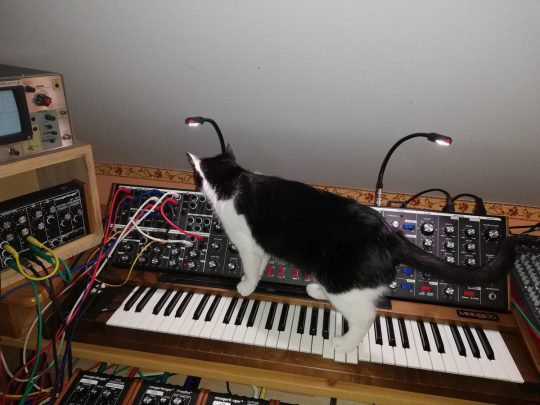
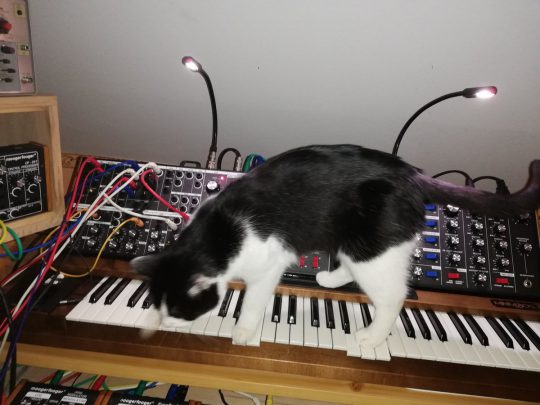
From @ModularSynths (Daniel.ModularSynths) on Twitter, we have this photo of a cat inspecting a MiniMoog Voyager. Specifically, it appears to be the Voyager XL model.
Immer neugierig (Always curious)
IWe are sure this cat is making some interesting music with his curiosity, although the Voyagers are monophonic. So we will only hear one paw at a time.
Please tweet us your cat-and-music @catsynth to be featured in a future post and across our social media platforms.
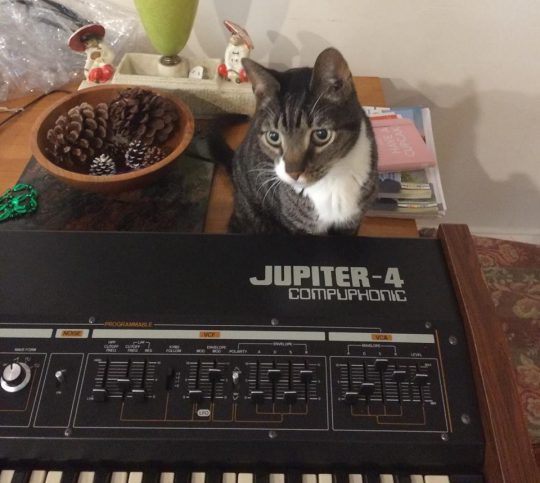
Cat with a vintage Roland Jupiter-4 synthesizer. By Matt Vraja via Facebook.
Jupiter-fur
The Jupiter-4 was a transitional synth in Roland’s early offerings, from the more modular mono-synths to its dominant analog and digital models from the 1980s.
The first Jupiter synth. It was among one of the first poly synthesizers (4 individual voices which could be synced together for one fat monophonic lead), it had a pitch wheel that could be assigned to the VCA, VCF, VCO or all together, there are 8 memory locations and a cool arpeggiator – the arpeggiator can be heard in the Duran Duran classic, “Rio”. It also has a very slow LFO for those ever-so-long filter sweeps. Pretty good for 1978!