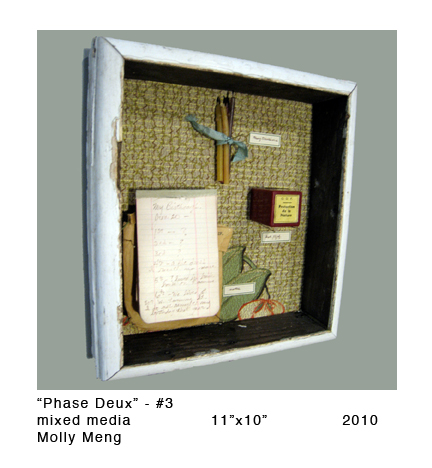
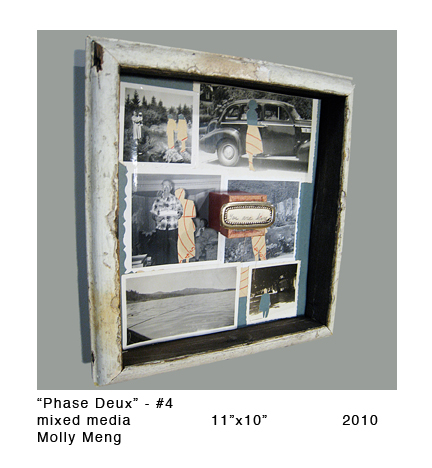
(This image can also be seen on flickr as part of the Wordless Wednesday set.)
I have been meaning to write reviews on some recent exhibitions I have seen set SFMOMA: the selections from Fisher Collection and New Topographics photography exhibition, both of which I have actually seen multiple times. This article covers the Fisher Collection, which will be closing this coming Sunday, September 19.
I have been spending some time thinking about what it means to write “CatSynth reviews” for a major exhibition like this about which so much has already been written. In the end, it’s about personal significance. It was really a microcosm of many of the exhibitions and artists that I have followed or discovered over many years – indeed, the exhibition included artists that i had first discovered through retrospectives at SFMOMA including William Kentridge and Chuck Close, or artists such as Ellsworth Kelly and Sol LeWitt whom I have gotten to know better through the museum’s programs. It is also an opportunity to explore what does (and does not) captivator me with modern art.
One of the things I find most compelling about modern art is the simplicity and sense of calmness I can feel in its presence. This is particularly true of the more minimalist and geometrically inspired works shown on the upper floor of the exhibition. This included those labeled formally as minimalism like Sol LeWitt, but also the large monochromatic panels of Ellsworth Kelly and Richard Serra’s geometric metal sculptures.

[Installation view with Janus by Gerhard Richter (1983) and multiple pieces by Richard Serra. San Francisco Museum of Modern Art.]
There is something about this type of art that I find very comforting, especially in a large scale presentation like this. I can focus on lines and curves and colors and nothing else. I can get absorbed into the repeating variations in Sol LeWitt’s drawings and sculpture, or allow my mind to go blank in Ellsworth Kelly’s simple series of panels. (Perhaps this is what made the placement of Anselm Kiefer’s straw-infused works inspired by the Holocaust in the middle of the same gallery all the more jarring.)

[Ellsworth Kelly, Blue Green Black Red (1996). San Francisco Museum of Modern Art]
Even Alexender Calder’s more organic forms fit into this category and were placed together with the others on the upper floor of the exhibit. It would be interesting to consider Calder’s curving but solid mobiles next to the intricate and delcate straight lines in LeWitt’s Hanging Structure 28c and Antony Gormley’s Quantum Cloud VIII.

[Alexander Calder, Eighteen Numbered Black (1953) . Sol LeWitt, Hanging Structure 28c (1989).]
LeWitt also touches on my interest in mathematics and algorithms (and technology) in art, and conceptual art, most notably in his Wall Drawing, which was created directly on the wall of the gallery in colored pencil from the artist’s specifications.
Gerhard Richter was a bridge between the minimalist and geometric art and the other parts of the collection. His Farben 256 with its array of solid-color rectangles was closer to the previously described works (and although I liked it I couldn’t help but think of a paint chart). Other pieces were more photographic – my favorite of these was Verwaltungsgebaude with its modern arctecture and motion.
The other direction that my artist interests tend is towards urban environments, including graffiti or industrial scenes. Cy Twombly’s large paintings in the exhibition feature repeated curving scribbles that remind me of the graffiti that I often photograph. The white scribbles on gray background in Untitled (Rome) reminded me specifically of walls I saw shooting photos in Warm Water Cove.
Twombly was placed along other works from the middle of the century. A large-scale piece by Lee Krasner was prominently featured (I have yet to see a solo retrospective of her work). A canvas with bright blue by Sam Francis caught my attention. The permanent collection of SFMOMA prominently features works by Richard Diebenkorn, and I think I liked those more than his work in this collection.
In addition to minimalist and geometric works, I also tend to notice art with a playful or surreal nature, or things that are particularly unique. William Kentridge’s installation based on Mozart’s The Magic Flute falls in this category. He built an entire miniature stage with archival photographs and moving images set to selections from the opera. While much more elaborate and complex than the previous works, the performance was still very arresting.
Strictly speaking, there was relatively little photography in the exhibition (although many of the paintings seemed derived from photographic sources). Of the few photographs, the strongest was an image by Sophie Calle which depicted a decaying bed in a courtyard of an apartment building, and was accompanied by a rather morbid story. Another of the featured photos, John Baldessari’s Blue Moon Yellow Window, Ghost Chair was quite painting-like with its extreme contrast and colored overlays.
I certainly did not touch upon everything within the exhibition in this brief review, so those who are interested are encouraged to check out the online exhibition page, or visit if you are in the area in the next five days.
[The photos in this article can be seen on flickr. You can also see photos by others tagged SFMOMA on flickr or via SFMOMA’s online communities page.]
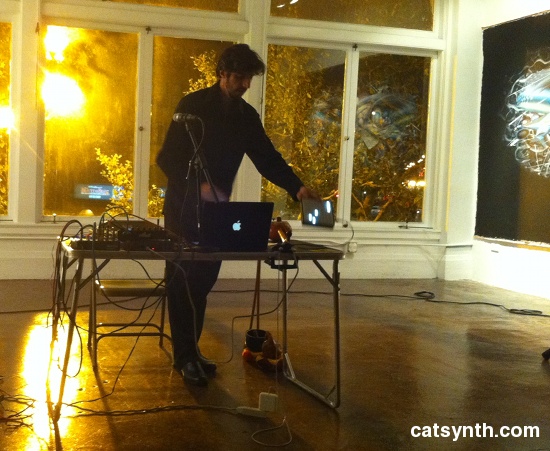
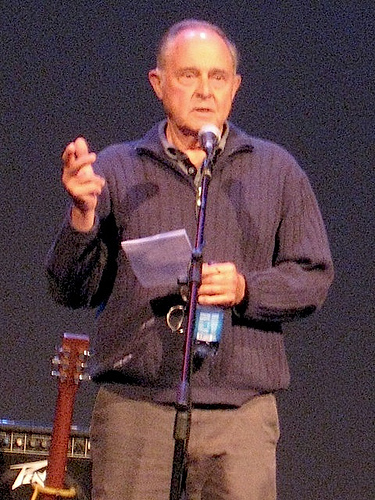
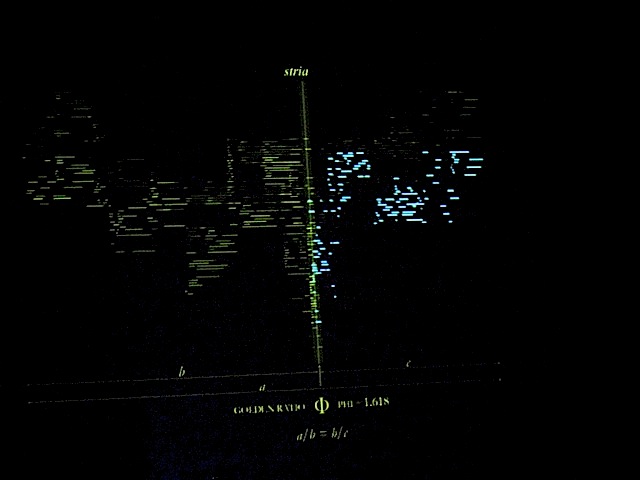
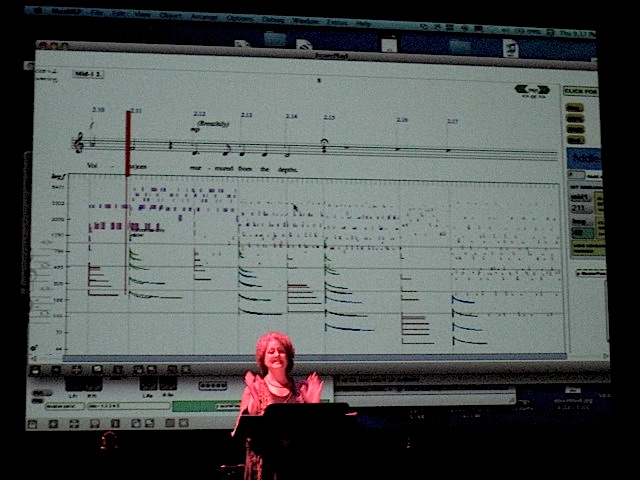
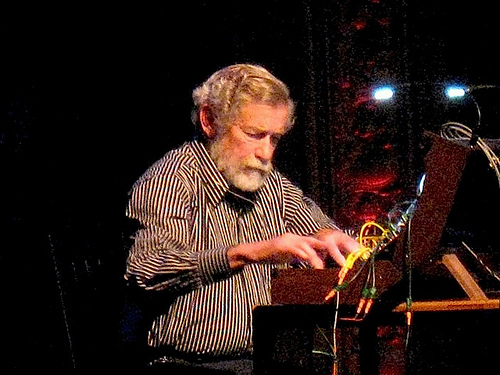
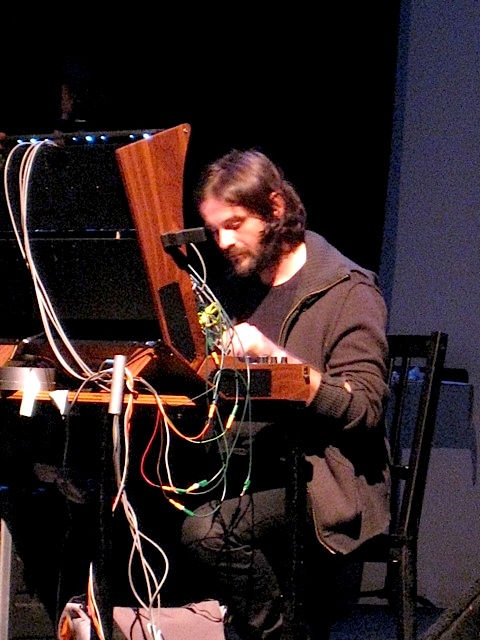
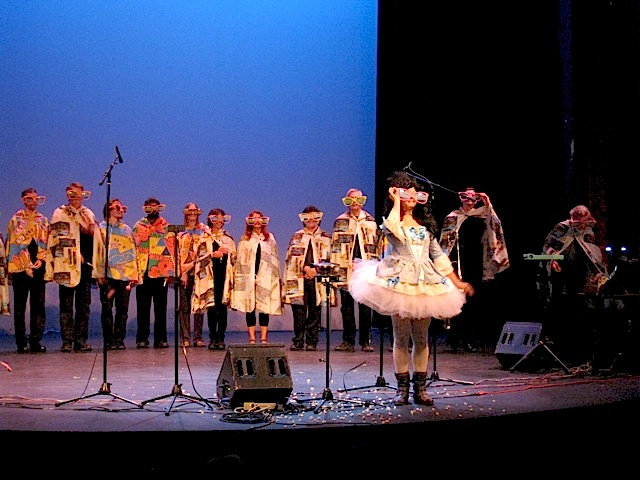
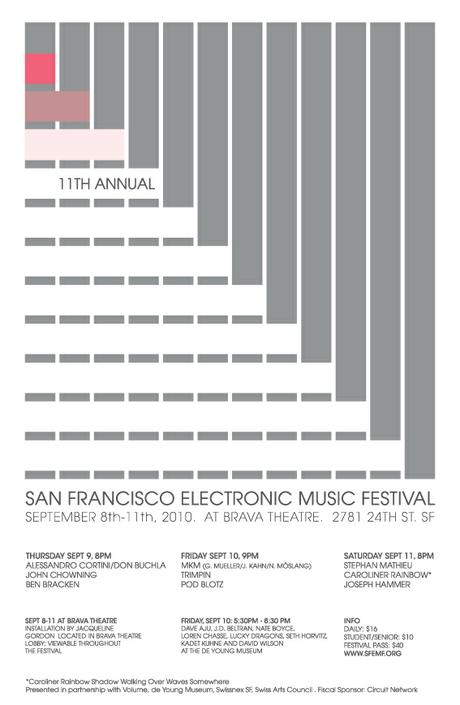
The 11th San Francisco Electronic Music Festival will be happening today through Saturday and I plan to be there for at least the performances tonight and Saturday. Once again, I will be live-tweeting and readers can follow on Twitter @catsynth or via the #SFEMF tag. So those not in the Bay Area can follow along vicariously – though I encourage local electronic-music enthusiasts to attend in person.
The performance tonight includes a collaboration of Alessandro Cortini, whose videos and images we have been featuring here on over the past coulee of months, with Don Buchla. Also performing are another synthesis pioneer John Chowning, and Ben Bracken. You can see the full schedule for the event here.
A week ago I saw the exhibition 0-Viewpoint by Stella Zhang at the Chinese Culture Center here in San Francisco. Zhang is the 2010 featured artist in the CCC’s Xian Rui (”Fresh & Sharp”) series, which showcases “the work of an incredibly talented but under-represented Chinese artist in America.” This year’s exhibition also had a goal of pushing the boundaries of what is considered “Chinese art” and challenging more traditional viewers’ expectations. Zhang was schooled in classical Chinese art techniques, but the contemporary mixed-media installation eschews cultural tradition (except perhaps in some more subtle ways) and challenges the expectations many viewers might have of art and an artist identified as “Chinese.”. 0-viewpoint is also a deeply personal exhibition, in which Zhang “explores the constantly shifting inner landscapes of self and femininity.” Similar to heritage, gender comes with expectations. Confronting traditional expectations of both gender and heritage are topics of personal interest to me, which makes this an appealing exhibition to both see and reflect upon.
The main corridor is covered by a long undulating white canvas, which sets the overall tone for the entire installation: curving forms of white fabric. Indeed, the gallery and all the pieces were almost entirely white. The white seemed to cast a silence over everything, which is both simultaneously meditative and a bit “anxious”. Although the color was uniform, the textures and shapes were quite complex, and in a way the use of white helps focus one on these dimensions instead of on color. It also made it possible to detach from the question of challenging tradition and allow it to fade into the background while focusing on the pieces themselves.
[Stella Zhang, 0-Viewpoint, installation view. Photo courtesy of the artist. (click to enlarge)]
The installation in the first room is a collection of tall rather phallic sculptures. They were slightly higher than human size, and one could walk amongst the irregular arrangement of columns. The irregular shapes suggested something organic, like a forest or sea creatures. But the metal structure underneath the cloth also gave them an architectural feel.
[Stella Zhang, 0-Viewpoint, installation view. Photo courtesy of the artist. (click to enlarge)]
The second room contains an array of small cushion like objects suspended on wires from the ceiling but nearly touching the ground. The forms, which are again made of fabric, are soft and curving and body-like, but are covered in spines made from toothpicks. The combination suggests sea urchins or single-cell organisms. But the shape and texture also seems to play on and challenge stereotypical associations with feminine, e.g., soft curving shapes but then pierced by something more angry and aggressive. Along the edges of the room are small seats, again made from soft fabric but also covered in spines. (I would not be tempted to try and sit on one.)
[Stella Zhang, 0-Viewpoint, installation view. Photo courtesy of the artist. (click to enlarge)]
Towards the end of the gallery, the long canvas that covers the corridor descends to the floor and then comes back on the floor ending in a somewhat mysterious hole big enough to crawl through. Nearby, a video was projected onto the ground showing an image of swirling smoke or vapor with ethereal dreamlike music. The music was mostly in a minor mode, but with slightly unsettling tones in the middle section.
Arranged along the corridor were a series of twelve panels suggesting the twelve signs of the zodiac (one of the few overt nods to Chinese tradition). Each of the white panels had a shape made of sand. Although the material was different the shapes seemed related to other parts of the installation: round curving but somewhat elongated with irregular holes.
[Stella Zhang, 0-Viewpoint, installation view. Photo courtesy of the artist. (click to enlarge)]
The afternoon included a dialog with the artist, in which we learned a bit about her journey that included growing up in Beijing in a family that encouraged her to pursue art; the culture shock and growth of her time studying and working in Japan; and then settling in the United States. I also had a chance to view the documentary on the making of the exhibition, which was presented as part of a dialog and discussion with the artist. An excerpt of the documentary is online, and presented below:
Stella Zhang, 0-Viewpoint from Jim Choi on Vimeo.
It was interesting to see the physical process that goes into making the work, welding metal frames, gluing fabric and manually inserting the skewers into cloth. The full documentary also explores the tensions of the work, such as there was between Zhang and curator Abby Chen around the piece with the suspended cushions and wooden skewers. There was also a phrase that Zhang applied to herself, “trapped in a box”, that a viewer in the video later ascribed to Chinese art and culture as a whole. This phrase intrigued me, but there wasn’t a chance to follow up further.
0-Viewpoint will be on display at the Chinese Culture Center through September 5.
Last Thursday I participated in Instagon 543 at the Luggage Store Gallery in San Francisco. Instagon is an improvising ensemble where the personnel change every time, i.e., no two performances contain the same group of people. In addition to myself and Lob, the group’s founder, this version included Lena Strayhorn, Mark Wilson (aka “Conure”), Alan Herrick, Martin of Vernian Process, and Blancahillary (aka Hillary Fielding).
I had brought instruments from opposite ends of the size spectrum: the Nord Stage and the iPhone 4, on which I played the Smule Ocarina and Leaf Trombone apps, as well as Bebot and Nlog which I have used in previous performances. Lena Strayhorn had acoustic instruments (to be played into a microphone) including a flute and a large one-of-a-kind kalimba-like instrument. Mark Wilson had a large array of electronic sound sources and effects, Alan Herrick performed via laptop, Martin and Blancahillary played guiltar; and Lob played bass and the main mixing board.

[Photo by Yvette Lucas, via Lob]
Basically, everyone was improvising independently, with Lob controlling levels via the mixing board. As he brought performers in and out of the mix, everyone was (presumably) listening and adapting their performances, which turn may or may not be presented in the mix. Thus there was a complex feedback loop with the live mixing and the instrumental improvisations.
Musically, the overall the theme was “drones and creepy.” As such there were lots of long, drawn-out tones from everyone, with periods of noise and static, heavy distortion or large tone masses. I used the electric piano on the Nord to contribute to the “creepy” theme, with augmented chords and effects that resembled a 1970s horror-film soundtrack. It was in fact hard to sometimes hear who was performing what, although Lena Strayhorn’s acoustic instruments were quite distinctive, and Blancahillary’s guitar playing was more staccato. I found that the Ocarina iPhone app was picking up and responding to the ambient sound from the speakers, so I spent a fair amount of time with it, bring the iPhone closer to the speaker to manipulate the sound. Its output was of course then fed back into the overall mix.
[Photos by Yvette Lucas, via Lob. Click images to enlarge.]
An additional level of “chaos” was Blancahillary’s “performance” with aluminum foil. She unrolled a large sheet, first using it as an acoustic sound source by shaking and crumpling it. She then tore off pieces which were lobbed at audience members and at other musicians, and finally she fashioned a large piece into a mask (covering her nose and mouth) that matched her silver pants.
As one might expect from a complex non-linear feedback system, there was quite a bit of chaos, relatively controlled chaos. There were many moments there in fact quite loud, and the overall texture was quite dense. But there was still a lot of variation and an overall structure to the set.
At the very end, Lob introduced each of the musicians and provided an opportunity for everyone to play a momentary solo so that the audience could hear his or her contribution to the overall performance.
We were preceded on the program by a solo performance by aris-based guitarist Richard Bonnet.
[Click image to enlarge.]
The first pieces in his set were based on more conventional musical techniques, but very well done. He opened with a series of percussive and harmonic tones that moved between more dissonant (seconds, tritones) and consonant harmonies. He used some delays that produced rhythmic patterns that gradually disintegrated. From these pieces, he built up a big cloud of sound that narrowed to a lone almost pure high tone. The second piece was more virtuosic in terms of finger work. It felt “bluesy” in terms of slide technique and vibrato, but the harmonies were very different from any standard blues. The third piece was more of a minor ballad with lots of melodic material and implied harmonies. It resolved into something that sounded more latin but then suddenly became more abstract with back-and-forth between fingerwork and chords.
In the remainder of the set, Bonnet brought in more experimental techniques. The next piece was darker, with lots of low tones and real-time manipulation of the tuning pegs, and use of an e-Bow for long drones. The overall tone with more “electric” between the use of the e-Bow and distortion. The melodic lines were more abstract and interspersed with sustained lines, timbral effects and harmonies. Some of the sounds seemed more synthesizer-like, but his conventional guitar technique continued at the same time. The piece ended with darker and grainier sounds, a long high note coming out of a dark cloud, and then fading out.
[Click image to enlarge.]
The final piece explored “prepared guitar”, in which various objects are placed in and around the strings to alter the sound and behavior of the instruments. Some of the objects included a bottle, a metal slinky that produced very scratchy sounds, and a chopstick under the strings. This was combined with delays and other electronic effects. The overall sound was eerie and haunting with sliding notes, like an old suspense film, with percussive and scratching sounds that not surprisingly reminded me of a prepared piano. From the delay lines and loop emerged that became a background jazz riff, but some buzzing and other complex sounds. This was probably the most fun piece of the set, and a good conclusion.

You can find this photo on flickr, as well as others (including previous Wordless Wednesday photos).
Last week I went on the First Thursday art walk of downtown galleries for the first time in several months. August is a bit of a down month, and so there weren’t really many things opening, and for several exhibitions this was really more of a “last Thursday” as they close to make way for the fall openings. Nonetheless there were several things that caught my attention, and there were a few that I was glad I caught before they closed.
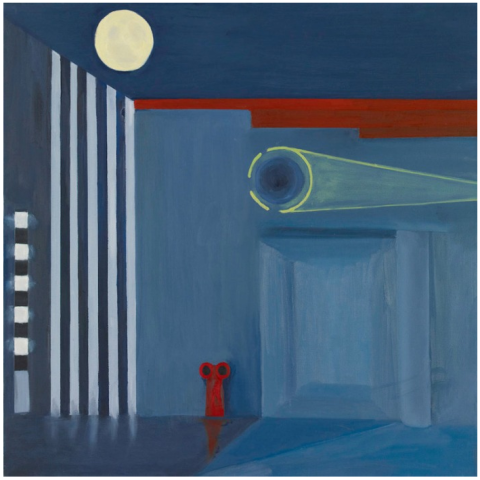
At A440 Gallery, I saw recent paintings by Peter Onstad. Of particular note was a large painting, mostly blue, with abstract geometric lines and shapes. However, on closer inspection (and with some guidance from the artist), one can see that it is in fact a very stylized map of San Francisco, with prominent representations of Golden Gate Park, the Panhandle, the Richmond District and North Beach. Once one becomes oriented, the grid of streets downtown and the diagonals of Market Street and Columbus Avenue become apparent as well. There is even a marker for 49 Geary. The exhibit will be coming down this Thursday, but the painting will soon be on display at Vesuvio’s in North Beach. As a side note, Onstad’s grandson also showed some of his work at the exhibition: small characters fashioned from wine corks and household items. One of these was sold to a friend.
At Robert Koch Gallery. I saw a series of photos by Czech photographer Miroslav Tichý. He spend decades from the 1960s to the 1980s photographing the women of his hometown Kyjov, often surreptitiously using homemade cameras and lenses made from everyday materials such as cardboard tubes and Plexiglass. The resulting images are quite grainy, and the female figures blurry or ghostly. They are also quite voyeuristic, with the subjects seemingly unaware that they are being photographed. Although many of the featured photos depict nude figures, I personally preferred the more mundane images of casually dressed woman walking, such as the two Untitled photos shown below (all of his photos in the exhibition are Untitled). Although still grainy, these feel more like snapshots documenting fashions in a small town in Eastern Europe, but there also a bit of darkness to them. There was also a video of Tichý in which he demonstrated some of his homemade cameras and lenses and talked about his work.

[Miroslav Tichý. Courtesy Robert Koch Gallery.]
Also on display were a series of photo montages by Hungarian artist Foto Ada. Her pieces combine various images depicting modern urban life in the 1930s. There is often urban architecture and industrial elements juxtaposed with whole or partial human figures, such as an areal photo of the New York skyline superimposed above a row of legs of sitting female figures; or the Untitled photo combining a large industrial building “Europahaus-Musterchau” with an attractively attired woman, a strange puppet and a bicyclist wearing a gas mask. The latter is one of many images that reference the pending world war and the rise of Nazism and Fascism alongside high-paced modern life. The images feel in a way vary contemporary and familiar, particular as someone enamored of modernism – and the references to Fascism are perhaps a warning of what could happen in our own modern times.

[Foto Ada. Untitled, c. late 1930s-early 1940s. Courtesy Robert Koch Gallery.]
Both exhibitions at Robert Koch Gallery are closing on August 21.
Photography seemed to be the featured medium in most of the exhibitions I saw, even at galleries where I usually see paintings or mixed media. Stephen Wirtz Gallery presented photographs by Michael Kenna. Kenna’s black-and-white prints are extremely detailed with high contrast, and combine natural and human-made elements. The quality of the prints and subject matter can be seen in Lake Bridge, Hongkun, Anhui, China, with the sharp black lines and curves of the lilies and bare trees against the stone bridge. The water of the lake is essentially invisible except for the reflections of the other elements, giving the image a more abstract quality.

[Michael Kenna. Lake Bridge, Hongkun, Anhui, China. Courtesy of Stephen Wirtz Gallery.]
In addition to several others from lakes and gardens in China, I also liked his architectural-detail images from Venice, such as Fondamente Nouve Poles, Venice. Again, the elements seem to be taken out of their aquatic context into a more abstract realm. The exhibition will remain up through August 21, and is worth seeing if one is in downtown San Francisco.

[Michael Kenna. Fondamente Nouve Poles, Venice. Courtesy of Stephen Wirtz Gallery.]
It is interesting to look at the crispness (clean lines, sharp contrast) of these photos, even as small images in this article, in comparison to Tichy’s blurry and grainy images. The former appeals to more to me as an aesthetic (and something I aspire to in my own work), although I did appreciate the latter as well, and having both as part of “evening of photographic exhibitions” worked well for me.
Modernbook Gallery presented an exhibition of photos by Fred Lyon of San Francisco from the 1940s and 1950s. There are iconic images such as the Golden Gate Bridge but also more esoteric locations, such as the detail of streetcar slots in Noe Valley or close-ups of people walking near buildings. The large prints are very detailed, and some such as Huntington Hotel, 1958 truly capture capture the fog against architecture. I also was drawn to a large image geometric grids, which turned out to be the interior of the Sutro Baths when it actually was still public baths and not stone ruins. The gallery was also playing host to photographers presenting limited-edition books of their work. One of these books, Chinatown By the Bay by Neeley Main caught my interest…and may be a subject of a future article.

[Fred Lyon. Sutro Baths Divers, 1953. Modernbook Gallery.]
Haines Gallery, where I usually see paintings or mixed media work, also featured a photography exhibition. Youngsuk Suh’s Wildfiles explores the “myths of the American wilderness.” All the photographs were shot during the California wildfires of 2008-2009 – though severe wildfires are an annual event here and he could have chosen any year. His large-scale images depict wildness areas obscured by smoke, with human subjects incongruously going about their daily lives, as if the fire and smoke were just another part of the weather. We see people at leisure on a riverbank underneath a bridge, relaxing or wading into the water, with a thick haze in the background. In my favorite picture from the series, a lone chipmunk stands on an artificial lookout point on a hillside. Only in the picture of a fireman are the dangers and challenges of the fire apparent (ironically, he is smoking a cigarette). Also on display was Amy Ellingson’s Summer Frieze, which was composed of a series of abstract panels featuring uniform oval shapes in a variety of colors and transformations. In some cases, they were presented straight, with different combinations of solid colors, in others they were overlaid on textures made from disjointed pieces of the shapes. The panels were arranged in a uniform line stretching around all four walls of the room.
Photography even worked its way into the Cold+Hot exhibition at Micaela Gallery, which was primarily about glass sculpture. However, it was the abstract sculptures that drew my attention, such as the large towers of rounded handblown silver-mirrored glass by Michelle Knox and the curving steel-and-glass shapes by JP Long that would actually look quite at home in CatSynth HQ although they are completely devoid of any straight lines. Tim Tate’s installations combined stationary glass with abstract moving video. Silvia Levenson’s small bottles provided yet another, perhaps more intimate, interpretation of glass.

[Michelle Knox. Installation view of silver-mirrored sculptures. Also Silvia Levenson’s The Pursuit of Happiness. Courtesy of Micaela Gallery.]
Finally Bekris Gallery surprised me with a series of cartoon-like drawings that featured a character that was basically a large nose on legs. It seemed quite familiar, and it only took me a moment to recognize it as William Kentridge, whose retrospective at SFMOMA in 2009 had been a surprise discovery for me. It’s not something I would pick out from an exhibition postcard by default, but everytime I see his work in person, whether still or moving images, it draws me in (no pun intended). I remember Kentridge’s 2008 animation piece loosely based on Nikolai Gogol’s The Nose, to which the still images in this exhibition are clearly related or derived.