The first Thursday of this month featured an impressive performance by Andrea Centazzo together with Gino Robair at the Luggage Store Gallery in San Francisco. I had missed an earlier performance of theirs at another Bay Area venue earlier the week, but glad I was able to make this one.
The evening opened with solo sets by Trevor Dunn on upright bass and Travis Laplante on saxophone. Dunn’s set unfolded as a single piece, which had just started when I arrived. It was a combination of long bowed notes that are part of traditional bass practice along with timbral effects and more percussive extended techniques. The low tones filled the room nicely and provided a more meditative start to the evening.
Laplante’s solo saxophone set was quite a contrast in terms of energy and dynamics. It was nearly all extended technique with fast runs of notes. And it was quite loud. Given the acoustically active nature of the Luggage Store Gallery, this made for some interesting effects. I think the combination of the two sets worked well. Dunn and Laplante were touring the west coast of the United States and Canada together, so I suspect their contrasting styles played into their other performances as well.
Afterwards, the audience shifted 90 degrees towards the front of the gallery, where two tables festooned with a variety of percussion and electronic gear awaited the start of the second set. Andrea Centazzo’s table was dominated by the MalletKAT, a marimba-like electronic controller.
He also had a variety of small acoustic percussion, as well as this toy that he said was from a previous visit to San Francisco in the 1980s.
Gino Robair had his usual assortment of percussion, noisemakers and electronics, including the Blippo Box and his signature broken cymbals.
The set began in either a dramatic fashion, nor in an especially subtle way. It was well timed and well balanced and drew one quickly into the music. As I have said on previous occasions, a masterly improvisation performance will balance rhythm, dynamics and timbres into a cohesive whole, and this performance was no exception. Even with the “noisy” source instrumentation, I felt like the interaction of the performers created a harmonic structure of sorts to go along with the rhythms. And the electronic and acoustic elements blended well in this context. You can hear a short excerpt in this video:
Overall, this was a great performance, and I sat quietly and intently in full absorption of the music, foregoing the note-taking I sometimes do during experimental-music concerts. And it was a perfect conclusion to what had been a long day of not only experimental music but art-gallery openings. But that is another story.
This past Monday, I visited the studio of musical instrument inventor Tom Nunn to talk ahead of his upcoming retrospective performance at the Community Music Center in San Francisco on Friday February 17. The full interview appears below.
Tom Nunn with the Lukie Tube
AC: So why go through the trouble of invention? Why invent a new instrument versus learning existing instruments?
TN: To me, they create a more interesting compositional format, or forum, I should say. They open up possibilities that traditional instruments can’t, because of tradition. Traditional instruments come with tradition, that’s why they call them that. That means that that’s a whole set of expectations that are historically and culturally determined before you even start saying anything. So, in experimental and improvised music, what I get from traditional instrumentalists is that they are trying to get beyond the traditional instrument. So they use different techniques and they use, you know, very imaginative ways of looking at the instrument as a sound-making device. Well, that’s what I am doing with found objects and then ultimately constructions out of found objects. So, we’re all on the same path. What we’re trying to do is, and what all artists and creators have tried to do is, extend and evolve tradition, not simply represent it. And it’s no disrespect to tradition because we wouldn’t be here without it. So I’m doing the same thing that Philip Greenlief or John Butcher or any of the rest of them are doing. It just happens to be with these things instead of those things. We have the same language, we have the same orientation to sound, and we bring to that an expression through phrasing and proportion that represent classical training and sensitivities.
AC: OK, so we can go from the “why” to the “how.” So if you were to begin a new instrument, or a new invented instrument, how do you begin that? Does it start with a particular set of materials or objects, or a process, or a particular musical or sonic idea?
TN: I think it starts with the material that you discover. You discover something about material or some combination of material or use of material that is sonically interesting, and then you see what you can do to shape that material to see if it’s musically interesting. And then you see what is involved in shaping that material and start focusing on that evolution from the sound of the material to the understanding of the material and its relationship to how you make it work, the techniques you use on it; and then finding the best designs for those techniques to accommodate those techniques.
AC: Yes, so what was your first invented instrument that was used in a performance or a recording?
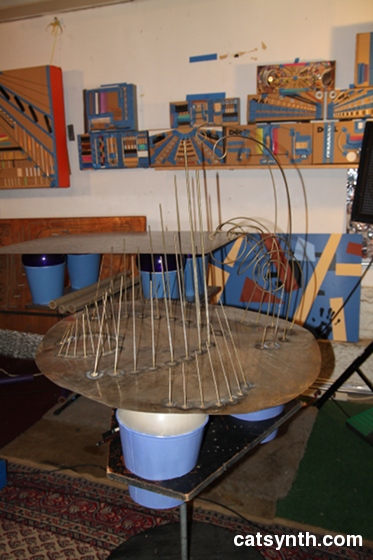
TN: Oh, that’s difficult to say, because I got into this when I was a graduate student at UCSD, and we were doing outside of the class outside of the university a pro-active socialism with music. And so we would go to a park and set up found objects and get the public involved in that. And I was interested in both the sociology of that and the composition of that. But the main thing was that it’s just an evolution of these materials and circumstances they exist in. So what I was getting at is I guess it was hard to say what the first was. Maybe the first was a gas bottle. Maybe the first was a certain way of using some material. The first constructed instrument that I called and have stuck with and keep to this day is the Crustacean. It was about 1977. And again, we had already discovered that rods work with plates and plates sit on balloons so it was a refinement already.
[The Crustacean. (Click image to enlarge.)]
AC: OK, and then presumably since that time there’s been more refinement learning from previous ones. So what sort of things have changed since this early instrument, or since those early performances? What sort of things have you learned that have been put to use in the latest instruments?
TN: Well, it was not so much a linear evolution in one direction. Those plates on balloons with rods, space plates I call them, that was one way, and actually didn’t go very far beyond that. What I got into were electro-acoustic percussion boards and that’s like the Bug and the Crab and these things on the wall here, Techphonic Plates, and ultimately the T-Rodimba. So it was basically hardware devices attached to plywood with a contact mic on the board. That was it. You play them with different things in different ways. But I used combs in that. And ultimately over the years, over many years, I got to the point of realizing that the combs were wearing in a certain way and how would I accentuate that because they seemed to be getting better. Therefore, because of the shape they were better. What if I started experimenting with shapes of combs or what if I started experimenting with things I put the combs on? So in a sense it was an evolution from electro-acoustic percussion boards and the technique of using combs into the creation of the Skatchbox, which was a new thing. 2008.
[Skatchboxes]
AC: OK, so actually I was going to ask about the Skatchbox. Visually, it seems a little bit different from the other ones and it’s more “reproducible.” And even though each one is unique and there are quite a few of them – there was the workshop we had at Outsound a couple of years ago. And even looking around the room there is almost like you would have with saxophones, like a soprano and a bass. So just a little bit more about the evolution of the Skatchbox and the different varieties and the different ways it can go?
TN: Yeah. Well, it started with the implement, oddly enough. It was almost like inventing a stringed instrument because you happened to have a bow. So that’s how that instrument evolved. It evolved out of the implement and to a certain extent technique because what I started with was a blank cardboard box. A big huge box that I found on the sidewalk that I put aside saying “I must be able to use this. It’s much too neat.” So I tried the combs over it because I had incidentally scraped a box that was full of National Geographic magazines, so it should have been really dead. But it wasn’t. It was very alive, resonant, as long as I was making the sound and when I stopped making the sound it stopped. And so I thought, “Hmmm. Wow.” So I started experimenting with how I pushed the comb across that cardboard box. Then I tried it on the big empty box on a keyboard stand. And then I started taping objects down to that to see what that does. And then like a silly goose I put a contact mic on the other side of the box and said “Well, that doesn’t work.” (And I said, “Well, maybe that’s a good thing”). But then I realized, no, put the contact mic on the inside of the top just like you would the plywood sheet and I did and it was like “Oh my god!”. It was like “God, this is five times more efficient than plywood.” Ten times. It was incredible. So I had a kind of “articulation instrument” that I had always wanted and never had. I always felt in recordings my instruments sounded like they were in the next room compared to everybody else, especially electronics. So this now has the presence and dynamics and articulation of electronics. I can take on any electronics with this. So that’s how I developed into these things and I just tried different layouts and designs of stuff and evolved different materials that I put on them and different techniques for putting them onto the box from tape to glue. And then it became more specific and more prototypical and more evolutionary…until I got these two which are perfect.
AC: OK, we’ll take a look at the perfect ones.
TN: Yes.
[“Perfect” Skatchboxes]
AC: Alright. That actually leads to one of the next questions that I had, which is that when I have been hearing the performances over the last few years, I am often struck by how the timbres remind of electronically generated sounds. I know there are the contact mics and the electro-acoustic aspect through that, but it is still coupled with acoustic sources. And in designing or evaluating the sound, is the relationship between electronics or the mathematics of sound?
TN: Not really, not really the mathematics at all. The closest thing I have to anything like that would be – well it’s not even mathematics, it’s scale-wise. The only scalar instrument is the Octatonic T-Rodimba. It has octatonic scales on G, G sharp and A, overlapping, and it’s definitely a pitch instrument. It’s sounds something like a marimba. So other than that, what I have done is, really, and on purpose, create elements, or use elements, which are somewhat random and themselves improvised as the building of the instrument happens. So that when I have the instrument, it’s not so much an instrument that represents a system, it’s an instrument that represents a kind of territory to explore. So for me I like the idea that an instrument has a character, a life of its own, and it speaks to us as we play it. We have an interaction between one another as we’re playing together. And I think that happens naturally with all instruments and players anyway, ultimately, when they’re improvising at least. But I’m sure otherwise, too. So, it’s again the same thing that all musicians feel and sense and experience in relationship to their instrument.
[Tom Nunn demonstrating the Octatonic T-Rodimba.]
AC: Yeah, especially looking around [the studio], thinking of the visual aspects of the instrument. So how do the visual aesthetics play in. So how much of the design of a particular instrument is visuals versus sound quality versus playability? Sort of, the physical aspects?
TN: Well, if I were to order them in priority, I would say first is sound. And that then mandates technique, and technique mandates design. And once you get the design, you can decorate it however you want. But you need to get that essential design that works to get that essential sound that works, because of that essential action that makes the object sound like that. So beyond that, since you’re building something, you might as well make something attractive, interesting, fun, curious. So if you are going to have rods why not bend them and make antennae? And as you’re doing that visual thing, you’re also gaining some kind of acoustic thing because you’re changing the harmonics of the rod. It’s different than a rod that was straight. So like for the Crab, I have three bends in the rod, or two bends in the rod, and they look like little crab feet. But they also create a very distinct acoustic sound because of that. They have a high sound and a very low sound. When I got the Lukie Tubes that was because I had these plates that had been sanded for looks only. But had they not been sanded, the tubes wouldn’t have worked. So sometimes the decoration leads to actual new designs for acoustic reasons.
[The Crab]
AC: So in terms of being able to play the instruments, how does one “master” one of these instruments? Is there a discipline for learning how to play them and for practicing?
TN: Well, it’s a lot of hours of practicing. But as you’re practicing, you’re doing two things. You’re getting familiar with the instrument, but you’re also practicing improvisation, you’re also practicing composition. And you’re practicing composition and improvisation in the context of that instrument with that format and those techniques. So you’re working always on two things – that’s the way I work. Maybe somebody could more objectify it but it’s hard for me to separate the work on the instrument alone from the work on the instrument as a compositional device.
AC: So is that process a little bit different when it’s having somebody else play one of the instruments?
TN: Well, when somebody else plays one, I see different things happening, I hear different things happening. I see different orientations, different approaches. Sure. I’m just an individual. I’m not a prototype, or a metatype, or whatever. Every time I’ve seen people play my instruments they come up with ideas I hadn’t thought of, or approaches or sounds or styles or all kinds of stuff they come up with on their own. Including what kids do.
AC: So, thinking about the performance coming up where there are also a lot of guests that are also using traditional instruments, what is the process for working with performers who are using standard instruments? Is it more about working with the individual performers who were invited, or is it about trying to pair instruments?
TN: It’s more the relationship with the performers who happen to have those instruments but also happen to have a history of playing with me. And so I’ve played innumerable hours with everybody that is going to be on this program. So we all know each other very well. And that’s a really nice thing if you’re doing free improvisation, which most of it will be. But these are master players, master improvisers, and I’m just damn lucky to have a situation where I can call on people like that. So many of them, and such a diversity! And that’s what we discovered with the TD Skatchit project. And that was David’s idea and it just was spot-on in terms of connecting with his culture and bringing the boxes into that. In this particular performance, it’s going to be people I’ve always played with, but I’ve always played with people who play traditional instruments. It’s actually easier for me to play with people who play traditional instruments than people who play experimental instruments. Actually much easier.
AC: So you were mentioning that there is going to be a lot of free improvisation. Has there been a lot of work with formal composition with your instruments?
TN: Yes, the second piece on the program, Plasticity, is written by Allan Crossman, a good friend of mine, who is a retired teacher from Concordia in Montreal. And he is an active composer. He wrote this piece for the Soniglyph and orchestra, and we got it performed by the San Francisco Composers Chamber Orchestra. And we had about four or five rehearsals of that and then did it live and I have a recording of that. But we are going to be doing a piano and Soniglyph version of that piece. That’s the most formal piece, the most absolutely composed piece. But still within that, the composition is about what parts of the instrument I’m playing and what techniques I might be using but not exactly what I’m playing. Whereas what he has, some places are very specific and some are quasi-improvised.
AC: Following up on that, any thoughts on how one would notate for your instruments?
TN: [Laughter] One of the big reasons I got into improvisation with these things! I mean, they [composition and improvisation] happened at the same time, but, my god, what a nightmare trying to notate for this.
AC: I figure it would be an interesting challenge, actually…
TN: Especially the boxes. Good damn luck with that. It’s like notating electronic music. For one thing, what’s the point? As if somebody is going to one: learn how to read it; two: learn how to play it with that notation, with those techniques; and three: get even remotely close to what you were thinking. So no, you know the thing about experimental instrument and stuff is trying to push the envelope of what music is. Part of that is getting away from the idea that everything is compositionally controlled. But it isn’t, like, burning your bridges. We still have relationships to composers and compositions. It’s just that we sit around the same table now and they take into account what we thrive on and vice versa. It’s great.
AC: So in the context of that newer relationship between composers and performers, would you like to see more compositions?
TN: If they’re good.
AC: And then, anything thoughts on how your instruments have affected people in this community or beyond who think about music, whether they’re performers or listeners?
TN: It would be difficult to say what effect I have on anything. That part is kind of a hope and a prayer that maybe there would be some influence that is positive in somebody’s life and just let it go at that. I’ve given away a lot of instruments. I’ve given away a lot of CDs. It’s my inclination to give things away rather than sell them when it comes to music anyway. To me it’s like this is food for the soul and so how can we put a price on that. So yeah, I end up giving away a lot of instruments. And that is, I think, an appropriate way to dispense with this stuff. If somebody says, “well I can do that”, then go home and do it. Rent [Romus of Outsound Presents] went home, and he and CJ each made a box, after [the workshop at the 2010 Outsound Music Summit]. Great! It’s kind of like that. If teachers saw what the potential of the Skatchbox was for elementary school kids or junior-high school kids, kids that hadn’t gotten the big dose of cynicism that’s going to come down the line yet. So that they don’t see it as silly or stupid or not cool or whatever. But that they see it as just interesting. Which is the virtue of kids.
One exhibition I have come back to a few times over the past month is Todd Hido’s solo photography show, Excerpts from Silver Meadows at Stephen Wirtz Gallery.
[Todd Hido, Untitled #10121-A,2011. Courtesy of Stephen Wirtz Gallery]
The show features large images that were taken near Kent, Ohio, where Hido grew up. We see wintry scenes of modest houses and fields in a flat landscape with a few trees. The effects of snow, wind and the windshield of a car give the images a somewhat blurry quality. Interspersed among these pieces are a contrasting set of clear, high-contrast images featuring female models in vintage dress or poses. All the pieces bear very dry titles that are presumably based on serial numbers of some sort, a detail which I find interesting for what are emotionally strong images.
[Todd Hido, Untitled #10106,2011. Courtesy of Stephen Wirtz Gallery]
[Todd Hido, Untitled #10473-B,2011. Courtesy of Stephen Wirtz Gallery]
At first glance it may seem to like two shows mashed together into one, a stark wintry landscape in a small community, and stylized portraits of female subjects. The often blurry effects of weather and glass in the exterior images also contrast with the hyper-clarity of the indoor portraits. But taken together they do form a narrative whole that is very film-like. Indeed, I had the impression of stepping into a David Lynch film. The wintry exterior is a small town somewhere in the Midwest that seems perfectly normal. It’s a not a picture postcard of a the archetypical “small town” adorned with a layer of snow, but rather a place that is maybe a little more bleak, a little more tired, a little more isolated. But afterd entering a few of the snow covered houses, a more eerie and eccentric reality emerges within, populated with unnerving but seductive characters. The effect is accentuated by the fact that several of the portraits feature the same model in very different roles and appearances (something I would not have recognized if it were not pointed out to me), but by the dreamlike effect of the inclement weather and dark skies in the outdoor photographs.
[Todd Hido, Untitled #9221,2010. Courtesy of Stephen Wirtz Gallery]
My impressions seem in line with Hido’s mission in this collection, “the artist’s metaphorical reckoning with his own past, while providing a majestic summation of the suburban childhood experience in general…homes built similarly to convey stability actually conceal lives seething with sexual and psychological instability.” I also like how he uses road trips as his part of his execution of this vision (indeed, the feeling of looking out a car window in stormy weather permeates much of Hido’s outdoor imagery). It suggests a dark corner of one of my “Fun with Highways” posts.
[Todd Hido, Untitled #1843,1996. Courtesy of Stephen Wirtz Gallery]
[Todd Hido, Untitled #10502-42,2011. Courtesy of Stephen Wirtz Gallery]
The cat portrait is a bit random, but it is quite humorous and does fit into the overall structure. I thought it worked especially well paired with the classic head portrait reminiscent of the late 1950s or early 1960s.
The show will continue at Stephen Wirtz Gallery in San Francisco through February 25.
Today we look at the last show I attended in 2011. On December 29, Outsound Presents featured a pair of duos at the Luggage Store Gallery: Hare and Arrow, and Charm and Strange.
Hare and Arrow was a duo of musical-instrument maker Sung Kim and David Dupuis. I had the opportunity to hear Kim perform on his instruments several times during 2011, but I found this performance to the the most musical. The instruments were of course quite interesting sonically as well as visually, but the music held its own with having to be conscious of this. The set started with a combination of scratchy noise and feedback, but then moved to more traditional bowed sounds and glissandi. The combination of harmonies and relatively gentle noise had a plaintive quality. Over time, the music grew noisier and darker, and more animated. You can hear a short clip of the set in this video:
There were some interesting moments as the piece continued, including a clarinet-like timbre from one of the string instruments and a jazzy bass line. The second piece was more percussive, with plucked strings and striking of the instruments. As a result, it had a more sparse texture. Towards the end, Kim set aside the instrument to manually control the effects pedals for an electronic conclusion to the set.
It was then time to transition to Charm and Strange, an electronic-music duo of Julia Mazawa and Sharkiface. During the intermission, I found myself quite curious about this bright red device. It definitely had the look of a Ciat Lonbarde instrument (i.e., like the kitten-nettik that I have somewhere at CatSynth HQ).
It turns out it is a combination of oscillators and loop processors, although in this performance it was mostly used for the latter. Plus, the red color matched Sharkiface’s shawl. And they both contrasted nicely with the leopard-print table cover.
The set opened with a looping sound and a texture that was industrial, ambient and machine-like. Mazawa, who was performing on an iPhone, appeared to be controlling the loops and applying turntable-like effects. Over time, different looped sounds came in. It was only after the performance that I found out that the sampled sound sources were actually from Hare and Arrow’s set. Simultaneously, Sharkiface played the red instrument, both using the raw contacts and applying jumper cables at various points. A syncopated rhythm emerged, with environmental sounds set against machinery. It then turned to a more turntable-like pattern with metric scratching. There were repeated string phrases (i.e, from Hare and Arrow), hissing sounds, and loud machine noises. The loops seemed to have similar lengths, but set at different phases to create rhythmical effects. Other pieces featured chaotic noise that reminded me of circuit-bent instruments (though I think the sounds were coming from the iPhone), a steady pulse set against more random wobbling sounds, and a section where Sharkiface played the red instrument more expressively, almost melodically.
You can hear a tiny bit of their set in this video:
The video clip is rather short (only a few seconds). I’m not sure why that is all I have of the video, but it is what it is. And I hope to hear more performances from them in the future.
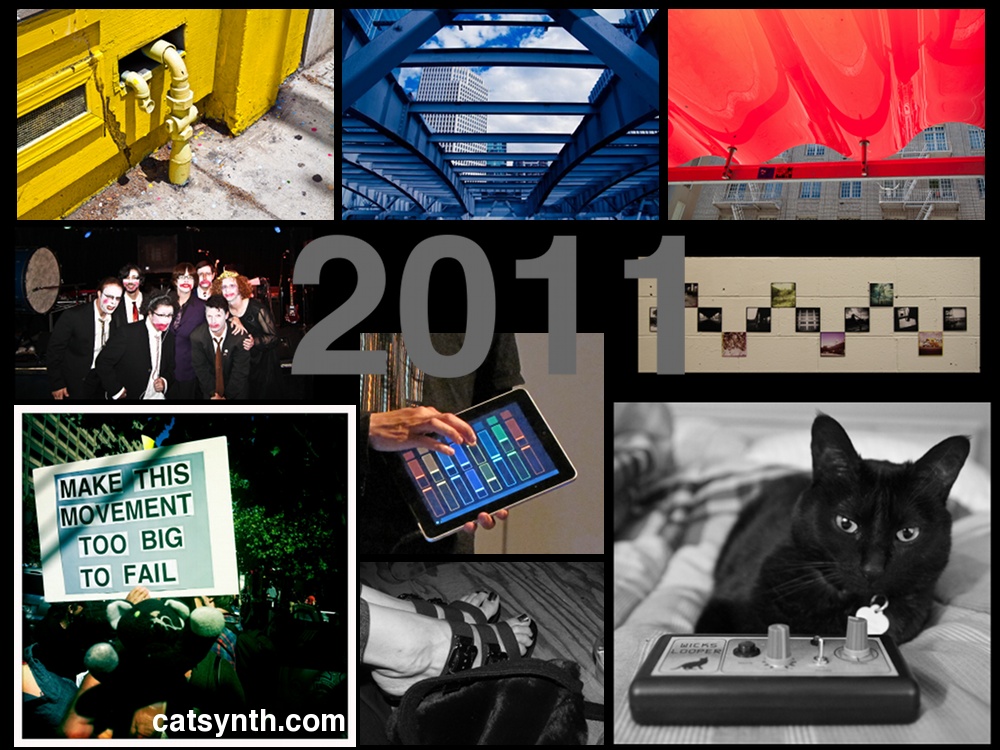
As has become a tradition here at CatSynth, we present our end-of-year image.
[Click to enlarge.]
It was a bit of a challenge to decide what to put in, as there were so many this time. But I think these are particularly representative. And it’s also significant that it is more colorful than previous end-of-year images.
The first few days of this year were quiet and a bit dark. That changed quickly, with tumultuous events around the world, and new experiences close to home. It’s the year I finally had a photography show, and by the end of the year I had several. There were new surprising types of performances and the costumes to go with them. I deepened my connections back in New York with friends, music, art and the landscape. And I no idea what I would have the chance to participate in something like the Occupy movement . There were many sad moments as well, with the loss of friends.
In all, 2011 has been particularly rich and productive, if sometimes a bit chaotic. If one had told me at the end of 2007 or 2008 (or 2001 for that matter) that this is what life would be like now, I would have been pleasantly surprised. There is a sense, however, that the patterns of this past year are not sustainable. This will have to be part of the plan for 2012, in particular getting organized, staying healthy and trying to make good choices. We will see how that unfolds as the new year progresses…
Happy New Year and thank you for all the support and warmth from those who read these pages!
Earlier this month, I participated in a show at the Luggage Store Gallery in San Francisco called Space Music Night that turned out to be quite memorable. So what exactly is “space music”? It is not straightforward to come up with a definitive answer, except that it should reflect some sense of “outer space” as one might imagine it. Or, perhaps more accurately, as people might have imagined it in the 1960s and 1970s. The music that we performed that evoke “space rock” that one might associate with early Pink Floyd or Gong, but also more freeform ambient soundscapes. The latter comes closer to ambient music one might hear on NPR’s “Hearts of Space” program but without crossing over that dangerous line into New Age. The music was certainly contemplative at times, but retained an edge to it and often veered back to rock and jam idioms, and moved back and forth between defined harmonies and more abstract timbres. The “space” effect was also heightened by having a dark room with abstract video projections by Tim Thompson.
The show was divided into two sets with four musicians each. Although many of us were familiar to one another, this was the first each each set of four played together as a group. The first set featured Matt Davignon on drum machines and effects, Kristen Miltner on electronics, Karl Evangelista on guitar, and Andrew Joron on theremin. Musically, this set had a very thick electronic texture with a soft beat from the drum machines that came in and out of presence. The electronics and heavily processed guitar provided anxious harmonies, and the theremin seemed to be narrating a space story with warbles and slides that approached the rhythm of human speech. At moments, the rhythm dropped out altogether, while at others it came closer to an extended jam. You can hear a bit of the set in the following video:
In the second set, I performed with iPad and the Dave Smith Evolver, along with David Leikam, Sheila Bosco on drums, and Steve Abbate on guitar. Perhaps it was the instrumentation of the set, or the musical leanings of the performers (including myself) towards strong rhythm, but we very quickly gelled into a steady rock jam rhythm that extended for most of the length of the set except for avery deliberate breaks. I mostly used Sunrizer on the iPad to provide ethereal harmonies to set again Leikam’s Moog Rogue and his “electric bass cello” and provide structure for melodic improvisation. This was definitely approaching the “space rock” idiom that inspired the evening.
I was quite happy with how well we able to play together despite having not played together before, and indeed a few people afterwards expressed some surprise that we hadn’t. But perhaps we will get a chance to play again.
Today we look at two current exhibitions at the San Francisco Museum of Modern Art (SFMOMA) that opened in October and continue through mid-January: Richard Serra Drawing and Sharon Lockhart’sLunch Break. I had the opportunity to attend the museum’s press preview for both of these exhibitions and posted live updates via my Twitter feed @catsynth (the hashtag was #serrapreview).
The main event of the day was the opening of Richard Serra Drawing. I have long been fond of Serra’s large-scall metal sculptures. The minimalist yet strong constructions of flat steel planes or gently curving metal are instantly recognizable as his. This exhibition was my first experience with his drawings and sketches. Many of the pieces had the same characteristics as his sculptures, the reliance on strong geometric forms in a minimal presentation, such as his 1973 piece Untitled. One could see this piece as the shadow of one of his sculptures.
However, to simply describe the work in this exhibition as Serra’s sculptures flattened to two dimensions would miss most of what makes it unique and surprising. Many of the large black pieces are done with painstick, and the large geometric shapes which smooth from a distance have a very rich and rough texture. However, to simply describe the work in this exhibition as Serra’s sculptures flattened to two dimensions would miss most of what makes it unique and surprising. Many of the large black pieces are done with painstick, and the large geometric shapes which smooth from a distance have a very rich and rough texture. It was something I referred to while visiting as “liquidy roughness.” The texture and medium also allowed Serra to move beyond basic geometry into forms that cannot easily be realized as sculpture. In out-of-round X, an exaggerated texture is present in the main circular shapes, and continues to diffuse out past its edges. It is not a simple graduation where the texture becomes more diffuse from the center, there is still some semblance of a geometric shape in the image. But it is nonetheless unlike any of his sculptures, and I would not have automatically marked this as Serra’s if I saw it from a distance outside of the exhibition.
Indeed, more organic circular shapes and ambiguous edges abound in Serra’s drawings. He also escapes from the solid or semisolid forms with line drawings that add more empty space. In these drawings, he reduces the drawings to one-dimensional forms in a way similar to his use of planes in three-dimensional space.
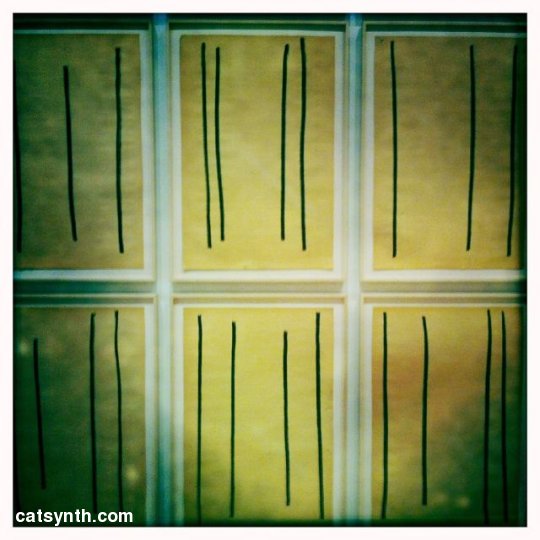
The gallery presentation provided a chance to see the diversity of the works side-by-side, but also left a large amount of empty space that abstract pieces truly need to be appreciated. I liked this location which featured Diamond (1974/2011) in the foreground and the circular Institutionalized Abstract Art (1976/2011) around the corner. Both were redrawn on the walls for this exhibition. They are perhaps the most minimal of all the pieces, and as such benefited the most from the context of gallery and the association with the other works. They provided a contrast to more roughly drawn or textured pieces. The spacious presentation also allowed room to explore the shapes in a personal manner. One wall of pieces entitled Drawings after circuit featured simple lines against aging paper, and seemed ripe for interpretation as a Hipstamatic photo.
[Click image to enlarge.]
The notebooks, while not as monumental, presented another dimension of Serra distinct from both his large drawings and his sculpture. We see the freedom to explore shapes and ideas that don’t yet need to stand up in large scale.
There are not only small sketches of ideas that could be used in larger works, but energetic and curving sribbles and even playful human shapes. The notebooks serve more as inspiration for visitors (particular visitors who are themselves artists) than as works unto themselves.
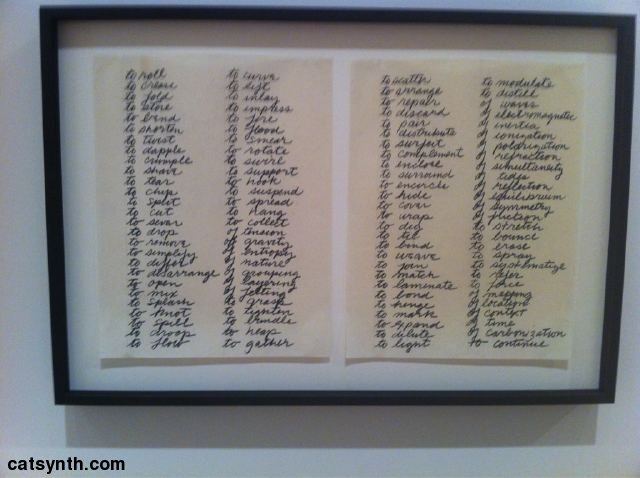
Perhaps the most unusual piece was the list of verbs that appeared at the beginning of the exhibition.
[Click image to enlarge.]
It could serve as both an artist statement as well as an art piece.
At the end of the tour, Richard Serra was present to discuss the exhibition and take questions from the press. He had a very clear and accessible way of describing his work and process, as much engineer as artist.
It was interesting to hear him describe traditional architecture he saw in Spain and Turkey as sources of inspiration for his work. I associate stylized form and intricate detail with such architecture, and what attracts me to Serra’s work is its break with these traditions for a more simple focus on large-scale textures and geometries, and the exploration of asymmetry. I did not get a chance to ask any questions myself, squished among members of the established art press, but it still good to just be present and listen.
Sharon Lockhart’s Lunch Break is quite a contrast to the Serra drawings in media, style and subject matter. Through photographs and film, Lockhart presents a personal-scale view of industrial labor at the Bath Iron Works, a large naval shipyard in Maine. The artist spent a year in the town and at the shipyard, “interacting with workers and gaining their trust and collaboration.” The result is a portrait that is both intimate and detached. In the photographs we see everyday objects and elements of the “shadow” economy among the workers, such has makeshift cafes and lunch stands. The film meanwhile turns a short period of the workers on lunch break into a monumental portrait of industrial life.
The film is based on ten minutes of footage tracking along the a 1,200 foot hallway, without any panning, zooming or any other motion of the camera besides the steady forward progression. Along the hallway, workers go about the normal routines during lunch break, sitting, standing, eating, reading, talking However, what we ultimately see is anything but routine. The film is slowed down to 80 minutes (one eighth the speed of the original). The result is a stretched out abstract industrial exploration, which emphasizes the expanse and straight lines of the hallway as we pass by the workers.
The music, a similarly slowed down mixture of sounds collected from the factory space by filmmaker James Benning and composer Becky Allen, gives a heightened sense of a fictionalized industrial landscape. Of course, I immediately started deconstructing the sound, which appeared to be a combination of pitch and time shifting and granular synthesis, but this did not detract from the overall presentation of the film, which was projected on the wall of a dark elongated room with surround sound for an immersive experience and other worldly experience. Although the film itself was interesting to watch, it was the music that kept my attention for an extended period of time. I tended less to see the details of workers in the visual and focused more on the big picture of the hallway, while in the music I kept looking for details, little bits of metallic or machinery sounds, or the occasional hint of human activity, amidst the overall drone of low-frequency noise. It is hard to give a sense of the piece, with just an image. It should be experienced in person with the full sound.
The photographs that accompanied the film were not altered and presented images of the lives of the workers at the shipyard that would normally be hidden to outsiders. Several of the workers have set up small shops that sell coffee and food and operate as a shadow economy, where people leave money in boxes on an honor system.
The images are impersonal in the sense that they do not include any people, but the personalities of the workers who created the objects and spaces are indirectly present. In contrast to the film, with the industrial sounds of the music and scale of hallway dominate the viewer’s attention, the images and silence leave the viewer free to imagine the people who wrote the signs on the shops or attached the stickers to the lunch boxes. In particular, that was my impression from the sign “Please don’t forget to put money in the bank” with its accompanying smiley face. This sign forms the cover for exhibition catalog as well.
Although Lunch Break presents it subject with a certain detachment and abstraction, it is hard to separate it completely from the economic and political reality of contemporary life in the U.S. As stated in the official release, “The project’s attention to the local and to the rarely portrayed experience of the working class take on a particular social and political relevance in the context of global capitalism, war, and economic recession.” The opening was occurring at the same time that the Bay Area incarnations of the Occupy movement were just picking up momentum (my first visit to OccupySF was just a few days earlier.) The combination leads to interesting questions about how protest, art, and the daily routines of working people intersect (and how they often don’t).
It was interesting to have seen both of these exhibitions together, and then reflect on them side-by-side several weeks later. My experience of Serra’s drawings is defined by shape and texture, and leads to more internal contemplation and fewer words that reflect the scale and space of the exhibition. By contrast, Lockhart’s Lunch Break speaks to me on a technical level with music, film and photography, and is on a personal scale. As such, it leads to more words and thoughts upon reflection. Both are valuable experiences and ways of seeing art.
Both exhibitions will be on view at SFMOMA through January 16, 2012. I strongly recommend checking them out if you are in the Bay Area.
[All captioned images are provided courtesy of the San Francisco Museum of Modern Art. Images marked “catsynth.com” were taken by the author during the press preview.]