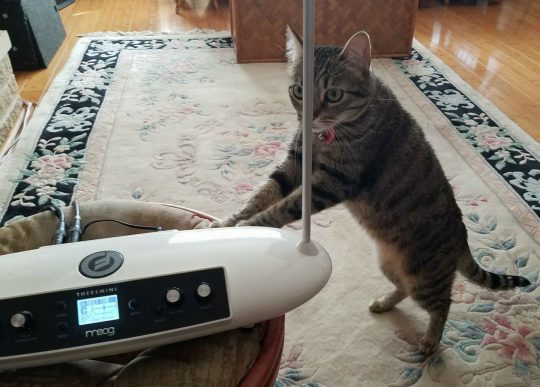
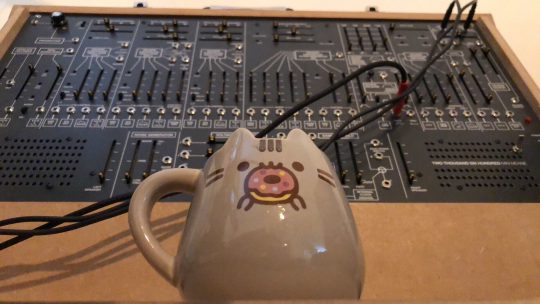
Cat mug with a TTSH, a clone of the Arp 2600 synthesizer. By Alexander Henriksson on Facebook.
And another cat has found its 🏠
The TTSH is an Arp 2600 clone that can be built as a DIY project, as described by The Human Comparator. San Pedro Labs builds full versions, including wood casings. (They used to be here in San Francisco, but have recently relocated to New Mexico.)
Charlotte the cat contemplates the horror that is a circuit-bent Big Mouth Billy Bass. From Ok Housecat on YouTube.
I was often sardonically amused by this fishy contraption since the commercials in the 1990s. But now I am genuinely intrigued by its circuit-bending possibilities. At the very least, it could make for a fun CatSynth TV episode. I found at least one set of instructions here, but it might be even more fun to just take it aport and just explore with alligator cables.
The Horror…The Horror…
From Ok Housecat. Visit their website okhousecat.com, where you can see an amazing array of circuit-bent and other custom electronic instruments. We at CatSynth are going to spend some more time exploring the video demos 😻
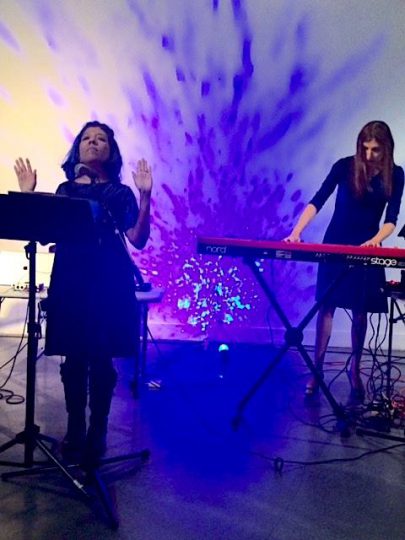
As we get ready for our next Pitta of the Mind show this Thursday, March 8, we look back at our recent show at Pro Arts in Oakland, where we were joined by Usufruct, Alex Cruse, and Murder Murder. You can see a bit of all four groups in this recent CatSynth TV episode.
Pitta of the Mind’s color theme (we always have a color or pattern theme) for this evening was blue and featured blue-themed poems by Maw Shein Win, many from her new book Invisible Gifts.
[Photo by Tom Scandura]
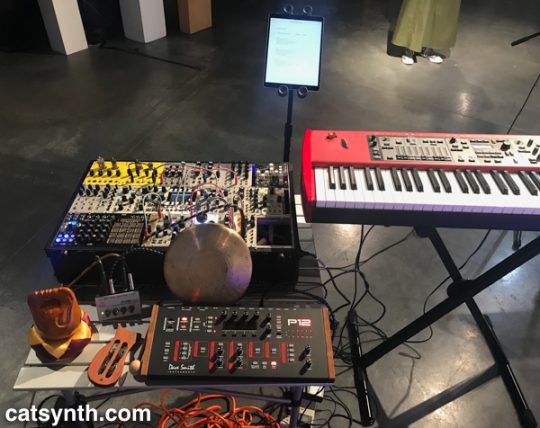
I used the Prophet 12 synthesizer, along with the modular system, my trusty Nord Stage, and some percussion instruments to create a musical interplay with the words as well as the space between them.
Even though we haven’t performed in a while and only had one rehearsal, I felt this was one of our strongest performances – and the feedback I got from the audience backed up that perception. In particular, I think the poem “You Will Be With Me in a Town Called Paradise” came out particularly well, with a sultry vibe and jazzy accompaniment on electric piano.
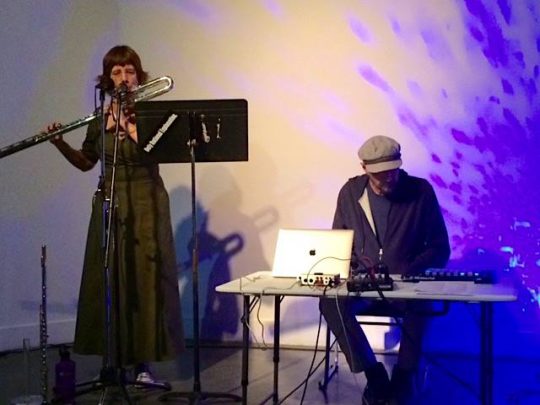
After our set, Usufruct, the duo of Polly Moller Springhorn and Tim Walters took the stage.
[Photo by Tom Scandura]
As the word “usufruct” implies, they make use of materials for which they have usage rights beyond ownership, such as public-domain text sources. Polly’s vocal interpretations of the texts are processed electronically by Tim using custom programs written in SuperCollider. The end result is simultaneously dark and playful. But beyond the text sections, I was particularly taken with the instrumental portion at the beginning, which featured bass flute live and electronically processed.
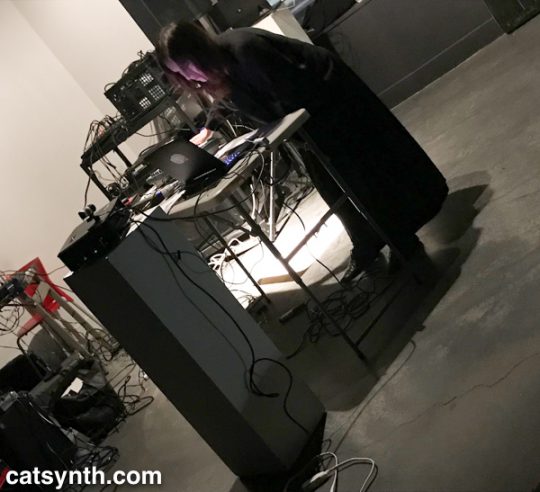
Alex Cruse brought a very different vibe and sensibility to the evening, with an electronic performance that focused on beats, loops, and hits.
There were many delightful sounds and many hard-edged industrial noise moments as well. The vocals were deliberately obscured by heavy distortion and other processing but provided a percussive element that worked well with the rhythms.
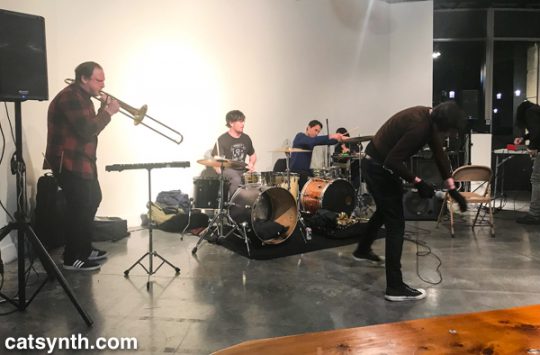
The final set by Murder Murder was again something altogether different. With two drummers, two horns, two electronic performers, and vocals, it was nonstop intensity from the first drum hit.
The intensity continued for several minutes and then came to a sudden close. It was the musical equivalent of a tornado tearing through our calm evening of voice and electronics, but perhaps it was a fitting coda to the evening.
We thank Pro Arts and Sarah Lockhart for having us at this series, which has become quite a mainstay of the Oakland scene. I hope to be back again soon with one of my other projects. And of course, we are looking forward to our next Pitta of the Mind Show – where we will once again be joined by Usufruct – at the Luggage Store Gallery in San Francisco on Thursday, March 8 at 8 PM.
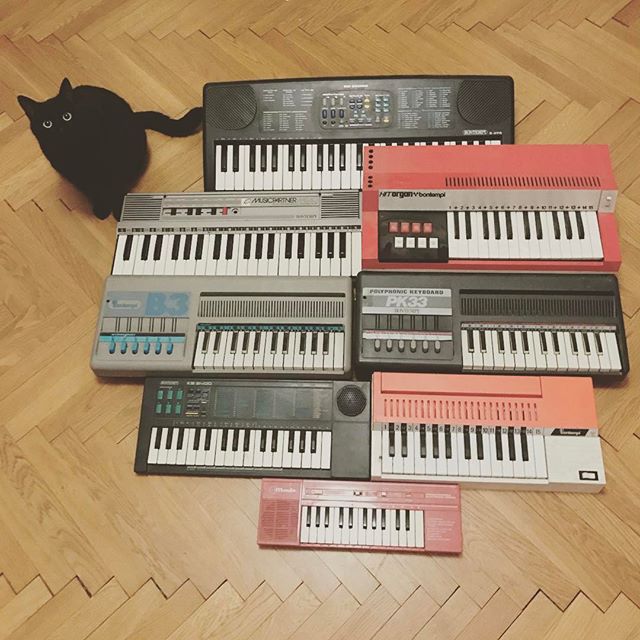
A black cat posing with several vintage small keyboards, including some familiar ones from Casio and Yamaha. From Milomi Studio on Instagram.
Some of these keyboards may be considered “toys”, but they are still musical instruments. I coveted some of these small keyboards before I discovered synthesizers. I do now have a Casio SK-1 that gets used in live performance.
Purim is the “most synthesizer-y” of Jewish holidays, given that one of it’s central rituals is noisemaking. This year we created a synthesizer demo running sounds from a gragger through several modules.
The demo uses a mixture of pre-recorded gragger on the QuBit Nebulae and live sound via the Mikrophonie and Make Noise Echophon. The full list of modules used in the Purim demo is:
Make Noise Echophon
Qu-Bit Nebulae (v1)
Rossum Electro-Music Morpheus
Mikrophonie
Make Noise Maths
Make Noise Tempi
Malekko Heavy Industry Noisering
I do wish I already had a Qu-bit Nebulae v2 for this project. You can see our review of v2 from NAMM 2018 here.
Purim is a holiday that commemorates the saving of the Jewish people in the ancient Persian Empire from the king’s wicked advisor Haman, as told in the book of Esther. Traditionally, the gragger is used to mask the name of Haman when said out loud during readings.
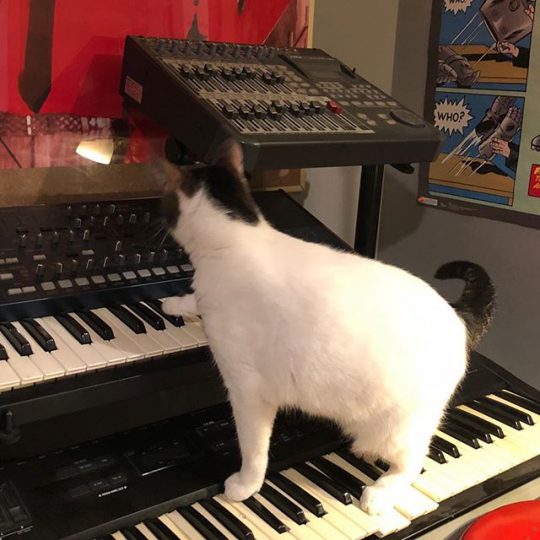
No, this isn’t Sam Sam, though this cat does look a bit like her from behind. This is the cat that lives with synthguy216, who shares this photo via Instagram. He has certainly mastered the art of playing two-tier keyboards 😸
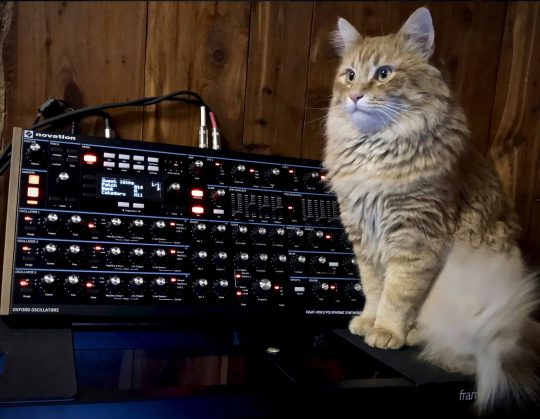
Mr. Maximillion returns, this time in a handsome portrait with a Novation Peak synthesizer. By Charles Whiley via Facebook. You can see Mr. Maximillion’s previous appearance here.
We were wondering what exactly an “Oxford Oscillator” is, as Novation chose to display the term prominently on the panel. From their website:
The implementation of the FPGA opens the doors to a new type of oscillator design for Peak — The New Oxford Oscillator — the design of which stems from the analogue imperative. Peak’s raw waveforms are generated using an architecture designed and realised by Chris Huggett. It employs two waveform-generating techniques: Numerically Controlled Oscillators (NCOs) and wavetables.
The NCOs are used for the traditional subtractive-synthesis waveforms (e.g., saws, squares, pulses, and triangles). The wavetable oscillators can morph between different source tables. The architecture of the oscillators with traditional waveforms reminds me a bit of the Evolver from Dave Smith Instruments. It is quite intriguing, including the fact that it is implemented on an FPGA.

🏠