By tedjames on flickr, via matrixsynth:


Submitted by Briana Jones on facebook.

“Caliope composing her set w/ 2 tone genators.”
I would be quite curious to hear that piece.
December 25 (Christmas) is a completely free day us.

After a season (and indeed, a year) that has been exceptionally hectic even by my own standards, such emptiness can be a bit jarring. One could catch up on the myriad creative projects and practical items that have been languishing, or just relax. Luna on the other hand has no problem with this whatsoever.

This is yet another lesson we should learn from our animal friends.
I would go for a walk downtown or along the highway structures, but with the blustery wind and stormy skies outside, it seems best to stay inside this morning with a warm cup of of coffee and a cat. It also seems like a good morning for some 1950s/1960s minor-key jazz (actually, a lot of mornings are good for that). Just imagine The Dave Brubeck Quartet’s Take Five or John Coltrane’s Equinox in the background with the pictures of Luna and you can glimpse Christmas morning at CatSynth HQ.
Weekend Cat Blogging #290, Holiday Edition is hosted by Jules and Vincent at Judi’s Mind Over Matter.
The Carnival of the Cats will be hosted tomorrow by Nikita Cat.
The Friday Ark is on hiatus for the holidays.
Today we look back at a busy Thursday back in November. In the early evening, after spending the afternoon with the folks at Smule busking around San Francisco with the newly released Magic Fiddle, I met up with members of the Cornelius Cardew Choir at the Powell BART station to perform several pieces for voice, motion and interaction with the environment.
We performed two pieces by Bob Marsh and Tom Bickley, respectively, in the sunken plaza next to the station. Both pieces were very meditative, even as one moved about the plaza, and the relatively soft and sparse nature allowed one to also listen to sounds of the city as the evening commute tapered off. A few onlookers stopped to see what we were doing and listen in, but mostly we were on our own. We then began a piece by Rachel Wood-Rome that combined live voice with prerecorded material. However, as we were bat to start, a rather enthusiastic individual came over and asked to sing with us and forthwith began his rendition of “The Love I Lost”, a minor disco hit by Harold Melvin and the Blue Notes. As if on cue, at the end of his song a young man on a skateboard wiped out at the base of the staircase. I wish I had captured this moment on film. We then continued with our performance, in which four participants listened to pre-recorded material on iPods and headphones and then sang their parts for the others to follow.
Later on, several of us made our way to the Luggage Store Gallery for Outsound’s Soundspeak Series, a “series presenting pairings of sound and voice artists.”
The first set featured Hugh Behm-Steinberg with Matt Davignon. Rather than just a recitation of poetry with music, the performance featured both live voice and pre-recorded readings that we played back in combination with live electronic sounds. The first piece, “Sea Monster”, featured electronic sounds by Davignon that sounded very aquatic, like wind and waves. Behm-Steinberg’s pre-recorded spoken lines were separated with large spaces in which to hear the other material. Various loud metallic sounds emerged as the words become more fragmented. Eventually, the words seemed to disintegrate completely and were obscured by harsh resonances from the electronics. Overall, however, the piece maintained an undulating motion. A couple of lines from the text that stuck with me were “to be a girl in her 50s shoes” and “Don’t pay attention to modern literature.”

[Hugh Behm-Steinberg and Matt Davignon.]
The next piece began with metallic sounds that were almost FM-like in timbre, and the texture of the music was more choppy with individual events. The words started out more fragmented as well, and were rendered with a variety of voice qualities. Not only differences in tone, but differences in spatial perception as sometimes the voice seemed more distant. The electronic sounds became more liquidy sounds came in against percussive sounds, and gradually became more “gargly”. The voice began to shift pitches, up and down, against bits of liquidy bells. More glitch noises emerged, and words spread further out to the point of a single word per timbral event. I remember something about “fish bodies”.
The final piece, “Teeth”, was more of a monologue and quite humorous. It began with the line “Suppose you see a tooth” set against very percussive music reminiscent of tablas and other South Asian drums, played more in clusters than continuous rhythmic patterns. The imagery of the text was quite vivid, describing “infinite amounts of teeth” as the drums became more electronic. The text moved on to other topics, but then came back to teeth. As the piece continued on, more layers of electronic percussion emerged, however, the rhythm remained focused on clusters.
The second set featured Rent Romus on saxophone and electronics with CJ Borosque reciting poems from her new blog The Cloud Journals. One piece, “Love is a needle in the ass” was quite memorable both for some of the lines in the poem such as “white is the color of death and evil” and “the drum circle was fun, though” and its combination with Romus’ lively saxophone improvisation and live cassette-player performance.
The next piece “American Hunger”…or “Staving off Hunger (an American Diatribe)” dealt with issues around both hunger and consumption and how one can be both consuming massive amounts of food and other resources while still being “hungry” in some way. The line “where’s my beer” in the middle of the diatribe particularly stuck out for me, perhaps how it was set against the music. Sonically, the music featured warbling tones and chirping, glitches and loops, and effects from a Line 6 variable delay.
The piece “roads and wishes” featured the particularly memorable line “season to season, jam session to jam session” which resonated with me as a musician and as someone who has been quite busy with a great many things in these past few seasons. The poem was set against a variety of string tones: pedaled strings, bending blue tones, and others, and then gave way to more flute tones. The final piece “what if the world ended” featured more saxophone performance and string tones. And while these were not the final lines of the poem, they did once again connect to music and to being at the performance: Music is your muse, I am your butterfly, And your dragonfly, And your sword.
We at CatSynth would be remiss if we did not post this holiday offering from Keyboard Cat, (i.e., chuckieart at YouTube).
And if you’re feeling adventurous, here is the full commercial-style video for “It’s a Keyboard Cat Christmas”:
By the way, they are not joking, you can download this holiday extravaganza from iTunes.

From kingdulcimer on YouTube.
FLAMIN DARWIN RECORDS PRESENTS… OTTO “GENTLE DIAMOND” SMOTHERS-SMITH, CAT OF SATURN SMITH (FROM REX ROPE & FRIENDS). DEBUT PERFORMACE, LIVE FROM THE TIME TRAVEL INN, CAMDEN. BOOKING INFORMATION: HTTP://FLAMINDARWIN.BLOGSPOT.CO.UK
Submitted by Anton Proskurnin on facebook:

“Maceo looks at the notes.”
I believe the keyboard is a Yamaha CP-33.
Via matrixsynth, where you can see more photos:

Also, check out recoilsun’s bandcamp, featuring music with this Buchla setup. Interesting and meditative. Not sure if the cat assisted.
At the beginning of month, I attended a retrospective concert of music by the composer Sylvano Bussotti, performed by members of sfSoundGroup at the San Francisco Museum of Modern Art (SFMOMA). Bussotti is an Italian avant-garde composer whose body of work transcends into visual media and film as well. His music itself is very visual, and his graphical scores are works of art that combine standard music notation with graphical symbols, spatial positioning on the page and text instructions that inform the musicians on how to interpret and perform the piece. They are also known for being difficult to play, but sfSoundGroup is up to the challenge.
The performance took place in the museum’s expansive atrium, which was bathed in red light, with the musicians in the center and the audience orbiting around them. The space was bounded by two pianos, mysteriously set apart.
In the few minutes before the concert began, I was able to check out a couple of the scores up close.

[Score for “Phrase a trois” by Sylvano Bussotti.]
This score is for the piece Phrase a trois for string trio (violin, viola and cello). I also was able to view the score for Geographie Francaise alongside the percussion setup:
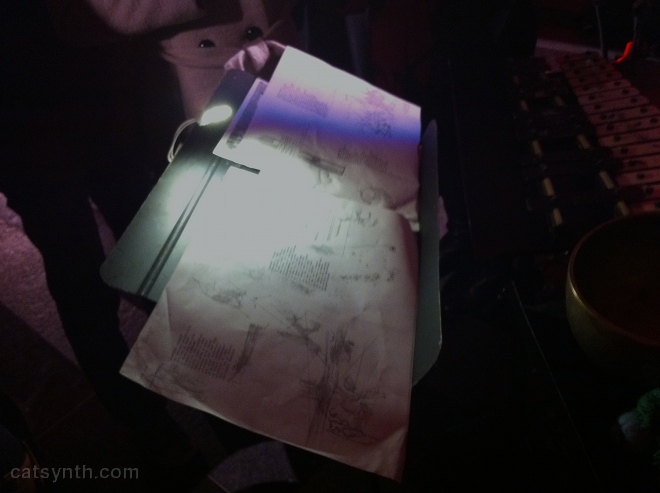
[Score for “Geographie Francaise”, by Sylvano Bussotti, with percussion instruments. (Click image to enlarge.)]
Unlike many graphical scores, which often allow for wide interpretation of visual elements and improvisation, these seemed more designed to describe precise instructions to the performer.
Bussotti himself performed in two of the pieces. For Geographie Francaise, he played piano and incanted stark vocal lines in French, alongside featured soloist Laura Bohn and percussionist Kjell Nordeson. I quite liked this piece for its starkness, conceptual simplicity (i.e., centering around the title itself) and the disparate texture of the instrumentation: voice, piano and percussion. One does not really hear traditional rhythms or melodies, even of the early-twentieth century “atonal” sense, but rather directly on the various sound, musical and narrative concepts, more like an abstract theater piece.
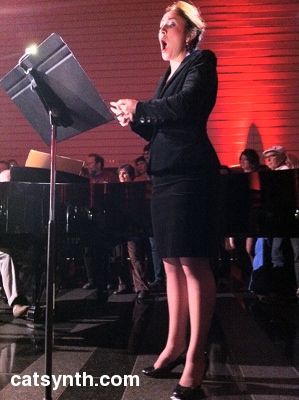
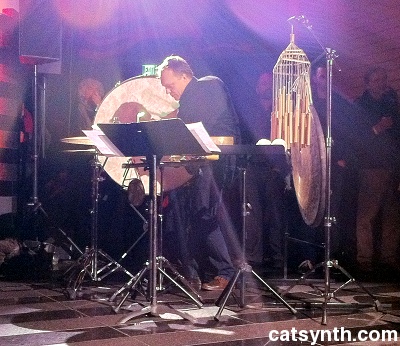
[Laura Bohn and Kjell Nordeson performing “Geographie Francaise” by Sylvano Bussotti. (Click images to enlarge.)]
Bussotti also performed in In Memoriam Cathy Berberian. Here, his voice was more central to the piece, and he spoke in Italian in more expressive tones. This is not surprising, given the subject of the piece was Cathy Berberian, his longtime “friend and muse”.

[Sylvano Bussotti performance with members of sfSoundGroup. Photo by Michael Zelner. (Click image to see original.)]
Different personel from sfSoundGroup were featured in different pieces, ranging from the full nine-member cohort in Autotono to a solo performance by Matt Ingalls on clarinet in one of Bussotti’s more recent pieces, Variazione Berio composed in honor of Luciano Berio who died in 2007. In the performance, Ingalls takes advantage of the portability of his instrument to move freely about the space. In doing so, he was able to employ spatial effects on the timbre of the clarinet within the music, which was filled with lots of empty space punctuated with occasional loud tones.

[Matt Ingalls performs “Variazione Berio” by Sylvano Bussotti. Photo by Michael Zelner. (Click image to see original.)]
The sparseness of the music and performer’s motion did in fact remind me a bit of Berio’s Sequenzas, and also made me think of the parallels between the theatricality of Berio’s music as compared to Bussotti’s. They were contemporaries in Italian avant-garde music – and as another link, Cathy Berberian was Berio’s wife in the 1950s and early 1960s.
The concert concluded with a performance of Tableaux vivants avant La Passion selon Sade (1964) for two prepared pianos. This was probably my favorite of the evening (along with Geographie Francaise). The pianos that were separated up to now were joined together in the center of the space. The two pianists (Christopher Jones and Ann Yi) playing cooperatively on a single piano, operating both the keyboard and elements within the instrument’s body. Their bodies often crossed paths and intertwined as they attempted to perform their respective parts – the motion seemed both chaotic and intimate at the same time. As the piece progressed, they spread out to both pianos – and in the final movement, they close their scores and attempt to play from memory. Throughout, the music was filled with intense, and sometimes violent energy especially when playing the interior of the piano. I contrast this to they very calm and contemplative nature of John Cage’s better known prepared-piano pieces. It fun to watch, and provided for a dramatic finish to the concert.
The concert was preceded by a screening of Bussotti’s 1967 silent Rara that included live piano accompaniment by Bussotti himself. The music, which was based on live interpretation of a graphical score in which he moved about at will, did not strictly follow the events and actions on the screen, but rather provided more of a backdrop and a counterpoint to images that would have otherwise been rather jarring to watch to watch in silence. [However, the music as performed did have a narrative structure of it’s own, moving between very abstract discrete tones and more idiomatic and even tonal sections.] The film itself consisted mostly of “film portraits” of figures from the Italian avant-garde – mostly images of men (though Cathy Berberian is also featured) in a variety of sexual and emotionally uncomfortable poses, including countless shots of tear-streaked male faces. As such, the film did not really hold my attention, although I did like the abstract imagery and close-ups of the musical score, as well as the play on the letters of the title R-A-R-A itself, that were used alongside the more homoerotic portraits. And certainly it was was interesting to see the composer and filmmaker respond musically to his own work after so many years.
Additional credit goes to Luciano Chessa, who organized the evening’s events. We had previously encountered him last year when he organized the event Metal Machine Manifesto, Music for 16 Intonarumori.
