A week ago I saw the exhibition 0-Viewpoint by Stella Zhang at the Chinese Culture Center here in San Francisco. Zhang is the 2010 featured artist in the CCC’s Xian Rui (”Fresh & Sharp”) series, which showcases “the work of an incredibly talented but under-represented Chinese artist in America.” This year’s exhibition also had a goal of pushing the boundaries of what is considered “Chinese art” and challenging more traditional viewers’ expectations. Zhang was schooled in classical Chinese art techniques, but the contemporary mixed-media installation eschews cultural tradition (except perhaps in some more subtle ways) and challenges the expectations many viewers might have of art and an artist identified as “Chinese.”. 0-viewpoint is also a deeply personal exhibition, in which Zhang “explores the constantly shifting inner landscapes of self and femininity.” Similar to heritage, gender comes with expectations. Confronting traditional expectations of both gender and heritage are topics of personal interest to me, which makes this an appealing exhibition to both see and reflect upon.
The main corridor is covered by a long undulating white canvas, which sets the overall tone for the entire installation: curving forms of white fabric. Indeed, the gallery and all the pieces were almost entirely white. The white seemed to cast a silence over everything, which is both simultaneously meditative and a bit “anxious”. Although the color was uniform, the textures and shapes were quite complex, and in a way the use of white helps focus one on these dimensions instead of on color. It also made it possible to detach from the question of challenging tradition and allow it to fade into the background while focusing on the pieces themselves.

[Stella Zhang, 0-Viewpoint, installation view. Photo courtesy of the artist. (click to enlarge)]
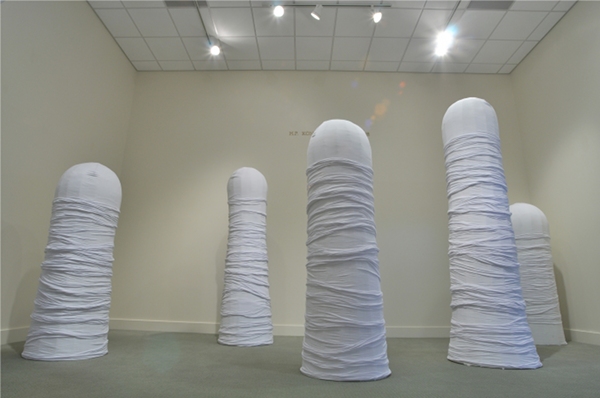
The installation in the first room is a collection of tall rather phallic sculptures. They were slightly higher than human size, and one could walk amongst the irregular arrangement of columns. The irregular shapes suggested something organic, like a forest or sea creatures. But the metal structure underneath the cloth also gave them an architectural feel.
[Stella Zhang, 0-Viewpoint, installation view. Photo courtesy of the artist. (click to enlarge)]
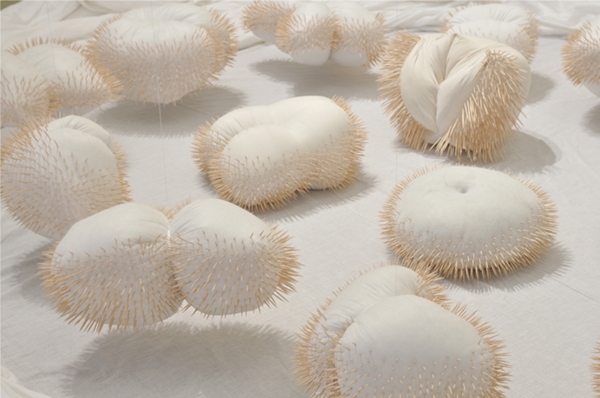
The second room contains an array of small cushion like objects suspended on wires from the ceiling but nearly touching the ground. The forms, which are again made of fabric, are soft and curving and body-like, but are covered in spines made from toothpicks. The combination suggests sea urchins or single-cell organisms. But the shape and texture also seems to play on and challenge stereotypical associations with feminine, e.g., soft curving shapes but then pierced by something more angry and aggressive. Along the edges of the room are small seats, again made from soft fabric but also covered in spines. (I would not be tempted to try and sit on one.)
[Stella Zhang, 0-Viewpoint, installation view. Photo courtesy of the artist. (click to enlarge)]
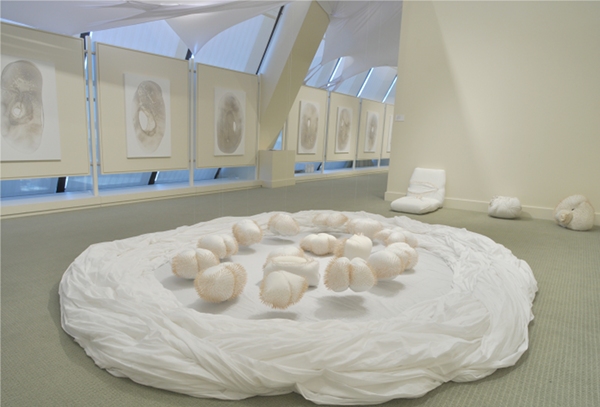
Towards the end of the gallery, the long canvas that covers the corridor descends to the floor and then comes back on the floor ending in a somewhat mysterious hole big enough to crawl through. Nearby, a video was projected onto the ground showing an image of swirling smoke or vapor with ethereal dreamlike music. The music was mostly in a minor mode, but with slightly unsettling tones in the middle section.
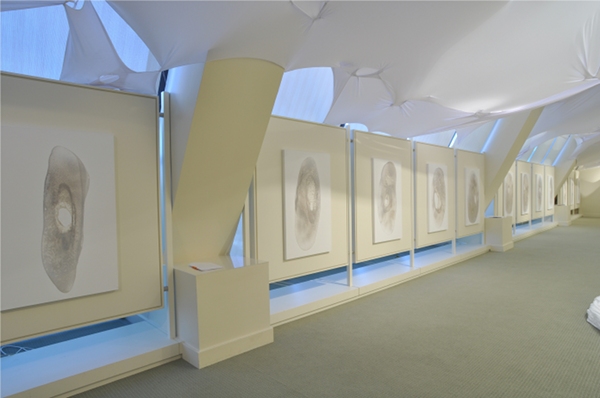
Arranged along the corridor were a series of twelve panels suggesting the twelve signs of the zodiac (one of the few overt nods to Chinese tradition). Each of the white panels had a shape made of sand. Although the material was different the shapes seemed related to other parts of the installation: round curving but somewhat elongated with irregular holes.
[Stella Zhang, 0-Viewpoint, installation view. Photo courtesy of the artist. (click to enlarge)]
The afternoon included a dialog with the artist, in which we learned a bit about her journey that included growing up in Beijing in a family that encouraged her to pursue art; the culture shock and growth of her time studying and working in Japan; and then settling in the United States. I also had a chance to view the documentary on the making of the exhibition, which was presented as part of a dialog and discussion with the artist. An excerpt of the documentary is online, and presented below:
Stella Zhang, 0-Viewpoint from Jim Choi on Vimeo.
It was interesting to see the physical process that goes into making the work, welding metal frames, gluing fabric and manually inserting the skewers into cloth. The full documentary also explores the tensions of the work, such as there was between Zhang and curator Abby Chen around the piece with the suspended cushions and wooden skewers. There was also a phrase that Zhang applied to herself, “trapped in a box”, that a viewer in the video later ascribed to Chinese art and culture as a whole. This phrase intrigued me, but there wasn’t a chance to follow up further.
0-Viewpoint will be on display at the Chinese Culture Center through September 5.